

St Olaf’s is a curious building to look at. In style, it’s just a fairly simple church, with a plain sloped roof over the nave and a square tower supporting a sharply pointed spire, all in that boxy, whitewashed Baltic style. But in scale it is enormous. Getting to the top, through an amazing assortment of different rickety wooden steps and winding stone spirals that hide in those white walls, was an adventure in itself.

The viewing gallery is at the base of the staggeringly tall spire, whose steep sides are a patchwork pattern of old green and new brown copper, narrowing to a sharp point aimed straight up at heaven.* Health and safety measures are refreshingly Eastern European, and only a waist-high metal fence and a narrow wooden pathway stop you sliding down that hot, curved copper to oblivion on the cobbles. From the tower, you can see all Tallinn: the red roofs and white walls of the Old Town, bounded by marching lines of medieval watchtowers; the glass and concrete of the newer city, shining in the hot white light; the huge, clear shapes of the coastal giants; the tarmac expanse of the port complex, as it embraced a pair of Baltic cruise liners; a smudge on the far coast we fancied was Finland, under the cobalt-glass sky. A party of game old Japanese ladies passed us as we came back down the vast tangle of stairs, and we privately wished them luck.

Next was Fat Margaret, a short stroll through shady cobbled alleys later. She is, as you might expect from her name, a stout old thing, stony-faced and round-bottomed, with a neat stone arch linking her to her little sister, and three decks of gunports running through her two-metre-thick walls to cover the harbour. Plaques on the street outside said nice things about the British and the Royal Navy. An excellent video display on her first floor showed the history of Margaret, who was once known as the “Rosencrantz Tower”. The Meremuuseum inside is run by the same group as the seaplane hangar, and the big-ticket items have been moved there, leaving behind a lovely, intimate history of Estonian sailors, traders and ice-fishermen, full of model ships, spyglasses, two-headed eagles, a century and a half of black-and-white photos and a millennium of mad old maps. On the roof, a number of picnic tables sat under parasols, and a lady manning the little bar there provided us with milkshake floats and supporting evidence for Russian stereotypes about Eesti slowness.**
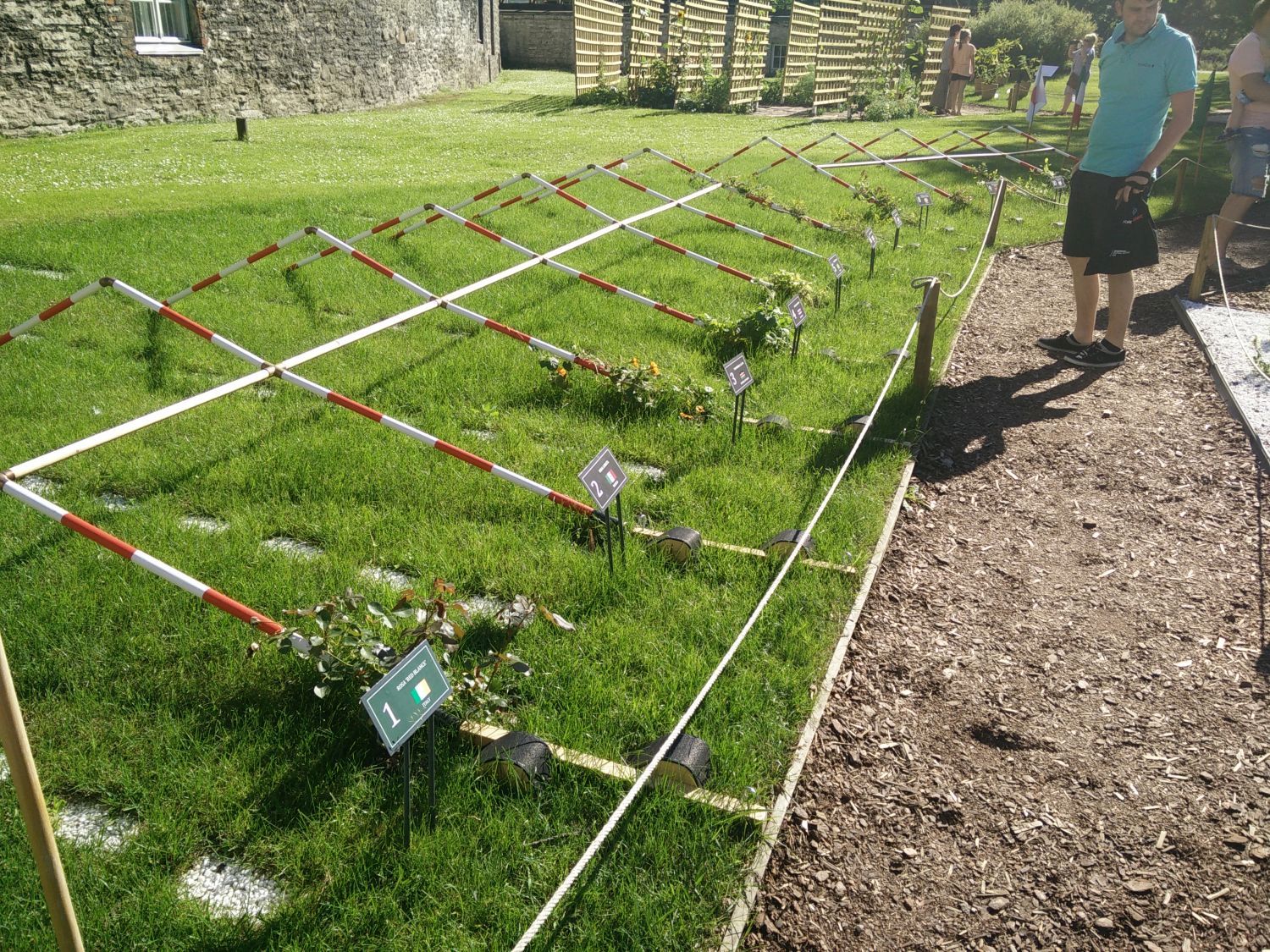
Outside the walls, on the west side of town, were lawns, flowerbeds and curious public art installations: giant ants, weird abstract shapes, curious mirrors. Someone had set up an “Olympics of Creepers”, an assortment of climbing plants from around the world, each with their own bamboo cane to “race” along.*** (Eesti slowness jokes at the end, please.) Getting a little footsore, we strolled back through the new(er) town, certain landmarks now familiar – the weird, cool, shining gold apartment block with the luxury shops in its cut-back lower levels, the amazing, oppressive brick Art Deco oddity, the scrappy car park which always seemed to have some new kind of vermin in it – to Liivalia and a bolognaise dinner.
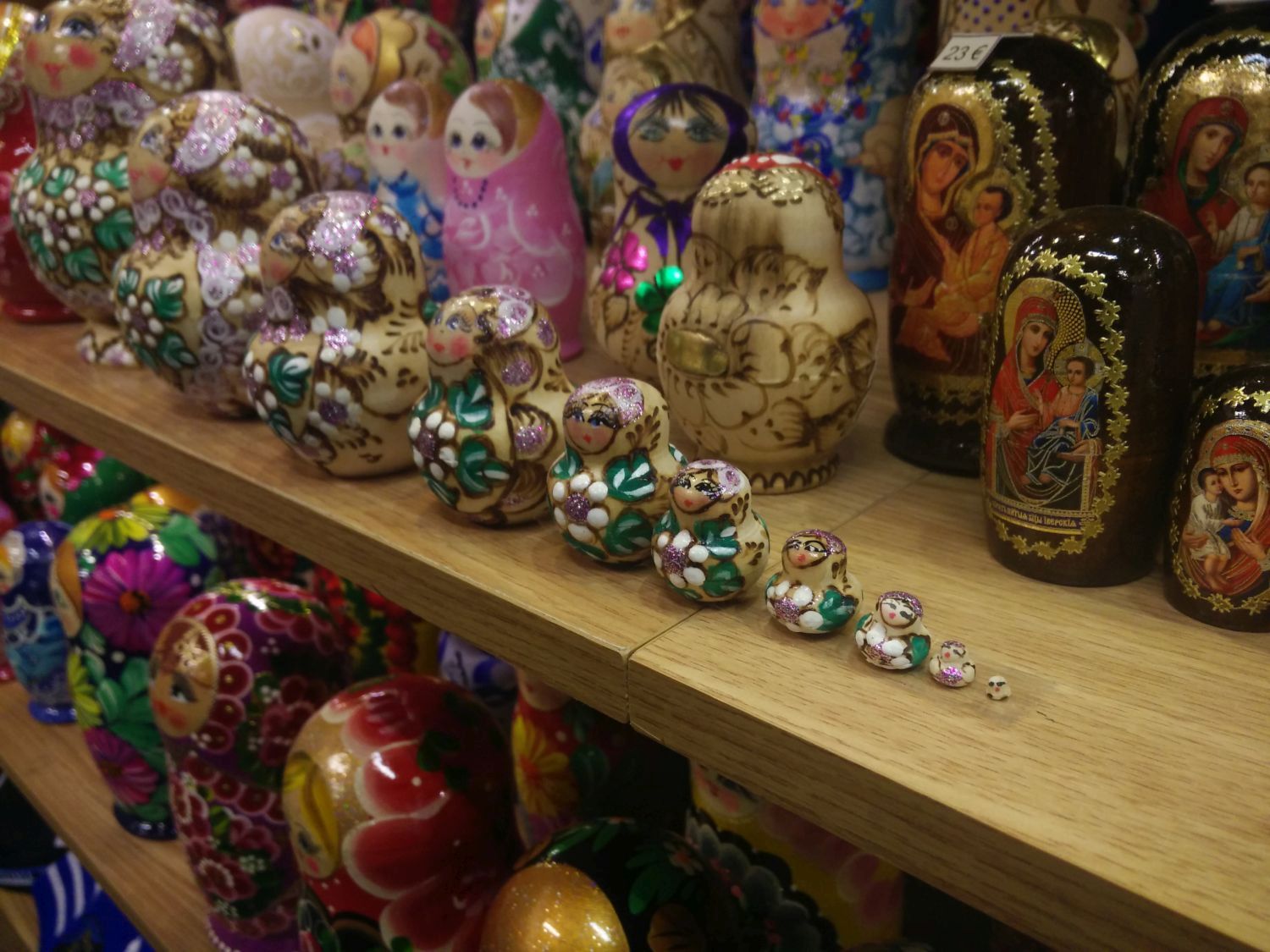
But Misha doesn’t seem to need sleep, and after filling up we went back out again to the Old Town, locating “Catherine’s Passage” and investigating the tat shop hiding in a cellar there; and to Old Hansa, dark and full of guttering candles, for honey beer in big earthenware tankards. At another tat shop, I bought a tiny Estonia lapel pin and a fridge magnet made of Baltic pine and amber. The streets were deserted late in the evening (“after dark” would be inaccurate; white nights, remember) and we found ourselves back up on the Toompea, looking down on the city as it glittered with a hundred thousand points of light. I watched one enormous red dome-shaped building on the eastern horizon, could swear that it actually seemed be getting bigger – but it was only after a few minutes that I realised it was the moon, full and red and enormous.
* It is believed the spire has been struck by lightning at least ten times. It’s rude to point.
** A Russian joke:
An Estonian waits at a railway station. Another Estonian passes by, pumping a hand-car. The first one asks: “Iiis iit faaaaarrrrr tooo Talllinnn?” “Notttt verrryyyy faaaarrrr,” the other answers. The first gets onto the car, and helps work the pump. After two hours of silent pumping, the first Estonian asks again: “Nooowwww iis iit faaaaarrrrr tooo Talllinnn?” “Noooowww iiitt iiiis verrrryyyyy faaaaarrrrr.”
*** The American plant was a clear winner with the Japanese one fairly close behind. The British creeper was pathetic and hadn’t even started.
Tallinn 2015
Old Town and Toompea – Linnahall, Patarei Prison, Seaplane Museum – A Brief Interlude on the History of Tallinn – St Olaf’s, Fat Margaret, Old Hansa
 underneath the open sky