(Click the images for full-size versions!)
We arrived in darkness, passing without friction through the echoing eco-lodge of Keflavik airport. Our first sight of Iceland was made surreal, ethereal, by the combination of deep darkness, ground fog and strange assortments of electric lights. A lighthouse in the middle distance wagged alternating fingers of green and white across the horizon, over the blazing swoop of the runway path-lights. Streetlights made the weird undulating haze in the middle distance seem almost solid, and when another plane tore in its hull was concealed by the dense glare of its landing lights, like a backwards comet. The houses – low, square, mostly very modern-looking – had Germanic Christmas decorations, little peaks of coloured LEDs; beside a tin tabernacle, a cemetery was filled with light-up crucifixes, which would look gaudy and absurd if they were a little less spooky.

We dined at “Olsen Olsen”, a faux-authentic American style diner, done quite convincingly apart from the panels displaying Icelandic poems about the fair folk and the £65 bill for three burgers (!!!). We headed on, in an evening full of orange streetlamp haze-cones and the tearing bubblewrap sound of studded tyres in motion, to our hired flat, located in a district called Þing which, yes, is pronounced “Thing.” It was uncompromisingly modern and minimalist: smooth, uncreaking floorboards, a geothermal rain-shower which smelled of sulphur, and very comfy beds.

In the long pre-dawn of the next morning, Þing presented a weird science-fiction landscape: black soil, yellow plants, lakes of ice; the architecture entirely square-cornered ultra-modernist cubes lit up erratically by Christmas decorations. But it’s a clean, prosperous science fiction world, rather than a bleak retro used future. There is something weirdly Planned about the whole landscape here. The houses are almost all detached, which in such a cold environment would be ludicrously wasteful were it not for their unlimited geothermal heating (and I bet they insulate well, too).

Dawn lasted an hour, a gradual cranking up of the ambient light which did nothing to change the overall sense of dreary gloom. Through it, along Iceland’s #1 road (the country has not a single railway, although since it also has only one plausible town and doesn’t produce anything heavy, it makes sense) we entered an endlessly broken landscape of black, white and dark green; unweathered rocks, patchy snow and dense moss. Every few miles, high plumes of white steam and an eggy sulphur smell announced the presence of geothermal vents. Off to one side, an airstrip, a windsock, high black hills streaked with snow, a mysterious structure like a lighthouse – a single black finger of stone tipped with a radiant light.
“There’s three different designs of pylons there, in parallel, following the same route. Do they have privatised utilities?”

Our first really stunning vista came at an icebound viewpoint overlooking Hveragerði: painted houses and orange-lit polytunnels, trickles of steam coming from the town and the black cliffs above it, a vast haze creeping across the flat plains to the south. Then we were down among it all, and the cliffs that loomed above us faded to smoke-grey insubstantiality at their bases. The long horizontal jib of a tower crane floated in the mist like a ghost ship.

A long drive southeast, along flat roads that cut through a featureless yellow landscape: the occasional headlights of a passing car, the occasional skeleton of a waiting pylon. The only signs of life were little fat ponies and huge, slow-flapping ravens. Passing along through the tiny, functional towns, depressing signs of globalisation were everywhere – Subway, Domino’s, KFC (it’s svooo gott). But we’re not here for the culture. Narrow bridges crossed streams with black gravel banks; huge panes of blue-green ice, six inches thick, lay on them like stranded whales.

Towards the coast, the land becomes more dramatic, big scree-sided crags rising from the flat plain. It was hard to tell if Eyjafjallajökull was quietly fuming or just shrouded in low cloud, but we flipped it off vengefully anyway.

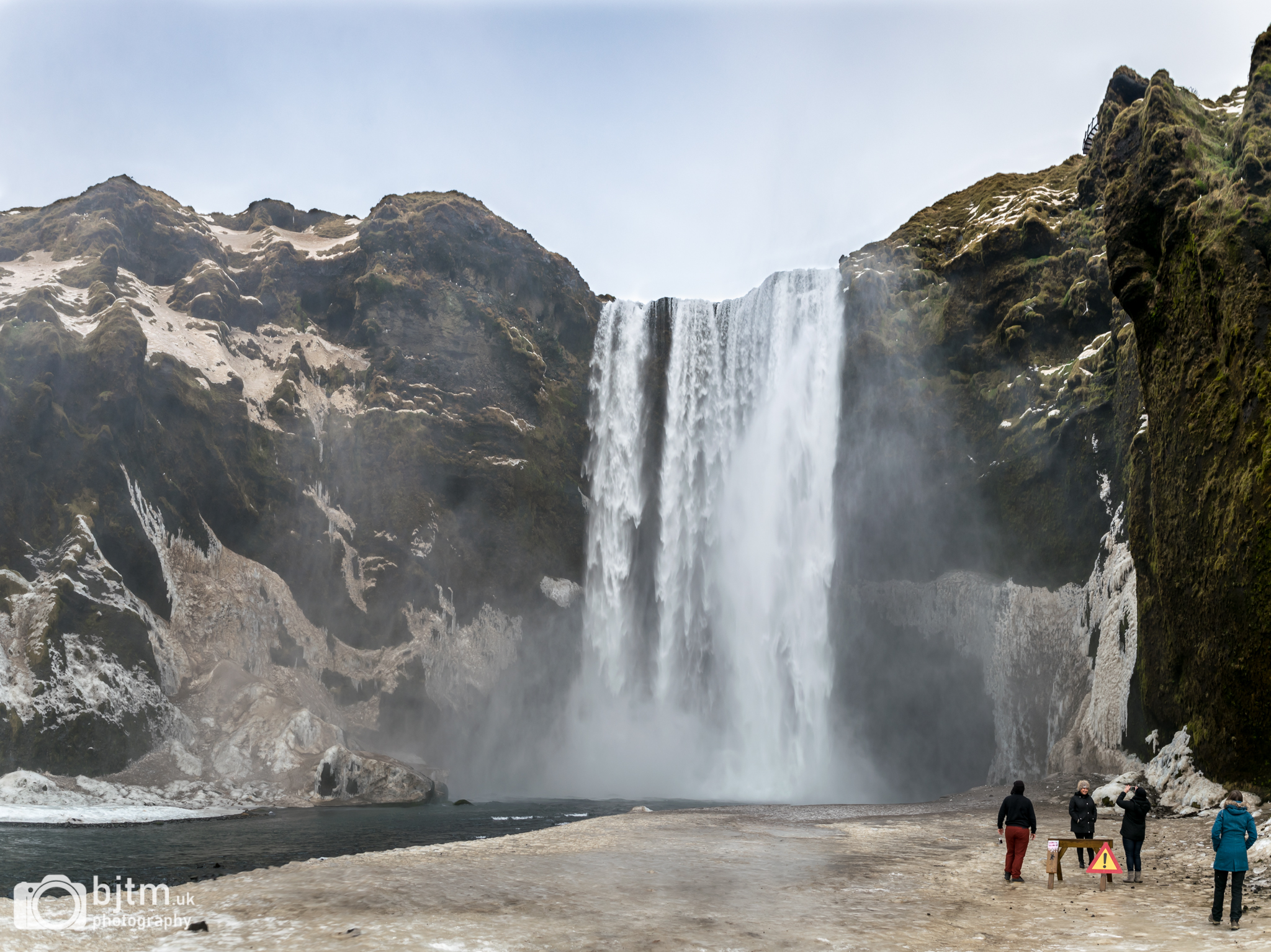
At Skógafoss, the satnav had some sort of brainfart and kept repeating the place name twice with different pronunciations. There, a great tall waterfall drops from the old sea-cliffs, drenching the tourists who trek over the ice to get closer to its base. Around its plunge pool, the overhangs are bearded with ice from fall-spray that sticks and freezes to their undersides. Drones soared high above the waterfall, the honesty-box toilets and the signs saying NO DRONES in several languages. Even at high noon, the sun could barely bring itself to creep much above the horizon.
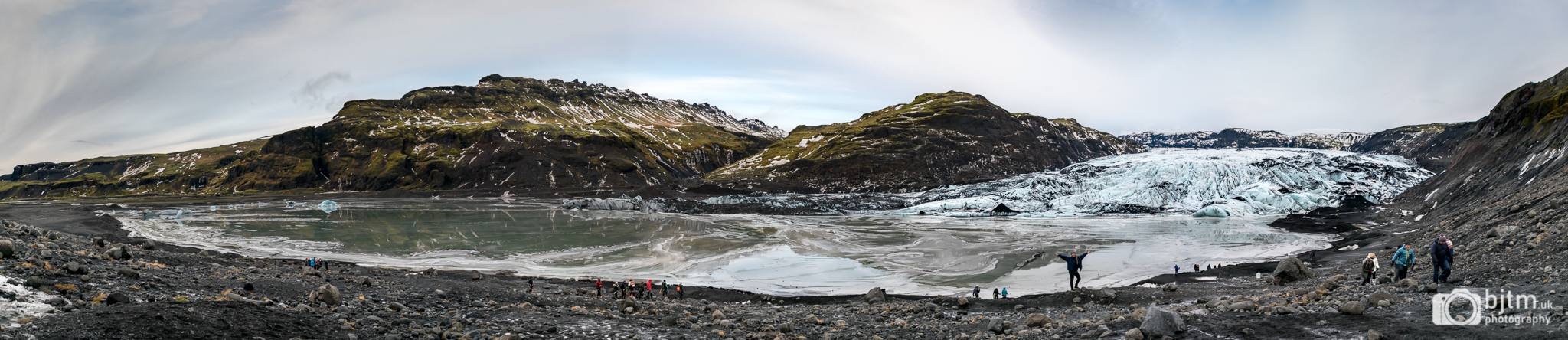
We came to the base of Sólheimajökull, the southernmost glacier in Iceland, a tongue reaching down from the huge Mýrdalsjökull ice cap (yes, I’m pasting all these names). The glacier was immense, silently threatening: a towering head of cold blue marble, filthy with black sand, feeding into a many-times-frozen cappuccino swirl of grey and black ice strata. Down by the rumpled shore, among the drumlins, sheets of ice had been shoved up into a jagged foot-high wall. Some had melted there, leaving a dry, crumbly fault line of muck.
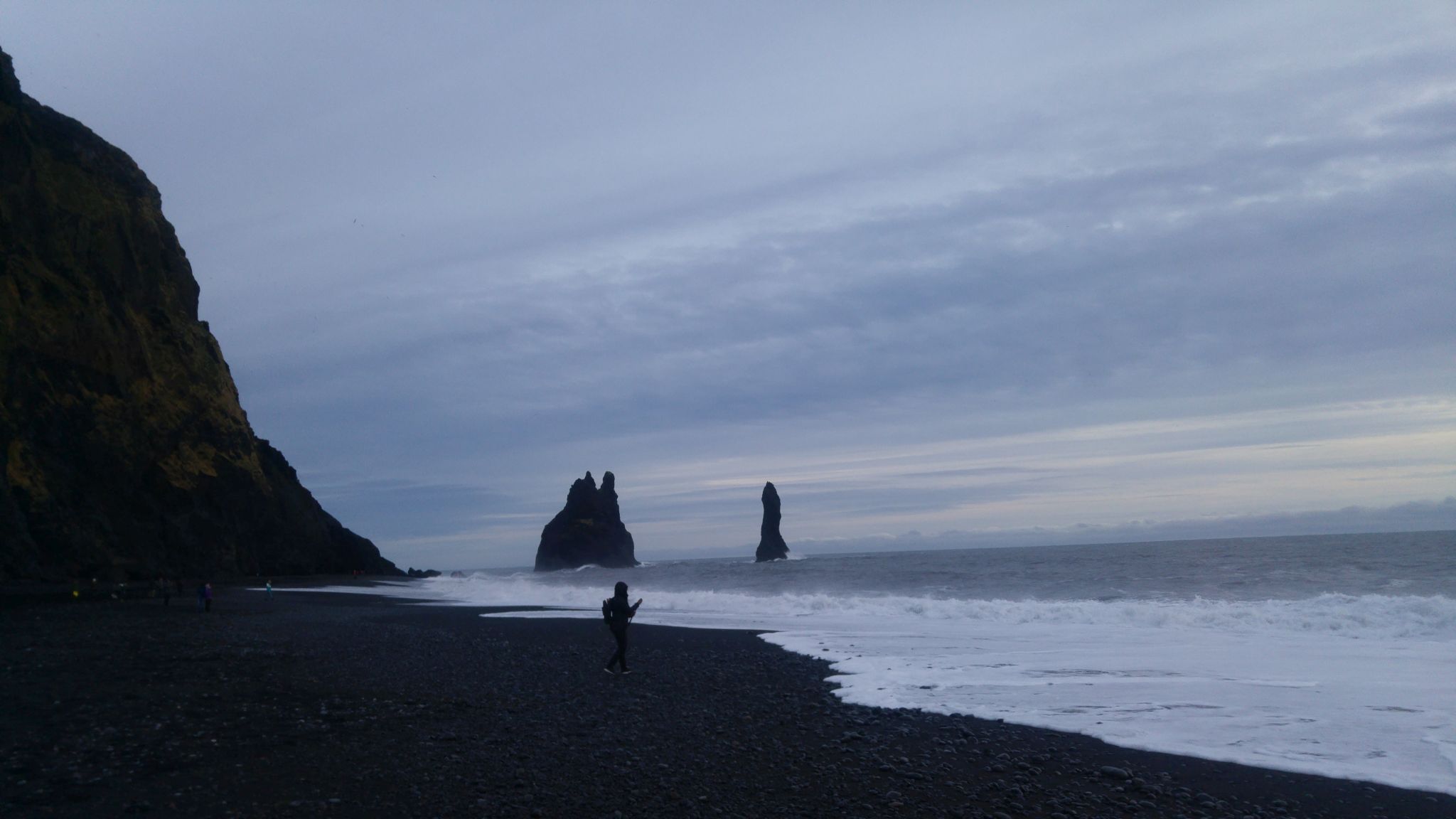
Off in the distance, we would sometimes see individual long-armed excavators doing something or other – digging out ditches, shoring up a riverbank, building a breakwater at Vik. They were distant, lonely, alien. At the black beach of Reynisfjara we joined the surprising number of tourists freezing their faces off to the cry of the gulls and the roar of north Atlantic rollers. There’s a great finger of rock poking out of the sea, a whale skull outside a visitor centre, and most interestingly a little section of Giant’s Causeway basalt columns. Some arch off to form an intriguing cave, where underneath the regularity of the hexagonal prisms dissolves into a gooey fondue of dark stone.
“So I’ve been thinking – ReykjaVIK, KeflaVIK –“
“Vik is clearly just the suffix for town.”
“Right. So since we’re ging to a town which is just called Vik…”
“You wonder how boring it’s going to be?”
“Yes.”
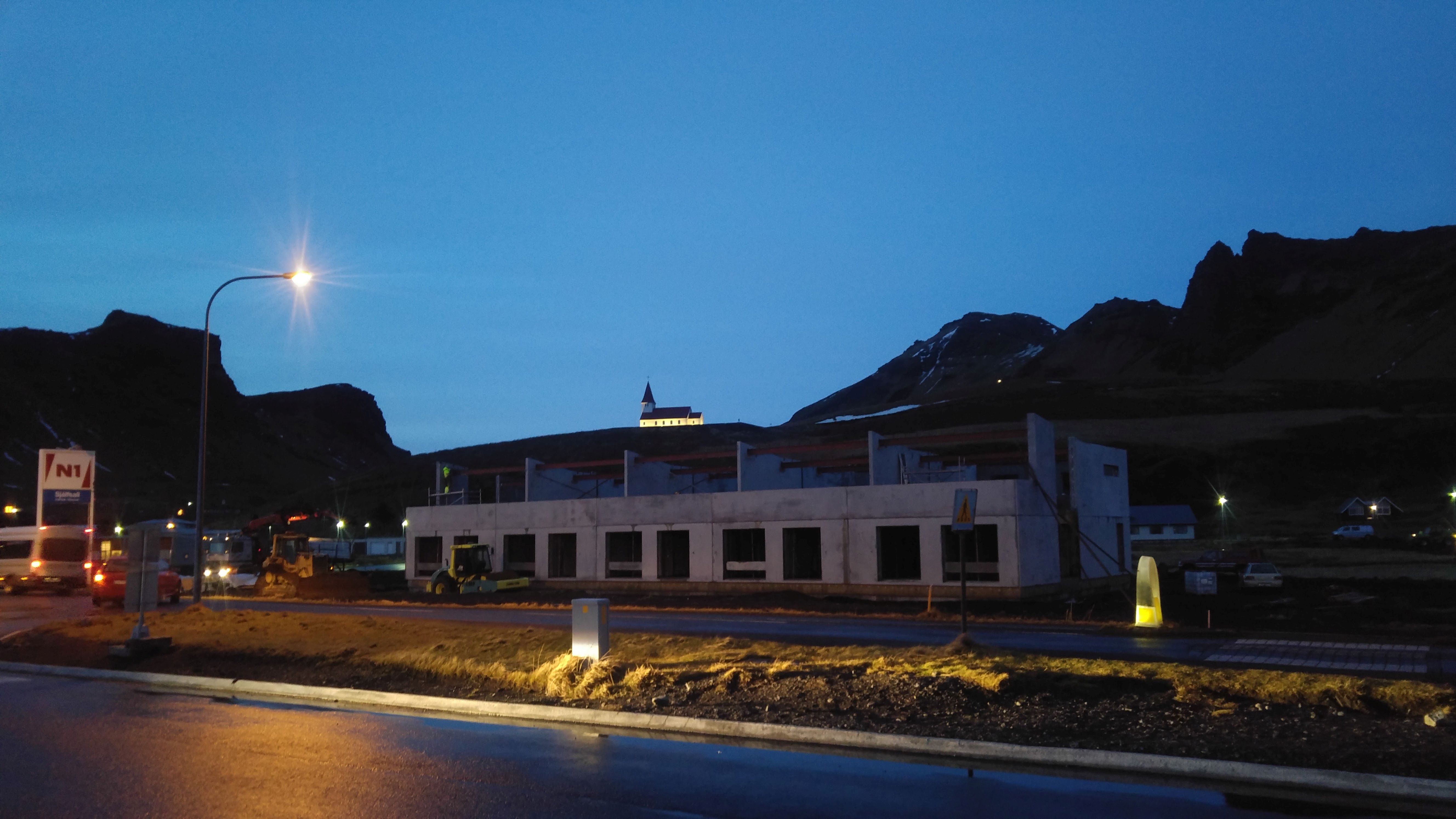
Answer: quite. A little red-roofed white church, with more lit crosses in the cemetery; a few shockingly expensive Icelandic groceries, and we headed back west-north-west in the slowly gathering dark. Towns ahead showed on the bellies of low cloud as islands of orange light as we stopped for Ben to photograph an enormous yellow moonrise. And then, looking up through the clear air above us, the strange strand of luminescence suddenly brightened into a hazy curtain of ethereal green, our first glimpse of the aurora.

Iceland 2017
Waterfalls, glaciers & black beaches – Thingvellir, Geysir, Gullfoss – Grindavik, Keflavik, Blue Lagoon – Reykjavik, aurora borealis
 underneath the open sky