(Click the images for full-size versions!)
North and inland, a different landscape to the south coast, this one smooth and fully glaciated, green-yellow grass striated with snow. I once described the rolled-over Scottish Highlands as like a mite’s-eye-view of a camo jacket; this was the same, but a winter jacket. As we moved upland the white gained dominance, with the odd pathetic little spinney of tiny Christmas trees.

We were following the “Golden Circle”, the Grand Tour of southwest Iceland’s high-profile tourist destinations – all three of them. It’s shocking just how little there is in this country; the island manages to stay a pristine eco-paradise partly due to fairly strict anti-rambling policies (driving off the roads attracts a fine of half a million ISK) but also because, let’s be honest, it’s 99% wilderness which is lovely to look at from the inside of a heated car but unpleasant/pointless to interact with in any more meaningful (or destructive) way.
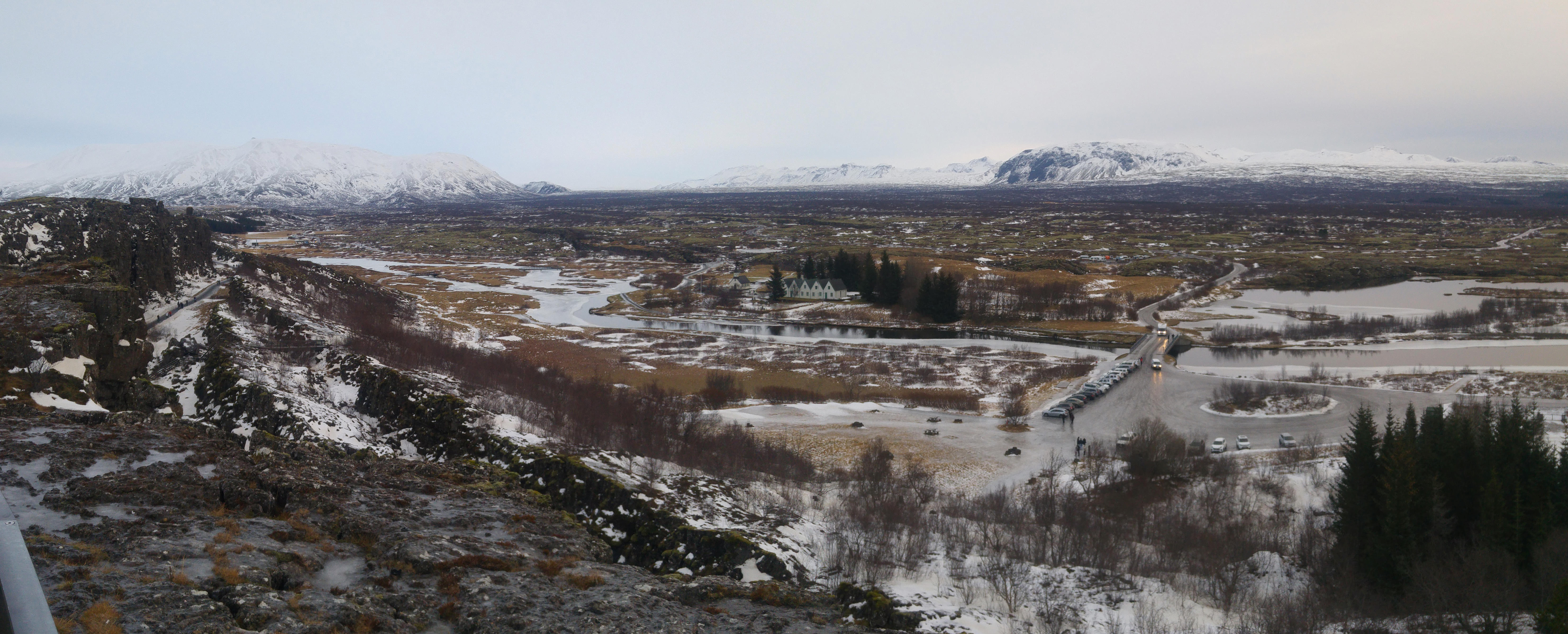
First on the Circle was Þingvellir, where the visitor centre was absolutely rammed with people trying to get in out of the driving cold. This Thing, even at the height of winter impassability, combines the usual highly interesting geology with one of Iceland’s few real historical sites: it’s a rift valley, with steep basalt trenches like the walls of some dark fortress overlooking the site of the “Althingi”, which they like to style as the oldest parliament in the world. The ancient site of the “Law Rock”, where chiefs and freemen assembled to hear the Lawspeaker recite aloud all the laws in force at the time (now wouldn’t that keep your statute book short?) isn’t clear, but it’s still very cool both historically and just as an incredibly striking site.
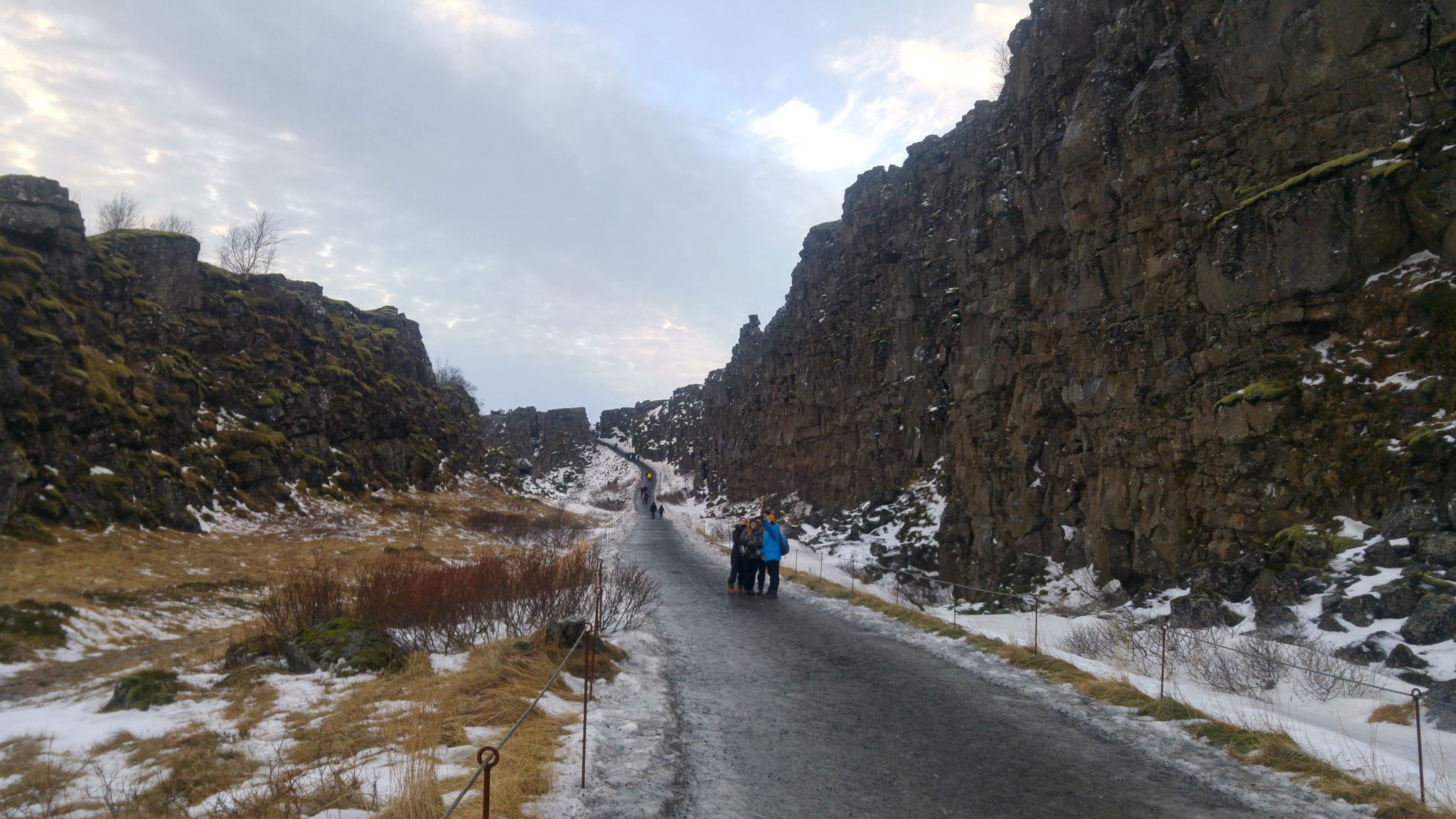
Down the rift, past signs which requested no underwater photography and talked in a rather deadpan fashion about the three fish you could find in Lake Thingvallavatn (“biodiversity in Iceland is limited”) stood a little corrugated church which could seat about sixteen, a tiny row of incredibly unimpressive houses which apparently comprise the summer residence of the Prime Minister of Iceland, and a graveyard which successive freeze-thaw cycles had turned into a bath of thick ice. Actually, all the pathways and most of the roads were covered in inches-thick ice, but the canny locals had scattered enough black grit over them all that they were more or less usable, although unnerving. The paths which hadn’t been gritted were horrifying rinks of deep translucent blue-green, as was one of the picnic areas we encountered. For some weird reason our breath, and the tea we bought at the visitor centre, produced no mist in that air.


A different landscape again as we headed east: a wilderness of small rounded basalt boulders, in tumbledown cairns rather than high big outcrops, shaggy with thick piles of grey-green moss, and everywhere low scrubby despairing outlines of bushes. Above it, the highest hills were pure snow white. The original Geysir, which gave the English language that word, doesn’t blow much any more, but its little sister Strokkur does, and draws great crowds. The whole thing is wonderful – bubbling pools puffing out eggy steam, trickles of water lined with oddly-coloured mineral deposits and signs warning “this is hot, don’t touch it, the nearest hospital is 62km away, DON’T STICK YOUR FINGERS IN YOU PILLOCKS.”One of the ponds wafted sufficient hot steam up to distract from the bitter cold; another had a worrisome-looking cave in its clear blue depths, as though a dragon was going to climb out at any moment. Every few minutes Strokkur exhaled, blowing out plumes of white steam as high as a house (a proper house, not an Icelandic two-storey cube).


Onwards, through another countryside again: a tremendously wide flatland of scrubby yellow grass, horizons rimmed by black and white peaks. We stopped to see some little fat ponies, and I admired the shelving of ice in the clear depths of a solid pond. Before long we had reached Gullfoss, a three-stage waterfall feeding a river from a wide meander into a steep basalt ravine; in its wintry setting of glistening pillows of green-blue ice it was immensely impressive, although I felt the noticeboards comparing it to Niagara were coming it a little high. The path to the overlook was solid ice, ungritted – but despite the lethality of the paths here and elsewhere I neither saw nor committed any pratfalls. I feel there’s a certain fairly pragmatic kind of tourist drawn to Iceland, not a cheap-thrill-seeker (the country being neither cheap nor thrilling) but inclined to dress sensibly, obey safety warnings, take small steps and gain proper enjoyment from a really good vista or huge frozen waterfall. Good company to be in.


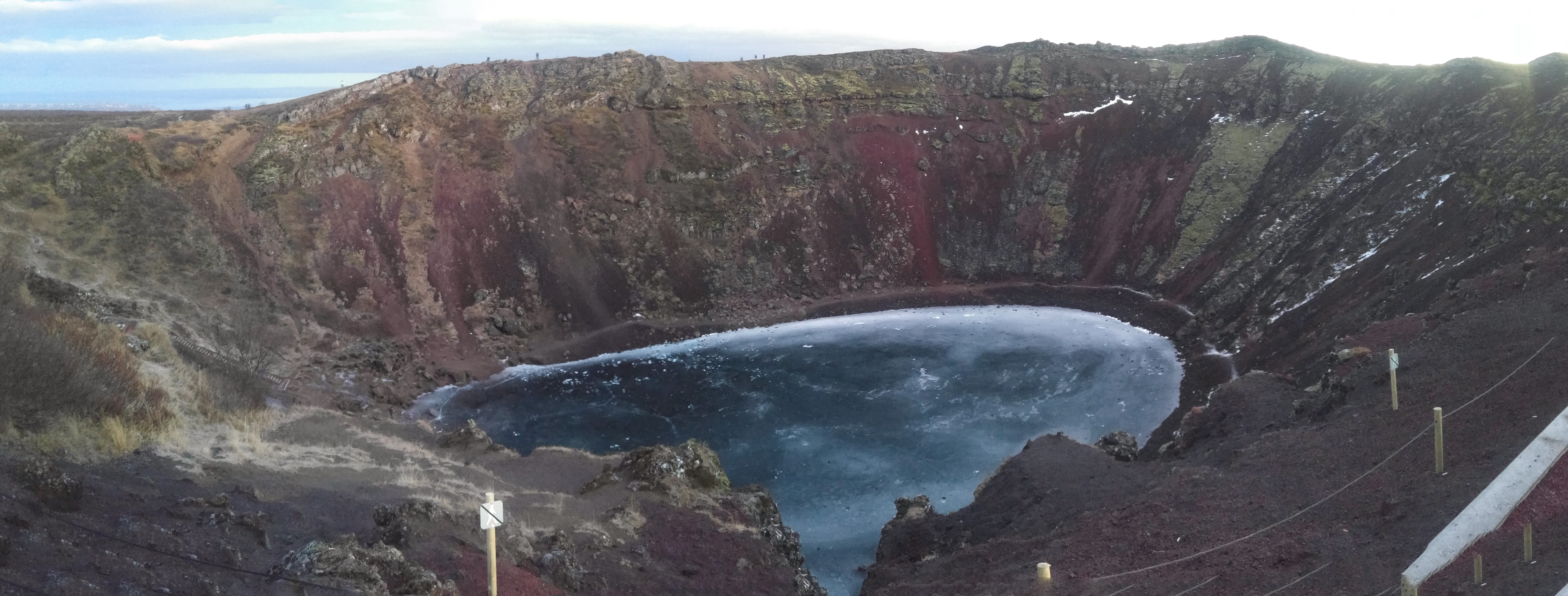
Turning back west to Reykjavik: ahead, a long pink-bellied sunset, behind, mountains fading into a dark grey haze. Two stops remained on our journey back: the cathedral of Skálholt, tall and lonely, unremarkable but for its absolute remoteness, and the crater at Kerið, which we approached just as the sun was finally properly setting. This is a cindercone whose core solidified and then subsided, leaving a far larger and more dramatic crater than the volcano itself would have had. There’s a booth which would charge entrance, but the attendant packed up and left as we arrived, and I was free to walk down the steps into the crater itself, standing on the iced-solid caldera as the dark deepened around me.
Iceland 2017
Waterfalls, glaciers & black beaches – Thingvellir, Geysir, Gullfoss – Grindavik, Keflavik, Blue Lagoon – Reykjavik, aurora borealis
 underneath the open sky