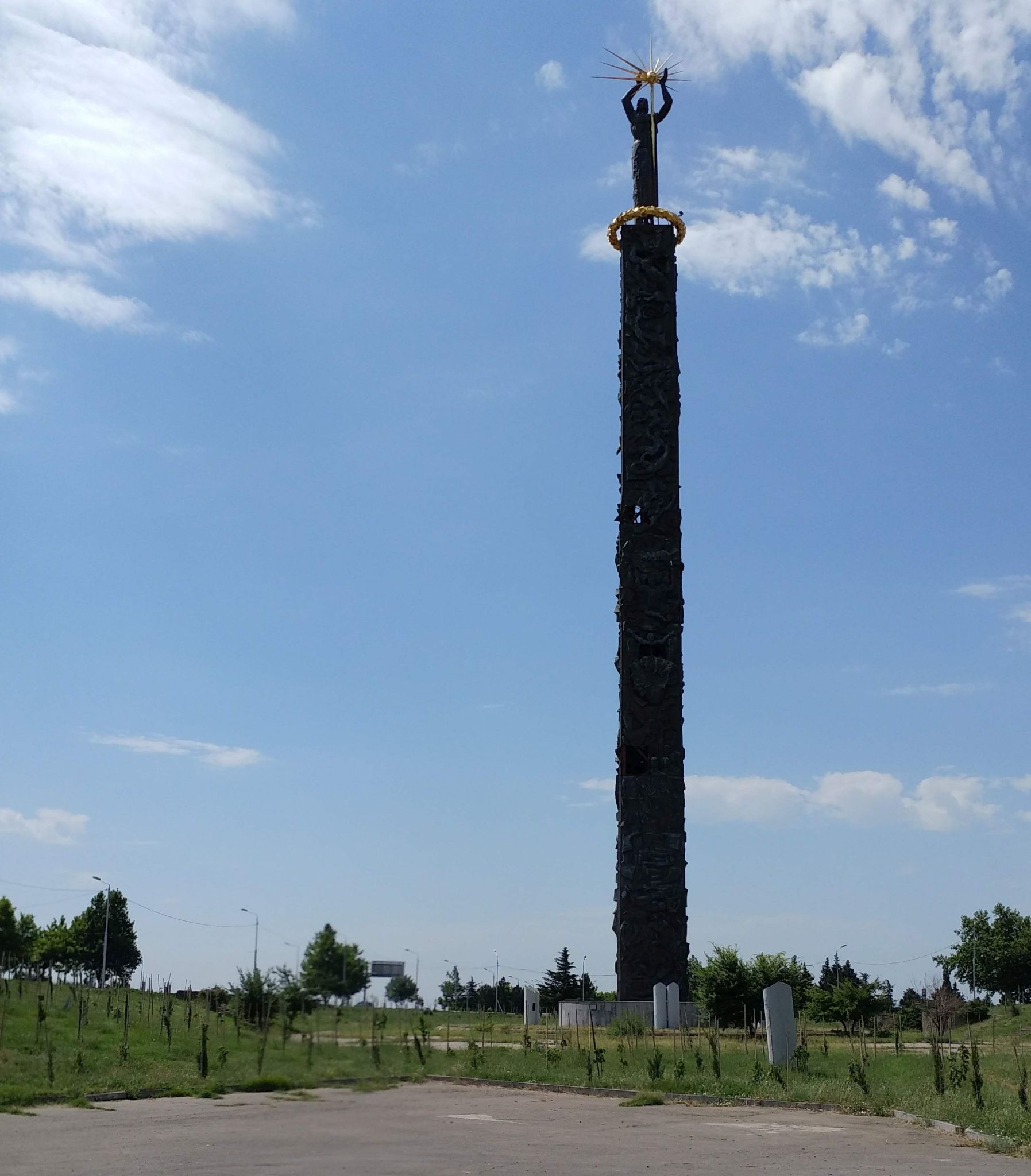
David Gareja was one of the true highlights of the tour, up there with Chiatura in “this is something you can only really see here” terms. There’s a daily (slightly poorly organised) minibus tour from Liberty Square, and we joined the crowd of intrepid-looking tourists, hearing Polish, Chinese and German spoken as well as the dense Georgian consonants and the inevitable English. We handed over our 25₾ (about eight quid) each, and the marshrutka whisked us away onto a dusty highway lined with watermelons and rows of shiny new tractors. The sheer density of the melon stalls bemused me – who looks at the fifth hopeful looking melon-seller in the space of a kilometre, and thinks “yes, this is the moment I need a watermelon big enough to hide a three-year-old inside”? But they must sell enough to bother showing up, because they’re there. A giant dark metal column passed to the south, knurled with unclear sculptures and crowned with a robed figure holding up the sun – who? Why?
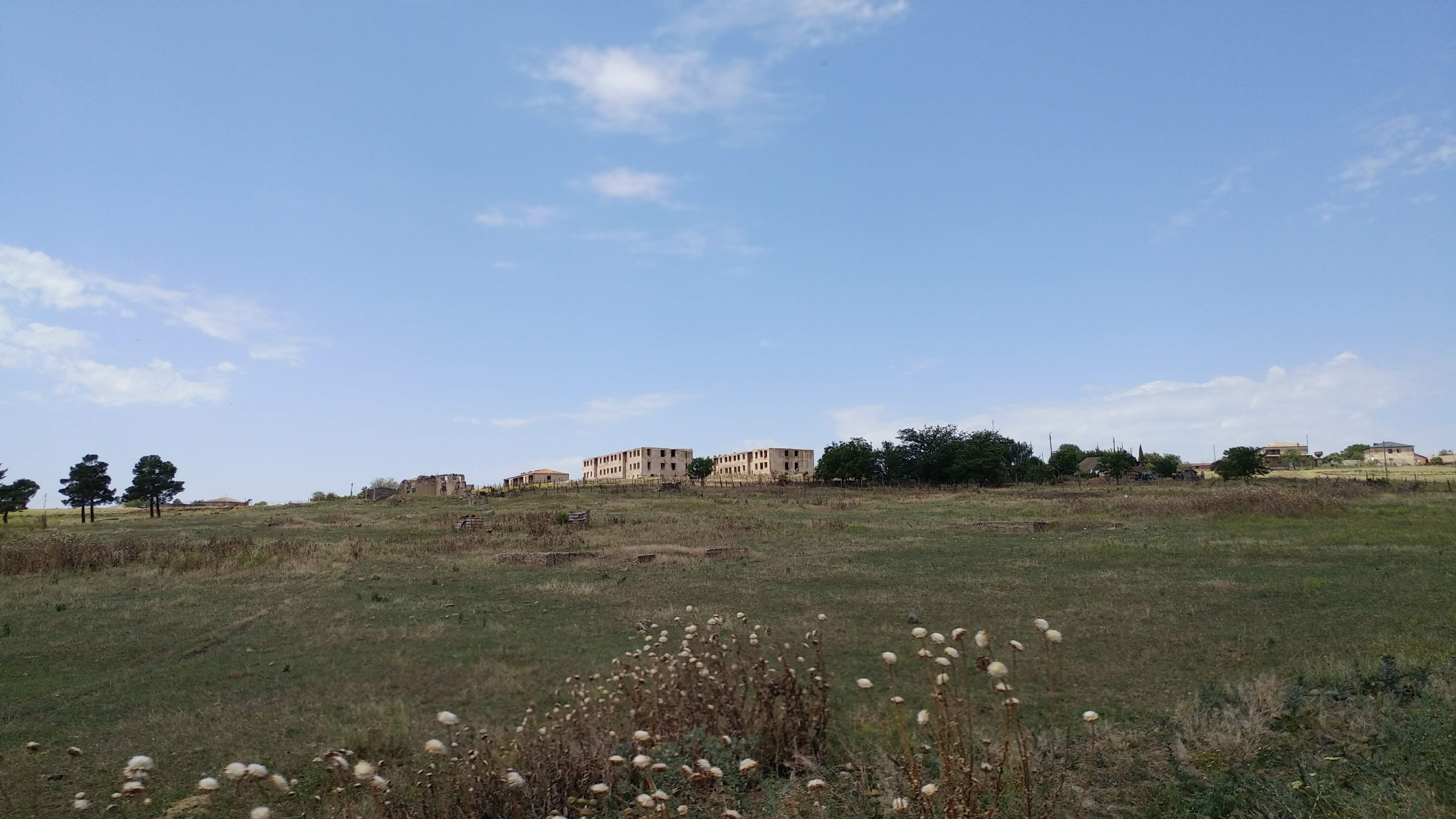
We passed more ghosts of infrastructure, cows grazing among concrete skeletons (abandoned or never finished in the first place?) East of Tbilisi turns to really pretty country, more cultivated than the Chiatura uplands but just as green; we saw the first crest of naked orange rock at the same time as we felt the road get noticeably worse beneath. Scrub gave way to grassy plains and then to high, rugged heathland, scattered with wildflowers, cloud-shadows and prefab concrete parts. I feel like this would be a cool place to grow up, among the many birds and mysterious ruins, all the concrete culverts just built to dam or crawl inside. There were occasional outbreaks of barracksy-looking buildings, all clearly neglected. Did Georgia ever have collective farms? On non-collective farms, little boxy combine harvesters spat out little boxy haybales.
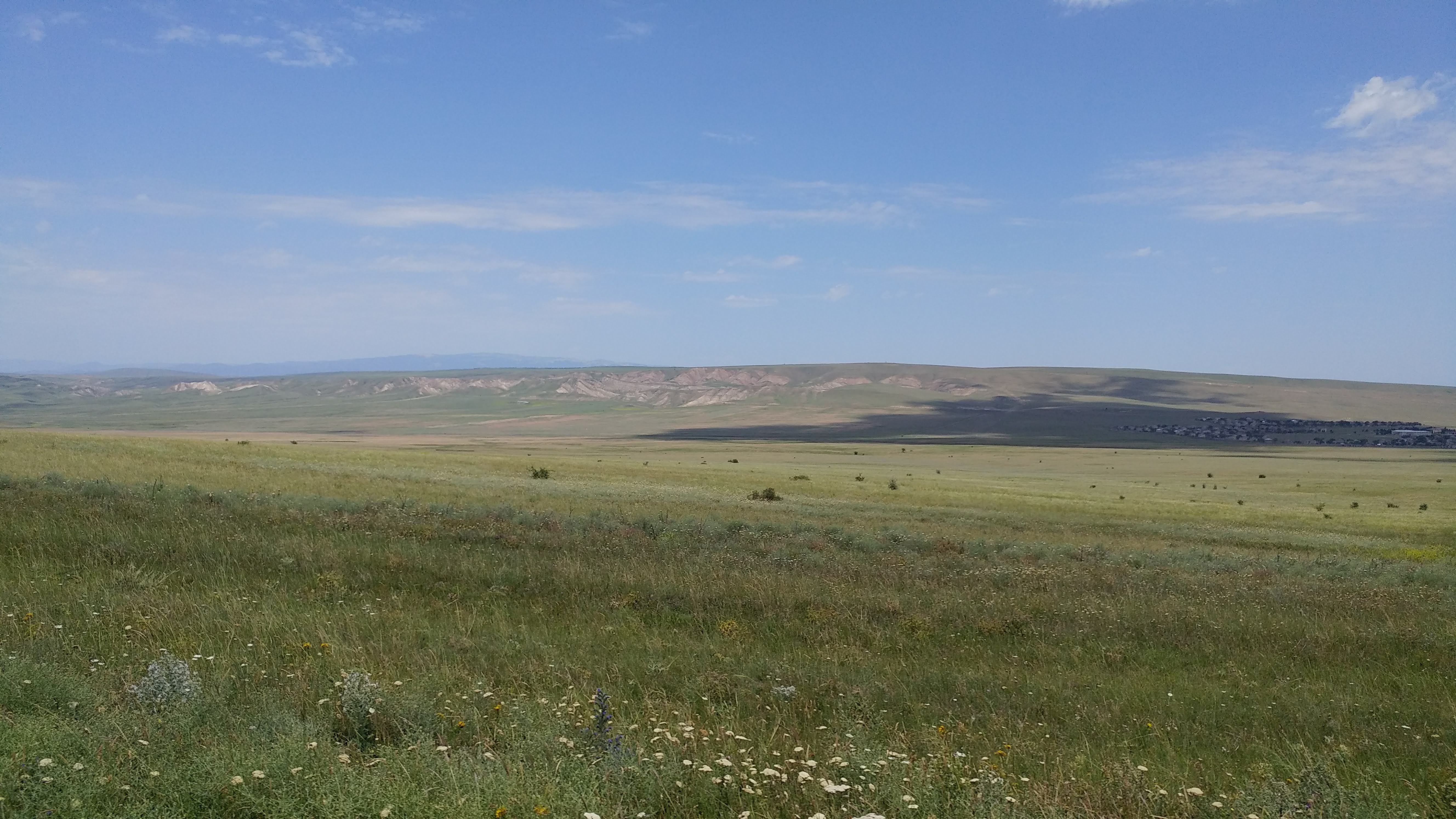
The road only arguably existed at this point, and our driver decided the best way to deal with potholes was to take the van half off the remaining tarmac, leading to a horrendous, storm-tossed lurchiness which did nothing to reduce the impact of the potholes but meant the whole roasting, juddering mess was canted over twenty degrees. A low polyglot murmur of alarm could barely be heard over the sound of stones popping under tyres and hot, unhappy bodywork being wrenched about. But we survived, and reached David Gareja as the landscape turned incredibly interesting.
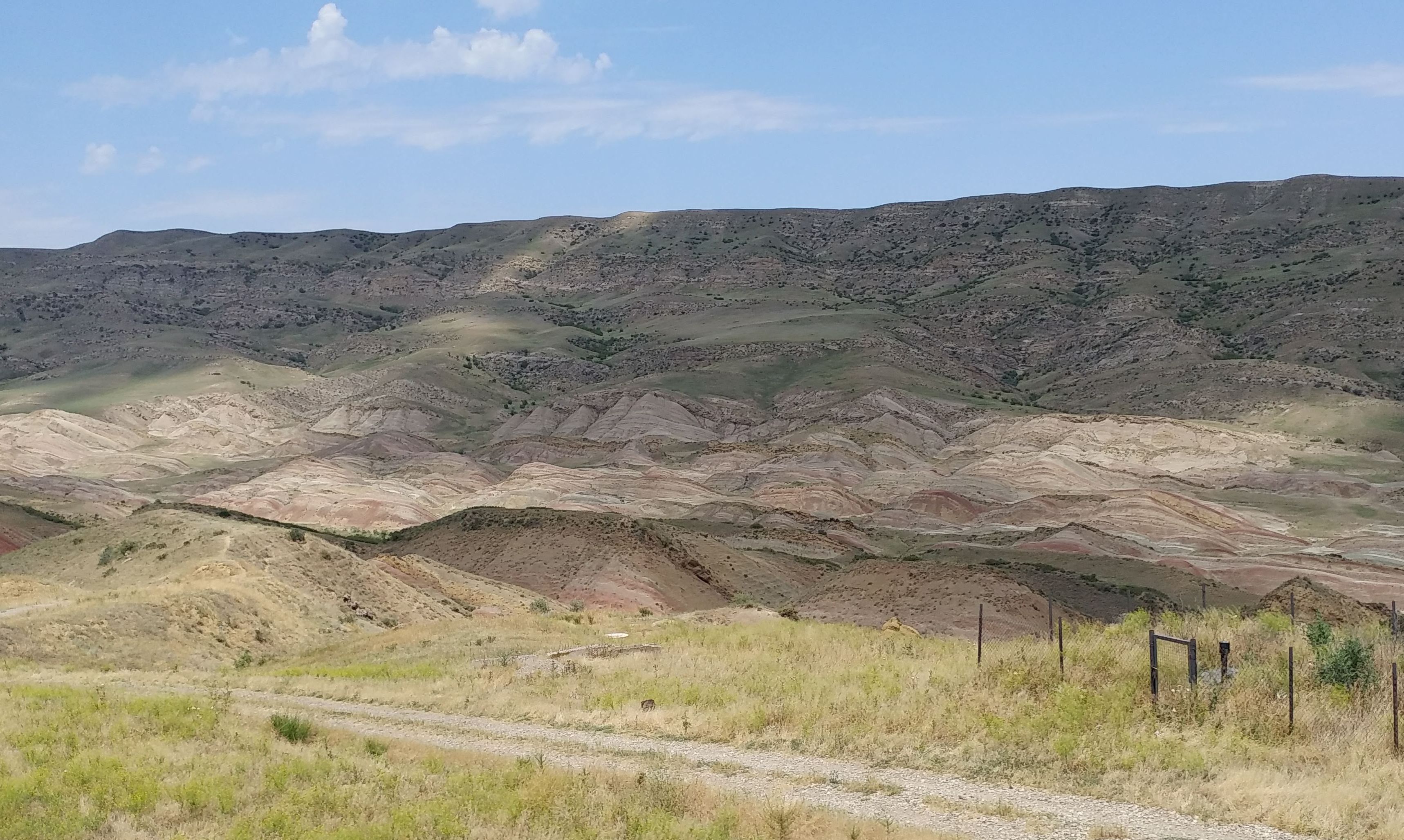
Some minor fault line here, an outlying wrinkle of the continental ruche which raised the whole Caucasus range, has lifted the bedrock and shaken it out, leaving a landscape with a wobbly, uncertain feeling entirely recognisable to a bunch of recently freed marshrutka inmates. Chunks of tilted strata, striated with rust like the clouds of Jupiter, jut up out of the ground: some are proud and triangular, pointing up like the prows of torpedoed ships; some are smooth and curved, bunched together like the knuckles of a buried god.
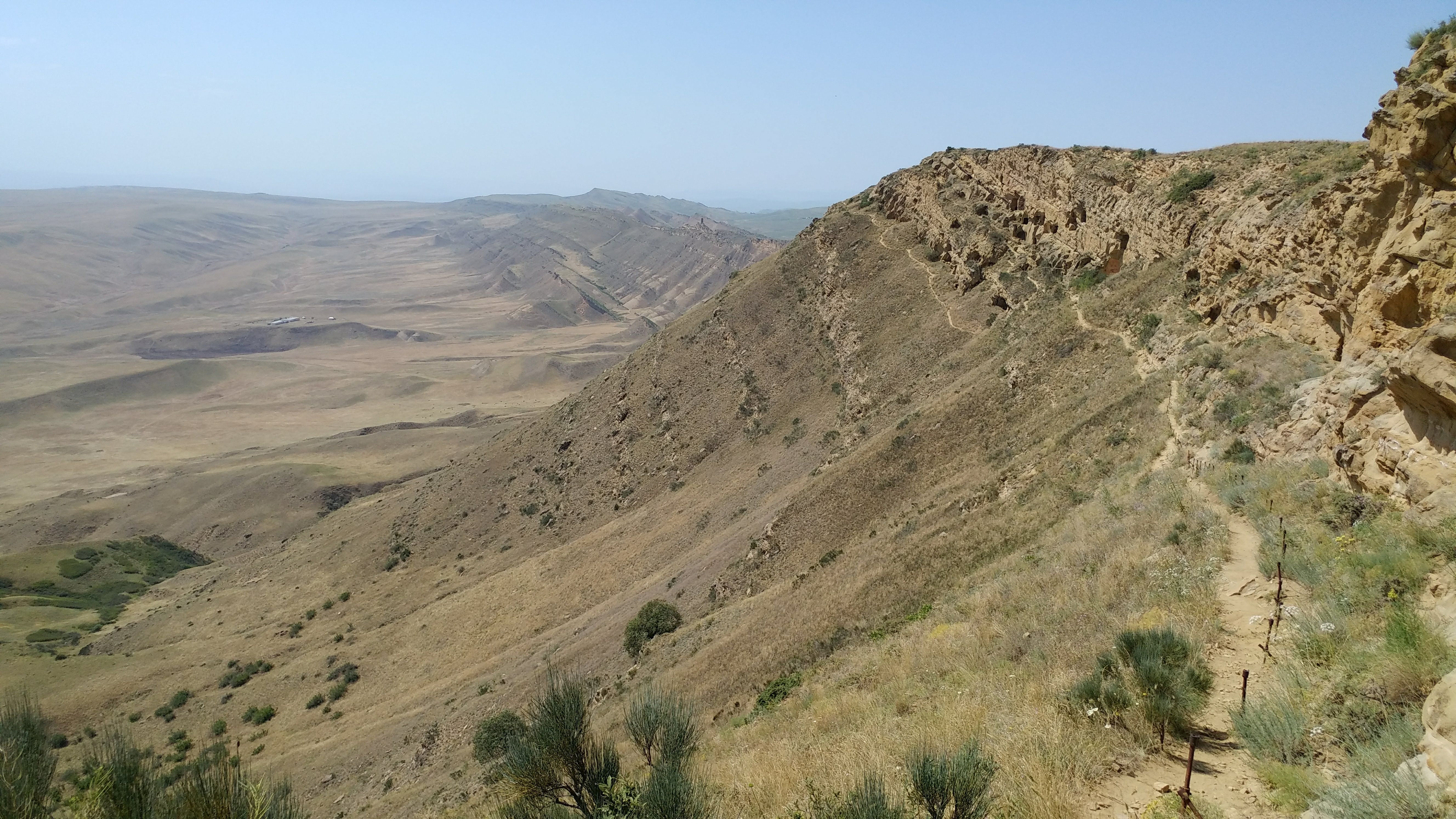
The David Gareja complex occupies the largest and southernmost of these upheavals, an immense long ridge it shares with the Azerbaijani border. We went straight up the hillside with a fellow-traveller, a cheerful town planner from Dresden, without whose sensible pace-setting we would plausibly have either died from heatstroke and overexertion (both incline and temperature were about forty degrees) or given up. A huge flat piece of exposed stone has ancient rainwater channels cut into it, and the ants here have very long legs, to keep their bodies from the baking earth. Even the lizards – big, clever-looking things with spiky heads – keep to the shade at midday, and move from shadow to shadow with a leaping, loping gait.
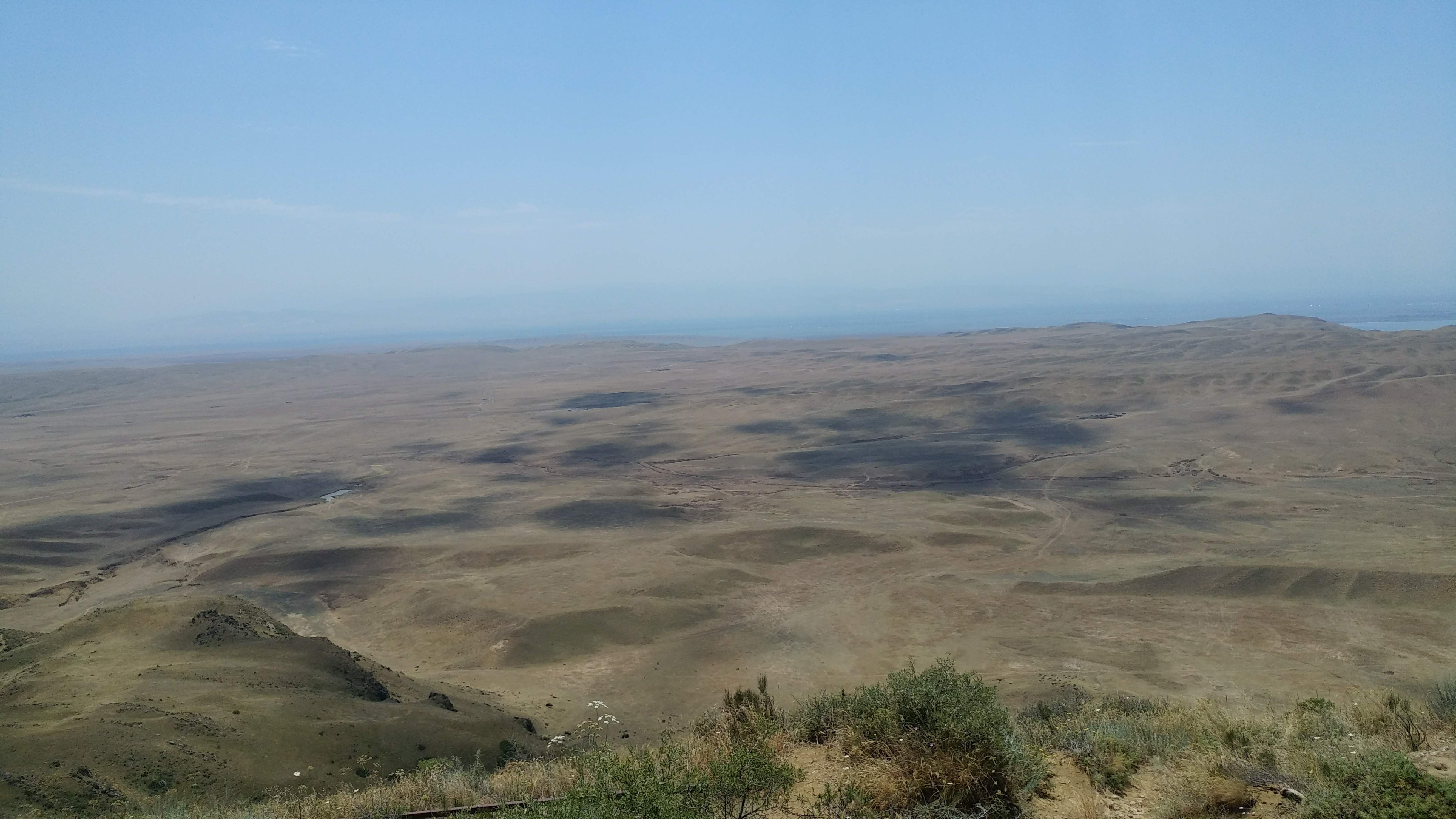
From the ridge’s peak, you look north to see the frozen waves of strata, west along an enormous rampart of broken stone, south to see the land fall away into Azerbaijan, with the distinctive silhouettes of power plants visible in the hot blue infinity. The exact border isn’t clear (unless it’s the nubbins of steel fence, in which case we and the path both crossed the border and back again with wild and gay abandon); it was in our interests not to really notice it, as many of the best monastic remains are on the Azerbaijani side. The geology round here has led to bands of iron-impregnated sandstone in alternating hard and soft layers, ideal for cave-carving. So we walked east, where the hidden monastery of Udabno is buried.


The eponymous David was an Assyrian monk, one of a legendary thirteen who came to Georgia a millennium and a half ago.* He and successive monastic types have inhabited this rock off and on until the present day, carving and building an eclectic patchwork of caves and above-ground complexes, most abandoned, some decorated with beautiful, ancient frescoes. The faces and some of the fine detail on the paintings have faded, and only the brightest of the details remains: blazing crucifixes and the wings of angelic hosts. The art is at once fairly primitive (asymmetrical crosses, formless angels), and quite strikingly accomplished: the use of colour and repeating pattern is timelessly gorgeous, the visual language of devotion and exaltation as clear as high Baroque. The cave mouths are ringed with wild flowers, and pigeons have set up in the corners of ancient altars. Entering each cave, a blur of surprised black butterflies would billow out past me, into the light.


The caves themselves feel like a microcosm of the whole pitted, riddled cliffside. The strikes of ancient mattocks are still clear in the stone; the clay and plaster has been much blown by burrowing wasps; the dusty floors are full of the reverse cones of ant-lions. Worst is the graffiti. Bored Soviet soldiers have carved names and dates into the faces of ancient frescoes, leaving lines of warrior saints half scribbled out and walls deeply chiselled from that time in 1965 Alexeyev from Dnepropetrovsk had half an hour off watch.** The refectory had a triple line of carved stone benches under the long Orthodox faces of the Last Supper. Other caves had flood channels, wine jars, huge, dark cisterns deep enough to leave a two-second silence between tossing a stone through the entrance and hearing a bassy bat-guano thud. Up top, three Georgian soldiers smoked in the shadow of one of the above-ground structures. At the highest point, an iron Russian trig point stood underneath a mysterious frame, overlooking yet more dramatic strata – whole plateaux of sheared-off rock.


We slipped and scuffled down the hillside and past the vast flat slab of rock with its rain channels, overlooking the fortified Lavra monastery (currently undergoing reconstruction.) In the shadow of the hill, stone steps have been cut and cisterns dug, some of them still actually in use. The spring called David’s Tears was, alas, bolted up and inaccessible, with the gaps in the bars giving away only a musty smell and the vague glints of Orthodox altar paraphernalia. So we turned back into the light, back towards the waiting marshrutka, and in one of the nearby cisterns a cave frog suddenly sounded off, loud enough to make everyone jump.


* There is evidence of plenty more Assyrian missionaries operating in Georgia around the time; it’s possible that David and his twelve colleagues were simply retrofitted on to the thirteen major sacral sites they are said to have founded.
** I am hesitant about having three posts in a row containing some sort of anti-Russian polemic, but they used it as an artillery range, for crying out loud. Disgustingly, it took serious protests to stop the independent Georgian government doing the same thing.
Good morning, Kutaisi! – Museums and wine – Chiatura from above – Pioneers’ Palace, Gori – Tbilisi – David Gareja – Akhaltsikhe – Vardzia
 underneath the open sky