The Wind Rises: A very gentle, beautiful film which doesn’t seem to know what it’s trying to be: a doomed love story between a man and a woman, a doomed love story between a man and an aeroplane, or a doomed love story between Japan and militarism. Like Porco Rosso, it’s a paean to aviation pioneers and the lost world between the wars, but much more serious and realistic – and so, much more maudlin. It’s set in the real world, which is still full of wonders (the mad 1920s behemoths like the Caproni Ca.60 and the Junkers G.38, realised in perfect Ghibli animation with that obsessive anime eye for detail) but, far more so, horrors: the Great Kanto Earthquake (again, realised in perfect Ghibli animation with that obsessive anime eye for detail), the inescapable knowledge that everything our quiet, unprepossessing protagonist is working for and obsessed with will serve only to help a monster do more damage before it is finally killed.
I am, of course, biased, but I don’t see much romance in Japanese aviation design. They built fragile, boring deathtraps, refined but in no way inspired, that were kings of their theatre for a year or two but failed to keep pace – and then they renounced the art forever, just when things were getting interesting.
This series was originally jointly on my blog and Philip Reeve’s, but his has been overrun with malware so all four posts are now on my own site: Part 1Part 2Part 3
T is for Rob Turpin
Early on in the development of the IWOME, it had more of an artbook-y feel: big, fancy full-colour works taking up whole pages at a time, with the relevant text on the opposing page and any empty space filled by fancy cogwheels (which ended up on the cover.) We wondered if we could make it feel more of a technical, encyclopaedic sort of thing, the sort of book which says “refer to Fig. 2a”, by adding more, smaller illustrations – perhaps little black and white ones…?
To which Jamie, the Scholastic design manager, said “Ah! I know just the chap!” Rob Turpin is an illustrator and designer from Yorkshire who has been living and working in London for the last twenty years. Mainly working in science fiction and fantasy, Rob has a love for spaceships, robots, imaginary places, and the colour orange…
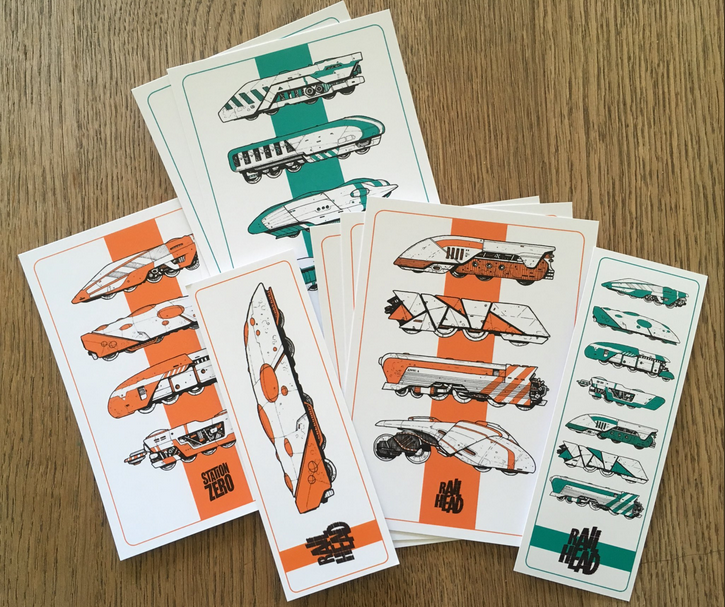
He also did a nice set of Railhead postcards for Philip.
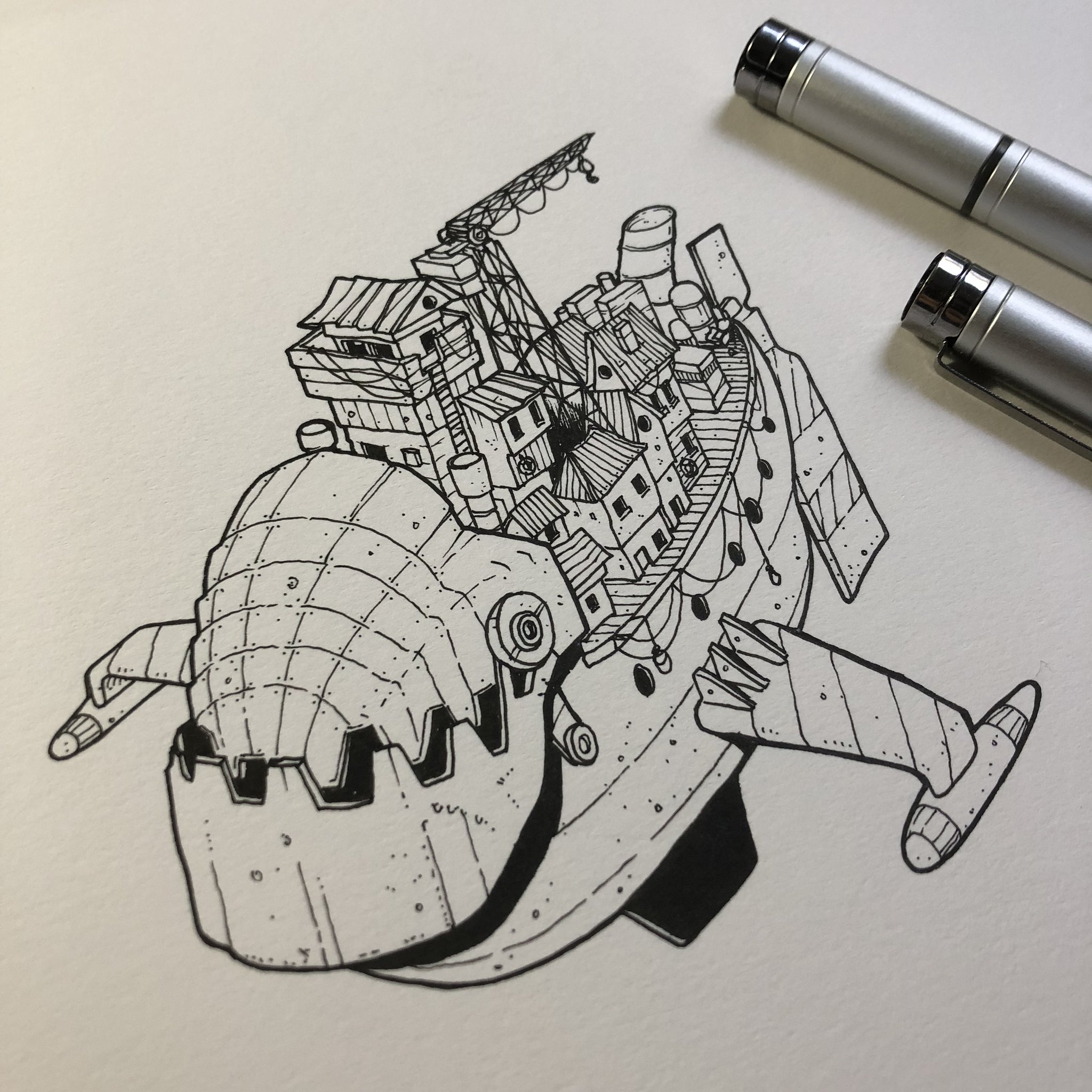
Rob’s lovely little cities, full of detail and personality, crowd the book and are all laid out in the endpapers. In particular, he’s taken on all the more bizarre experimental cities, like Panjandrum, Vyborg, Borsanski-Novi and Havercroft. Probably my favourite of these is the Nuevo-Mayan piranha town. We originally envisioned these as smaller than the first version he sent in, only about the size of houseboats, but the one he sent was so lovely we had to keep it in anyway, with a little squadron of smaller friends. And, absolute gentleman that Rob is, when I said it was my favourite, he only went and sent me the original art…
Rob is thisnorthernboy on a lot of sites: Twitter, Instagram, WordPress, and ellipress where you can buy prints of his work. Give them all a look!
U is for Uncertainty, or Unsolved Mysteries – it’s all one.
The IWOME answers a lot of questions. Readers will come away knowing how London got from the end of Scrivener’s Moon to the start of Mortal Engines, how Tractionism spread to India, which was the largest moving city ever built, what on earth is actually going on down in Australia, and who originally used Nuevo-Mayan Battle Frisbees. They will also have a much better idea of the geography of parts of the world and how much the Sixty Minute War really reshaped things, which has been a source of great speculation and interest in the fan community.
But it doesn’t answer all of them. This isn’t an exhaustive encyclopaedia or comprehensive atlas; we have no interest in naming every Traction City ever built and categorising them all. The book leaves a great deal up to the reader’s interpretation and imagination; it’s a history as seen by people inside the world, which is still full of mystery and uncertainty. Hopefully, we’ve left a world that feels wider, rather than narrower.
V is for Philip Varbanov
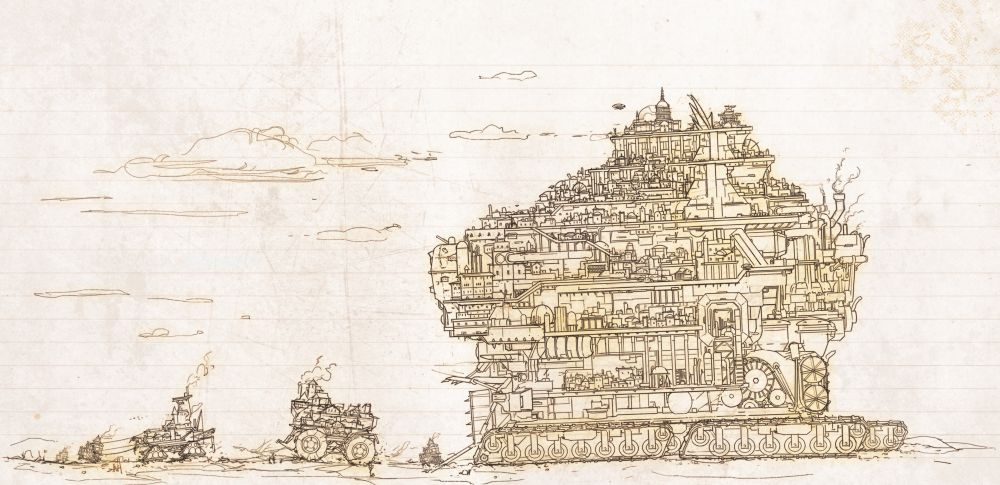
As mentioned in Exploded Diagrams in the first blog, something we were anxious to include from the very beginning was artwork which captured both the scale and the detail of a Traction City. And for that, Philip Varbanov’s work exceeded all our hopes.
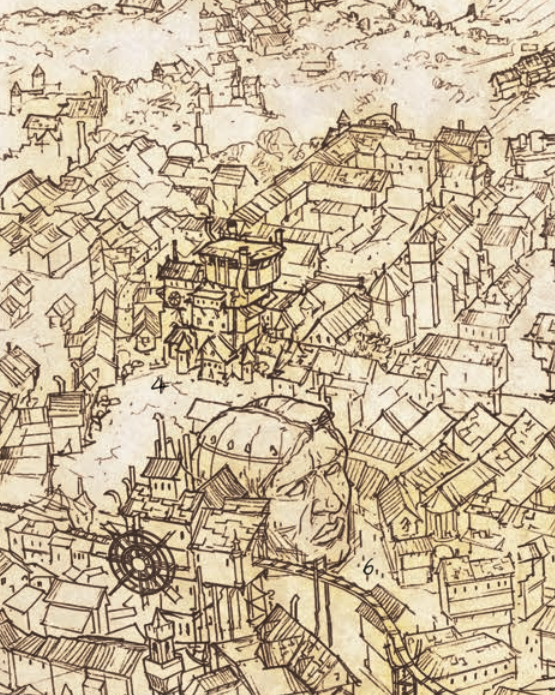
Detail of Philip’s Pre-Traction London, feat. the Barbican and Godshawk’s Head.
Philip is a concept artist and illustrator with a background in fine art and graphic design. He’s based in Sofia, Bulgaria, and works in the entertainment industry, specialising in environment art and production drawings. He illustrated the “Evolution of London” series at the start of the book, as well as several helpful cutaways of traction cities, an illustration of the Municipal Darwinist food chain and a stunning Jenny Haniver.
Philip’s works are striking for their great attention to realistic-looking mechanical detail. His drawing of Fever’s London on pages 10-11 is a masterpiece – we were worried it wouldn’t be possible to get central London, Nonesuch House (which is well away from the centre, on the edges) and the Orbital Moatway (which is far off on the horizon) all into the same drawing satisfactorily, but Philip used space and perspective so cleverly the whole thing just works.
Chances are if you’re a fan of Philip Reeve’s worlds you’ll already be familiar with the works of David Wyatt. He’s responsible for the charming black-and-white illustrations of the Larklight series and, closer to home, a series of Mortal Engines and Fever Crumb covers (along with the Haunted Sky comic-that-never-was.) His covers are exactly how I imagined the world of Mortal Engines as a little boy, and the IWOME simply wouldn’t have felt right without him involved.
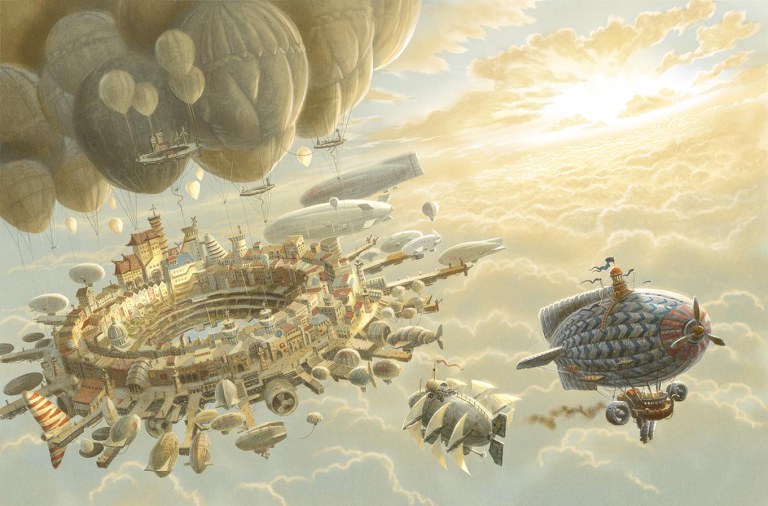
David’s huge full-page illustrations are scattered through the IWOME. All his works have an incredible sense of atmosphere: contrast the rain-slick, overcast landing pad of the 13th Floor Elevator with his light, airy Brighton, or the calm of his Zoffany-like art gallery with the oppressive, chaotic Battle of Three Dry Ships, where a three-tiered London grinds implacably into view over a blood-red battlefield. I also adore his Nuevo-Mayan traction city chase, which is like the cover of a Mortal Engines book that never happened – it’s so close to what I had in mind when writing the brief it’s spooky.
David is a prolific illustrator (I hadn’t realised quite how prolific until, looking at his portfolio, I found half the books of my childhood were in his covers – everything from The Hobbit to The Amazing Maurice and his Educated Rodents), and recently won the Blue Peter Book Award for The Legend of Podkin One-Ear alongside Kieran Larwood. Like Philip Reeve, he lives on Dartmoor, and you can see evidence of its mossy hillocks, windswept tors and curly, spooky old trees in his art here. More of his IWOME art (among many wonderful other things) can be found on his blog here.
X is for Xanne-Sandansky
…one of the many, many Traction Cities mentioned in the Quartet, but which never got its own entry in the IWOME. I’d love to come back to it – there are plenty of ideas for cities which we never quite got round to.
Xanne-Sandansky is best known in the IWOME as the eater of Borsanski-Novi, a catch so crammed with spare parts and useful machined goods that its Gut bosses had a spring in their step for months thereafter.
Y is for whY can’t I think of anything for the letter Y?
It’s a copout. But I really can’t. Suggestions in the comments section, please…
And finally, Z is for Amir Zand.
Although he’s last in the alphabet, Amir Zand was one of the first artists involved in the IWOME. Amir is an Iranian illustrator and concept artist, specialising in cover art and promotional illustration. He’s been featured in numerous magazines and books, including Spectrum 25: The Best in Contemporary Fantastic Art, and has illustrated more than 35 book covers.
Detail of Bayreuth – get the book for the rest!
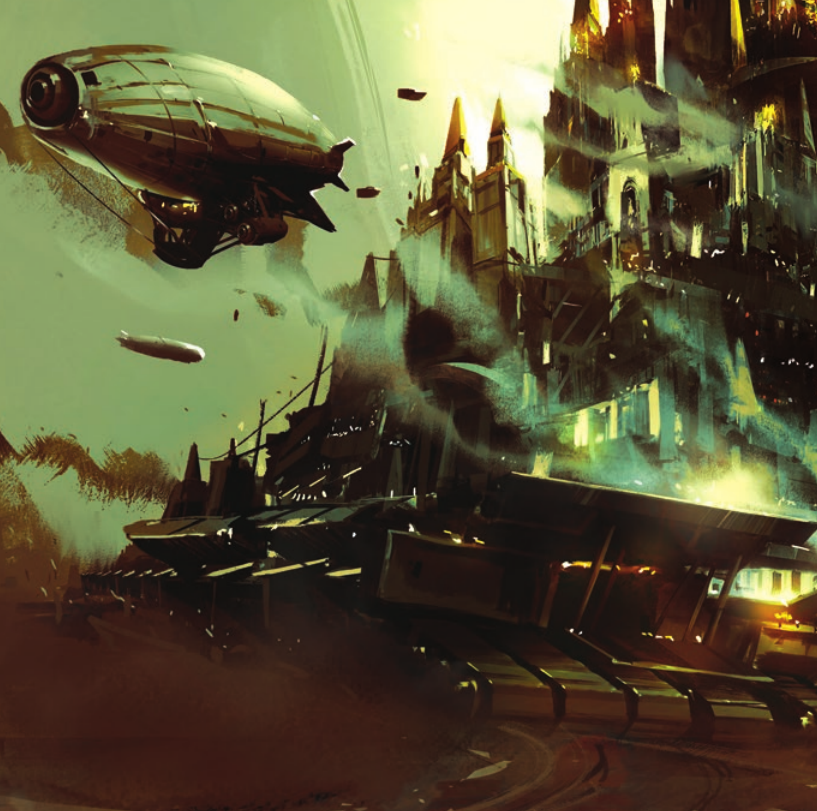
Amir contributed all sorts of works to the IWOME, providing a marvellous set of mutant creatures (his Maydan Angels look rather a lot like shoebills, which are easily the most malevolent-looking birds in the world) and a lot of static settlements as well as a wonderful variety of cities (his Juggernautpur, continuing the “person in front of Traction City” theme of the Ian McQue covers, also looks like the cover of a book which hasn’t been written yet.) Amir’s works are all incredibly evocative: you can feel the chill of his winter-dawn Kometsvansen, the heat of the sun on his gleaming Zagwan city, and the aching stillness of his wreck of Motoropolis, lit from below by scavenger’s spotlights in the purple night. One of my favourites is his Panzerstadt-Bayreuth, a huge, intimidating silhouette wreathed in smoke and scattered with lights, and you can get a sense of how Londoners must have when they saw it bear down on them in Mortal Engines.
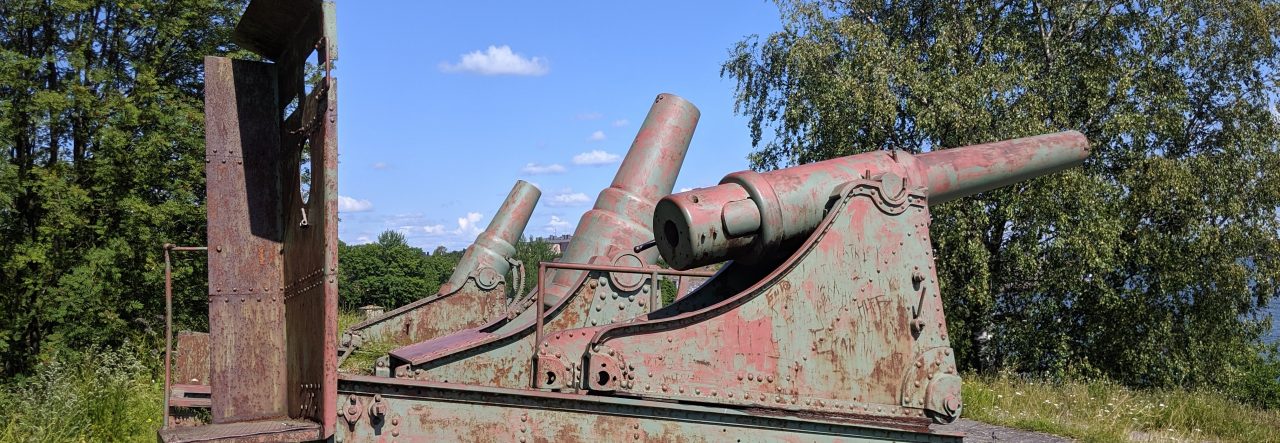
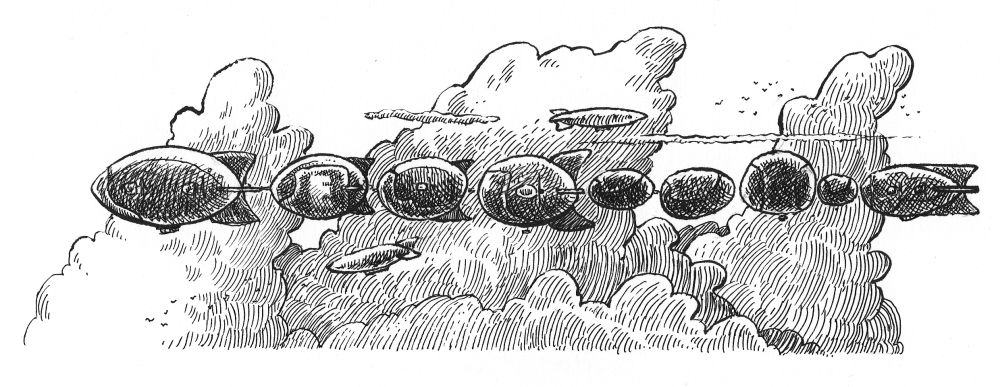
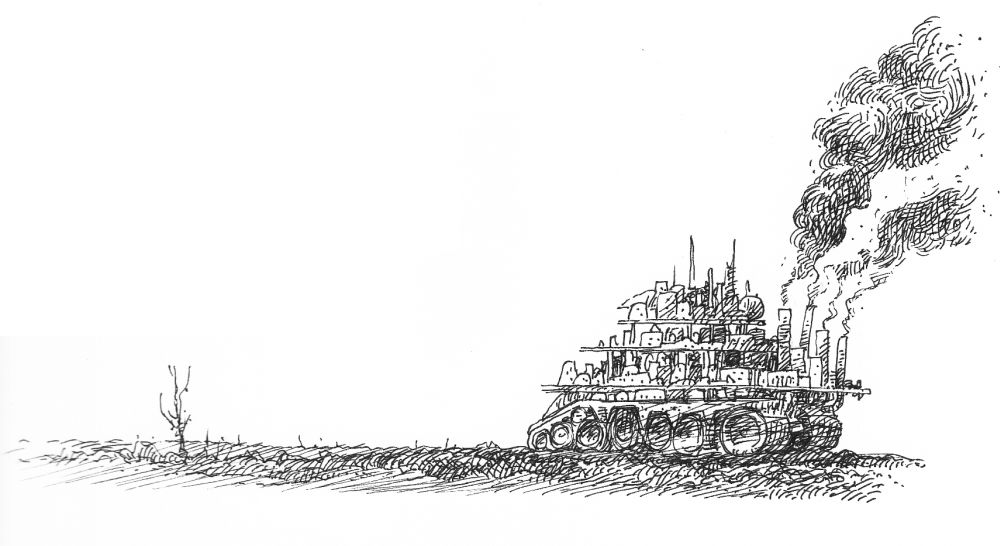
Pictures in order: Piranha suburb, Railhead postcards and Kom Ombo, by Rob Turpin; Sky-train, by Philip Reeve (originally for the Traction Codex); detail of pre-Traction London and Diagram of Municipal Darwinism , by Philip Varbanov; Airhaven and Nuevo Maya, by David Wyatt; Traction City, by Philip Reeve; Arkangel, detail of Panzerstadt-Bayreuth, and Tunbridge Wheels, by Amir Zand.
This was originally posted on Philip Reeve’s blog here. Philip’s blog has been overrun with malware so all four posts are now on my own site: Part 1Part 2Part 4
To mark the publication of The Illustrated World of Mortal Engines, my co-author Jeremy Levett has put together an A-Z guide to what it is, how we wrote it, and who did all the lovely artwork. The first part is here, the second is here, and now for the third:
Night Flights is very much its own thing – most of it came from old stories and ideas Philip had about Anna Fang – but one story, The Teeth of the Sea, drew on an idea that came out of the IWOME *: Fastitocalon, a very peculiarly adapted aquatic predator city. You can see David Wyatt’s gorgeous illustration of Fastitocalon in action here, and another version by Ian McQue in Night Flights itself.
* To give time for all the illustrations, the manuscript for the IWOME was actually finished by autumn 2017 – it’s been difficult keeping a lid on it all this time!
O is for Old-Tech A problem with setting things in the future that refer back to the present is that the present won’t stand still, and episodes of Black Mirror keep coming true. Most of the stuff being dug up in the world of Mortal Engines is old tech right now. Fever Crumb found herself standing on a floor tiled with iPods in Scrivener’s Moon, which is about all they’re useful for now. When Tom first found a CD in Mortal Engines, they were common, but here in 2018 they’re now less popular than vinyl, for some reason. How long until they’ll need explaining to young readers, as if he’d found a VHS or a 5″ floppy disc? (Perhaps this is why the film seems to have replaced it with a toaster…)
It’s mad to think about now, but back when the original Codex was written hardly anyone actually had a smartphone, the quintessential Screen Age device. Of course, these feature (our archaeology is bang up to date), but perhaps future editions of the IWOME will have to keep with the times. I’m looking forward to some sort of hands-free brain implant replacing smartphones, which a) will mean no more fiddling around with perishing touchscreen keyboards and b) will neatly explain where Stalker-brains came from…
Some of the Old-Tech actually belongs in the future, and as well as the carefully preserved modern remnants being loaded into the 13th Floor Elevator, you can read about artefacts from lost civilisations like the Electric Empire or the Blue Metal Culture (which everyone seems to think is a reference to some obscure musical movement – it’s really just a civilisation which made lots of things out of an attractive blue metal.)
P is for Maxime PLASSE
…who illustrated all the IWOME’s maps. Maxime has been a role-playing gamer from an early age and always had an interest in fictional worlds, mythology and ancient history; he found his way into graphic design through part-time work for a French RPG publisher, alongside his career as a social worker. He now works full time as a graphic/layout designer and freelance cartographer, working on RPGs, video games, historical magazines and for a range of other clients.
Maxime has a very versatile style, and put all sorts of beautiful details into his IWOME maps: an Aboriginal pointillist pattern surrounding Australia, an Mayan-influenced one for Nuevo Maya. As well as depicting places like south India, Australia and Nuevo Maya, he’s produced a military-style campaign map of the Zagwan Deluge and a lovely, highly stylised representation of the Bird Roads.
You can see his website here and his deviantART page here.
Q is for Ian (Mc)Que
(sssh, it’s a difficult letter.)
Ian McQue was born in Sunderland and worked on the Grand Theft Auto games before becoming a freelance concept artist and illustrator. He now mainly works in the film industry, and lives with his wife and an assortment of cats in rural Scotland.
Ian is one of Philip’s favourite artists, and has worked on covers for the Railheadbooks as well as illustrating Night Flights and the new set of Mortal Engines covers (you can see some of the new cover art in the IWOME!) Ian has a gorgeous style, filled with stark light and mechanical intricacy, and you can almost feel his cities bearing down on you. As well as giant mechanical things, he’s also very good at character art, and all the little portrait pictures in the IWOME are his work.
You can follow Ian’s twitter here (he shows a splendid appreciation of funny little specialised airport vehicles), find him on Instagram here and buy his artwork here. And if you want to experience his work in a non-Mortal Engines context, give the spookily beautiful game The Signal from Tölva a play.
R is for Realism
Realism is something a lot of people get hung up on, particularly in a science-fiction context, and especially these days now that internet forums allow one to rage to an appreciative audience about how hearing things in space is Stupid, or try to calculate the velocity of an asteroid from how big a half-second explosion in a movie is. This sort of “realism” demands copper-bottomed mathematical working-out of every detail. There’s a place for this – “hard sci-fi” is a popular genre for a reason – but it’s an unhelpful mindset to apply to everything.
I was brought in on the Codex and IWOME partly because I have enough of a reasonable basic engineering knowledge of guns/planes/airships/tanks etc, but the moment scientific reality gets too far in the way of a plot point or a good pun we ignore it, especially if there isn’t a good “OLD-TECH DID IT” handwave.
Something much more important than realism is verisimilitude, in the sense of “internal realism”. The world of Mortal Engines isn’t really a “realistic” one: it’s based around machines that are probably impossible and has immortal cyborg zombies. But it obeys its own internal logic, and, importantly, the humans inside relate to it in a believable way. There are some very, very silly things going on in the IWOME, but it’s not completely implausible that people would think, for instance, that a bouncing city would work (it does for kangaroos!)
S is for Spoilers
How, in a history book where the end of Mortal Engines is one of the more significant events in recent history, do you get around the fact that, well… Mortal Engines has an end? Referring darkly to “the MEDUSA incident” could only get us so far. We ummed and ahhed about how to address the rather important point, and finally decided to take the bull by the horns on the very last page of the IWOME, set against a full two-page rendering of Ian McQue’s cover for A Darkling Plain.
Hopefully, few people who get to the last page of the IWOME will find what’s written there as a surprise – and those that do will go off and read the book to find out how we got there.





 A problem with setting things in the future that refer back to the present is that the present won’t stand still, and episodes of Black Mirror keep coming true. Most of the stuff being dug up in the world of Mortal Engines is old tech right now. Fever Crumb found herself standing on a floor tiled with iPods in Scrivener’s Moon, which is about all they’re useful for now. When Tom first found a CD in Mortal Engines, they were common, but here in 2018 they’re now less popular than vinyl, for some reason. How long until they’ll need explaining to young readers, as if he’d found a VHS or a 5″ floppy disc? (Perhaps this is why the film seems to have replaced it with a toaster…)


 underneath the open sky