
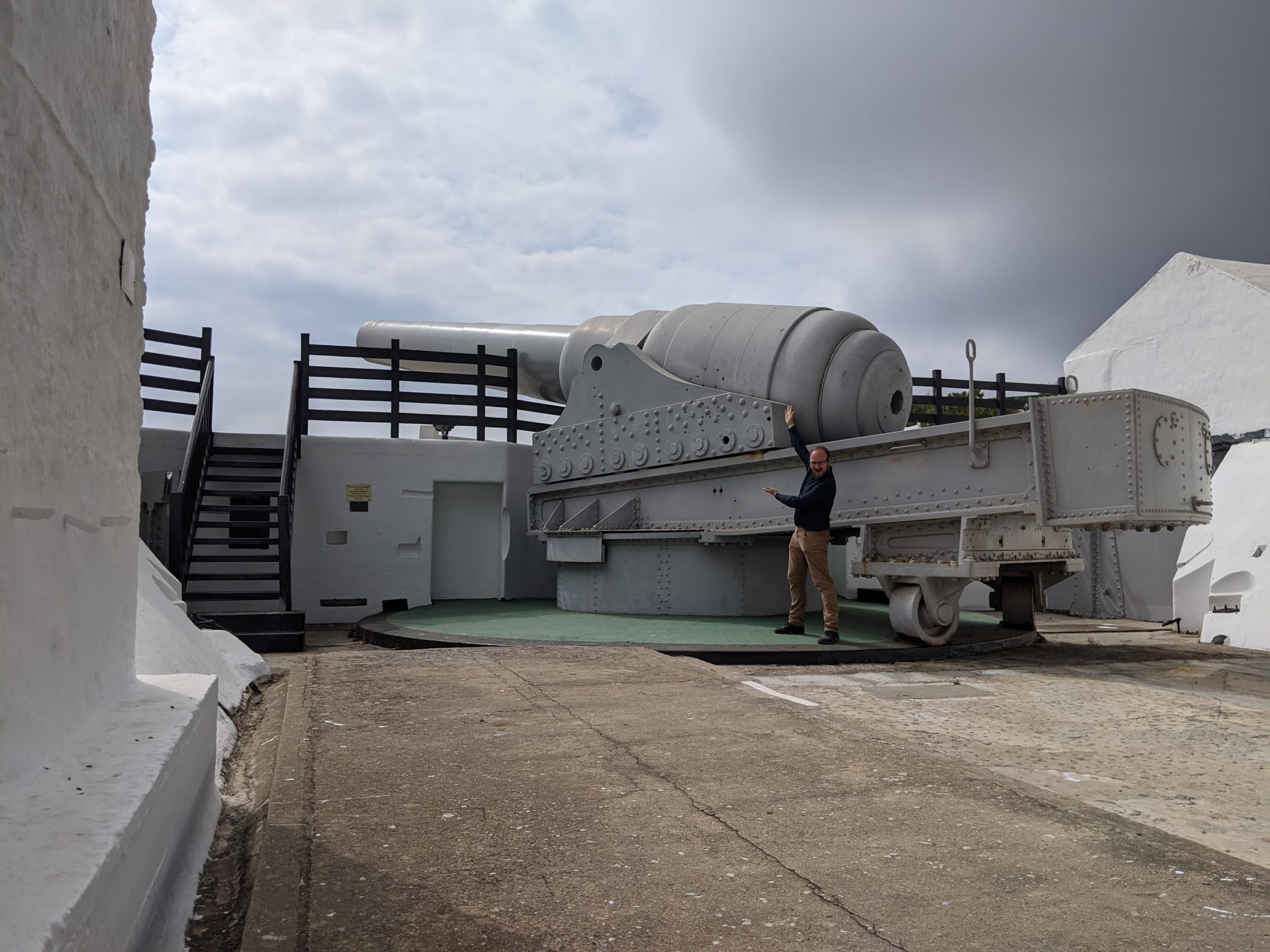
The gigantic gun at the Napier of Magdala battery is, by my standards, the ideal weapon. It’s an exquisitely complex piece of engineering (its smooth fleet-grey paint hides a carefully assembled jigsaw of huge castings; beneath its plain glacis is a warren of magazines and Victorian engineering). It’s a money-no-object application of unlimited resources and cutting-edge technology to a problem (silk bags for its 200kg powder charges! a platinum element for its brand-new electric ignition! its own steam engine and grossly complex hydraulic traverse!) It’s a weird, unique curio, the apotheosis of the rifled muzzle-loader* (a total evolutionary dead end in artillery design). Best of all, it is completely worthless as a weapons system and never actually hurt anyone. The only thing that could make it cooler if it were a part of a huge, sophisticated defence complex rather than just a stand-alone battery. Then I realised: it was, and the complex was called “Gibraltar.”


We started the day with pancakes at the Pancake Factory, and headed to the perfect city museum, which in quite a small space captures everything exciting which has happened in Gibraltar in the last thirty thousand years. Two Neanderthal** skulls have been discovered in Gibraltar, a female adult and a male child, and in an incredibly accomplished scale reconstruction from the skeletons on up, they have been given form as “Nana” and “Flint”; the final result is a pair of engaging, weatherbeaten little people, definitely inhuman but creatures you could probably be friends with. More old-fashioned glass cases held descriptions and preserved pieces of the various terrifying megafauna these poor proto-humans had to share Gibraltar with, before uncontrollable numbers of true Homo sapiens extinguished them all. A similar reconstruction of a modern human, “Calpeia”, sits in a nearby case.

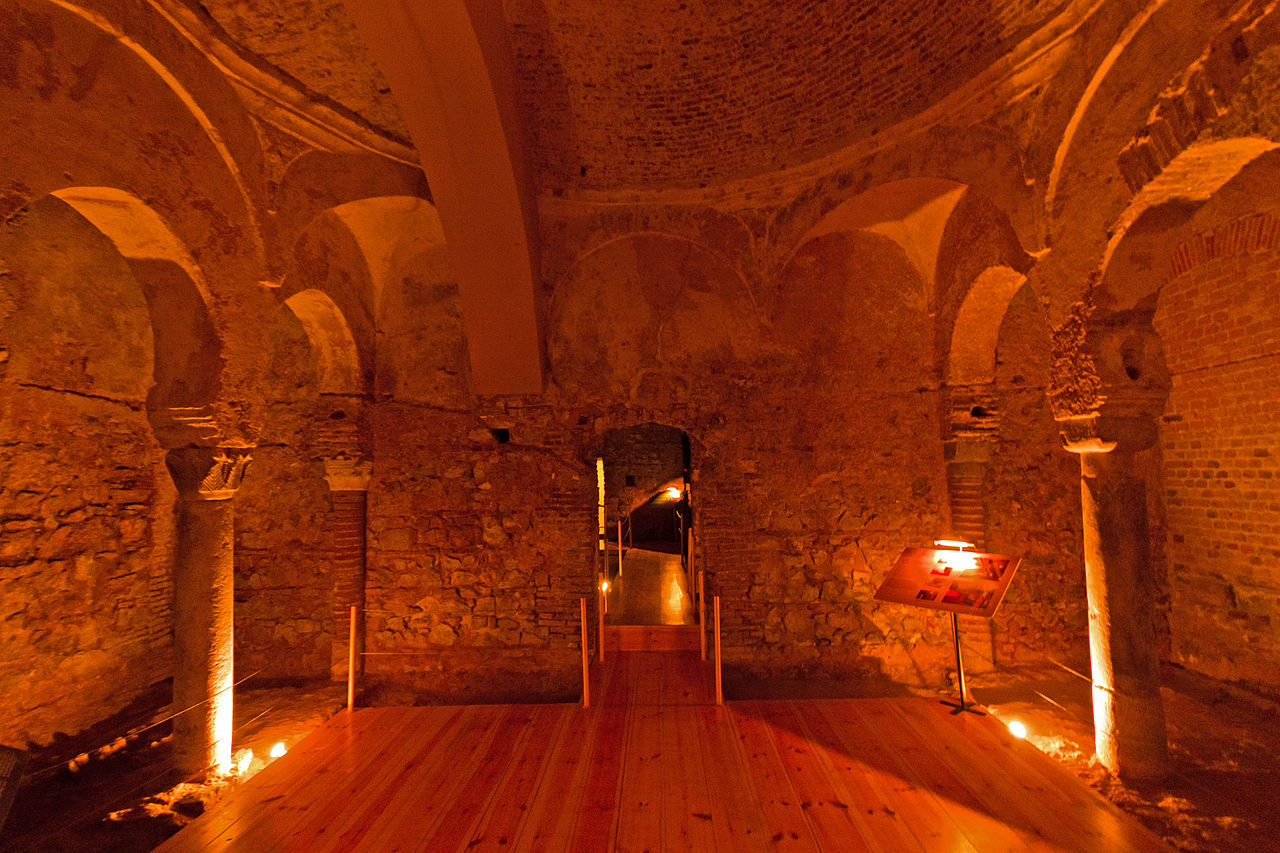
Part of the museum complex is occupied by the wondrous Moorish baths, one of the few non-military survivors of the old Islamic city. Mistaken for a mosque and used as an ordnance clerk’s office in the intervening centuries, it’s an astounding survival, striking both for its similarity to much older Roman designs (in layout, columns, capitals) but also its authentically Moorish flourishes – horseshoe arches, eight-pointed ventilation cutouts. As with the Tower of Homage, half the conservation work seemed to be undoing well-intentioned but disastrous 1970s efforts.
The rest of the museum is an interesting assortment of Gibraltar’s best artefacts: Phoenician and Carthaginian relics, a solid-lead Roman anchor, a non-magnetic diver’s knife, a lost-seeming set of samurai armour, a random pickled snake in a bottle, an armband from a German WW1 prisoner – with a GIBRALTAR battle honour his Hanoverian unit earned in the Great Siege. The crowning glory was a gigantic, very precise 1:600 scale model of the entirety of Gibraltar as it was in 1865, with the much smaller Victorian town and its defences – and the immense amount of land that’s been reclaimed since then – very obvious.


We ducked into the local Catholic cathedral, St Mary the Crowned: busy, urban and honestly a bit tatty, its best parts the chipped pseudo-Moorish tiles. We headed south along the old Victorian walls, past Commonwealth Park’s fishponds and an abandoned outpost of Toc H. The dockyard was very reminiscent of parts of the Bristol’s harbourfront – the same hefty Victorian stone buildings and Orthanc-like mega-chimneys, the same modern sheds over huge old graving docks. The key difference was the militarisation – the gun emplacements perched on every mole and breakwater, the firing ports of concrete pillboxes covering all the approach roads – and the vastly larger scale.


The Napier of Magdala battery sits by “Nelson’s Anchorage”, a little semi-artificial cove overlooked by a couple of much older cannon. There was nobody at the door to collect our fee so we just wandered on in, and enjoyed a very well put together exhibition laying out (in English, Spanish and French) the vast, unprecedented High Victorian military silliness of the battery: the three hours it took to build enough hydraulic pressure to rotate the gun, the 23-man crew needed to squeeze a shot out of it every four minutes.**** The RML design meant that the entire 150-tonne gun and carriage assembly had to rotate around to point into one loading port for a giant 15-metre hydraulic ramrod to shove the charge in, then twirl a full 180° to the other port to take a shell, then be laid on target. (Like the Duilio-class, it also meant that during the loading sequence the battery had a fully loaded super-heavy gun pointed at its own magazines.)
This absurdly involved loading process is the reason it was such a useless weapon – the gigantic 900kg shells it fired were well beyond overkill on any ship of the day, but meant the rate of fire was hopeless and the chance of scoring a hit on anything faster moving than an island minimal. The Royal Navy knew this initially, and turned them down when Armstrong initially offered them – but when the Italians eagerly snapped some up for their new battleships and started making threatening noises about Malta, the British government suddenly felt outgunned and bought a bunch with the 1870s version of an Urgent Operational Requirement (sadly, designs for a 224-ton gun never came to anything). So these ludicrous dinosaurs proliferated all over the Mediterranean, Armstrong built Cragside, and nobody was hurt.
“The day before practice firings of the gun, the Gibraltar Chronicle warned people to leave their windows open and take fragile objects down from shelves.” As we left, we noticed the gate had been closed; possibly the whole exhibition should have been. Whoops?


Having ticked off the day’s to-do list, we went into General Exploration mode. An amble uphill along a broad stairway took us to the old naval hospital (now St Joseph’s School, much brighter than its 1/600-scale 1865 representation, but very recognisable); we were getting thirsty, but weren’t convinced by a grotty-looking pub called “Wembley”. St Joseph’s church, built for the Maltese community, had an almost Greek-looking tower, an interestingly broad, sweeping arch to its ceiling, and a psychedelically bright mural above the altar; past it, the tower blocks south of the Alameda had the feeling of a London council estate on a muggy day.


We descended to the old town for a siesta and a surprisingly good Indian-Japanese fusion dinner, then had a good night wander of the quiet streets and the northern defences. The levanter had given the Rock a dramatic quiff of cloud, lit from beneath by the airport floodlights, and the Tower of Homage sat on the city’s shoulder like a cube of rose gold.


* ARTILLERY ESSAY TIME! Early 19th century guns of all sizes were basically smooth iron tubes, open at one end, into which you put a charge of black powder and then a ball. Breech-loading (putting the shell in at the back) is an improvement for various reasons, including working better with rifling, but mid-C19 technology had difficulties making a breech which opened but was strong enough to contain a large blackpowder charge. Thus, RMLs – rifled muzzle-loaders, which look very silly now but for several decades were the acme of heavy weapons.*** Eventually, improvements in metallurgy (better steel castings), chemistry (nitrocellulose guncotton and later smokeless propellant, which burned more controllably than blackpowder) and engineering (threaded obturation seals which would “screw in” and securely hold a breech closed) enabled the creation of modern artillery, which hasn’t changed much in over a century.
** Gibraltar 1 – “Nana” – was actually found before the Neander Valley skull (though after Engis 2 in Belgium), but initially misidentified as human. If her finders had known what they were looking at, the knobby-browed prototype humans might have been called Gibraltarians rather than Neanderthals. Hmm.
*** They aren’t even close to the weirdest late-19th century naval weapon in an era which also saw spar torpedoes and ironclad ram ships. My favourite entirely forgotten, now utterly bizarre-seeming 19th century artillery experiment was the “dynamite gun“, basically a pipe using compressed air to throw bombs made of dynamite – which couldn’t be safely fired from normal guns without setting it off.
**** One enterprising commander, Lt. Col Ogilvie, got this down to two and a half minutes – “which possibly contributed to the splitting of the original barrel.”
Arrival, old town, Alameda – Fortifications old and older – Atop the Rock – Museums, models and an unfeasibly large gun – Gorham’s Caves, south and east
 underneath the open sky

