from emmet to grockle

St Austell was a comprehensive disappointment. I wanted to visit the Wheal Martyn china clay museum (which I’d been to as a wee un but have almost completely forgotten – vague memories of clay-white wooden leats in the turf and a huge iron power linkage up into the mines). Prior research indicated that there was no public transport to get to the museum (which is 45 minutes’ walk away along B roads with no pavements, uphill with my large backpack), so plan A had been to get a minicab from the station. Unfortunately, the minicab would not take card.*
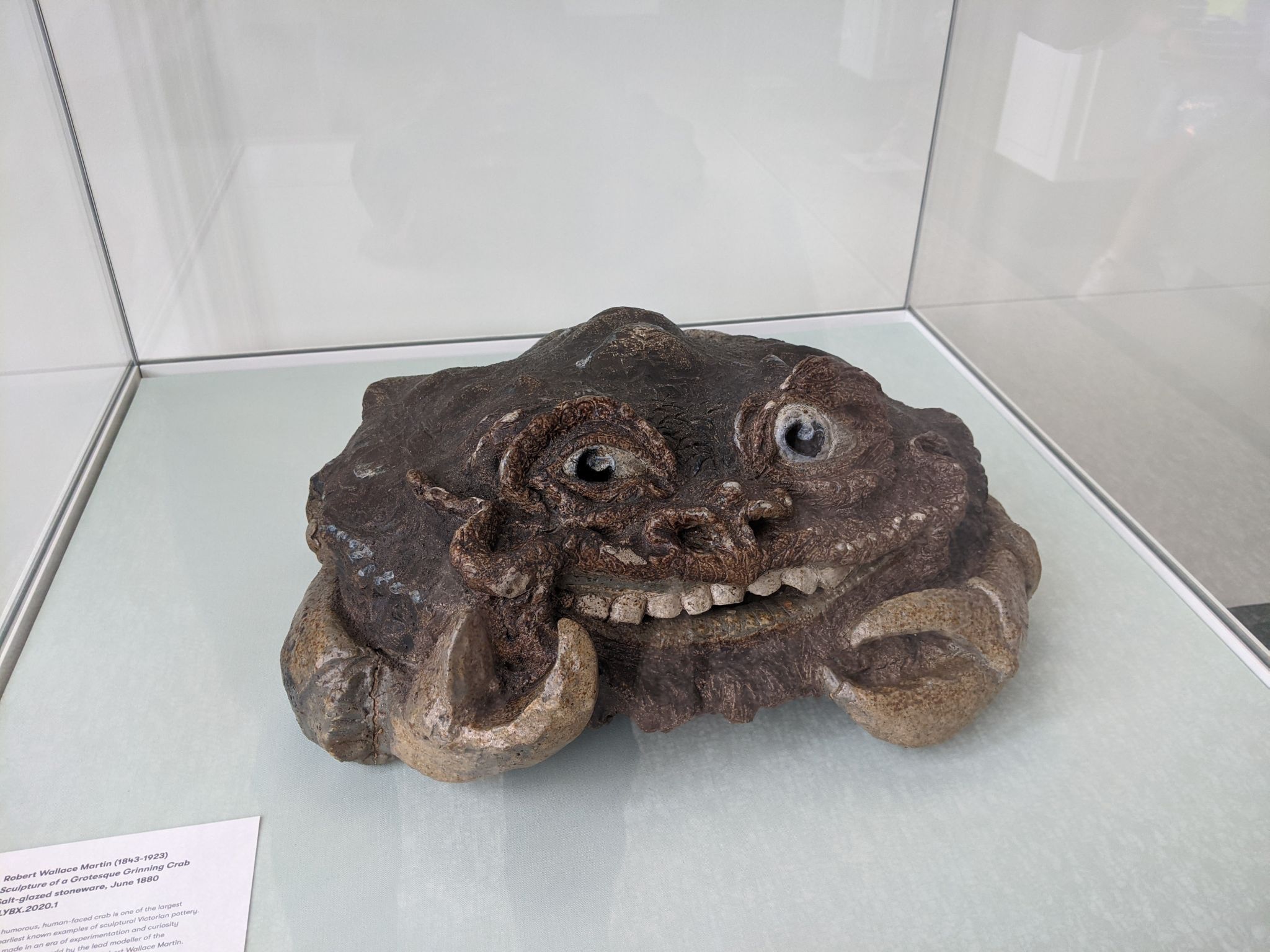
A happy ceramic crab I found at the museum.

Plan B: into town in search of an ATM (and lunch). The town is a stark and miserable contrast with Falmouth or Penryn, a closed post office and a food bank on the road into town the least despondent of the parade of empty, mossy shopfronts.** I found a caff full of glum pensioners for the most disappointing full English I’ve had in years (they also didn’t take card, but I’d found a cashpoint by then). Feeling committed to the china clay museum, I looked up the numbers of two minicab firms, but one didn’t answer and the other wouldn’t have a car free for an hour. I trudged back uphill to the station where there was at least a taxi rank; it was empty and the other firm still wasn’t answering. An announcement told me the next Plymouth train would arrive in two minutes, so I decided fate was telling me to give up on St Austell.

“The origin of this carved and painted wooden figure group remains a mystery. Its style suggests that it comes from the Congo, central Africa, and that it depicts a European missionary family. The woman whispers into her husband’s ear while slipping her hand into his pocket.”

The whole experience was frustrating on both a personal and a local government level: St Austell has sundry attractions (including the immensely popular Eden Project) right on its lap and could do very well as a rail gateway there, but the complete lack of options for anyone not in a car (not to mention GWR’s actively vicious policy towards bringing bikes on a train) completely scotches that. A Cornish colleague I was messaging reminded me that yes, Cornwall is by some metrics one of the most deprived areas in Europe, and this is what that looks like. I felt guilty for getting quite so annoyed, but also satisfied that I’d tried my best.  On to Plymouth.

“The Plan for Plymouth” detail at The Box museum. This isn’t how the final city looks – most of the gardens in the centres of blocks ended up as car parks. If you look closely you can just see the outline of the old city plan beneath it.

Plymouth’s appeal to me is twofold: it has an outstanding array of Victorian coastal fortresses, and its urban core is (still) a very interesting example of postwar British town planning. The “Plan for Plymouth” was drawn up while the Luftwaffe were still handling demolition duties in the town centre, in those heady, technocratic years when nobody had clocked that zoning doesn’t work or that unpainted raw concrete buildings look vile when they’re new and worsen with age, and it sketches out a plan of modern shopping precincts flanking broad boulevards, with a grand pedestrian avenue from the railway station down to the seafront. The production values are high (a lot of the fronts are actually proper stone rather than concrete) and the ambition prodigious. Unfortunately – like in those towns the other side of the Iron Curtain built to similar principles – the 2021 local economy and the council’s fountain budget are not quite up to the dreams of the designers, so there is something a little betting-shop desolate about the cyclopean boulevards and dry watercourses, even though there are some outstanding buildings left and the core of town is genuinely humming.

I found my guest house – the front lounge was all retro-American-diner fashion with red and white striped seating, boxes of lateral flow tests at reception and a big white dog with heterochromia chilling in the hallway – dropped off my stuff and set on out. Museums require bookings at the moment, and I’d got one at The Box, Plymouth’s city museum (in the Victorian-museum-with-a-bunch-of-modern-stuff-grafted-on fashion). Upon entering you are immediately greeted by a vast wall of Royal Navy ship’s badges, and the lower galleries did well both at explaining the centrality of the Navy dockyard to Plymouth’s entire existence and touching on the many lives affected by its rise, peak and gradual decline. An upper library level had archives and maps (including models of The Plan for Plymouth)  – but the whole place lacked any mention of the forts, the other big draw. Otherwise, great museum, would come again.

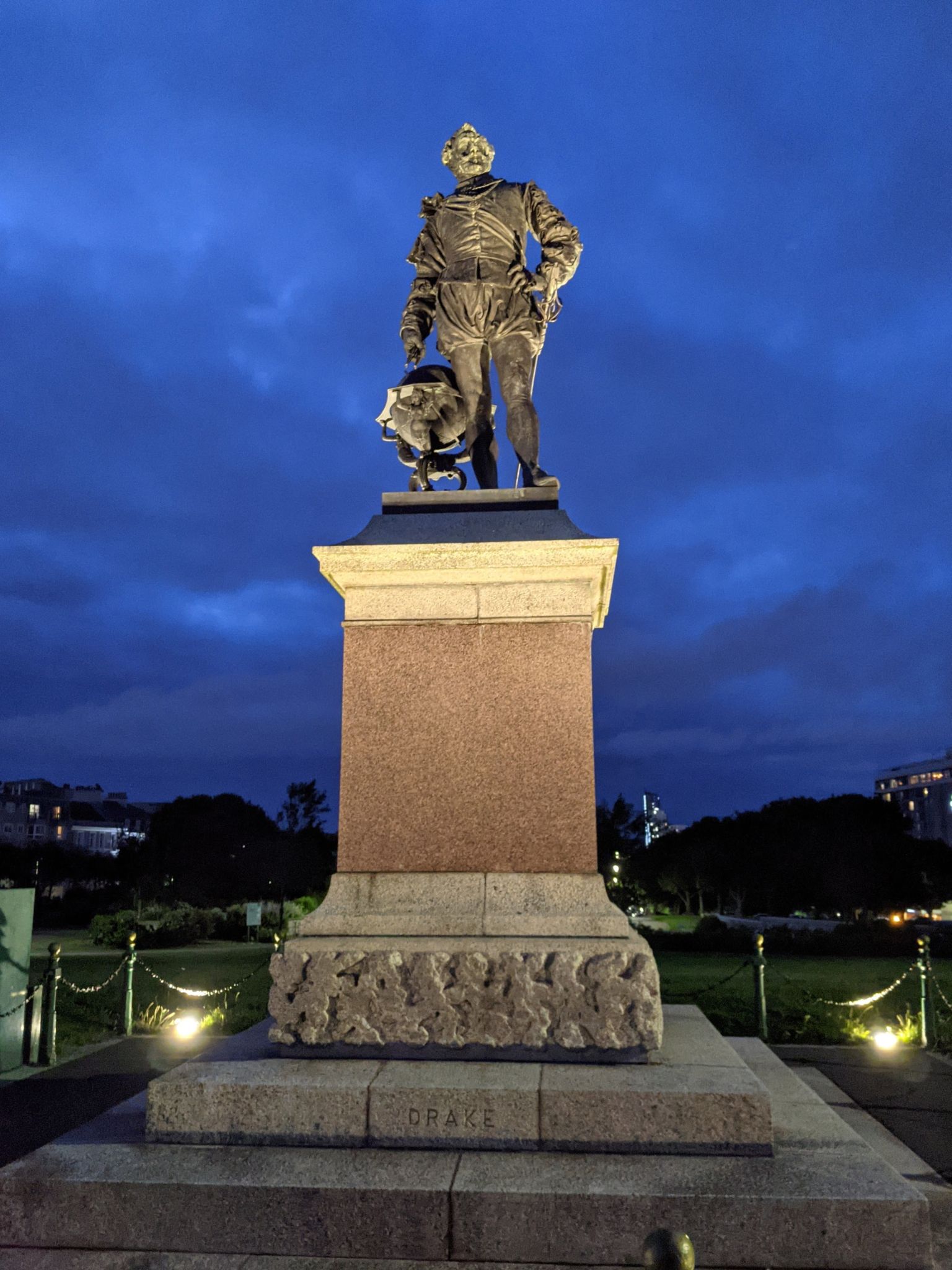
The “Barbican quarter” is that part of the waterfront old town that was spared from both Nazi bombs and British town planners, and was lively and active in a “virus, what virus?” way. One chippie had a terminal trying to sell me Bitcoin; I demurred and got a battered sausage. Sutton Pool, the oldest part of Plymouth, is now a mix of trendy Waterfront Development, antique party district, and – most surprisingly – actual real live fishing boats. Plaques commemorate the setting-off points of the Mayflower (and the first colony ship bound for New Zealand – hands up who knew it was called the Tory?) I didn’t see anything about the Armada – the English fleet that sailed out to defeat the Armada did so from Sutton – but given the general Pro-Drake vibe scattered around the town I’m sure it was there somewhere.***

I took the little yellow crossharbour ferry south to Mount Batten – it was not called the Spirit of Lord Louis, which I felt was a missed opportunity – for a wander in the hills, where polygonal forts are known to dwell. But in the interests of manageable post length, that’s a story for another day.
 

Out West 2021 

Out to Penryn – St Mawes and Falmouth – St Austell and PlymouthThe Forts of Staddon HeightsDrake’s Island and Saltash Totnes and Exeter

* OK, yeah, it’s a cab and obviously they don’t pay taxes, but I didn’t have any cash because it’s 2021 and one way or another I haven’t needed it since “coronavirus” first entered the wider public vocabulary.
** Every single town I visited this holiday had a barbershop with a big black window design showing some variant of a skull and crossed razors. I noticed the pattern here, although it was the third I’d seen.
*** Well. Weather defeated the Armada; the English acted as auxiliaries and support staff to the weather.

costa packet(boat)

The tides were not with the “Park & Float”, so I took the bus down from Penryn (clean, modern, on time, reasonably priced and everyone’s wearing a mask. Also – so far the single positive from this pandemic – everything takes contactless.) It passed the almost Genoese-looking church of St Mary the Immaculate and terminated at “The Moor”, Falmouth’s main square, all stout Victorian municipal architecture, cheery bunting and the cry of the gulls.

Finding a large pasty for breakfast was no trouble; determining which of the many different boats from the pier I should be taking to St Mawes only slightly more (another piergoer gave me a tab from his ticket which knocked 50p off the return.) The wind was up, blowing black Cornish flags hard across a low, leaden sky, and the “Duchess of Cornwall” was the first boat sailing that day. We threaded through the great flocks of parked yachts in the Carrick Roads, past a huge floating crane and the Argus.

I’ll post separately about St Mawes, that most beautiful and perfect of all Device Forts, but it was a cracking time, and a great pleasure to bring my model right up to the real thing.

Back in Falmouth (the ferry is very regular; children were crablining at the harbour) I refuelled and headed to the National Maritime Museum (Cornwall), a huge weathered-wood structure that recalled the Vasa’s housing in Stockholm. Rather than one galleon, it was absolutely chock full of smaller boats – everything from racing hydroplanes to ornate Maltese dghaisas, preserved fishing boats and a tiny dinghy called “Optimist”. The accompanying galleries deftly told stories of maritime history in general and Falmouth’s in particular. After the Restoration, the town picked up the status of Cornwall’s most important port from Penryn (much to Penryn’s dismay). It was known from late 17th to the early 19th century as the home of “packet ships”, fast mail boats carrying small high-value targets. Falmouth’s location as the first good harbour in the British Isles from the southwest, and a reliable place to send off fast boats rather than worry about the changeable winds up and down the Channel (not to mention hostile warships and pirates) brought it  considerable prosperity. In the 1830s, steamboats (and prolonged peace with France) destroyed these natural advantages and Falmouth’s port instead handled holidaymakers, Cornish emigrants to Australia and the New World, and warships, including acting as the setting-off point for the demented St Nazaire raid of 1942.

Leaving the museum, a stomp uphill took me into the sudden sunny calm of the west side of the peninsula, and along to Pendennis Castle. Pendennis is one of those marvellous old accretions of defensive architecture, with a Tudor core of similar size and vintage (though very different layout) to St Mawes sitting inside a giant 18th century bastion fort*, with Napoleonic barrack blocks, and that rare sight, Armstrong RMLs on classic looking fortress carriages.

The Tudor gun-fort itself has its original portcullis and the guide pointed out all the modern conveniences of value to the discerning mid-16th century king, like vents for powder smoke and internal loopholes for defence in depth. He also explained that the big square cutout below Henry VIII’s stone coat of arms was for the castle’s warden to put their own coat of arms in wood – a design feature I’d seen on loads of Device Forts but not made sense of before.

The fort’s perimeter has all sorts of wonderful pieces – a Victorian disappearing gun (the mounting wasn’t quite right but got the point across) and a fully equipped WW2 rangefinding station – the metal platforms for the depression rangefinders I’d seen in Gibraltar at last made sense. By using the rangefinder’s handles to aim its telescope at a target, the system would (through careful gearing) put a pointer on the exact location on a large map, giving you a ready-made firing solution. The Cornish translations of all the signs were charming – I now know how to say “dangerous explosives” and “little smasher” in Cornish.

I took a circuit of the great sloping walls and descended to the southernmost point to visit the blockhouse “Little Dennis”, another Henry VIII survivor and one of the best preserved of his blockhouses (less substantial than a proper castle, more permanent than an earthwork battery; think a sort of 16th century pillbox) which now mostly only exist as floor plans. I sat in the main gunport for a while, enjoying the view across the Carrick Roads and the crazed strata of volcanic rock full of tidepools. As I headed back up for a bus home, the clouds, sun and rain conspired for a moment to pick out the blockhouse in glorious golden with a flash of rainbow behind it.


* Falmouth is one of a tiny handful of places in the British Isles with a proper star fort (of which I’ve seen Tilbury, Landguard, Fort George, Berwick-upon-Tweed and the barely-recognisable shambles around Sheerness.)

Out West 2021 

Out to Penryn – St Mawes and Falmouth – St Austell and PlymouthThe Forts of Staddon HeightsDrake’s Island and Saltash Totnes and Exeter


Cornish Riviera Express

I never fail to be surprised, every time I go further west than Bristol, that this country is actually wide enough for a five hour train journey. The first segment is familiar, constantly saying hello to the Kennet & Avon canal, and town after town goes by, with clutches of clean redbrick new builds going up at their fringes, offensive in their shrunken living spaces and distended profit margins rather than their utter visual blandness. Entering Plymouth, a trio of arches across the river earned a curious google (the remains of an 18th century amphitheatre, apparently), and the citadels of the huge Royal Navy dockyard a murmured “I’ll see you in a few days”. West, the country gets more rugged and the crisp new Hitachi train feels more and more incongruous, a huge futuristic Brunswick-green missile nosing cautiously across buddleia-covered viaducts Brunel built. Dense, bosky tree cover, muddy rivers and tidal lagoons, and glimpses of the sea beyond.

At Truro I changed to a tiny little DMU, which took me down the old Cornwall Railway spur now branded the “Maritime Line” to Penryn (whose station, through some shenanigans with points, manages to get two platforms out of one platform). Obviously, it started to rain hard. I made my way to the campus jointly owned by Falmouth and Exeter universities, where I’d booked a room in halls for two nights. There were a striking number of Orthodox Jews around campus, and hand-lettered signage in Hebrew warning about the seagulls. I googled this, and apparently every year masses of Hasidim use the campus as a conference centre/summer camp together, brightening my evening with the peculiar spectacle of a number of serious, respectable-looking men in big cylindrical furry hats singing together in a slightly crummy student kitchen.

Penryn is a town of no great size but quite a bit of charm, the approach road tightly packed with little two-storey stone terraces with huge monolithic lintels of the local granite. It was an important port town in medieval and early modern times, when all an important port town needed was a warehouse, a quayside and a letter from the King; it lost that last privilege for picking the winning side in the Civil War, and was subsequently eclipsed by Falmouth, although the usual set of formidable Victorian public buildings on the high street show that it wasn’t left completely destitute. It doesn’t feel overly active (the intensifying rain probably had something to do with that), but it feels well-loved and well-preserved.

Continuing south, through a band of bleak marginal zone, all swishing roundabouts and fenced-off yards littered with the fibreglass corpses of yachts, I came to Falmouth proper. It’s much bigger and noticeably more touristy than Penryn, with an interminable (but still nice) high street of ethnic restaurants and characterful little tat shops – all stone dead at 1730, with the shop signs indicating that peak time was between 10am and 4pm. I explored the (closed) pier, the huge (closed) maritime museum complex, and across to thedockyards where at the huge technically-not-quite-a- hospital ship Argus was back from its trip to the Caribbean to support some Overseas Territories with the pandemic.

A little train took me back to Penryn and dinner at a chippie called Nemo’s (beef dripping chips! it’s been so long!) where I was told, if I fancied a friendly drink, to head down the road to “The Famous Barrel”. I ended up there, after some more wandering which took me around the site of Glasney College, namesake of my residence – Penryn had been an important site of Cornish and Catholic letters and learning until Henry VIII and the wars of religion rolled over both. I did get a sense later that some of these grievances are being dusted off again by people with Baner Peran bumper stickers.

It’s a fun little pub, with a magnificent collection of brass toasting forks (but a surprisingly limited cider selection), and as it got dark I myself chatting round a table with a group of locals (with leftover fishcakes and chips my new pal from Nemo’s brought), about the Device Forts and Brunel, about whale intelligence and dragonfly nymphs.  Sincere apologies for a) being from London and b) bringing the weather with me broke whatever ice was there (ok, they did say “chuck the emmet in the harbour”, but they didn’t actually do it). I stayed out late with one fantastic old bloke, whose dad had served on the Warspite and who had any number of lurid tales about working in a strip club in Soho in the sixties, and he gave me a lift back to the halls. The forecast for the next day was looking up.


Out West 2021 

Out to Penryn – St Mawes and Falmouth – St Austell and PlymouthThe Forts of Staddon HeightsDrake’s Island and Saltash Totnes and Exeter