St Austell was a comprehensive disappointment. I wanted to visit the Wheal Martyn china clay museum (which I’d been to as a wee un but have almost completely forgotten – vague memories of clay-white wooden leats in the turf and a huge iron power linkage up into the mines). Prior research indicated that there was no public transport to get to the museum (which is 45 minutes’ walk away along B roads with no pavements, uphill with my large backpack), so plan A had been to get a minicab from the station. Unfortunately, the minicab would not take card.*
Plan B: into town in search of an ATM (and lunch). The town is a stark and miserable contrast with Falmouth or Penryn, a closed post office and a food bank on the road into town the least despondent of the parade of empty, mossy shopfronts.** I found a caff full of glum pensioners for the most disappointing full English I’ve had in years (they also didn’t take card, but I’d found a cashpoint by then). Feeling committed to the china clay museum, I looked up the numbers of two minicab firms, but one didn’t answer and the other wouldn’t have a car free for an hour. I trudged back uphill to the station where there was at least a taxi rank; it was empty and the other firm still wasn’t answering. An announcement told me the next Plymouth train would arrive in two minutes, so I decided fate was telling me to give up on St Austell.

The whole experience was frustrating on both a personal and a local government level: St Austell has sundry attractions (including the immensely popular Eden Project) right on its lap and could do very well as a rail gateway there, but the complete lack of options for anyone not in a car (not to mention GWR’s actively vicious policy towards bringing bikes on a train) completely scotches that. A Cornish colleague I was messaging reminded me that yes, Cornwall is by some metrics one of the most deprived areas in Europe, and this is what that looks like. I felt guilty for getting quite so annoyed, but also satisfied that I’d tried my best. On to Plymouth.

Plymouth’s appeal to me is twofold: it has an outstanding array of Victorian coastal fortresses, and its urban core is (still) a very interesting example of postwar British town planning. The “Plan for Plymouth” was drawn up while the Luftwaffe were still handling demolition duties in the town centre, in those heady, technocratic years when nobody had clocked that zoning doesn’t work or that unpainted raw concrete buildings look vile when they’re new and worsen with age, and it sketches out a plan of modern shopping precincts flanking broad boulevards, with a grand pedestrian avenue from the railway station down to the seafront. The production values are high (a lot of the fronts are actually proper stone rather than concrete) and the ambition prodigious. Unfortunately – like in those towns the other side of the Iron Curtain built to similar principles – the 2021 local economy and the council’s fountain budget are not quite up to the dreams of the designers, so there is something a little betting-shop desolate about the cyclopean boulevards and dry watercourses, even though there are some outstanding buildings left and the core of town is genuinely humming.


I found my guest house – the front lounge was all retro-American-diner fashion with red and white striped seating, boxes of lateral flow tests at reception and a big white dog with heterochromia chilling in the hallway – dropped off my stuff and set on out. Museums require bookings at the moment, and I’d got one at The Box, Plymouth’s city museum (in the Victorian-museum-with-a-bunch-of-modern-stuff-grafted-on fashion). Upon entering you are immediately greeted by a vast wall of Royal Navy ship’s badges, and the lower galleries did well both at explaining the centrality of the Navy dockyard to Plymouth’s entire existence and touching on the many lives affected by its rise, peak and gradual decline. An upper library level had archives and maps (including models of The Plan for Plymouth) – but the whole place lacked any mention of the forts, the other big draw. Otherwise, great museum, would come again.


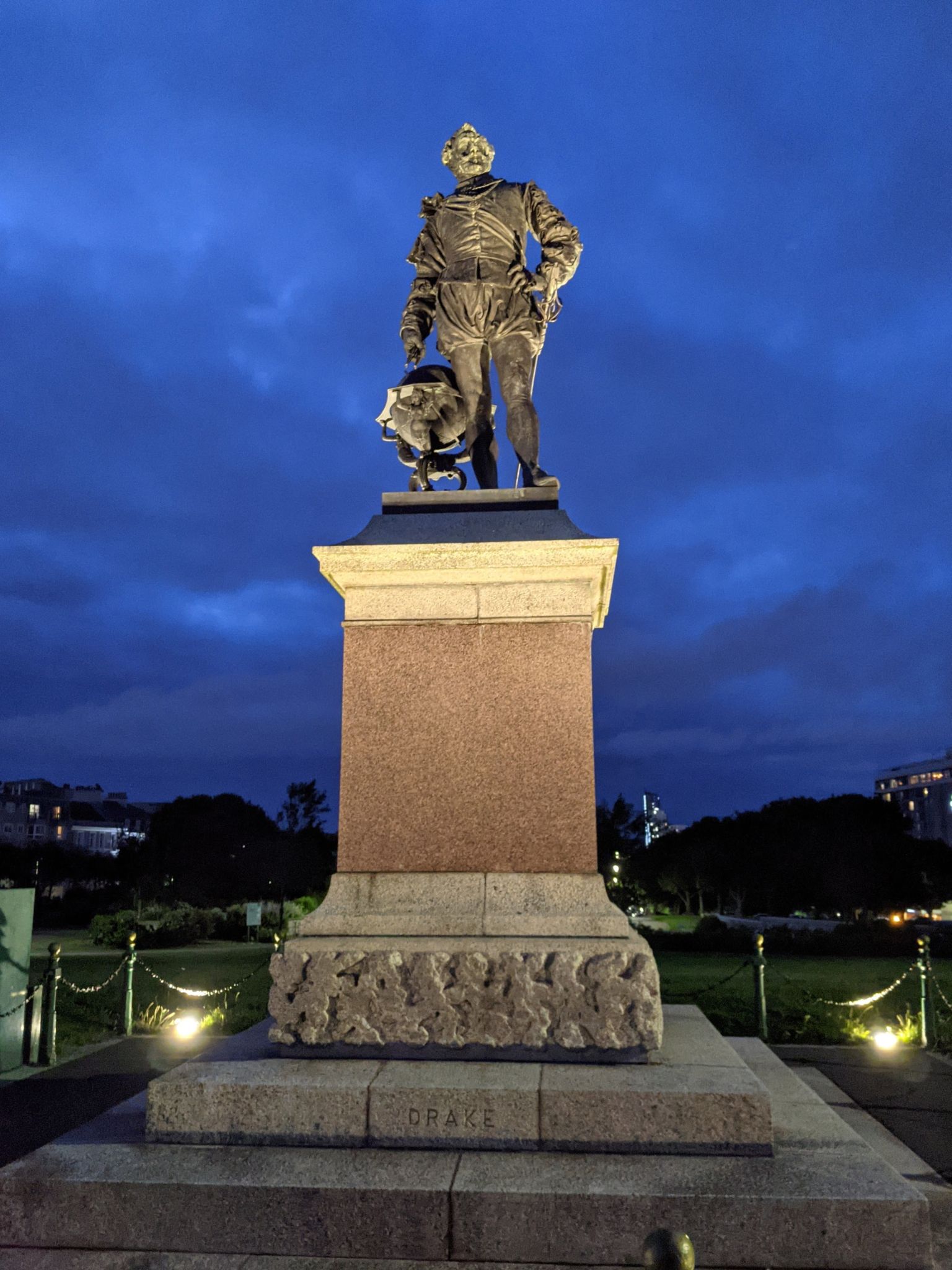
The “Barbican quarter” is that part of the waterfront old town that was spared from both Nazi bombs and British town planners, and was lively and active in a “virus, what virus?” way. One chippie had a terminal trying to sell me Bitcoin; I demurred and got a battered sausage. Sutton Pool, the oldest part of Plymouth, is now a mix of trendy Waterfront Development, antique party district, and – most surprisingly – actual real live fishing boats. Plaques commemorate the setting-off points of the Mayflower (and the first colony ship bound for New Zealand – hands up who knew it was called the Tory?) I didn’t see anything about the Armada – the English fleet that sailed out to defeat the Armada did so from Sutton – but given the general Pro-Drake vibe scattered around the town I’m sure it was there somewhere.***


I took the little yellow crossharbour ferry south to Mount Batten – it was not called the Spirit of Lord Louis, which I felt was a missed opportunity – for a wander in the hills, where polygonal forts are known to dwell. But in the interests of manageable post length, that’s a story for another day.
Out to Penryn – St Mawes and Falmouth – St Austell and Plymouth – The Forts of Staddon Heights – Drake’s Island and Saltash – Totnes and Exeter
* OK, yeah, it’s a cab and obviously they don’t pay taxes, but I didn’t have any cash because it’s 2021 and one way or another I haven’t needed it since “coronavirus” first entered the wider public vocabulary.
** Every single town I visited this holiday had a barbershop with a big black window design showing some variant of a skull and crossed razors. I noticed the pattern here, although it was the third I’d seen.
*** Well. Weather defeated the Armada; the English acted as auxiliaries and support staff to the weather.
 underneath the open sky