It’s only coming back to this for travelblogging purposes that I realised what an eerie retread of my movements on May 8th 2018 it was – exactly four years and one day later. But, and here’s the critical difference, the panorama was open.


May 9th is Victory Day in Russia and the old Soviet Union (Poland officially changed their observance to the Western VE day, 8 May, in the mid-2010s), the day a lot of slightly-below-top-tier military commentators were worried that Putin was going to declare unlimited war in Ukraine. So it was in an appropriate spirit of feverish Russophobia that we went to the Racławice Panorama. As a sort of nationalistic mass-market populist war-glorification, the closest modern analogue to a 19th century panorama is probably a really nationalistic history-lite blockbuster war film, and the bogglingly huge canvas is, in its own way, as technically and visually impressive. We accidentally timed it perfectly, getting a slot just before a huge noisy school group, and got the rotunda half to ourselves. It evokes, as much as is possible in 1700 square metres of canvas, a blazing, blood-slick day viewed from the heart of a colossal mess, cleverly throwing in some props and ground detail in the foreground (as the 1453 panorama in Istanbul did) to make it all feel much more tangible. An audio guide points out the salient details: Kościuszko with his little upturned nose visible urging on a crowd of patriotic peasants as they charge at Russian artillery batteries with modified scythes, the caricature-Asiatic faces of Cossacks as they turn to spear a proud moustachioed Polish cavalryman, a tableau of a peasant woman kneeling by her shot husband and blasted cottage, peasant-soldiers in a nearby column struck by horror and regret but sternly pressing on with their duty. It’s incredible propaganda. Poland won the battle of Racławice, but the uprising failed and the country was brutally partitioned (again) and disappeared from the map for over a century. But that just makes it an even more excellent piece of propaganda; in the business of myth-making, victory is nothing compared to martyrdom.


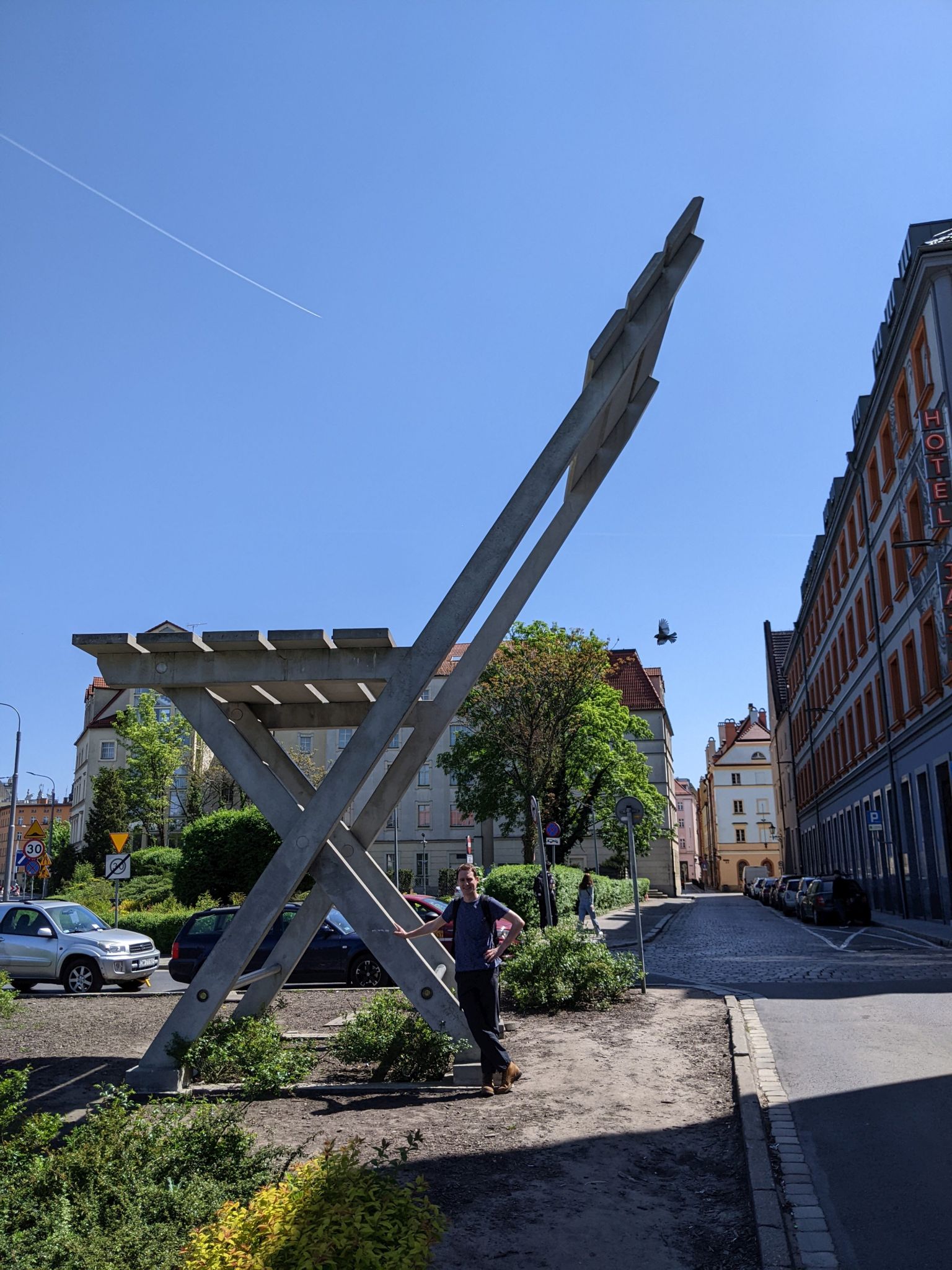
We returned along the lovely waterfront, enjoying a few Wroclaw-specific delights: a chap dressed as a monk who was probably actually a monk, the incredible Max Berg market hall filled with the smell of flowers and the sound of sparrows; the fun old hydropower plant (also a Max Berg) and a weirdly enormous chair.
Gosia arrived on the red-eye from Lublin and we had a vegan lunch out of the aching sun of the town square, chilled in our Airbnb a spell and then went up the tower of the Garrison Church – the church itself was closed for cleaning four years ago, and still was today. How long does it take? The green bridge to Ostrow Tumski has been cleared of those obnoxious love-locks and sports an explanatory plaque and a new padlock gnome. Animated by a weird nostalgia, we explored the churches, and went on a turn around the delights of the Centennial Hall and the Japanese garden which, yes, deja vu.


YES. GOOD.


On Wednesday, we left our bags at a hotel near the station and headed back into town for breakfast, turning down the Selfie Café for the longer menus and less obnoxious meme-ness of its next-door neighbour. Nearby, the magnificent university building (built originally for Jesuits – a promising indicator of the kind of bling meant to overawe the soul and burn out the optic nerve) promised limitless wonders, including some of the grandest baroque interiors in Poland and objects collected over three centuries as a seat of learning and intellect. Unfortunately, this would have to wait for another visit (probably around May 8-9), as unlike all the other museums the university museum is closed on a Wednesday.


So on to the military museum, which was just as good as last time, and the archaeological museum, home to some very striking bits (a reconstructed bloomery, a nest of bronze sickles, some really stunning axeheads) in among the usual collection of fairly anonymous bones, rocks and pot shards (which could have had better English signage – thank goodness for Gosia). In search of a late lunch, we stopped at the first open place, which turned out to be “El Cubano”, and was incredibly good. And then – shocker – the Garrison Church was actually open, and we could visit! Even better, we learned that the church very recently had its magnificent 18th century organ (a lucky survivor of the war destroyed in a fire in the 1970s. Better still, a skilled organist was putting the glorious thing through its paces.
The church is home to an astonishing set of commemorative masterpieces: plenty of Renaissance gold-and-alabaster memorials have somehow survived, but the stained glass is all postwar, and exquisitely expresses all the shades and colours of modern pain. A very Polish sense of remembrance was in evidence, sorrow leavened with bitterness, and an instruction to future generations: do not forget what was done to us. The anchor of the Armia Krajowa, a Katyn memorial, a chapel to Rafał Kalinowski, the patron saint of three centuries of Poles deported to labour camps in Siberia.


Out in the blinding contrast of the sunlight again, perhaps we could finally see the Ratusz? No – a sign at the door saying “sorry, ratusz closed”, and fluent English bemusement at the nearby tourist office (“it should be open today. I wonder why it isn’t?”) We were directed instead to the city museum, and warned by the that it would be something of a hurry in our available hour. I could have spent five hours there but one was still a wondrous experience, opening very strong with a giant, upsettingly pornographic meditation on Soviet trauma by Franciszek Starowieyski.


Going through the city, it struck me how completely and comfortably Polish Wrocław appears to have settled on the bones of German Breslau, and (in significant contrast to both Krakow and Gdansk) how little of the city’s very German – but also very lovely – 19th and early 20th century architectural heritage has been vandalised or replaced. The museum, likewise, was very comfortable with the city’s fascinatingly polyglot and many-mastered history: big-chinned Habsburgs and severe Prussians share wall space easily with Kosciuszko. As we get into the late nineteenth century, past demented wizard-staff-esque faculty sceptres and the woodblock prints of the university, the city’s industrial and intellectual pride are fully on display; pre-war Breslau exemplified a dynamic, diverse, prosperous central Europe of dozens of good-sized cities connected with each other, each doing its own thing just a little bit better than anywhere else in the world, until that world was annihilated for no reason by the Great War. Breslau as an entity staggers on for a bit in its artefacts (a replica of one of the famous Linke-Hofmann-Werke tram factory’s products, a photo of a Zeppelin over the centennial hall) but with the inevitable looming hideousness as you approach the 1940s in any museum on mainland Europe. In one case, a photo of a magnificent belle-epoque synagogue; in the next, the hazy outline of its burning dome, the morning after Kristallnacht.


Poland 2022
The Lost Wawel – Barbican, Celestat, Auschwitz – From Wieliczka to Wrocław – Racławice, Ostrow Tumski, Museums of Wrocław – Książ Castle – Gdansk town hall, Westerplatte – Malbork


 underneath the open sky