
After Auschwitz, we returned to Krakow (the evening bus would have taken hours upon hours, so we took a taxi, which gouged us horrendously) and walked Kazimierz, the old Jewish district, then blotted out all ability to feel with a huge Georgian dinner complete with a carafe of the house Saperavi. We rose early the next day, and the 304 bus whisked us to Krakow’s other favourite out-of-town ttraction, the Wieliczka salt mines.


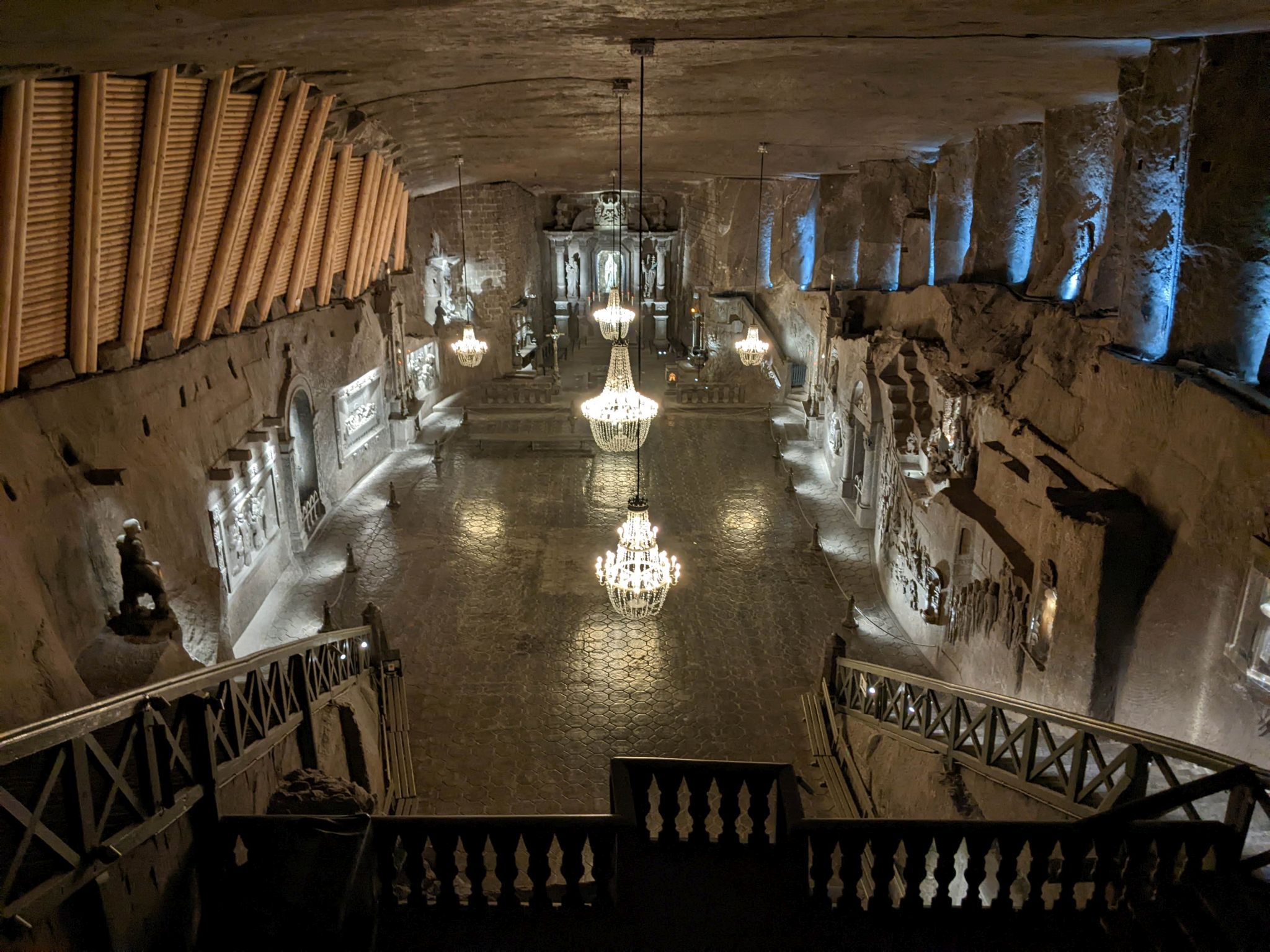
The experience was quite unlike the other Habsburgesque salt mine experience I’ve had, Turda. Wieliczka has been a tourist attraction since Copernicus (represented in a stylised carving from two huge blocks of salt) visited, and the atmosphere is quite different: past the initial hundred metres of descent, everything is so well-paved and decently-lit that at times you could be in any heritage centre, except every so often you glance down a side shaft and see rusty little railways running down a brine-streaked passage half a kilometre long. The tour gradually amps up the grandeur, starting with medium-sized chambers featuring the usual (slightly salty) mannequins and miniatures of minework life, working up through winding passages to the odd vast barely-lit cave, and culminating in a series of incredible cathedral-like spaces, thousands of trees’ worth of beams supporting each other in bizarre sunken megastructures. There’s even a break point where you can stave off dehydration at a café and peruse a gift shop filled with exciting salt-themed souvenirs, before you move on to a literally cathedral-like space lit by (salt crystal) chandeliers, with (salt) carvings directly into the (salt) walls showing scenes from the life of (salt) Christ, and a big freestanding Jan Pawel (sculpted, shockingly, from salt).


In the final stage, past the second gift shop (in case you regretted not buying any salt the first time) there was meant to be a museum of mine equipment, but the attendant with their salt-pick-buttoned tunic told us we would have to wait an hour, and so we headed back through another 800m of tunnels to a lift. Above ground was a third gift shop with the exact same salty souvenirs. Somehow, we resisted.

The bus (its info screen striped blue and yellow, with Ukrainian translations of important words) took us back to Krakow where we almost immediately bumped into two older men in incredible gold-embroidered red velvet outfits, including capes, one also wearing a crown and carefully carrying a huge two-handed sword by the blade. As we jostled past a seemingly endless stream of religious banners, nuns and little old ladies in peasant costume carrying burnished holy icons, some hurried googling indicated that this was in fact the Procession of St Stanisław. The Fowler King brushed past, complete with silver cock.


Somewhat dazed by the bright light and the sight of a troupe of Polish morris dancers (?!) we found a lovely indie pizza place – quite a Bristol feeling – in Kazimierz and recharged us ahead of the Remu synagogue. We paid our zlotys, put on the skullcaps offered, and got the wonderful feeling common to eastern European synagogues of an artistic and symbolic tradition at least as venerable and ornate as any Christian church, using the same materials and technical techniques but a completely different set of iconography and symbolic building-blocks. In the graveyard, with pebbles set on the metal rain-roofs of its curious-looking gravestones, a bearded man in a white shirtwaist and black trousers cleared the gravel and burnt kvitprayer sheets (check if correct term) from a grave whose Hebrew name I couldn’t read. A chilling moment as we came out: when the Nazis took over, they desecrated the gravestones and took many away to use as paving slabs. Those which can be recovered have been, but fragments of others have been mortared together into a wall of shattered names.


Back to Wawel, in a burst of rain, to see the cathedral, which was just as good as previously but this time included a turn up the tower to see the gigantic bells, and the excitingly death-metal stylings of the Szafraniec chapel. We just had time to go back to the city museum for a coffee, a cake and a renewed assault on the second floor gallery’s Decorative Art exhibition. It was the expected medley of virtuoso woodcarving, giant church keys, ceramics, tapestry and Misc Cool Stuff (a double-sided violin in the musical instruments section caused incredible ergonomic confusion). Even the Meissen porcelain, usually so reminiscent of blank-faced, nightmare-inducing shepherdesses on elderly relatives’ shelves, was chosen for individuality and craftsmanship and hardly smashworthy at all. The collection of Empire furniture was particularly fine, as was an enjoyably bonkers neo-baroque chess set themed after Sobieski’s victory over the Ottomans (one of the Turkish knights has fallen off his horse).


Polish railways still have compartments (at least in first class, which I’d chosen because it was still incredibly cheap and I don’t think I’ve bought a first class ticket for myself anywhere). Ours contained four youngish Poles in headphones; after hearing an altercation in English a guard arrived, checked our tickets and ID, removed one of the Poles and informed us there was no restaurant car. At low speeds the train juddered and vibrated in odd ways, but the harmonics changed as we accelerated out of town and settled into a rhythm. At the edge of Krakow, a girl stood by the track and lifted the hem of her white dress in front of a gaggle of photographers.


Having relied on the restaurant car, we were starving, and upon our arrival in Wroclaw stopped at the first decent-looking kebab shop on the walk in to our airbnb. “Tomorrow is big day for Russia, there will be big bomb”, one of the proprietors fretted to a colleague.
Poland 2022
The Lost Wawel – Barbican, Celestat, Auschwitz – From Wieliczka to Wrocław – Racławice, Ostrow Tumski – Książ Castle – Museums of Wrocław – Gdansk town hall, Westerplatte – Malbork
 underneath the open sky
Baffled by the pushmepullyou violin. Was there any explanation why it was made, how you could play it?