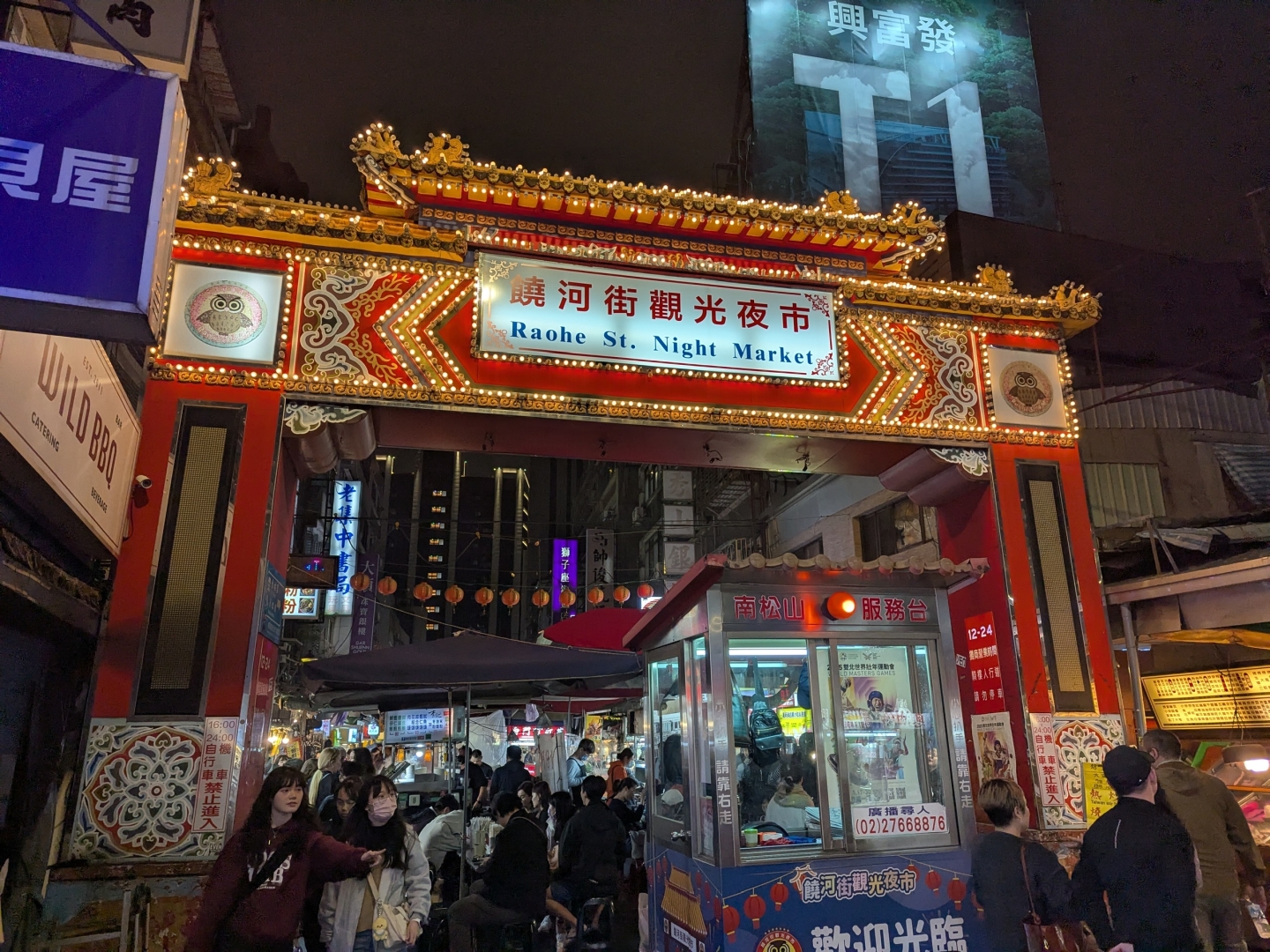
 The first impression Taiwan gave was of compactness: a small amount of heavily exploited flatland, a lot of unhelpfully steep hills, and a buildable grey-zone between them full of buildings and land reshaped to accommodate each other. Layers of road and rail viaducts crossed each other; very seriously embanked rivers and mossy, steep-walled storm drains suggested everything might get very wet very quickly. The smooth, swift metro dropped us off in the Ximending district, where we found our hotel, past shopfronts crammed with computer valves and maneki-neko, and headed, jetlag-addled but famished, for the Raohe Street Night Market.


Night markets are an excellent Taiwanese food tradition. The term “street food” has been abused into meaninglessness in London but these dense rows of stalls, all intently creating and serving up small portions of interestingly delicious things, are reclaiming it. We munched our way through black pepper and crab buns, sliced black pork sausage, crispy ribs, sweet crepe full of grated peanuts, ice cream and fresh coriander, iced green tea with lychee, and what seemed like an entire chicken formed into a colossal nugget. And, most importantly, keeping up with my “kebab in every country” tradition, a shawarma from the Dubai Shawarma stand.


In between we delighted in the sights and smells of Raohe: squid and stinky tofu and unfortunately translated signs, deep alleys of tat shop and gacha machines and fairground sideshow and cutesy soft toys reaching off from the band of shops. Fran honoured her own “inadvisable quantities of dessert” tradition by buying about a kilo of custard-apple. Ambling to the Rainbow Bridge over the nearby Keelung River, we saw the huge glowing crown of Taipei 101 peek out from the low clouds. We had not, in truth, spent much money at all.
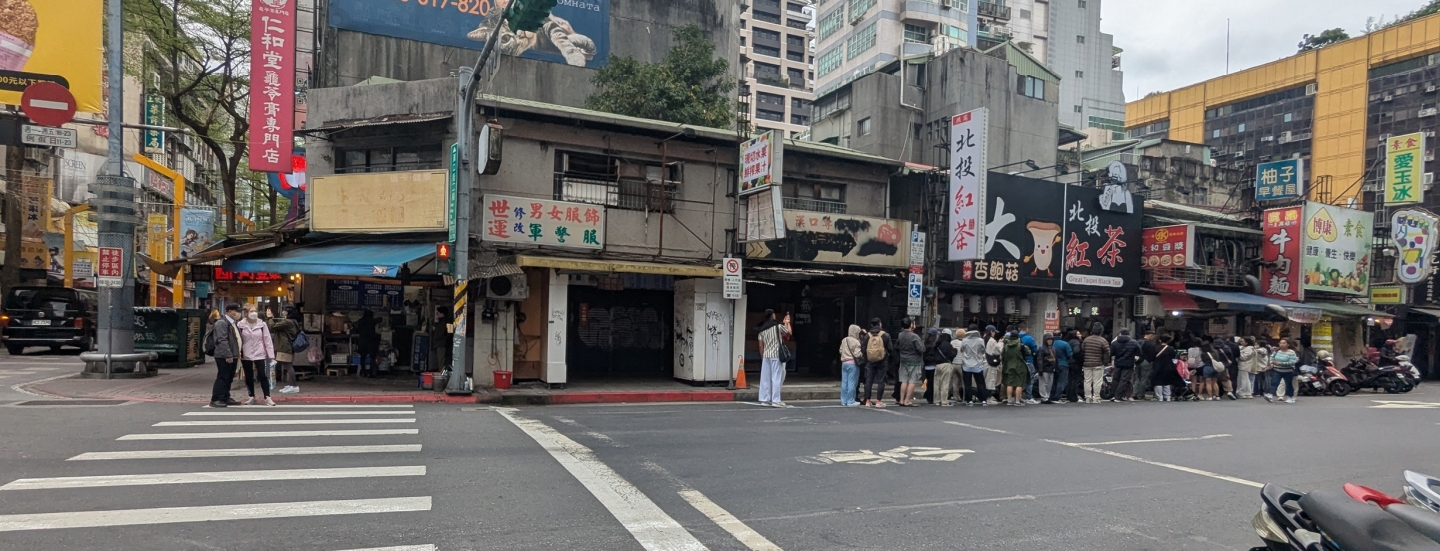
The morning brought two more Taiwanese food traditions: breakfast shops, and individual food joints becoming so trendy they get mile-long queues outside them. Guided by the excellent blog of Nick Kembel,* we headed to a street in Ximending featuring both, and went for an untrendy option. The old lady who runs it (initially grouchy, but warmed up to Fran’s attempted Chinese) gave us a laminated menu and a pen to order, and then pottered around an array of cooking and storage devices bursting out of her shopfront onto the pavement. I had a tuna, egg and sticky rice roll, Fran a bacon and egg roll, and we shared a pork floss (sort of powdered jerky) and scallion pancake along with soy-milk tea. We munched at a nearby bench near flags arguing for Taiwanese independence; Taipei is very clean and tidy, but it’s difficult finding bins. The main rail station (past a handsome old Japanese-era central post office) is an astonishing building, a colossal terracotta sweep of Chinese roof over a multi-layer warren of tracks and tunnels. After topping up our Easycards (Oyster, but for public transport and convenience shops for the entire country) we got the local commuter train to Ruifang, in the northeast of the island.


The urban landscape showed a lot of imaginative and hard-fought compromises with topography, moisture, earthquakes and sheer population density. The default building shape is a box (with an extra box on top as a machinery room for buildings tall enough to need lifts), but the positioning and exterior decor of the boxes are charmingly varied. The go-to exterior finish is tiles, the go-to street is very narrow or raised up on pylons, and everywhere too challenging to build on is lush vegetation or dense, damp moss. Everything is packed-in and competing – politely, but intensely – for space. A speckly rain intensified against the train.


The pavements are one such compromise: the buildings are stepped back from the street at ground level, creating rainproof covered pavements lined with shopfronts (mostly colonised by merchandise and mopeds) and maximising floorspace above. The bus from Ruifang up to Jiufen was on time and not rammed; the crowded mountainous switchback would have been terrifying in a less health-and-safety conscious culture (Ukraine, say, or Greece) but in Taiwan the roads and drains are good and the bus driver is probably terribly well trained.


Jiufen’s main attraction is its Old Street, a long, narrow alley densely lined with stalls – sausages, squid, balls of things, stinky tofu stands apparent to nose long before eye, endless interesting souvenirs and alien groceries. We bought some bubble tea (presented with far less theatre than the strange process of wiggling and stamping machines boba shops go through back home; ice and pearls in, tea in, lid on, one shake, straw in, done) and admired a limited but atmospheric viewpoint in the increasingly ferocious rain. On the way back down, we detoured into a traditional little wooden teahouse for some very old-school tea and biscuits (lots of theatre this time, water going from the huge pot on its burner, into the tiny teapot, through a strainer into a jug and into the little cups) and, last of all, saw a lovingly restored 1930s theatre (erm. No tea? But it did have the 1930s Taiwan hill town version of annoying adverts for new movies: a poster dangling from a stick carried by two children, and a speaking trumpet so they could caterwaul about it.) Outside it was a vending machine for fortunes – self-service 10 NTD, but “free for the miserable.”
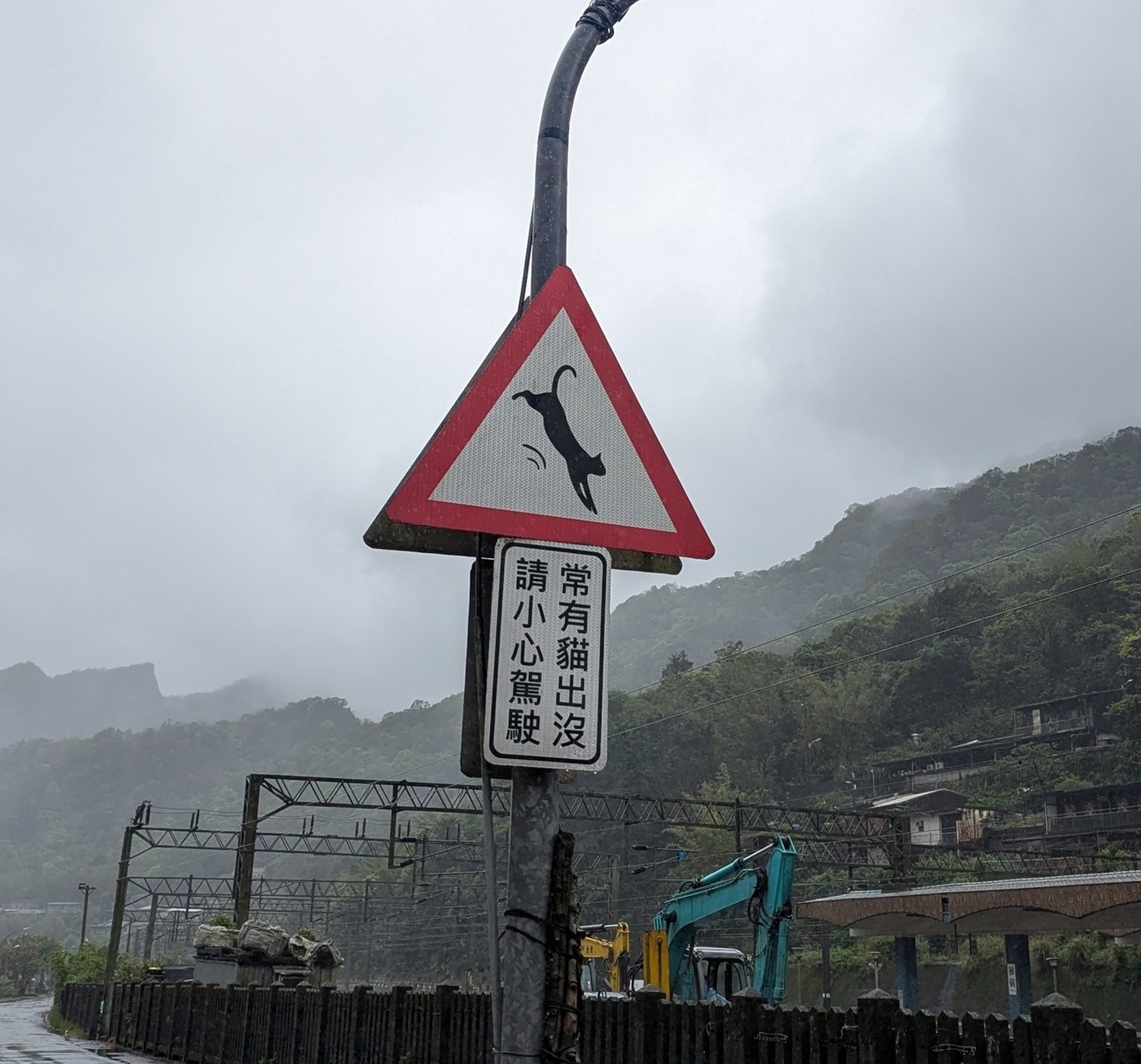
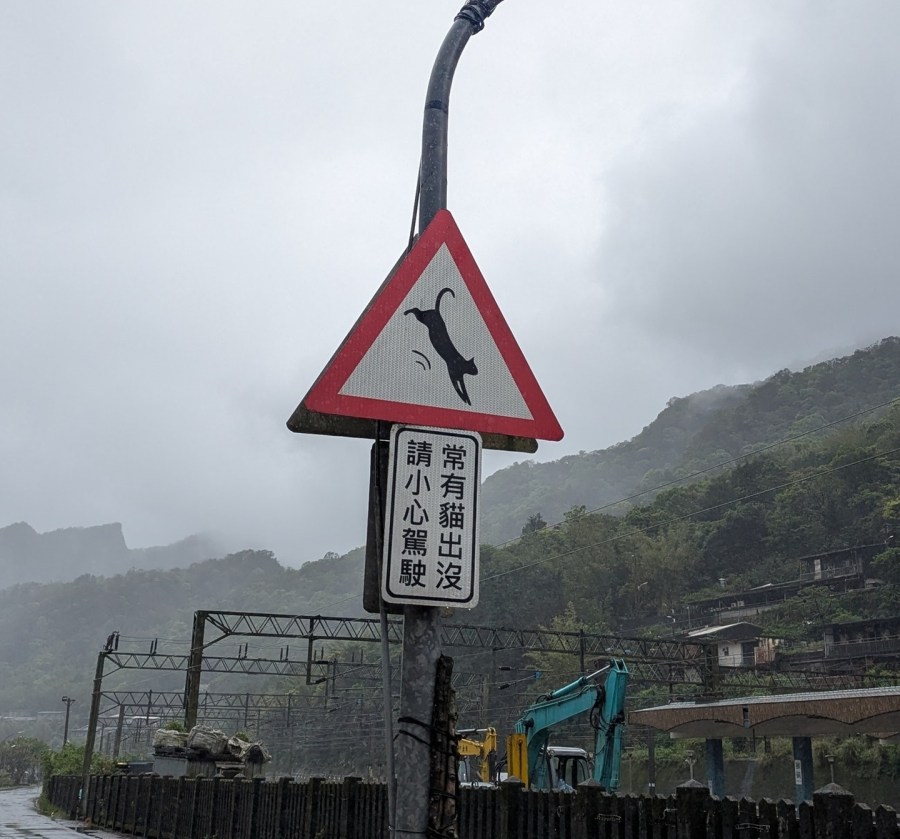
Back down the hill to a bus and one stop on the train to Houtong, whose twin attractions are a) abandoned coal mines and b) bonkers numbers of cats. One follows the other: in the late 2000s, faced with the decline of the industry and thus the town, some locals set up a sanctuary for abandoned cats which became a very popular attraction for day trippers from Taipei. The place now has cat-themed art everywhere, a narrow hillside street of cat cafes, several cat-related gift shops, a custom cat-friendly bridge crossing the railway lines and, of course, a fair number of cats.** It was raining fairly heavily at this point, so they were mostly sheltering. We greeted several cats, ate our cat-shaped cream puff and cat-decorated tiramisu, drank a mocha smoothie with a cream cat in it, and headed off.


Over the cat bridge and up the river, various little old remains of Japanese-built mining infrastructure have now been refurbished into a set of small museums in a charming and fairly high-budget way. The Taiwanese labour ministry apparently sponsors such places, provides English signage and supports retired miners to work there. An old narrow-gauge train depot held a tiny locomotive, and an exhibition spread between the old miners’ shower blocks and a separate minehead building covered props, coal, geology, and a fun history of the mines and their local culture (the usual refrains of blacklung, gelignite, company stores, dignity in labour and foreign exploitation). The latter we were shown around by a young man with good English and got interestingly technical (fortunately I already knew what Davy lamps and caisson disease were so could follow the more involved stuff) and lurid (apparently before 1960s laws banned women from working underground, people were basically giving birth at the coalface.)


We crossed the river and wandered downstream a bit (a cat came out of its shelter to cuddle Fran), thinking we had plenty of time for the final attraction (a museum in the old coal-washing building which closed at 18:00) and were stopped absolutely dead by the sight of a tiny mine train crossing the road. We immediately paid our 150NTD (about £3) each for a ride and found ourselves the only two passengers on a tiny electric wagon, driven along by a charming old bloke who gave lots of commentary through Google Translate. We’d expected it to just be a little jaunt through a tunnel and were very pleasantly surprised to be let off in a mad paradise of antique mining machinery and encouraged to play around with (actual! working!) pump wagons, pneumatic drills and a little excavator train. (“This machine was built in Japan before the war. There are only two left.” [switches it on] “Have fun!”) I had a great time and revised my opinions of Taiwan vis-a-vis health and safety.


All of this meant that we arrived four minutes too late for last entrance to the coal washing museum (although an American student told us on the train back it was “fine”, so we didn’t feel too bad, and the Vision Hall next door had a great little miniature showing what we were missing.) We got a train back to Ruifeng, a night bus to the hotel, and then for dinner to another recommendation (this time from Faine Greenwood) of Lao Shandong, a basement beef noodle place in Ximending. It was all a very good start to the holiday.
Taiwan 2025
Jiufen and Houtong / Taipei Museums / Taroko Gorge / National Palace, Lungshan Temple / A Brief Interlude / CKS Memorial and Maokong / Dihua Street, Taipei 101 / Anping District and Forts of Tainan / Tainan History / Fenqihu / Alishan
* Kembel’s blog “Taiwan Obsessed” is a genuinely excellent and comprehensive resource to basically the whole island, which we relied on a lot.
** Numbers have apparently come down in recent years; the sanctuary cats are all neutered, so numbers will decline naturally unless fresh sources are found.
 underneath the open sky
A fascinating read. Thank you. Pictures disappointing (even allowing for the weather…) when I opened the email – but good in the blog.
You are very good at holidays!