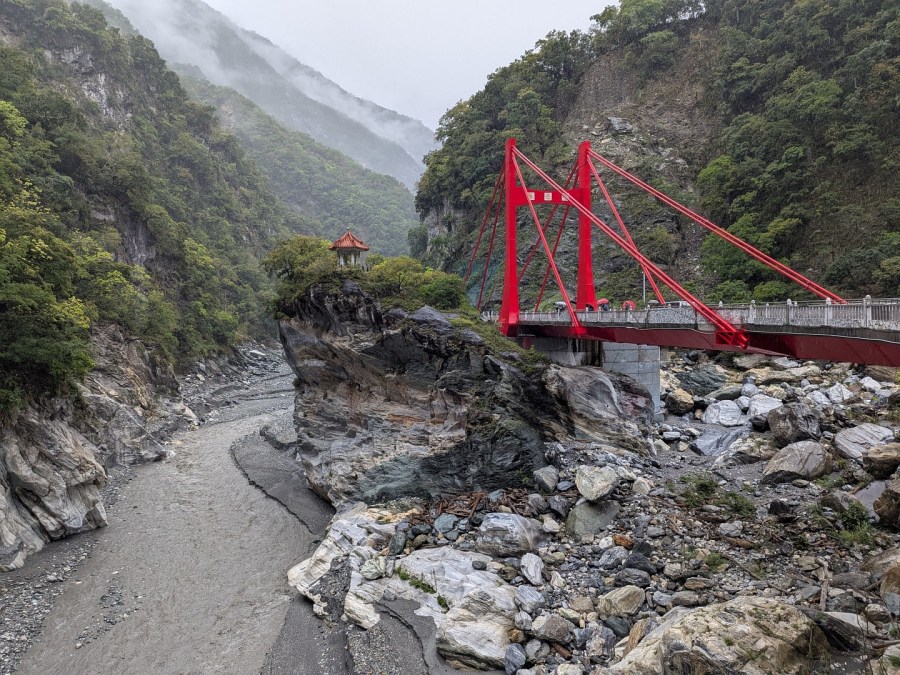
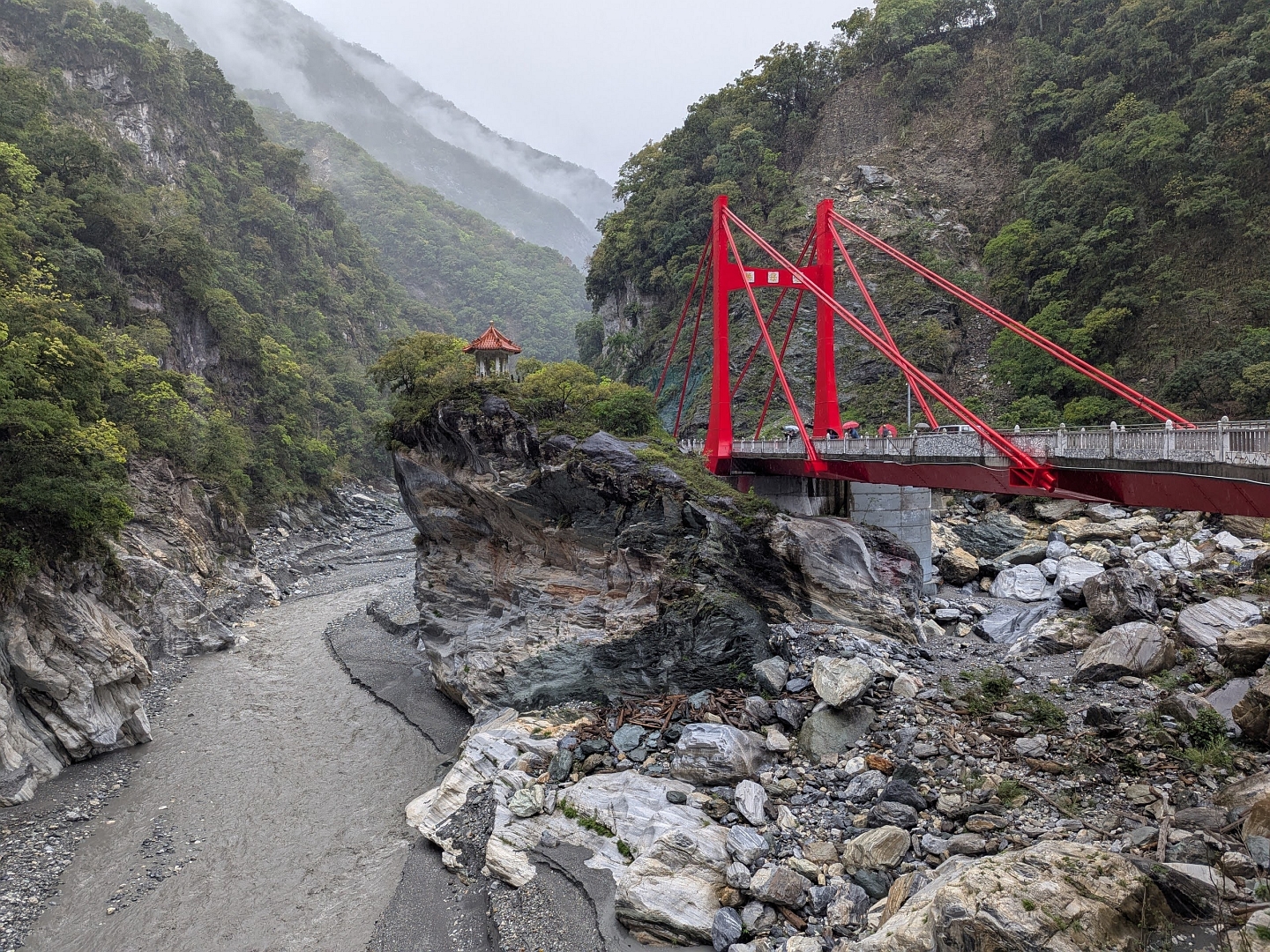
Taroko Gorge’s depictions in the National Museum raised our expectations; the knowledge that it had been devastated by an earthquake in 2024 tempered them. Our tour booking* was caveated with warnings that a) many attractive parts were still in ruins, and b) if it rained too heavily they’d have to cancel for fear of landslips. It was raining quite heavily as we ate our little packed breakfast from the B&B, but the minivan arrived with four fellow travellers and our guide (an unusually tall Taiwanese bloke with a camo jacket and a deep voice) told us that there was still a chance of cancelling the gorge itself but that he’d do his best to make sure the day was interesting.


First on the itinerary was the Sakul Trail, a well-made path (the government pays for them, apparently) into the foothills; we saw monkeys trooping through the treetops, and near the waterfall at the far end of the path, ambitious spiders were sketching out enormous cobwebs. The return path was much steeper, talking about Sun Yat-Sen (every Zhongshan Road in Taiwan is named after him) and looking down on the apron of the huge mostly-underground Hualien fighter base, where F-16s thundered, but nobody was particularly out of puff by the return to the van; if this was a fitness test for the gorge, we’d all passed it.


Back into the van and to the Taroko Gorge itself, which is genuinely worthy of the name (and the paintings). The Liwu River, solid opaque grey with sediment, has been carving a steep-sided notch into the marble mountains for tens of millions of years. In its broad lower reaches, little red temples nestle among tributary valleys or perch on crags; further up, it narrows significantly and much of the time the roadway is cut through the rock itself, sometimes through orange-lit modern tunnels, sometimes older concrete galleries, sometimes simply overhung terraces hacked into the cliff face. The current route of the road is clearly the latest of many iterations, with older bridges and oxbows of abandoned road visible (some collapsed). Earthquake damage was everywhere: huge boulders sitting where they shouldn’t, torn and bent metal safety guards, piles of debris bulldozed into corners, and almost every little pagoda-like rest point and rope bridge was cordoned off. The tunnels are all perfectly intact; they are obviously very well built. “A lot of people from Taipei only have small hearts, they only know how to drive the freeway from parking to parking,” said our guide conversationally, overtaking another car through a tunnel.


At the rain-swept, mosaic-decorated little mountain hamlet of Tianxiang, we disembarked and walked across a (fake; it’s a cantilever with red bits on top) suspension bridge to a Buddhist monastery. In its huge (either mostly undamaged or already thoroughly repaired) hall, pyramids of paid-for light offerings** shone and three vast gold Buddhas sat cross-legged under a beautifully painted roof. Another golden statue stood atmospherically outside in a cage of scaffolding, clouds curling around the dark green hillsides behind him. There were plenty of birds singing in the monastery’s lovely gardens*** and we saw a monkey munching on something on a balcony; we gathered later that it was probably a biscuit stolen from one of the workmen. Near an attractive little seven-tier pagoda was a rather extemporised-looking cable lift for bringing goods up across the gorge from the village (“it’s not a zipline, don’t even think about it” said our guide). In high season we could imagine this absolutely crawling with other tourists, but – an unasked-for privilege of the earthquake – it was all very quiet and peaceful.


We descended back through the gorge, stopping for photos at various particularly dramatic or devastated points, and to lunch. Our guide had done the classic ministerial submission thing – presented three options, one of which was obviously preferred [an indigenous Taiwanese restaurant which did wild boar and deer], one of which was barely plausible [a set menu at another place for a higher price without indigenous specialities] and one of which was simply unacceptable [7-11], and we’d all agreed with the preferred one. Lunch was a spread closer to my understanding of traditional “Chinese food” than anything else we’d had in Taiwan: a huge pile of rice, a vat of soup and a lot of shared, mostly sauce-heavy, dishes on a turntable. The Golden Eagle Flower soup was a bit too lightly flavoured to enjoy, the bamboo shoots and wild boar were excellent, the mountain deer (a Reeve’s muntjac, apparently) was quite nice, the chicken cold and too full of bones and encased in rubbery skin to be all that enjoyable.


After that, a local heritage centre; a lot of before-and-after photographs of the devastation of the earthquake (a huge monolithic statue of an indigenous grandmother had leapt forward, almost off her plinth), some modern heritage pieces about tattoos and textiles, some rather old and poorly taxidermied local animals, and a strong sense of local pride in indigenous Taiwanese traditions and communities; there is certainly a heavily sponsored narrative of these fellows being a respected and celebrated part of modern Taiwan (and we didn’t see anything contradicting it, but I really don’t know enough about Taiwan to know what the dark side is here).


We finished off at Qixingtan Beach, where the wind blows in from the east with a calm, relentless consistency, across grey shingle beach, white surf, a thick band of pale blue shallows and an immensity of deep blue ocean beyond. An F-16 tore overhead from the airbase, climbing steeply into the grey sky, and a C-130 came in to land as we headed back to Hualien, collected our train tickets, and headed back to Taipei in the gathering dusk.


For dinner we hit the Shilen night market, one of the most famous but now very much down at heel. It feels a bit unfair to compare Raohe on a Friday night with Shilin and Hualien markets on a wet Sunday/Monday, but neither of the latter came close in their sense of bustle, joy or actual; Shilin was a half-closed shadow with spooky staircases leading to an abandoned lower level, and the usual somewhat desperate carnival-sideshow attractions with bonus animal cruelty minigames where you can catch and grill live shrimp. Fortunately, even in its decline it has a good spread of solid fooderies, and we shared a colossal chicken nugget, a sausage inside another larger sausage made of rice, a Korean deep-fried breaded-mozzarella-coated hot dog, stinky tofu, braised pork on rice, and a portion of eighteen-inch-long chips (really, deep-fried straight potato noodles, but who’s counting) before heading home beneath a staggering intensity of rain.


Taiwan 2025
Jiufen and Houtong / Taipei Museums / Taroko Gorge / National Palace, Lungshan Temple / A Brief Interlude / CKS Memorial and Maokong / Dihua Street, Taipei 101 / Anping District and Forts of Tainan / Tainan History / Fenqihu / Alishan
* As of April 2025 the only English-speaking operator currently running.
** Like paying to light a votive candle in church but it’s a little LED and you can put down money to have it shine for a whole year. Chinese Buddhism has a fascinatingly pragmatic approach to technology.
*** Including what we later identified as a black bulbul and a hybrid between Styan’s bulbul and the light-vented bulbul. Birdspotting!
 underneath the open sky