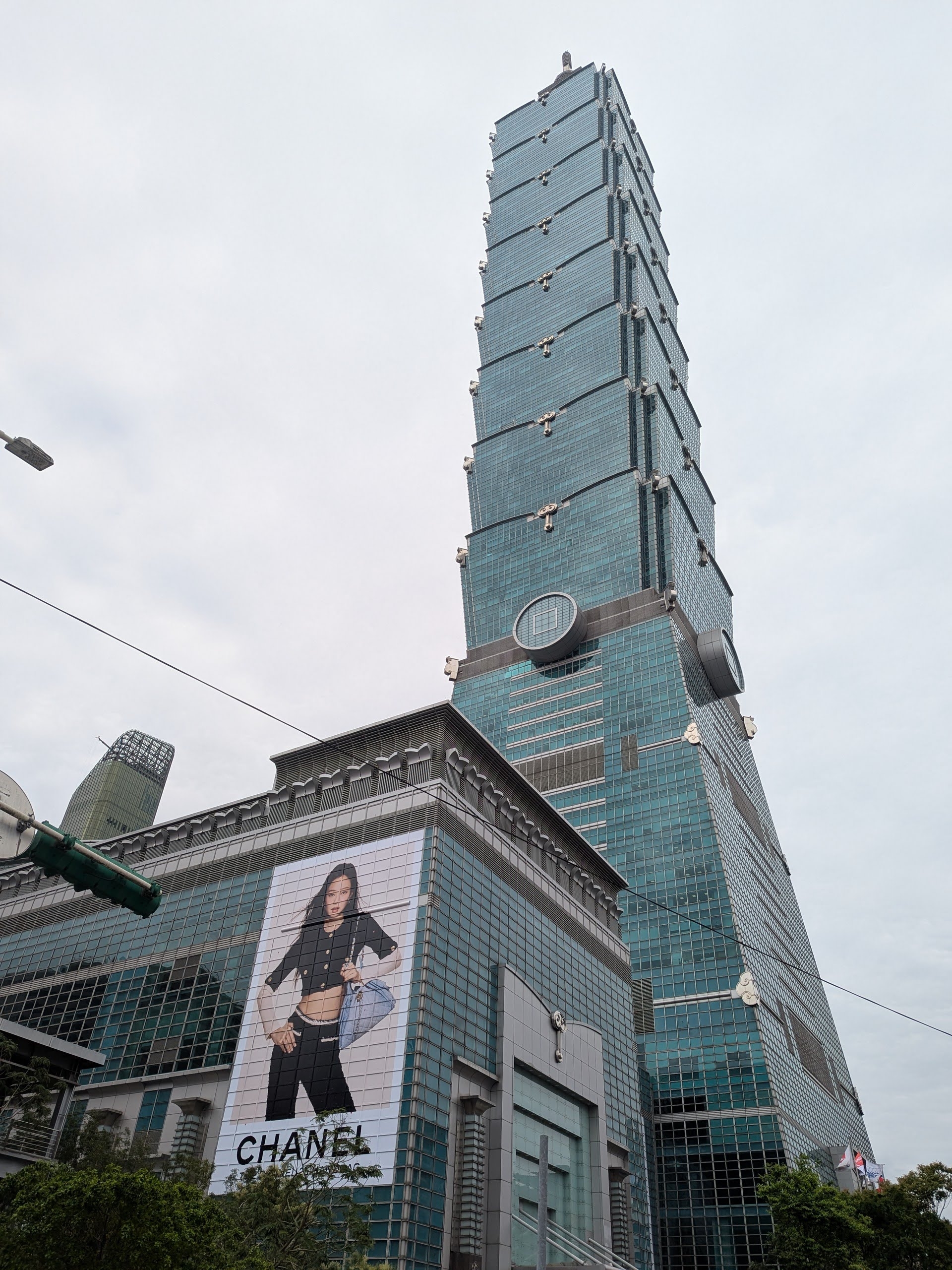
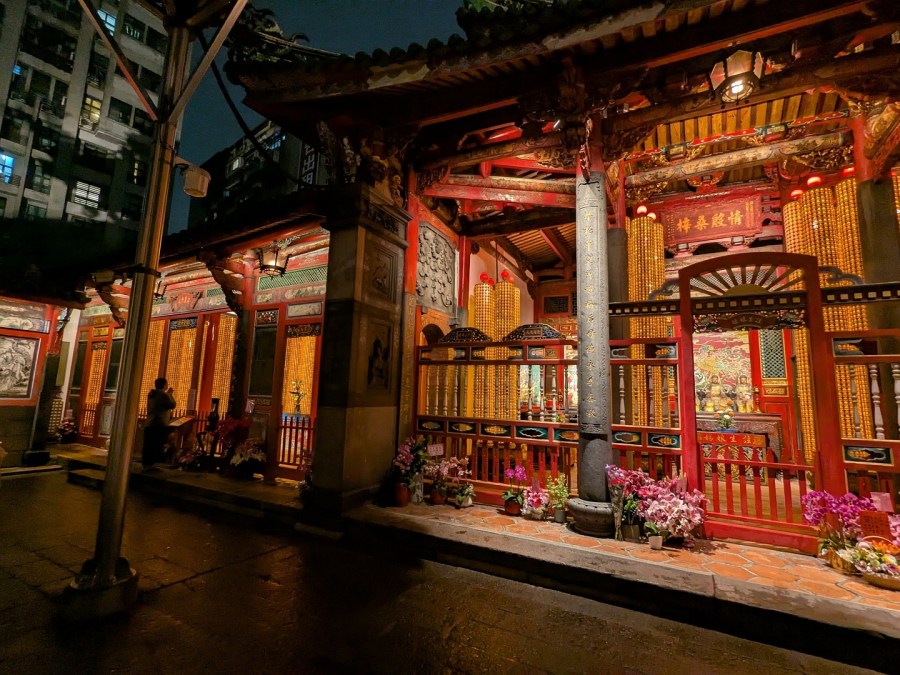
made it, 媽! top of the world!

We had accidentally timed our trip to coincide with tomb-sweeping weekend, when good Taiwanese go to their ancestors’ graves in the countryside and maintain them. Taiwan has about the best public transport network I’ve ever experienced, but it was likely to be packed completely solid, and we needed to get to Tainan, halfway across the country. HSR (bullet train) tickets with seat reservations had sold out well in advance; they always have several unreserved coaches, but it’s first-come-first-served onto the train, so we were expecting a fair bit of queueing on platforms. However, we took a punt at a ticket machine while in the station to lock up our bags, and managed to nab two seats on a perfectly timed train that evening! On top of managing (mainly through luck and Fran’s diligence) to get tickets for the Alishan forest railway (more anon, but tickets sell out instantly online and you have to be fortunate to catch the trickle of cancellations) we were rather chuffed; everything was coming up Milhouse.

Continue reading “made it, 媽! top of the world!”

“a cup of innumerable splendours”

Looking back, I think this was actually my favourite: “This vessel was commissioned by Le Ji-xian to be cherished forever by all descendants to come.” If only he knew!

When the Chinese Civil War was conclusively turning against the Nationalists in the late 1940s and they fled to Taiwan, they looted as much of the country as they could get their hands on, including most of the cream of China’s museums. With the Red Guards subsequently destroying as much of Chinese civilisation as they could get their hands on twenty years later, this has in retrospect turned out to be a wonderful act (although I feel the KMT shouldn’t get more credit than they deserved at the time) and has left the National Palace Museum in Taipei as a slightly displaced Greatest Hits of mainland Chinese material culture.

Continue reading ““a cup of innumerable splendours””

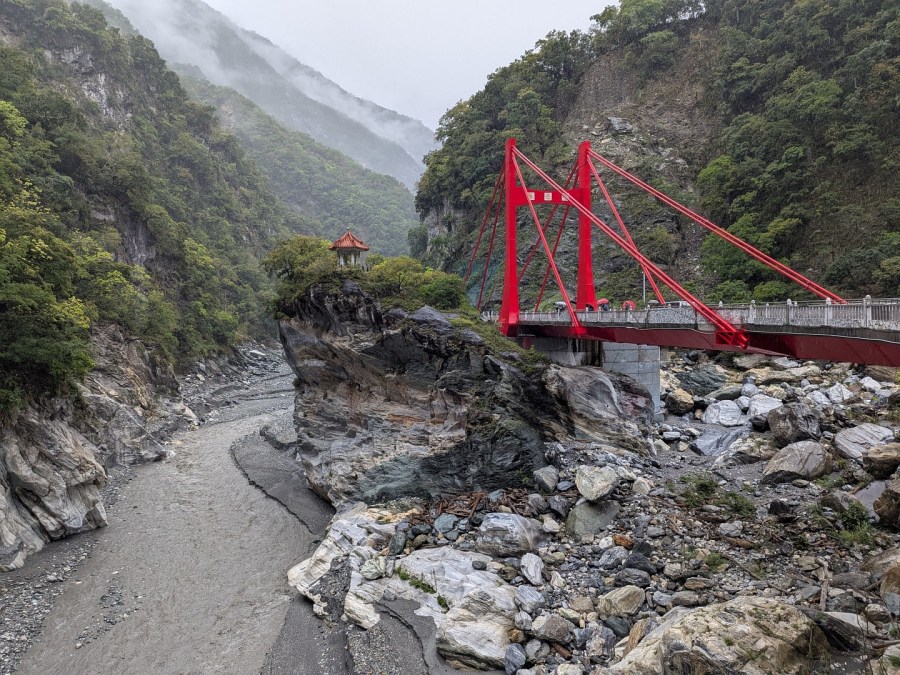
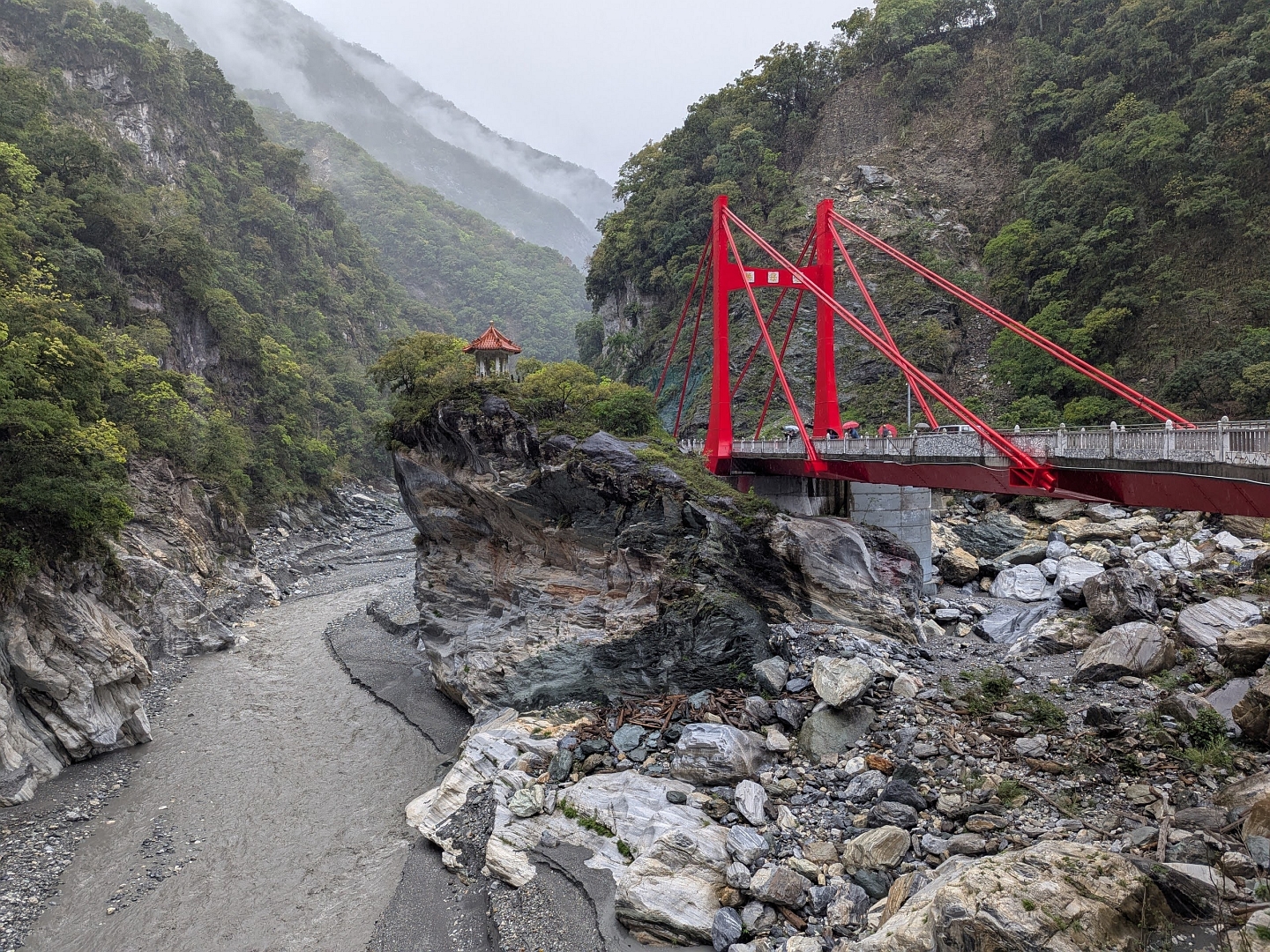
the lost marbles of Taroko

Taroko Gorge’s depictions in the National Museum raised our expectations; the knowledge that it had been devastated by an earthquake in 2024 tempered them. Our tour booking* was caveated with warnings that a) many attractive parts were still in ruins, and b) if it rained too heavily they’d have to cancel for fear of landslips. It was raining quite heavily as we ate our little packed breakfast from the B&B, but the minivan arrived with four fellow travellers and our guide (an unusually tall Taiwanese bloke with a camo jacket and a deep voice) told us that there was still a chance of cancelling the gorge itself but that he’d do his best to make sure the day was interesting.

Continue reading “the lost marbles of Taroko”

paregoric blues

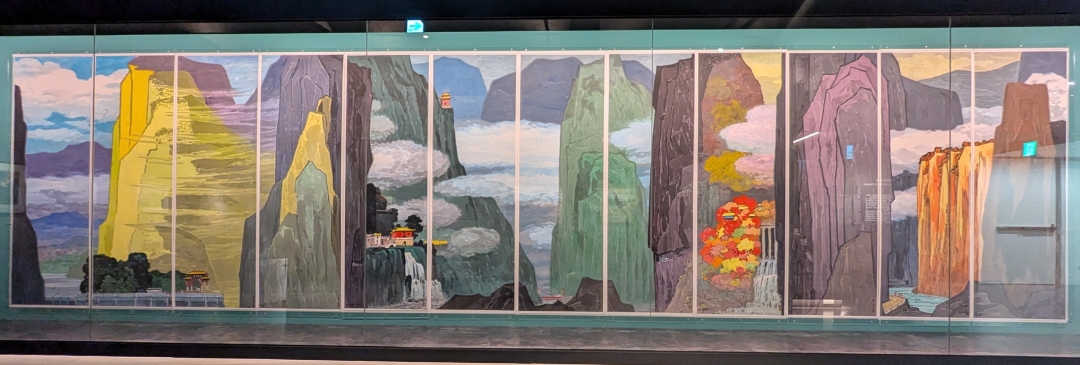
Section of “The Beauty of Taroko” landscape by Ma Pai-Sui (also written Bashui). These panels are over two metres high.

We started the grey, rainy second day with another Nick Kembel recommendation, a breakfast place called Ding Yuan Soy Milk, very popular with Japanese tourists. We ate xiaolongbao (little dumplings full of broth, not a million miles from khinkali), fried chive pockets, hot bowls of soy milk (Fran’s sweet, mine savoury with croutons and a slight cottage cheesy texture), and a clay-oven sesame bun. We picked up our train tickets for later at a convenience shop, in a ritual which will be fine the second time but was awkward the first (you enter your details in a kiosk thing which then gives you a receipt that you then take to the till and print tickets…?) This was a different district, a little quieter and more businesslike than Ximending, with gloomy passages through buildings and staircases promising abandoned underground shopping areas, and random shops with excellent names: Mikhail, THREEGUN, Master Max, Murder Gentle.

Continue reading “paregoric blues”

of damp cats and coal mines

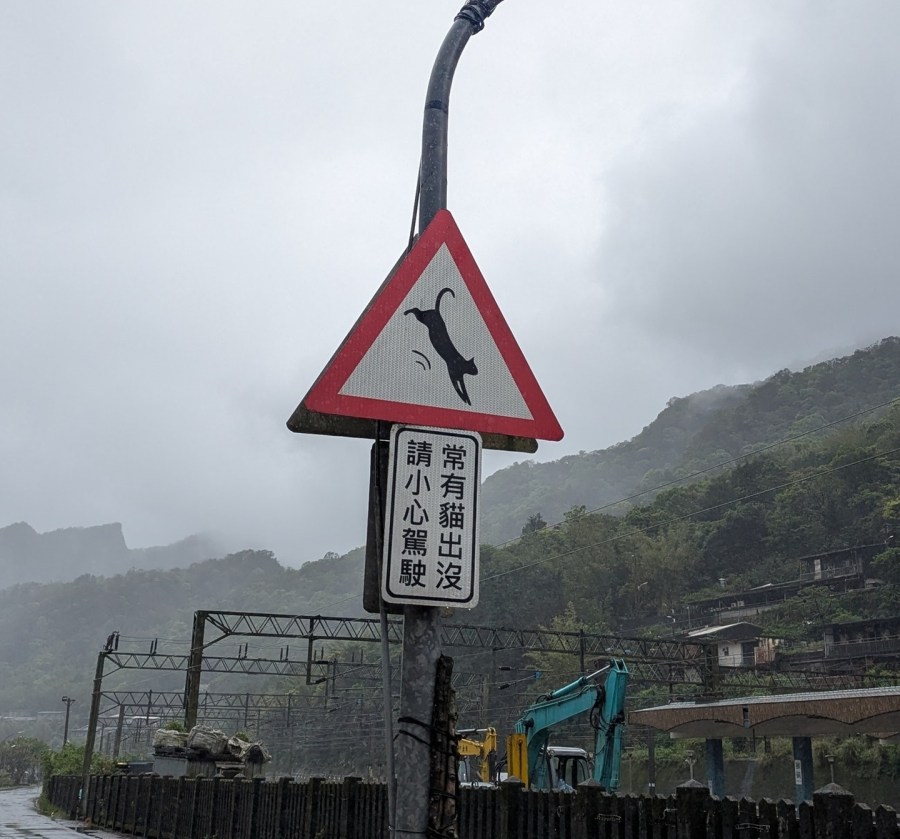
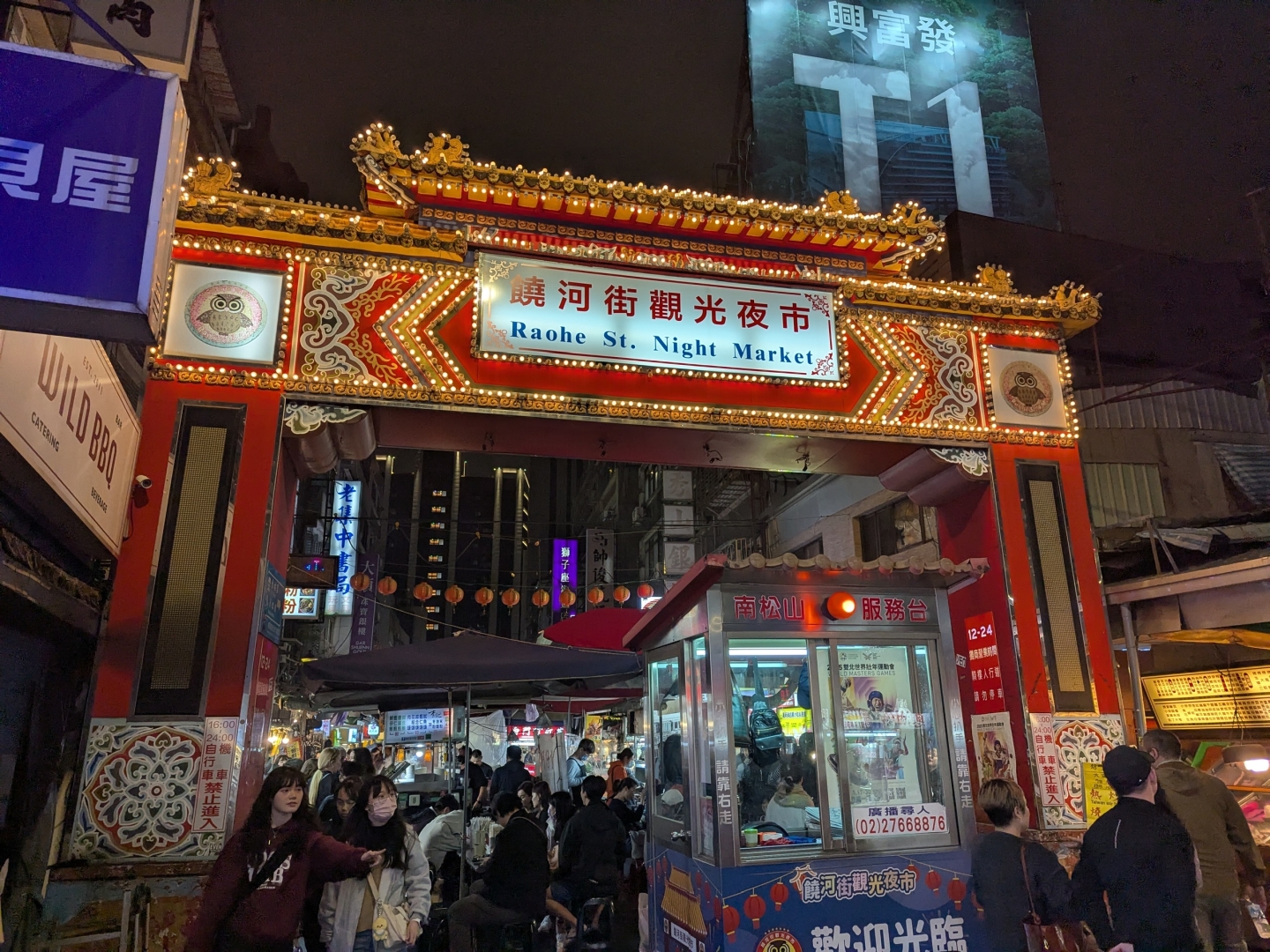
The first impression Taiwan gave was of compactness: a small amount of heavily exploited flatland, a lot of unhelpfully steep hills, and a buildable grey-zone between them full of buildings and land reshaped to accommodate each other. Layers of road and rail viaducts crossed each other; very seriously embanked rivers and mossy, steep-walled storm drains suggested everything might get very wet very quickly. The smooth, swift metro dropped us off in the Ximending district, where we found our hotel, past shopfronts crammed with computer valves and maneki-neko, and headed, jetlag-addled but famished, for the Raohe Street Night Market.

Continue reading “of damp cats and coal mines”

double plus good


Gdańsk is a Baltic city, built to look pretty under leaden skies and gentle drizzle, which was just as well under the circumstances. The old town has (as usual) been thoroughly rebuilt after being flattened in the war, but it has a very different character to Wroclaw. This was always a very different city, a Hanseatic trading port which looked to Dutch and Scandinavian influences instead of Mitteleuropan and Italianate; but more importantly, its somewhat idealised postwar rebuilding very deliberately stripped out all its German elements. Politics aside, the final effect is gorgeous and quite convincing (much more so than Warsaw’s old town); it really wasn’t easy to tell reconstruction from original, although one building conspicuously sported a date of 1953.

After a hearty, not to say stodgy, breakfast at another bar mleczny sort of place (served by Ukrainian ladies), we wandered down the Long Market, the city’s main street, to the city museum, housed in a totally rebuilt town hall. The museum has all sorts of interesting historic elements – a rebuilt audience hall is lined with accomplished 1990s copies of old portraits of kings of Poland. There are some truly spectacular old survivors, a late 17th century staircase and doorway and a magnificent complete guildhall room which was broken down and taken away ahead of the Russians’ vengeful advance in 1944. But in all too many places, “nothing of the old furnishings has survived to the present”. There is a pervasive mournfulness to all this stuff, a respect for these fixtures as symbols of resilience as much as works of art, and – like the housefronts – as icons of a pre-war (and illusively “pre-German”) conception of the city.

A brief history: Danzig/Gdańsk was founded as a trade port under the Polish Piasts around a thousand years ago, then violently taken over in the early 14th century by the Teutonic Knights (of which more next post). As a seaport, it was an important member of the Hanseatic League, that interestingly modern medieval trade combine which dominated the Baltic for centuries, and became a rich and sophisticated city (with a largely German-speaking population) acting as an entrepot for overseas trade into Poland up the Vistula river. Like most of the Hansa it declined in the 18th century, was taken over by Prussia amid the butchering of Poland and ended up in the German Empire. When the Polish state was resurrected after the First World War, and needed ports, the new League of Nations created the “Free City of Danzig” with the idea that it would be an independent city-state belonging to neither Germany or Poland. This was less intrinsically weird than it now sounds – places like Hamburg had been proudly independent city-states within living memory –but was a fudge that pleased nobody. The nationalism genie wouldn’t go back in the bottle, the vast majority of the city’s population identified strongly with Germany and against Poland (the Poles had to create a whole new port city, Gdynia, further up the coast as Danzig couldn’t be trusted), and fell in enthusiastically with Nazism (its own police joined the assault on the Westerplatte.) After the war, the surviving Germans were violently evicted and a largely new Polish population shipped in, themselves evicted from what’s now Belarus. The anti-communist Solidarity movement was born in Gdańsk’s shipyards and Solidarność iconography is all over the city today.

At the top of the town hall there is an entire gallery of Free City of Danzig memorabilia, filled with the paraphernalia of an artificial state which was almost universally despised for its two-decade existence. Walking through it, reading about its progressive healthcare system and currency pegged to the British pound, is a deeply peculiar experience. We shook this off and enjoyed a gallery of local art – the delightful steampunk confections of Jarosław Jaśnikowski re-imagining local landmarks, an engaging portrait of the progressive mayor Paweł Adamowicz, murdered in 2019. The weather had improved by the time we reached the top of the bell tower; we discussed whether its arrangement should be considered an instrument rather than just a set of bells, but dismissed the argument as carillon baggage.

We had coffee and cake off Mariacki Street (anti-gentrification graffiti read “Don’t cut down the old trees”), enjoying an unusually exuberant fountain and its bronze lions, and entered the Mariacki – the Church of St. Mary – itself. It’s an unusual building, its ceiling all at the same height (rather than with lower side roofs for aisles, transepts etc), and its boxiness manages to make it feel much more imposing than the (actually vastly larger) St Peter’s Basilica; the giant marching whitewashed columns quite dwarf the usual immensely impressive collection of organs/family monuments/astronomical clocks/war memorials/angelic choirs/bronze fonts with wall-eyed allegorical figures of virtues/alabaster reliefs of the land giving up its dead at the end of time. The overall effect is to leave you feeling very small before the majesty of God, or at least the majesty of 15th century bricklayers. Danzig had a relatively calm Reformation, not throwing the architecture out with the bathwater, so there are lots of lovely pre-Luther survivals.

We headed to the maritime museum to pad out our knowledge – and its collection all seemed very magnificent, but unfortunately, the time we had left before closing simply wasn’t enough, and I have a vague blur of model ships and in my mind and on my phone, and a lingering sense of resentment at the incredible Soviet passive-aggression of museum staff who visibly did no work all day hurrying us through so they could close up and knock off ten minutes early.

Finally, the Westerplatte. We ordered a cab and headed north through the immense dockyards and loading areas, a haze of black dust hovering over the coal terminal (I initially put the wrong directions – there are two Westerplattes and, confusingly, thanks to canal rebuilds the one we wanted is to the east of the river – but our nice young Uzbek Uber driver was very helpful). The Westerplatte is where the first shots of the Second World War were fired,* and its torn concrete fortifications and eloquent signage describe an overture of the ghastly, one-sided horror about to be replicated across all of Poland. A tiny Polish garrison, outnumbered twenty-to-one by a Nazi force including a battleship,** held out for a week.

As well as the smashed buildings there’s a weird, strikingly socialist-era granite memorial, muscly abstract soldiers and sailors.*** Unlike the vaguely awkward, helpless monument at Auschwitz, I felt it still has great power, but, like with Mother Motherland in Kyiv, poses complex symbolic questions about the triumphalist design language of one totalitarian oppressor celebrating victory over another. Just as the Ukrainians are reclaiming the Kyiv statue by replacing her Soviet symbol with the trident, the Poles have supplemented the memorial with an arc of Polish flags and a plaque with a 1987 quote from Jan Paweł: “Every one of you, young friends, finds in life some sort of your own Westerplatte. Some dimension of tasks, which one must undertake and fulfil. Some order of rights and values. Which one has to uphold and defend. Defend them – for yourself and for others.”
“That’s pretty hardcore for a modern Pope,” I observed. “He was Polish,” Gosia replied.

Past a bunch of tacky tat-stalls hocking plastic toy Kalashnikovs and hand-grenades to schoolchildren, we headed back into town, for an evening of burgers and cherry-related alcohol. The bus took a roundabout journey around the sprawling docks, filling up with tough looking blokes with short hair and puffer jackets who would all have fit perfectly into series 2 of The Wire, and wondered if any of the ships we passed were unloading British tanks for the next war.


Poland 2022

 The Lost WawelBarbican, Celestat, AuschwitzFrom Wieliczka to WrocławRacławice, Ostrow Tumski, Museums of WrocławKsiąż CastleGdańsk – Malbork

* Using the traditional Polish-British-French war timeline which starts in September 1939, rather than the Russian one which starts in June ’41 when the Nazis (who they’d been openly allied with and supplying for several years) turned on them, the American one which starts in December ’41 with Pearl Harbor, or the Chinese one which has several plausible start dates much earlier in the 1930s.
** To be clear, I’m not doing the journalist thing of calling anything grey and armed a battleship: an Actual Battleship, with old but enormous guns.
*** Really awkwardly, I can’t see the soldier and sailor in the upper section without it making a face resembling the bloke in that big stone Armenian sculpture.
the ghost of the southwest corner


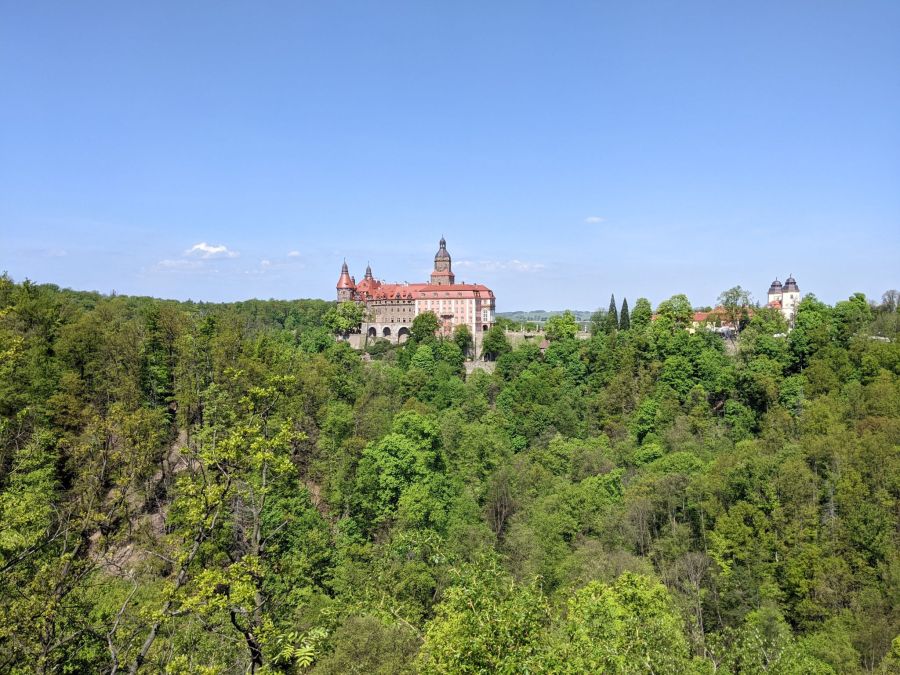
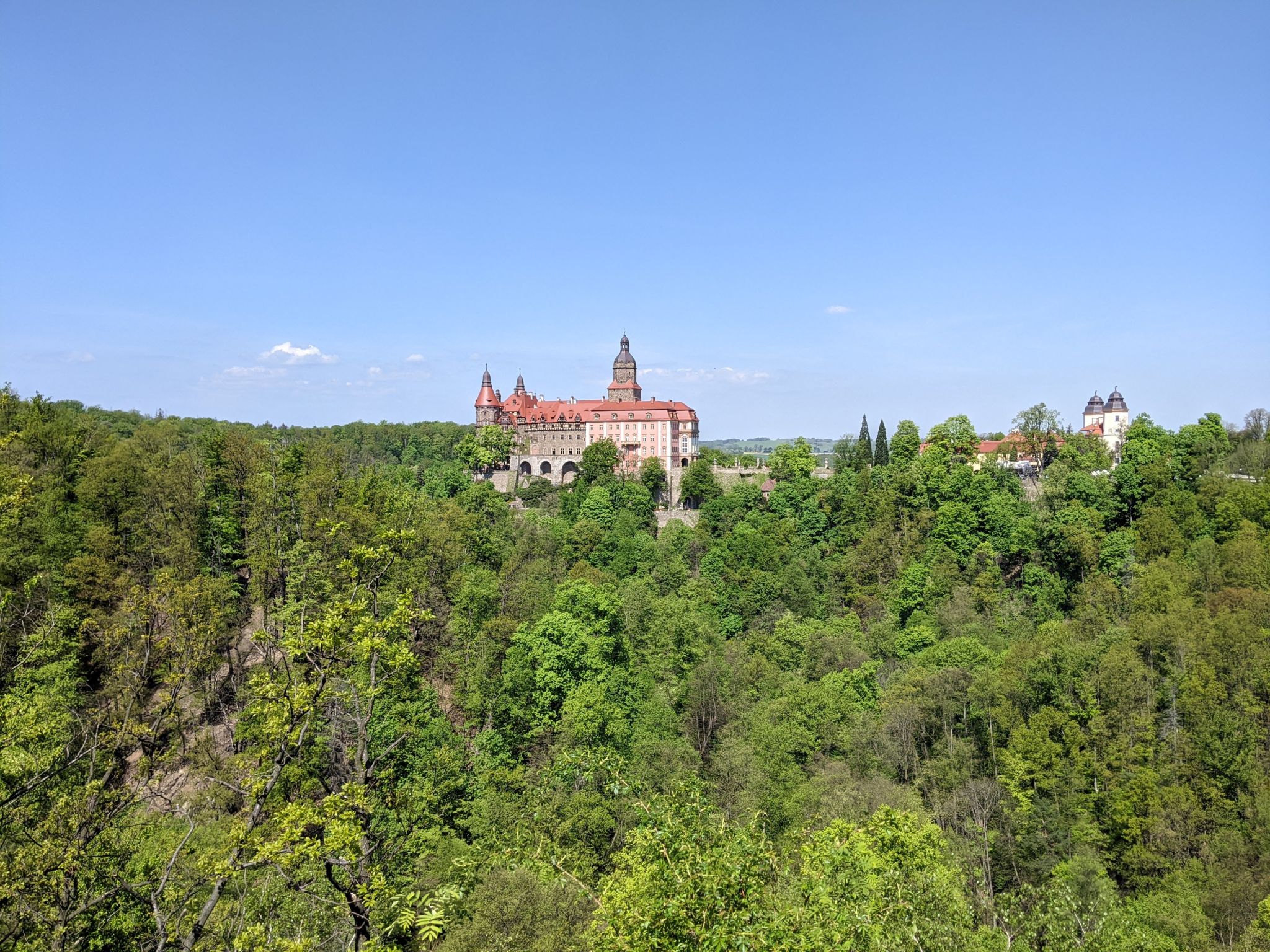
Książ is as quintessentially Mitteleuropan a castle as Dover or the White Tower are quintessentially English. There are structures underneath it all from the Iron Age, and a proper fighting castle was built and rebuilt in the early middle ages for the constant Bohemian-Silesian border wars, including one episode where it was overrun by the war-wagon-riding nonconformist Hussite insurgency. In the late fifteenth century it ended up in the hands of the Hochberg family, who hung on to it and steadily increased both their own wealth and grandeur and the castle’s, masterminding various extremely high budget expansions including an entire fake ruined castle on a nearby crag (oh, those Romantics). Despite shapeshifting from German to Polish nobility (most of their holdings being in the Polish state that was resurrected after the Great War), the family eventually imploded spectacularly between the World Wars. In the mid 1940s the castle, then in German Silesia, was identified as the keystone of a huge, pointless late-war Nazi building project (possibly as a personal HQ of Hitler himself, as they won’t stop telling you). Concentration camp slave labour was worked pointlessly to death in the final days of the second world war overengineering various tunnels to nowhere. Vandalised by Nazi architects and shelled by the Red Army, the castle has undergone a clumsy socialist-era reconstruction and an ongoing, more considered modern one, and it is now trying to style itself as a luxury hotel for a certain type of modern traveller. You could, in short, make any statement about it or set any sort of story in it and be comfortable that it would, in some way, be true.

Breakfast was at the bar mlecny “Mis”, which while closer to the Poznan experience wasn’t actually offensive. I had a cutlet with buckwheat and cabbage, followed by a lavender matcha latte from a hipstery place nearby which cost as much as the entire breakfast (still, for the record, not very much.) After a slight panic with ticket times we got onto the upper deck of a busy and somewhat smelly commuter train south. To the east, a lonely mountain broke the monotony of the landscape, and every town boasted a lovely old Victorian water-tower and, more often than not, a turntable engine-shed. An actual working rail-freight yard went by to one side. Arriving at Wałbrzych, we bought snacks (cactus juice!) and found a bus to the castle itself.

The customer service experience of getting in was what Gosia delicately called “classic Eastern Europe”. In the tunnels (deliciously cool after a warm bus journey and warmer walk), a well-made but slightly repetitive presentation hyped us up through lurid legends of golden trains and wonder-weapon labs, then supplied much more boring and historically rigorous explanations of what actually (probably) happened. The boring version is that in the exceptionally insane Gotterdammerung atmosphere of the late war people did all sorts of things for all sorts of reasons, most of the records have been destroyed and we don’t really know for certain what the tunnels were for, although as a junior officer noted they sucked up large quantities of steel and concrete that could have gone to more useful things.

Back above ground, the castle itself is just ridiculously big and mostly quite empty, populated with historical furniture but with most of the interiors refurnished fairly cheaply, consistently and incompletely. The pastel-painted rooms and endless parquet floor gave the odd impression of a communist school refurnished entirely from some rather good antique shops. I started off sneering at this, but after a while I warmed to it: just as the hacked-about wall décor and photographs of the once-magnificent Curved Room have a wan, badly-taxidermied-corpse feel to them, the obscene ostentation of the Maximilian Hall shines all the more by contrast with the haggard lemon-yellow main staircase and the obvious empty stair-rod holders its carpets were stolen from under.

The later Hochbergs’ closeness to the imperial family (the Hohenzollerns, not the Habsburgs) and ownership of lands which turned out to be full of coal mines brought them an astonishing wealth and apparently a Victorian town-building social conscience (claiming that a Hochberg inspired Bismarck’s social reforms is probably a bit much though); they indulged the usual hobbies of political intriguing, dressing up their servants in ridiculous uniforms, and the mass-murder of animals with modern express rifles. There’s a lot of stuff about “Princess Daisy”, a minor British noble who married into the Hochbergs in the 1890s. Despite the tourist-friendly Sissi-lite bootlicking towards her, Daisy comes through as quite a nasty figure, a parodically un-self-aware exemplar of chinless privilege and snobbery who spent her earlier years bullying interior decorators and sneering at gardeners, and her later ones periodically re-releasing increasingly gossipy autobiographies to a huge American readership. She gradually lost her money, friends and health, dying in 1943 against the background of a front moving westward again and the second war mopping up the few fragments of her Europe that had survived the first. There is a legend about a seven-metre string of pearls she owned, and a statue of her survives in a town her husband owned.

Easily the best part of the castle was the album of Louis Hardouin, a French chef who served the family through the early 20th century and moonlighted as a photographer: a mixture of posed and candid photographs of the three hundred staff employed night and day at the castle, dogs in hats, and the absolute splendour of the place in its heyday. We poked listlessly at a MAGIC ROCK which claims to bring luck and draw you back to Książ with your true love, and passed through the gift shop (standard issue mass-stamped-in-China “medieval aesthetic”, plus a fun coin-funnel soliciting donations to look after the castle’s many cats). We wandered out, circling the castle through the terraces of splendid, sun-soaked gardens (including a friendly cat that allowed us to pet it; instant return on investment) and had a drink and an enormous Polish dinner as a drone whined around overhead insufferably.

Twenty minutes’ walk away is the Palmarium: the Hochbergs’ wealth was such that Daisy essentially had her own Kew Gardens built for her, which nowadays has peacocks, lemurs and bonsai trees along with some very good succulents. A taxi back to the station later, the train was parping across the flat Silesian plain, for us to quest for a bottle shop, drink congenially on the balcony of our airbnb and invent stories about the strip club touts interrupting a nice Tuesday evening for the punters in the square down below.

Poland 2022
The Lost WawelBarbican, Celestat, AuschwitzFrom Wieliczka to WrocławRacławice, Ostrow Tumski, Museums of WrocławKsiąż Castle – Gdansk town hall, Westerplatte – Malbork