“grab what you can, we’ll do this ourselves”

It’s only coming back to this for travelblogging purposes that I realised what an eerie retread of my movements on May 8th 2018 it was – exactly four years and one day later. But, and here’s the critical difference, the panorama was open.

May 9th is Victory Day in Russia and the old Soviet Union (Poland officially changed their observance to the Western VE day, 8 May, in the mid-2010s), the day a lot of slightly-below-top-tier military commentators were worried that Putin was going to declare unlimited war in Ukraine. So it was in an appropriate spirit of feverish Russophobia that we went to the Racławice Panorama. As a sort of nationalistic mass-market populist war-glorification, the closest modern analogue to a 19th century panorama is probably a really nationalistic history-lite blockbuster war film, and the bogglingly huge canvas is, in its own way,  as technically and visually impressive. We accidentally timed it perfectly, getting a slot just before a huge noisy school group, and got the rotunda half to ourselves. It evokes, as much as is possible in 1700 square metres of canvas, a blazing, blood-slick day viewed from the heart of a colossal mess, cleverly throwing in some props and ground detail in the foreground (as the 1453 panorama in Istanbul did) to make it all feel much more tangible. An audio guide points out the salient details: Kościuszko with his little upturned nose visible urging on a crowd of patriotic peasants as they charge at Russian artillery batteries with modified scythes, the caricature-Asiatic faces of Cossacks as they turn to spear a proud moustachioed Polish cavalryman, a tableau of a peasant woman kneeling by her shot husband and blasted cottage, peasant-soldiers in a nearby column struck by horror and regret but sternly pressing on with their duty. It’s incredible propaganda. Poland won the battle of Racławice, but the uprising failed and the country was brutally partitioned (again) and disappeared from the map for over a century. But that just makes it an even more excellent piece of propaganda; in the business of myth-making, victory is nothing compared to martyrdom.

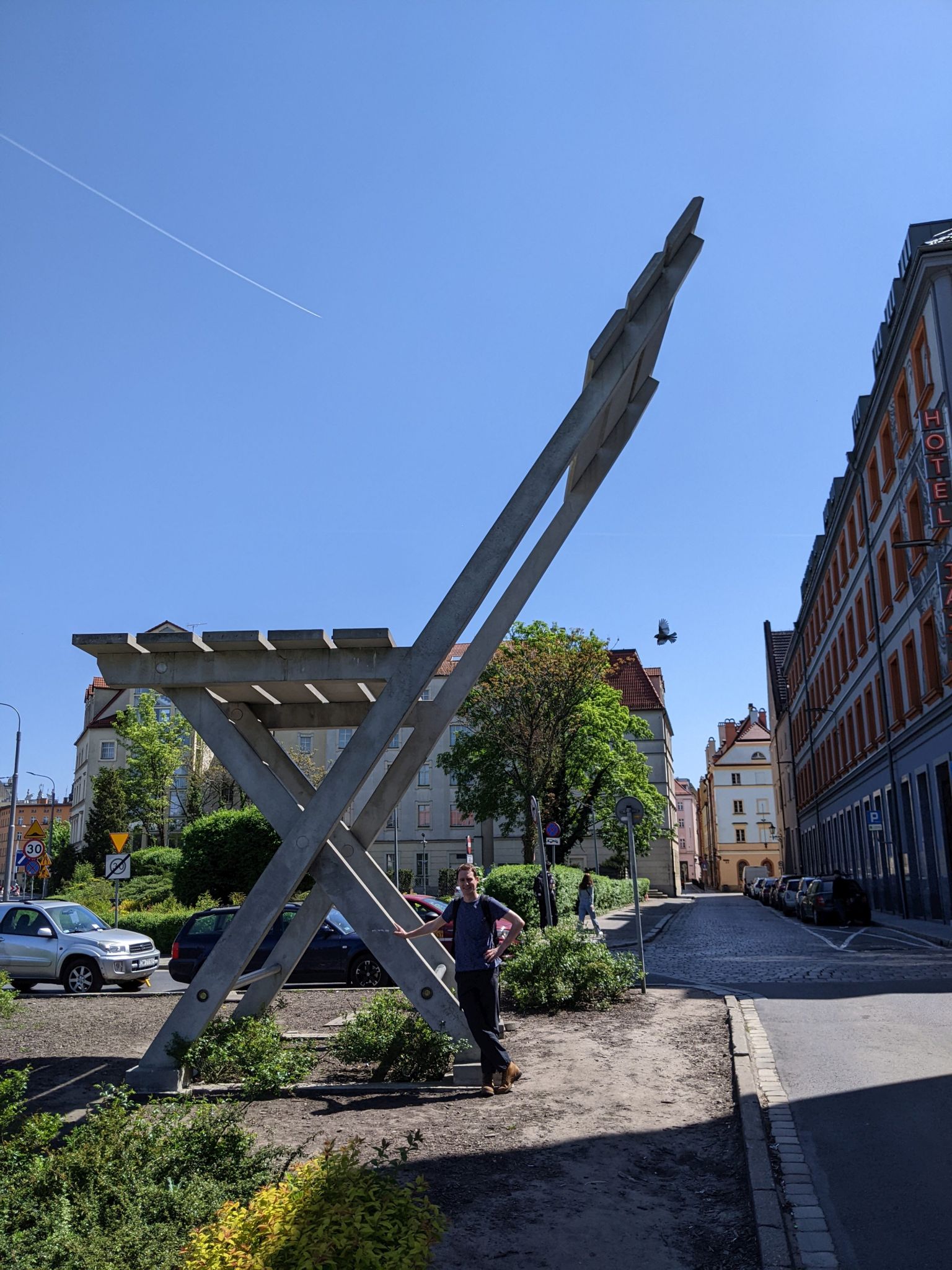
We returned along the lovely waterfront, enjoying a few Wroclaw-specific delights: a chap dressed as a monk who was probably actually a monk, the incredible Max Berg market hall filled with the smell of flowers and the sound of sparrows; the fun old hydropower plant (also a Max Berg) and a weirdly enormous chair.
“What if – what if you were B&Q, and instead of thinking about whether you should, you thought about whether you could.”

Gosia arrived on the red-eye from Lublin and we had a vegan lunch out of the aching sun of the town square, chilled in our Airbnb a spell and then went up the tower of the Garrison Church – the church itself was closed for cleaning four years ago, and still was today. How long does it take? The green bridge to Ostrow Tumski has been cleared of those obnoxious love-locks and sports an explanatory plaque and a new padlock gnome. Animated by a weird nostalgia, we explored the churches, and went on a turn around the delights of the Centennial Hall and the Japanese garden which, yes, deja vu.

YES. GOOD.

On Wednesday, we left our bags at a hotel near the station and headed back into town for breakfast, turning down the Selfie Café for the longer menus and less obnoxious meme-ness of its next-door neighbour. Nearby, the magnificent university building (built originally for Jesuits – a promising indicator of the kind of bling meant to overawe the soul and burn out the optic nerve) promised limitless wonders, including some of the grandest baroque interiors in Poland and objects collected over three centuries as a seat of learning and intellect. Unfortunately, this would have to wait for another visit (probably around May 8-9), as unlike all the other museums the university museum is closed on a Wednesday.

So on to the military museum, which was just as good as last time, and the archaeological museum, home to some very striking bits (a reconstructed bloomery, a nest of bronze sickles, some really stunning axeheads) in among the usual collection of fairly anonymous bones, rocks and pot shards (which could have had better English signage – thank goodness for Gosia). In search of a late lunch, we stopped at the first open place, which turned out to be  “El Cubano”, and was incredibly good. And then – shocker – the Garrison Church was actually open, and we could visit! Even better, we learned that the church very recently had its magnificent 18th century organ (a lucky survivor of the war destroyed in a fire in the 1970s. Better still, a skilled organist was putting the glorious thing through its paces.

The church is home to an astonishing set of commemorative masterpieces: plenty of Renaissance gold-and-alabaster memorials have somehow survived, but the stained glass is all postwar, and exquisitely expresses all the shades and colours of modern pain. A very Polish sense of remembrance was in evidence, sorrow leavened with bitterness, and an instruction to future generations: do not forget what was done to us. The anchor of the Armia Krajowa, a Katyn memorial, a chapel to Rafał Kalinowski, the patron saint of three centuries of Poles deported to labour camps in Siberia.

Out in the blinding contrast of the sunlight again, perhaps we could finally see the Ratusz? No – a sign at the door saying “sorry, ratusz closed”, and fluent English bemusement at the nearby tourist office (“it should be open today. I wonder why it isn’t?”) We were directed instead to the city museum, and warned by the that it would be something of a hurry in our available hour. I could have spent five hours there but one was still a wondrous experience, opening very strong with a giant, upsettingly pornographic meditation on Soviet trauma by Franciszek Starowieyski.

Going through the city, it struck me how completely and comfortably Polish Wrocław appears to have settled on the bones of German Breslau, and (in significant contrast to both Krakow and Gdansk) how little of the city’s very German – but also very lovely – 19th and early 20th century architectural heritage has been vandalised or replaced. The museum, likewise, was very comfortable with the city’s fascinatingly polyglot and many-mastered history: big-chinned Habsburgs and severe Prussians share wall space easily with Kosciuszko. As we get into the late nineteenth century, past demented wizard-staff-esque faculty sceptres and the woodblock prints of the university, the city’s industrial and intellectual pride are fully on display; pre-war Breslau exemplified a dynamic, diverse, prosperous central Europe of dozens of good-sized cities connected with each other, each doing its own thing just a little bit better than anywhere else in the world, until that world was annihilated for no reason by the Great War. Breslau as an entity staggers on for a bit in its artefacts (a replica of one of the famous Linke-Hofmann-Werke tram factory’s products, a photo of a Zeppelin over the centennial hall) but with the inevitable looming hideousness as you approach the 1940s in any museum on mainland Europe. In one case, a photo of a magnificent belle-epoque synagogue; in the next, the hazy outline of its burning dome, the morning after Kristallnacht.

Poland 2022
The Lost WawelBarbican, Celestat, AuschwitzFrom Wieliczka to WrocławRacławice, Ostrow Tumski, Museums of Wrocław – Książ Castle – Gdansk town hall, Westerplatte – Malbork
down here salt is a way of life

After Auschwitz, we returned to Krakow (the evening bus would have taken hours upon hours, so we took a taxi, which gouged us horrendously) and walked Kazimierz, the old Jewish district, then blotted out all ability to feel with a huge Georgian dinner complete with a carafe of the house Saperavi. We rose early the next day, and the 304 bus whisked us to Krakow’s other favourite out-of-town ttraction, the Wieliczka salt mines.

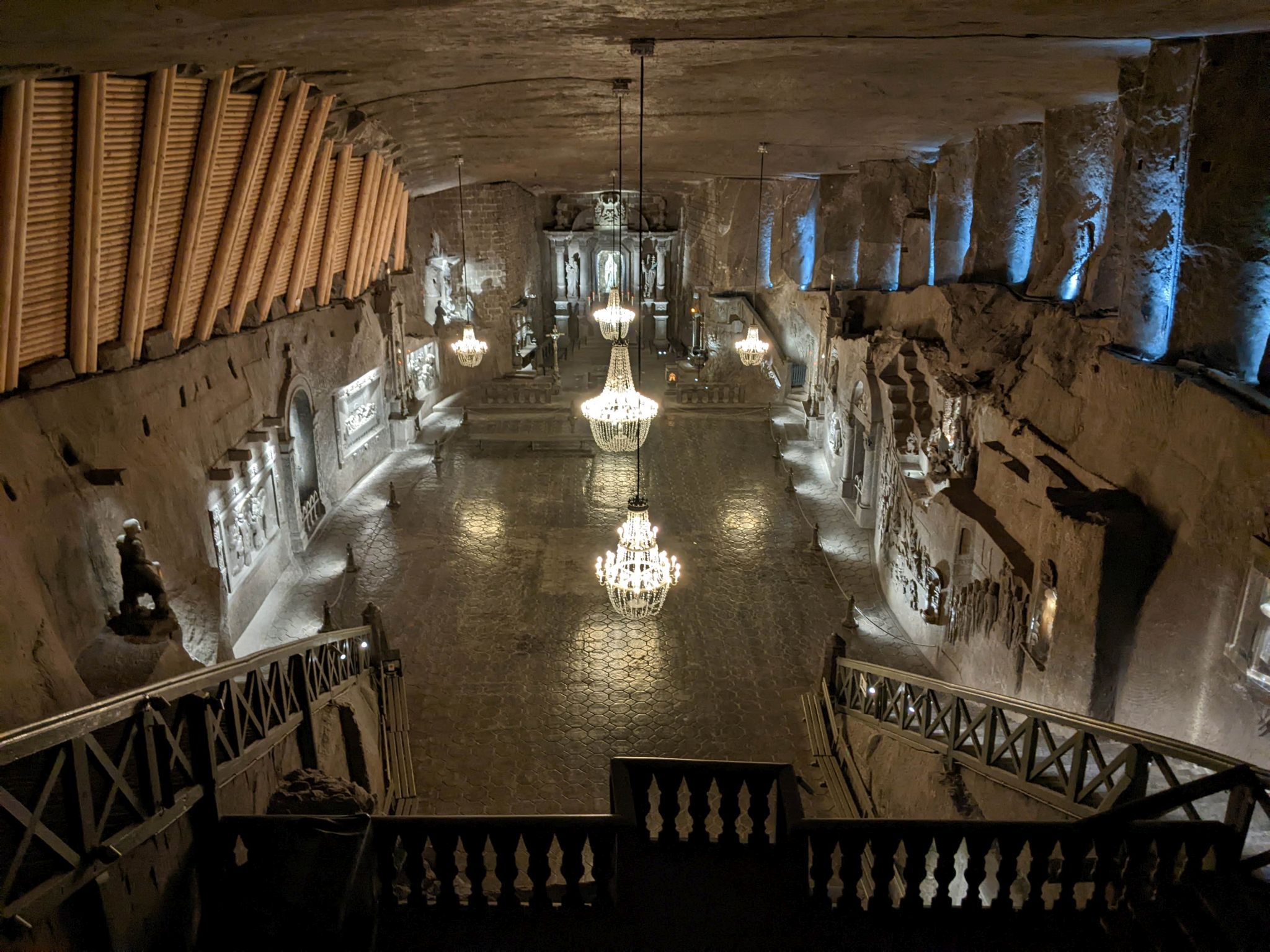
The experience was quite unlike the other Habsburgesque salt mine experience I’ve had, Turda. Wieliczka has been a tourist attraction since Copernicus (represented in a stylised carving from two huge blocks of salt) visited, and the atmosphere is quite different: past the initial hundred metres of descent, everything is so well-paved and decently-lit that at times you could be in any heritage centre, except every so often you glance down a side shaft and see rusty little railways running down a brine-streaked passage half a kilometre long. The tour gradually amps up the grandeur, starting with medium-sized chambers featuring the usual (slightly salty) mannequins and miniatures of minework life, working up through winding passages to the odd vast barely-lit cave, and culminating in a series of incredible cathedral-like spaces, thousands of trees’ worth of beams supporting each other in bizarre sunken megastructures. There’s even a break point where you can stave off dehydration at a café and peruse a gift shop filled with exciting salt-themed souvenirs, before you move on to a literally cathedral-like space lit by (salt crystal) chandeliers, with (salt) carvings directly into the (salt) walls showing scenes from the life of (salt) Christ, and a big freestanding Jan Pawel (sculpted, shockingly, from salt).

In the final stage, past the second gift shop (in case you regretted not buying any salt the first time) there was meant to be a museum of mine equipment, but the attendant with their salt-pick-buttoned tunic told us we would have to wait an hour, and so we headed back through another 800m of tunnels to a lift. Above ground was a third gift shop with the exact same salty souvenirs. Somehow, we resisted.

The bus (its info screen striped blue and yellow, with Ukrainian translations of important words) took us back to Krakow where we almost immediately bumped into two older men in incredible gold-embroidered red velvet outfits, including capes, one also wearing a crown and carefully carrying a huge two-handed sword by the blade. As we jostled past a seemingly endless stream of religious banners, nuns and little old ladies in peasant costume carrying burnished holy icons, some hurried googling indicated that this was in fact the Procession of St Stanisław. The Fowler King brushed past, complete with silver cock.

Somewhat dazed by the bright light and the sight of a troupe of Polish morris dancers (?!) we found a lovely indie pizza place – quite a Bristol feeling – in Kazimierz and recharged us ahead of the Remu synagogue. We paid our zlotys, put on the skullcaps offered, and got the wonderful feeling common to eastern European synagogues of an artistic and symbolic tradition at least as venerable and ornate as any Christian church, using the same materials and technical techniques but a completely different set of iconography and symbolic building-blocks. In the graveyard, with pebbles set on the metal rain-roofs of its curious-looking gravestones, a bearded man in a white shirtwaist and black trousers cleared the gravel and burnt kvitprayer sheets (check if correct term) from a grave whose Hebrew name I couldn’t read. A chilling moment as we came out: when the Nazis took over, they desecrated the gravestones and took many away to use as paving slabs. Those which can be recovered have been, but fragments of others have been mortared together into a wall of shattered names.

Back to Wawel, in a burst of rain, to see the cathedral, which was just as good as previously but this time included a turn up the tower to see the gigantic bells, and the excitingly death-metal stylings of the Szafraniec chapel. We just had time to go back to the city museum for a coffee, a cake and a renewed assault on the second floor gallery’s Decorative Art exhibition. It was the expected medley of virtuoso woodcarving, giant church keys, ceramics, tapestry and Misc Cool Stuff (a double-sided violin in the musical instruments section caused incredible ergonomic confusion). Even the Meissen porcelain, usually so reminiscent of blank-faced, nightmare-inducing shepherdesses on elderly relatives’ shelves, was chosen for individuality and craftsmanship and hardly smashworthy at all. The collection of Empire furniture was particularly fine, as was an enjoyably bonkers neo-baroque chess set themed after Sobieski’s victory over the Ottomans (one of the Turkish knights has fallen off his horse).

Polish railways still have compartments (at least in first class, which I’d chosen because it was still incredibly cheap and I don’t think I’ve bought a first class ticket for myself anywhere). Ours contained four youngish Poles in headphones; after hearing an altercation in English a guard arrived, checked our tickets and ID, removed one of the Poles and informed us there was no restaurant car. At low speeds the train juddered and vibrated in odd ways, but the harmonics changed as we accelerated out of town and settled into a rhythm. At the edge of Krakow, a girl stood by the track and lifted the hem of her white dress in front of a gaggle of photographers.

Having relied on the restaurant car, we were starving, and upon our arrival in Wroclaw stopped at the first decent-looking kebab shop on the walk in to our airbnb. “Tomorrow is big day for Russia, there will be big bomb”, one of the proprietors fretted to a colleague.

Poland 2022
The Lost WawelBarbican, Celestat, Auschwitz From Wieliczka to Wrocław – Racławice, Ostrow Tumski – Książ Castle – Museums of Wrocław – Gdansk town hall, Westerplatte – Malbork

the king of the silver cock

Day two broke quiet and cool, the turrets of St Mary’s looking astoundingly Cold-War-photograph through the grey haze. At a place on Tomasza street we found something calling itself Milkbar Tomasza and set out to wipe away the memory of the heinous bar mlecny in Poznan once and for all. With success: Sam’s pancake was exquisite and my full Irish breakfast very sound, with proper thick cut back bacon.

Thus fortified, we set about the city’s fortifications ourselves. Krakow upgraded its defences heavily at the dawn of the gunpowder age to a formidable set of concentric curtain walls, moats and thick-walled fighting towers mounting early artillery (quite a similar response to the Device Forts, in fact, a  few decades earlier). But it was never quite rich enough (or threatened enough?) to upgrade them to full-on trace italienne at any point and so staggered on with these picturesque-but-increasingly-worthless until the early 19th century when the (then Austrian) authorities demolished most of them and made a lovely park around the Old Town. But some were saved, thus the Barbican: fantastic both in the sense of being good and in looking like it belongs in a fantasy film, a big horseshoe of red brick topped with pointy little mini-turrets and riddled with as many odd-shaped loopholes as the British tax system. A gentleman in a mauve jerkin taunted us gently from the courtyard, let us play with his swords and armour, and having fully equipped Sam proceeded to beat him up with a sword. (I had no cash so left the castle and headed for a cashpoint to get him a tip; on my return he gave me a replica 15th century coin “for being honest”.)

A refugee support station by the main station was giving out food and medical aid to displaced Ukrainians, and the handsome late 19th century theatre had a huge ДЕТИ banner in solidarity with Mariupol. We had pastries and coffee and observed that while there weren’t many people around going full goth, the background level of let’s-call-it “Hot Topic quotient” is much higher than home.

As well as the Barbican itself and a quick jaunt through a surviving section of city battlements (individual towers named for the organisations responsible for their funding and upkeep: Haberdashers’ Tower, Carpenters’ Tower, etc) the Barbican ticket got us into the “Celestat”. This is the guildhall of the Fowlers’ Brotherhood: in both its historic tradesman’s-cartel past and present-day drinking-society-with-custom-bling nature very much like other medieval guilds, but, rather than engraving or silversmithing, their trade was shooting things. Sharpshooters’ guilds like this formed an important part of many city-states’ defences in the days before reliable national militaries. At regular contests, the best shot in Krakow was declared the Fowler King and awarded a huge silver cockerel on a neck chain. The club was full of decorative targets, antiquated marksman rifles, and paintings of various satisfied-looking men in Renaissancey getups with a big silver cock hanging round their necks (with gaps for the many years when the club was being repressed by one of Poland’s various authoritarian occupation governments). Outside, the Park Strzelecki – I know enough Slavic military vocabulary to work out it meant “Shooters’ Park” – seemed to be a sort of dumping ground for various recent and aggressively nationalistic statues about Polish history and Poland’s glorious yet endless struggles (in which Sobieski, his turban-mace-and-big-moustache iconography firmly established, features heavily).

Finding the bus station was easy (two American soldiers in uniform were wandering past as we approached) and buying a ticket for the coach we wanted even easier, especially by comparison with getting a drink out of the nearby vending machine. The “Lajkonik” coach rolled through the city’s clean outskirts to an open landscape, big box shops and wide sweeps of motorway giving way to boggy woods. Over the motorway sound barriers I could glimpse the odd cool modernist church, passing townscapes of church spires and tower blocks, the occasional striped factory chimney. Everything was cheerfully well-maintained, without the general weedy air of suffocating neglect and apathy in Russia. After around ninety minutes we arrived at Oświęcim, better known to history as Auschwitz.


I find it very difficult to write about any of this, or even think too hard for too long about it, and I do wonder how the guides manage. I don’t think I could in good conscience tell anyone to go to Auschwitz and at the same time it feels essential that everyone sees what was done here. Part of the horror of Auschwitz-1 is in how mundane and ordinary the fabric of it all seems: there isn’t anything intrinsically evil-feeling about most of the repurposed Polish army barracks and bunkers, their brick walls, cement floors, cheap old light fittings, and yet you stand in a room and are told that a hundred thousand people were murdered in it. And then: this is what two tonnes of human hair look like, shorn from murdered women to be sent to Germany to make carpet underlay. Here is a photo of a gaggle of confused children who will live for less time after the photo is taken than you will spend at the camp today. Here is a corridor of thousands upon thousands of mugshots of people who were killed, an incredible diversity of faces.  The guide moves from room to room, delivering each fact calmly and matter-of-factly; each horror sinks in but none can be dwelt upon for too long before another is described.

After Auschwitz-1 (with the “Arbeit Macht Frei” sign), you take a shuttlebus to Auschwitz-Birkenau (the building with the railway arch). Unlike camp 1 there is nothing improvised or extemporised about this: it is an enormous factory, carefully designed and purpose-built to kill and burn people. An infinity of barracks stretch away on both sides, many reduced to the brick chimneys of the double-ended stoves that kept a few “useful” workers alive a little longer. At the railhead a simple triage process established those who would go to the barracks and those who would be murdered immediately. It is then a very short walk to the gas chamber/incinerator complexes. These were dynamited by the SS and the postwar communist government built a memorial between the ruins of two of them: an abstract line of concrete shapes on a sprawl of cobbled steps. It is clumsy, awkward and almost meaningless, and conveys the sense that they felt a statement had to be made but had no idea what to say.


Poland 2022
The Lost WawelBarbican, Celestat, Auschwitz – From Wieliczka to Wrocław – Racławice, Ostrow Tumski – Książ Castle – Museums of Wrocław – Gdansk town hall, Westerplatte – Malbork

“dzień dobry, cracovia”

Krakow, again. The place hasn’t changed very much since I was last here, still a marvellous fantasia of medieval and early renaissance royal bling cocooned in lovely ornate 18th and 19th century urbanism and set in a coronet of endless marching socialist-era tower blocks. But the war was quietly everywhere, dark military trucks on the roads, Ukrainian flags and the trident of Volodymyr hanging from random buildings. I was sat by a British-Ukrainian lady on the plane, on her way to Lviv to see off a relative and look after a house she’s putting up refugee families in. She told me all about her family, the many ways in which this horror has been wrecking their lives for nigh on a decade. I gave her eclairs for the takeoff and landing, and told her dark jokes (“how do you stop a Russian tank? – shoot the guys pushing it”) which got barrel laughs. She bought me a cup of tea and refused all attempts to contribute to her work.

Landing was perfectly smooth, apart from Sam’s plane out of Bristol (“My flight is branded BUZZ and has a cartoon bee on it. I’m concerned. I hope they’re taking this seriously”) ganking my landing slot. A train and then tram to our quiet third-floor Airbnb aparthotel, through streets under exuberant regeneration and dozens of public parks filled with painted ironwork, Morris columns and bursts of bright yellow dandelions.

The Rotunda, then and now.

We had a late lunch of excellent pierogi and headed through the bustling parks that have replaced the city’s old bastions to Wawel Castle, still possessed of the same eclectic fiddliness and intimidating immensity as last time. This time the exhibition of choice was “The Lost Wawel”, through rooms built through the half-buried skeletons of previous Wawels, with a notable standout the ancient, strikingly simple and beautiful rotunda of the saints Feliksa and Adaukta, now literally buried inside the walls. There was lots of the eclectic, organic, pre-Baroque decoration, with a strong classicism probably partly due to general Renaissance Romanophilia* but, I suspect, mostly because all the decent architects on hire were Italian.

“This is the stuff that led to people going ‘alright, enough’?”
“Yes, as a result of which a third of Europe destroyed everything beautiful and the other two thirds decided to go in even harder on the bling.”


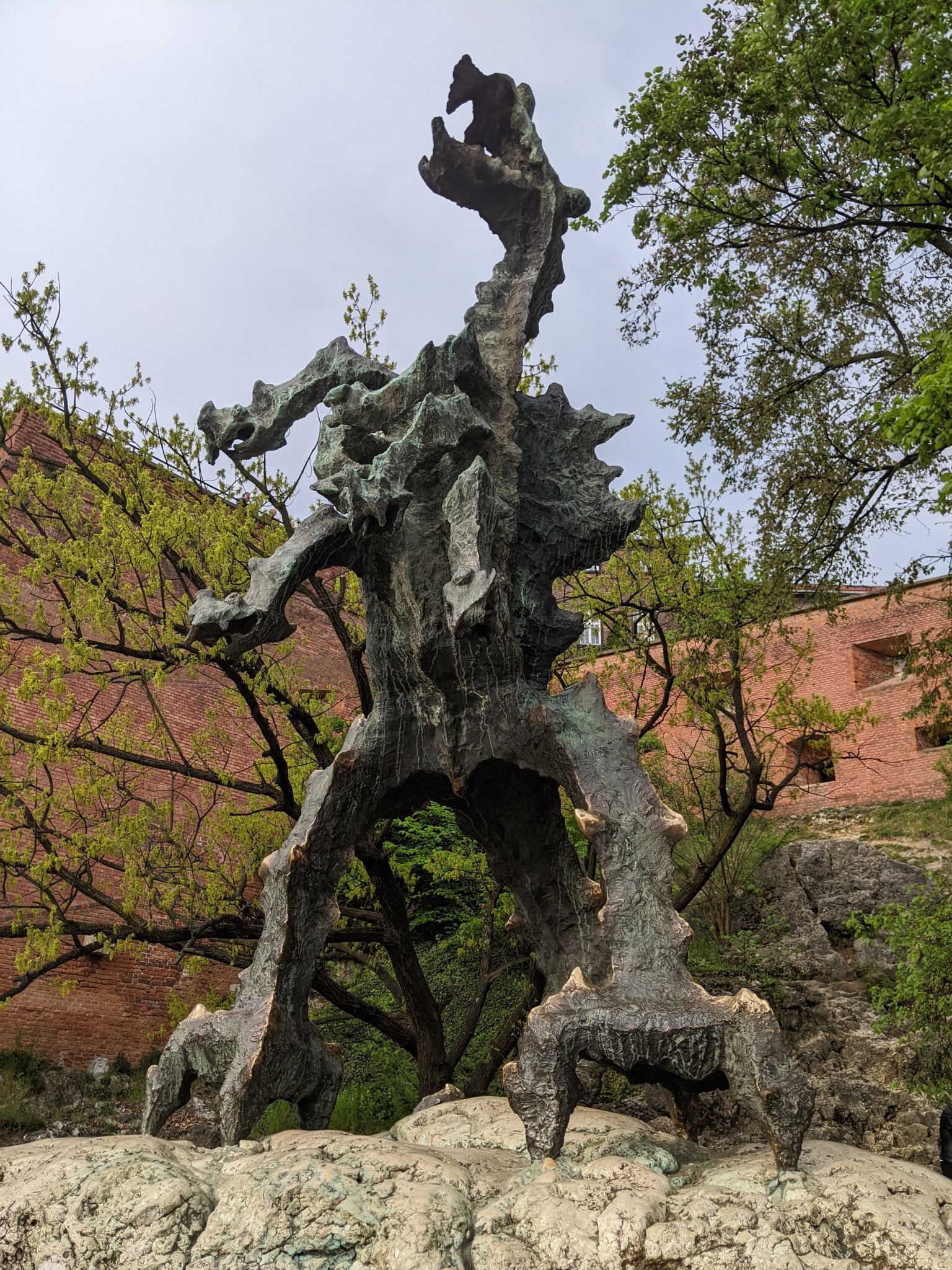
Down by the river we saw Smok again. An old Ukrainian man was playing the violin, with an album cover featuring a much younger him in front of St Andrew’s in Kyiv. I took his bank details, and said “slava ukraini” – he took me for a Pole and responded “chwała polsce.”

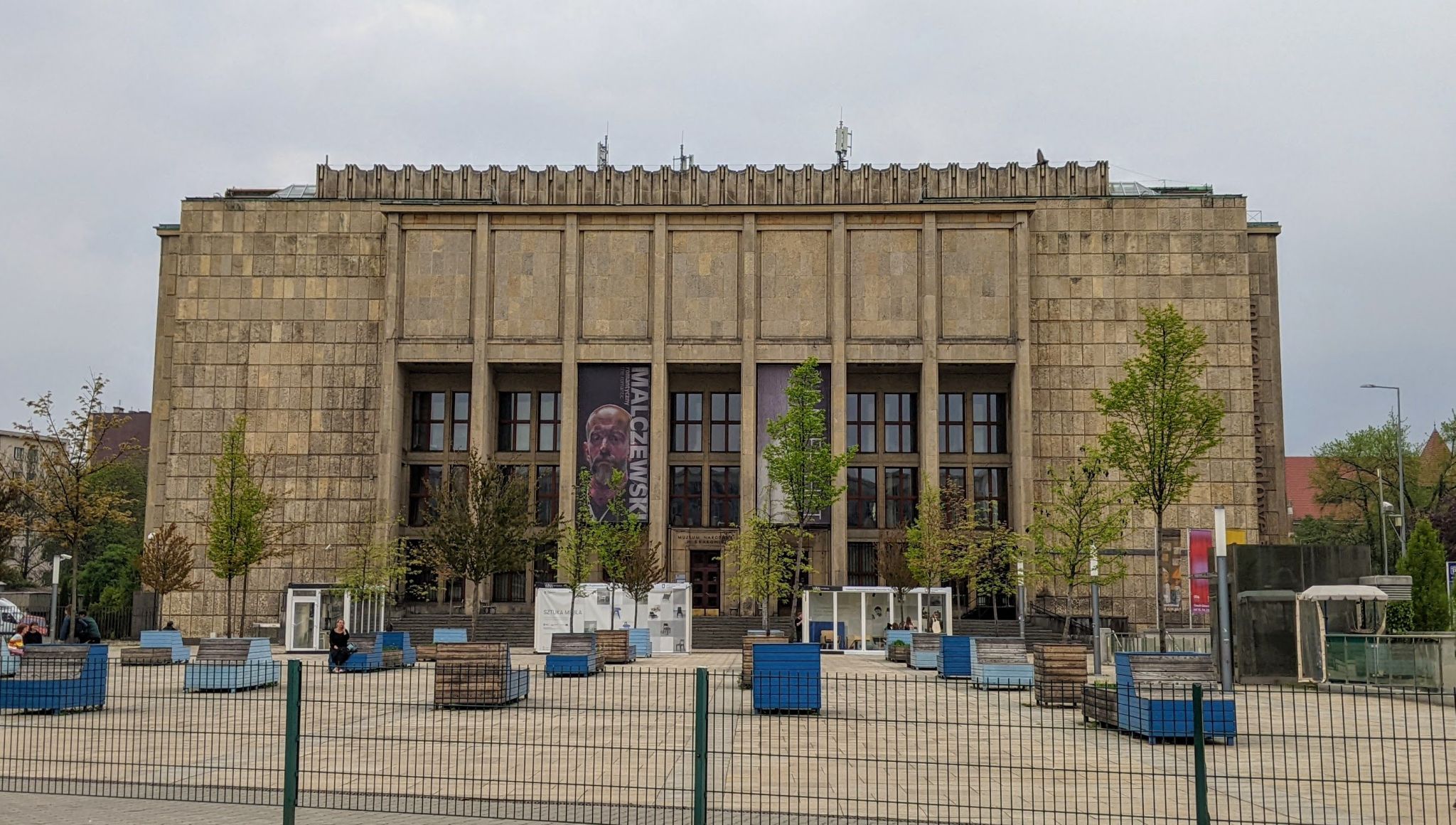
We walked to the National Museum, a big chunky thing like a Stalinist version of the Doge’s Palace, but although on the door the museum claimed it was open til 7, disappointingly they actually closed at 1845 and passive-aggressively stopped me from going into the Decorative Art gallery  more than half an hour before close – another day, I suppose. So we only had time for the the top floor, home to some really striking bits of painting, sculpture, stained glass and other crafts both modern and pre-war (unlike Warsaw, the collection here has either been much better reconstituted or wasn’t as badly looted and burned in the war – I suspect the latter).

Google maps thought the Barbican was open until 10 so we headed there – but upon arrival it was obviously closed. We wandered back to the town square for a wander (attracting the usual dusk chorus of touts offering us titty bars and, possibly, drugs) and a stout (which turned out to be 9.5% – oh well) and then, at Dan’s recommendation, a huge and wonderful meal at a place called the the Black Duck – Georgian house wine, pork schnitzel for me and stuffed cabbage for Sam, the whole coming to perhaps £18 a head. Poland remains a marvellously hospitable place.


Poland 2022
The Lost Wawel – Barbican, Celestat, Auschwitz – From Wieliczka to Wrocław – Racławice, Ostrow Tumski – Książ Castle – Museums of Wrocław – Gdansk town hall, Westerplatte – Malbork

lair of the green man

This is the last post in a series; you can read it in reverse order through the tag or start in Penryn here.

Dartington Hall is a lovely medieval estate, currently very much at the top of a historical sine wave of investment and decline. Built in Plantagenet days, it endured centuries of this before some rich oddballs bought it in the early 20th century to adapt into a sort of Bloomsbury Group combo of agricultural and domestic education college, artists’ retreat and back-to-basics proto-hippie-commune with elements of monastic self-sufficiency (it’s just down the road from an actual monastery, Buckfast Abbey, which mostly seems to make enormous amounts of money as a conference venue and selling bottles of what-the-hell-are-you-looking-at to neds.)* On a bright summery day it was quiet and felt extremely Proper. The main courtyard of grey, licheny three-storey buildings sets off the massive front of the hall itself, which inside has a really very good hammerbeam roof and some weird modern banners.

Through into the gardens, a great sculpted bowl of earth claimed semi-convincingly to have once been a tiltyard; a huge staircase was spaced in flights like a miniature Odesa Steps,** a carved stone otter had been munching on the same stone fish for who knows how many years. In the fun sprawl of the gardens, odd little doors led into the hillside (probably housing lawnmowers rather than hobbits) and plants bloomed out in an absurd diversity of shapes and colours. Set in a graveyard of overgrown stones with half-decipherable names, we found the Spookiest of All Trees: a yew so knotted it resembled a rope fender sized for the Ever Given. Only the brilliant sun stopped it all from feeling Proper Haunted. (Will we be seeing it in the new Utterly Dark?)

We visited Totnes for a nice brunch and a trip to the castle (working out my pandemic-underused CSSC membership). The castle, a fourteenth century stone enhancement of a Norman motte-and-bailey, is now basically just a little double ring of stone and earthworks, its guts all gone centuries ago leaving little to really engage with. Totnes, however, also boasts a perfect town museum in a Tudor house, with hundreds of exquisite, specialised artefacts each evoking memories of the town as a highly developed hub of trade and industry: tin, slate, pilchards, timber, the manufacture of coins, pottery, medicine, imports from Spain, Russia, the Low Countries. It’s a reminder of a very different world, before virtually everything that involved the creation and movement of physical objects was moved far out of town (and, ultimately, largely out of the country), where towns themselves were where things were made. The modern, Guardian-reader Totnes of cream teas, second-hand bookshops and new age tat that inhabits its buildings now feels as close to the Totnes of the museum as a hermit crab is to a sea snail: a completely different creature that just happens to live in the same house.***

Exeter showed to advantage on another blazing day. The local dark red sandstone comes heavily grained with veins of quartz, leaving the ancient city walls looking bizarrely like fat-marbled raw steak. Within those walls (crossing a Yaroslavl Bridge, which reminded me pleasingly of bits of Kutaisi and Newport being named after each other) it was a bright, cheerful place, a mix of really quite ancient buildings and modern shopping arcades all bustling with the life of a society trying its best to get out of under the pandemic. A trendy coffee shop provided some high quality shortbread, a castle complex rather at the bottom of the neglect sine wave provided a fun walk. Naturally, we had to go to the city museum (properly the Royal Albert Memorial Museum). One of the last recipients of serious pre-austerity investment in such things, the museum is another treasure, a pleasing mix of bonkers old artifacts and modern cultural appreciation for them, with some admittedly jarring moments like a Victorian staircase full of stone carvings painted hot pink. Outstanding pieces included a lot of echinoderms (especially if one’s companion is an author writing about 19th century science with an emphasis on sea horrors), and an immensely detailed 18th century model of the entire town.  (The museum’s own link is dead but in looking for it I found a wonderful then-local blogger who posted about it and many other Exeter treasures – have a look!)

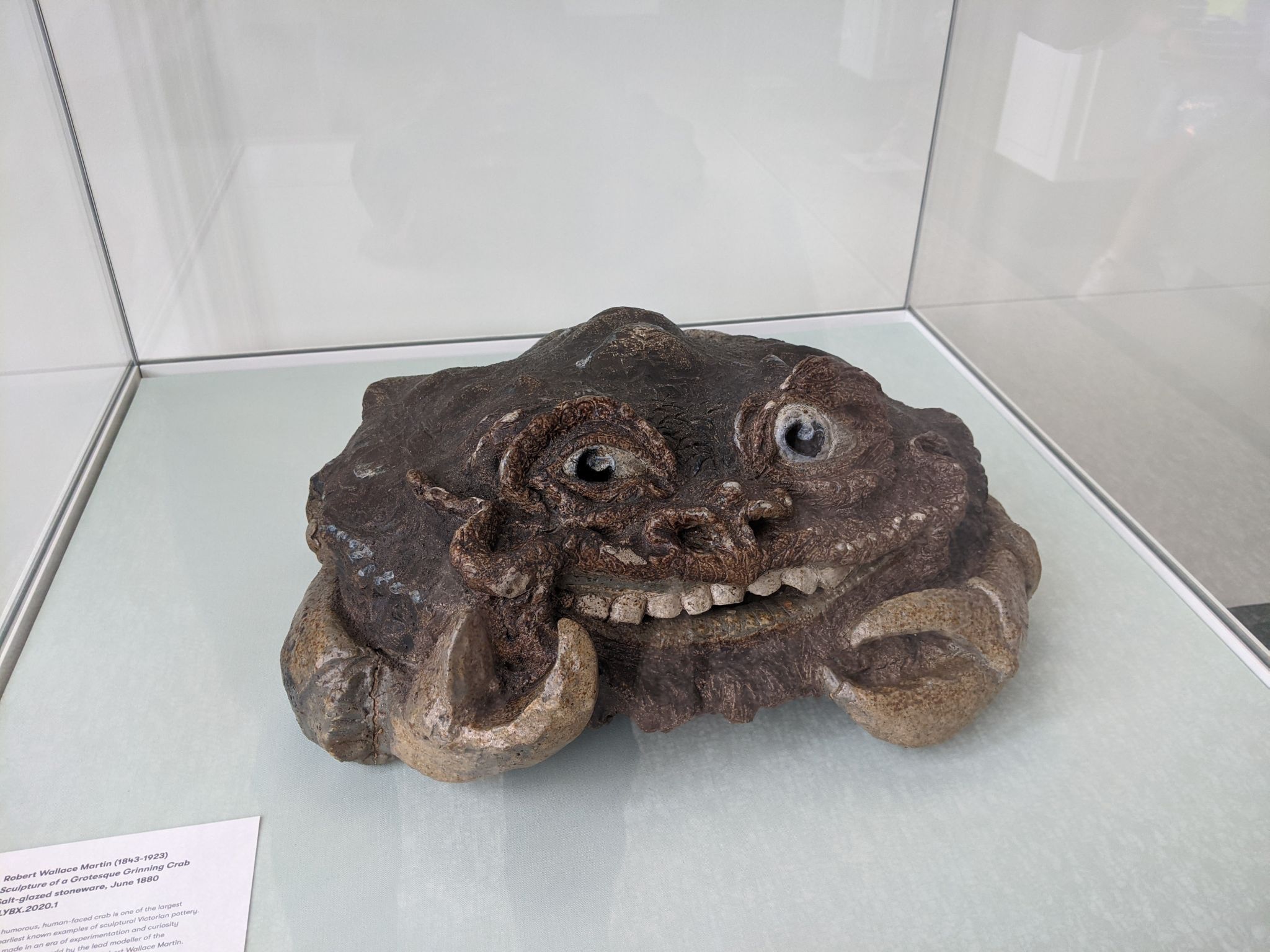
A Chinese money cat looted during the Opium Wars; a lascivious scallop; a c.1900 Nigerian caricature of a European officer; an 1850 engineering diagram explaining how Chinese characters could be sent through a telegraph; a warning of the dangers of blogging; and some characterful ceramics by the same chap as that crab back in Plymouth.


Finally, the cathedral. I have never really met a cathedral I didn’t want to be friends with, and this one Has It All. Happily spared much of the iconoclastic vandalism of the Reformation and Civil War, and the frosty machine-cut rectitude of later Victorian sensibilities (though not the war, which annihilated a lovely chapel), it is a joyful splurge of bright colour, gilt and over-the-top high-relief zaniness, with mawkish memorials from every century. An astoundingly detailed wooden choir boasts an elephant misericord dating back to Henry III, and a side chapel to Hugh Oldham is literally entirely owls. Enjoyably, it’s the home of an absolutely mad number of Green Men, whose upsetting, leaf-sprouting faces can be found all over the place, especially in the many ceiling bosses. I am certain at this point there were more depictions of the Green Man in there than there were of Jesus. (All quite high up and hard to photograph, though.)

This story trails off a while, as many of my logs do, because the remainder isn’t really of public interest. I stayed a little while longer on Dartmoor, enjoying a poodle chasing himself up and down the drive, bunnies on the lawn, ill-considered waltzes up tors in driving rain, and very good company. It was time to go home (and get a new raincoat.)


Everyone is fond of owls.

Out West 2021 

Out to Penryn – St Mawes and Falmouth – St Austell and PlymouthThe Forts of Staddon HeightsDrake’s Island and Saltash Totnes and Exeter


* The Wikipedia article for Buckfast Tonic Wine has probably been stripped of everything fun by now, but essentially it’s a surviving example of quackish Victorian ‘tonics’. The drink combines a lot of alcohol, caffeine and sugar in a glass bottle, meaning the person who has got to the end of a bottle is drunk, awake, energised, and armed. I don’t know if any of this is still current but it once caught a fair bit of flak for intensifying anti-social behaviour in deprived parts of Scotland, and when I tried to buy some near Inverness for the memes I got IDed despite looking about forty. It didn’t taste good.
** The Potemkin stairs are carefully designed so that looking from the bottom you can only see stairs and from the top you can only see landings. This staircase sort of managed it.
*** To be clear: I’m really not actually nostalgic for a world of small-scale, local, inefficient primary and secondary industry and all its comorbidities. I’m personally fine with a Britain which allows me and a very large number of other people to shuffle data on a screen for seven hours and then have an afternoon off rather than spending twelve hours trading fingers for lung and skin diseases in a factory. It’s just fascinating to think of how impossibly different the economic landscape was even a hundred years ago, and how transitory our own seemingly settled world of said pointless data-shuffling might be. My actual problems with a system where food, goods and tangible value are all created elsewhere and most economic “activity” in the West is just increasingly complex and baroque ways of sharing that value are: how unequal the current formula is, how it just puts the suffering out of sight and mind in the global south, and how much of it ends up hived off into parasitic rent-seekers and billionaires who don’t even do anything interesting with it.****
**** There are a lot of bad things one could reasonably write about, say, Armstrong, but he gave us some fantastic bridges, Nu-Bamburgh and Cragside. The current rich list are notable only in how incredibly banal their excesses seem to be.

“only that they cannot come by sea”

Of all Britain’s historical strata of castle-ish things, I feel the mid-19th-century Palmerston forts are the least known and least appreciated. They and their strange design language – near-invisible buried forts with immense defensive ditches, colonnades of steel-shuttered, granite-faced casemates like the broadside of a stone frigate – belong to that period of frenetic mid-late 19th century military development where bonkers ideas like guns that weighed as much as ships, hand-cranked combat submarines, pneumatic cannon hurling dynamite charges, ship-killing bombs on long sticks and the naval ram all appeared on paper to be plausible war-winners, were built, achieved nothing, and vanished into obscurity.* Like the rest of that list, the Palmerston forts were obsolete almost as soon as they were built** (which is what makes them such fun!) Unlike the rest, getting rid of them once they’d proven useless was so much hassle they’re largely still there. And Plymouth had twenty-four of them built in the 1860s.

The ferry dropped me at the old Royal Naval Air Station Mount Batten (named, it turns out, for an interesting 17th century naval figure – so my Lord Louis joke was rubbish). A noticeboard showed various exciting marine experiments with fast pinnaces, early flying boats, and TE Lawrence on a motorbike, next to a stone marker with a slightly cartoonish Sunderland. The Mount itself boasted a closed proto-Martello-tower, a round stub of stone from the 1650s.***  Nearby, a place called the Galley Kitchen, behind all its exciting signs, was actually closed. Up on the Heights, I could make out hints of forts and a strange, huge, angular silhouette on the horizon.

Along the coast path, wide, windswept fields were scattered with astonishing numbers of benches, their commemorative plaques giving the feeling of a curious latter-day graveyard (surely there are never enough punters to actually use them all?) The choice of high or low path was decided by signs warning the low path had collapsed into the sea. The high road climbed through shoulder-height gorse over an infinity of stout black plastic planks made from recycled bin bags; the trees closed in on both sides, and I only had occasional glimpses of the bay and the breakwater (with its own, chequerboard-painted gun fort perched on the submerged ridge that protects Plymouth Sound) until I was almost on top of my first destination, Fort Bovisand.

Bovisand was a defensive wedding-cake, a single deck of giant rifled muzzle-loaders daring any warship to get within range enhanced by several generations of newer,  fancier guns on the hillside above it. Like a lot of these places, it’s got an immense long list of failed bankruptcy-inducing development attempts to redevelop it into something.**** Unfortunately (for me, in the short run) the current one appears to actually be liquid and functional, and the front door to the building site is very well protected, so my usual intrepid trespassing urban exploring wasn’t an option, and I had to settle with the view from the heights and the overgrown (but still unbelievably good) defensive ditch.

Undismayed, I set off back up the Staddon Heights, the immense ditch to my left (a presence felt but not seen, a deepness beyond a wall of foliage), to the golf course. A seashell path took me to the brambly outline of Brownhill Battery, which while accessible doesn’t boast a great deal to look at (summer is a bad time to see these places): the afterimages of old generator houses in the concrete, and a Victorian stone building built into the bastion with a rope leading down into mysterious depths. I must be getting old: ten years ago, when faced with a risky descent in a so-overgrown-as-to-be-invisible corner of an abandoned Victorian gun battery, itself so remote as to only even be known by the more incompetent users of the local golf course, I’d have dived right in. I took photos, instead; there was nothing there but rubbish.

The golf course itself has the same upsettingly architect’s-model manicured feeling  as golf courses everywhere, but there are several good curios up there – a concreted-up gun battery visible behind a gate, a pattern on the ground which was once the footings of a barrage balloon. Best, and most visible, is the enormous stone backstop to a (now thoroughly golfed over) high velocity rifle range, looming over everything. It’s an astoundingly large and weird looking structure, and I do wonder what passing ships made of it (probably “oh, that’s nice, I do so dislike being shot” once its function was explained.) A white-bottomed (roe?) deer looked up out of the undergrowth and bounced away.

Near the entrance of the golf course is the imposing front of the still-MoD-owned Fort Staddon (which was finished but never armed). I took pictures, eavesdropped on a flaming row between some locals at the club building, and headed down the old military road in the lilac gloom of dusk, passed by swishing cars and a single high-speed, extremely radical gentleman on a skateboard to the final fort. Fort Stamford is a large, fully-formed polygonal fort now being used as a caravan park, its walls filled with slightly modernised windows and its interior crowded with those quote-unquote “caravans” that are just mobile enough to not pay council tax. Bunnies play on well-mown turf slopes and little cars park in bays once built for 9″ rifled muzzle-loaders. It’s absolutely charming, and the sort of place I’d love to retire to if it wasn’t deliberately built a safe distance away from anything worth firing a cannon at.

The yellow harbour ferry I’d come across on was, ominously, moored halfway across the sound, and I sat at the Mount Batten jetty listening to the dismayed shrieking of its caged pontoons rising and falling with the wave, until happily its smaller but perfectly functional little sister showed up. I walked back along Madeira Road and across the Hoe, the massive angular shadow of the Citadel against the sky on my right hand and a twinkling band of buoys across the Sound on my left, and flopped at the guesthouse, legitimately shocked at how many blisters I didn’t have.


Out West 2021 

Out to Penryn – St Mawes and Falmouth – St Austell and PlymouthThe Forts of Staddon HeightsDrake’s Island and Saltash Totnes and Exeter

* I don’t mean to be too dismissive here – at the time none of these would have been notably more or less bonkers than, say, ships made of metal, powered vehicles, revolving gun turrets, self-propelled torpedoes or sending messages down a wire using electricity, all of which went on to change the world.
** In this case strategically obsolete, rather than technologically; the underground, artillery-armed descendants of polygonal forts became less competitive but still worthwhile until the Second World War, which opened with a creative use of gliders and shaped charges by the Nazis against Eben-Emael, and ended with atomic bombs. But the French threat the Palmerstons were built against was comprehensively ended in 1870 by the Prussians annihilating the Second French Empire.
*** Actual Martello towers, as any fule kno, date from the Revolutionary/Napoleonic Wars realisation that even the Royal Navy wasn’t big enough to always have a ship on station combined with a Corsican escapade in 1794 where the 16th century Genoese “Torre di Mortella” proved frighteningly resistant to cannonballs. Mount Batten Tower is younger than Mortella but older than  its misspelled namesakes.
**** When the magnificent Ian V. Hogg was writing Coast Defences of England and Wales 1856-1956,  the fort was still under military use as a diving school and was in his opinion the best preserved Palmerston fort left standing. I do hope they’re looking after it.

Out West 2021 

Out to Penryn – St Mawes and Falmouth – St Austell and PlymouthThe Forts of Staddon Heights – Drake’s Island and Saltash – Totnes and Exeter

from emmet to grockle

St Austell was a comprehensive disappointment. I wanted to visit the Wheal Martyn china clay museum (which I’d been to as a wee un but have almost completely forgotten – vague memories of clay-white wooden leats in the turf and a huge iron power linkage up into the mines). Prior research indicated that there was no public transport to get to the museum (which is 45 minutes’ walk away along B roads with no pavements, uphill with my large backpack), so plan A had been to get a minicab from the station. Unfortunately, the minicab would not take card.*

A happy ceramic crab I found at the museum.

Plan B: into town in search of an ATM (and lunch). The town is a stark and miserable contrast with Falmouth or Penryn, a closed post office and a food bank on the road into town the least despondent of the parade of empty, mossy shopfronts.** I found a caff full of glum pensioners for the most disappointing full English I’ve had in years (they also didn’t take card, but I’d found a cashpoint by then). Feeling committed to the china clay museum, I looked up the numbers of two minicab firms, but one didn’t answer and the other wouldn’t have a car free for an hour. I trudged back uphill to the station where there was at least a taxi rank; it was empty and the other firm still wasn’t answering. An announcement told me the next Plymouth train would arrive in two minutes, so I decided fate was telling me to give up on St Austell.

“The origin of this carved and painted wooden figure group remains a mystery. Its style suggests that it comes from the Congo, central Africa, and that it depicts a European missionary family. The woman whispers into her husband’s ear while slipping her hand into his pocket.”

The whole experience was frustrating on both a personal and a local government level: St Austell has sundry attractions (including the immensely popular Eden Project) right on its lap and could do very well as a rail gateway there, but the complete lack of options for anyone not in a car (not to mention GWR’s actively vicious policy towards bringing bikes on a train) completely scotches that. A Cornish colleague I was messaging reminded me that yes, Cornwall is by some metrics one of the most deprived areas in Europe, and this is what that looks like. I felt guilty for getting quite so annoyed, but also satisfied that I’d tried my best.  On to Plymouth.

“The Plan for Plymouth” detail at The Box museum. This isn’t how the final city looks – most of the gardens in the centres of blocks ended up as car parks. If you look closely you can just see the outline of the old city plan beneath it.

Plymouth’s appeal to me is twofold: it has an outstanding array of Victorian coastal fortresses, and its urban core is (still) a very interesting example of postwar British town planning. The “Plan for Plymouth” was drawn up while the Luftwaffe were still handling demolition duties in the town centre, in those heady, technocratic years when nobody had clocked that zoning doesn’t work or that unpainted raw concrete buildings look vile when they’re new and worsen with age, and it sketches out a plan of modern shopping precincts flanking broad boulevards, with a grand pedestrian avenue from the railway station down to the seafront. The production values are high (a lot of the fronts are actually proper stone rather than concrete) and the ambition prodigious. Unfortunately – like in those towns the other side of the Iron Curtain built to similar principles – the 2021 local economy and the council’s fountain budget are not quite up to the dreams of the designers, so there is something a little betting-shop desolate about the cyclopean boulevards and dry watercourses, even though there are some outstanding buildings left and the core of town is genuinely humming.

I found my guest house – the front lounge was all retro-American-diner fashion with red and white striped seating, boxes of lateral flow tests at reception and a big white dog with heterochromia chilling in the hallway – dropped off my stuff and set on out. Museums require bookings at the moment, and I’d got one at The Box, Plymouth’s city museum (in the Victorian-museum-with-a-bunch-of-modern-stuff-grafted-on fashion). Upon entering you are immediately greeted by a vast wall of Royal Navy ship’s badges, and the lower galleries did well both at explaining the centrality of the Navy dockyard to Plymouth’s entire existence and touching on the many lives affected by its rise, peak and gradual decline. An upper library level had archives and maps (including models of The Plan for Plymouth)  – but the whole place lacked any mention of the forts, the other big draw. Otherwise, great museum, would come again.

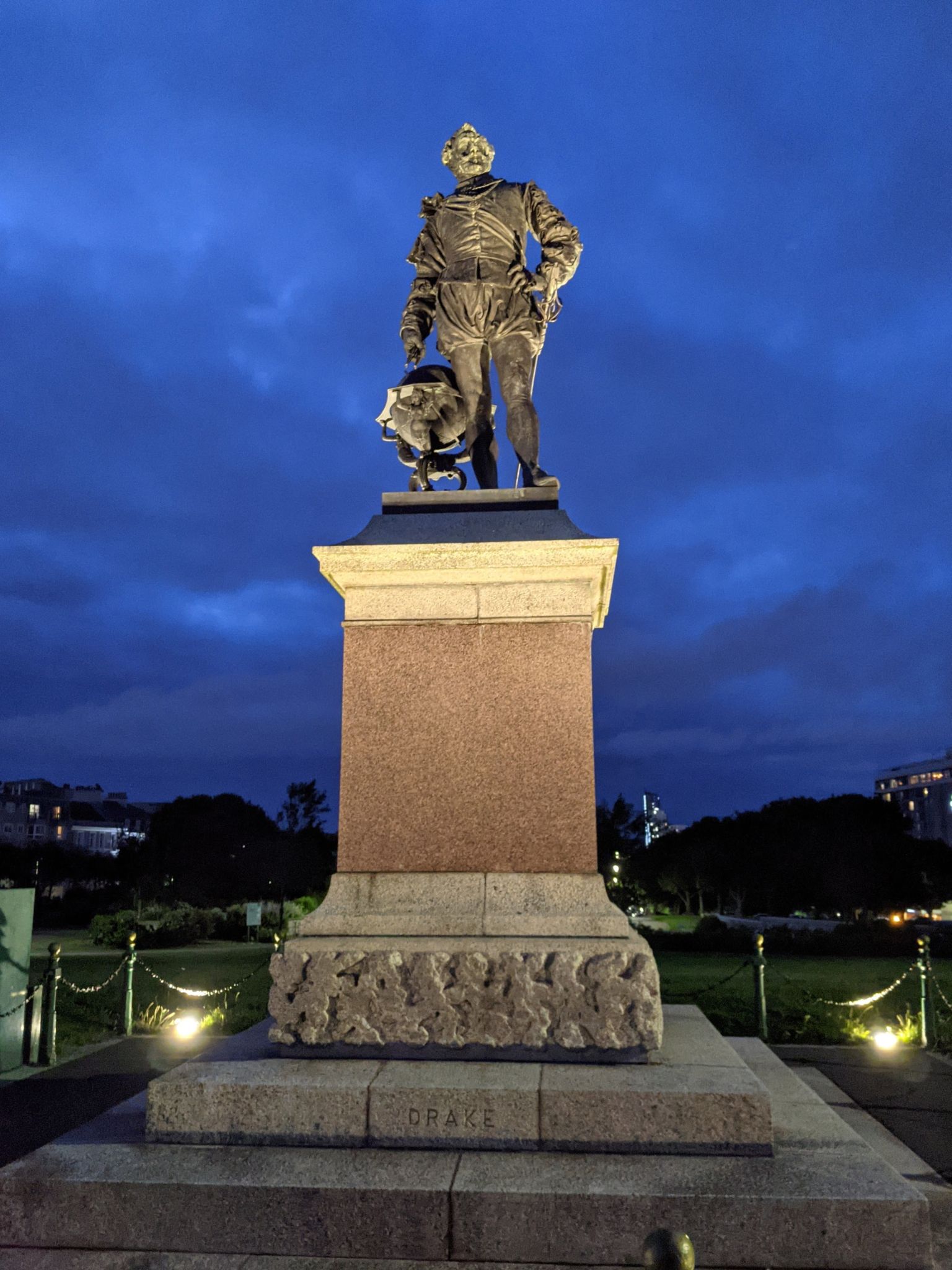
The “Barbican quarter” is that part of the waterfront old town that was spared from both Nazi bombs and British town planners, and was lively and active in a “virus, what virus?” way. One chippie had a terminal trying to sell me Bitcoin; I demurred and got a battered sausage. Sutton Pool, the oldest part of Plymouth, is now a mix of trendy Waterfront Development, antique party district, and – most surprisingly – actual real live fishing boats. Plaques commemorate the setting-off points of the Mayflower (and the first colony ship bound for New Zealand – hands up who knew it was called the Tory?) I didn’t see anything about the Armada – the English fleet that sailed out to defeat the Armada did so from Sutton – but given the general Pro-Drake vibe scattered around the town I’m sure it was there somewhere.***

I took the little yellow crossharbour ferry south to Mount Batten – it was not called the Spirit of Lord Louis, which I felt was a missed opportunity – for a wander in the hills, where polygonal forts are known to dwell. But in the interests of manageable post length, that’s a story for another day.


Out West 2021 

Out to Penryn – St Mawes and Falmouth – St Austell and PlymouthThe Forts of Staddon HeightsDrake’s Island and Saltash Totnes and Exeter

* OK, yeah, it’s a cab and obviously they don’t pay taxes, but I didn’t have any cash because it’s 2021 and one way or another I haven’t needed it since “coronavirus” first entered the wider public vocabulary.
** Every single town I visited this holiday had a barbershop with a big black window design showing some variant of a skull and crossed razors. I noticed the pattern here, although it was the third I’d seen.
*** Well. Weather defeated the Armada; the English acted as auxiliaries and support staff to the weather.

Cornish Riviera Express

I never fail to be surprised, every time I go further west than Bristol, that this country is actually wide enough for a five hour train journey. The first segment is familiar, constantly saying hello to the Kennet & Avon canal, and town after town goes by, with clutches of clean redbrick new builds going up at their fringes, offensive in their shrunken living spaces and distended profit margins rather than their utter visual blandness. Entering Plymouth, a trio of arches across the river earned a curious google (the remains of an 18th century amphitheatre, apparently), and the citadels of the huge Royal Navy dockyard a murmured “I’ll see you in a few days”. West, the country gets more rugged and the crisp new Hitachi train feels more and more incongruous, a huge futuristic Brunswick-green missile nosing cautiously across buddleia-covered viaducts Brunel built. Dense, bosky tree cover, muddy rivers and tidal lagoons, and glimpses of the sea beyond.

At Truro I changed to a tiny little DMU, which took me down the old Cornwall Railway spur now branded the “Maritime Line” to Penryn (whose station, through some shenanigans with points, manages to get two platforms out of one platform). Obviously, it started to rain hard. I made my way to the campus jointly owned by Falmouth and Exeter universities, where I’d booked a room in halls for two nights. There were a striking number of Orthodox Jews around campus, and hand-lettered signage in Hebrew warning about the seagulls. I googled this, and apparently every year masses of Hasidim use the campus as a conference centre/summer camp together, brightening my evening with the peculiar spectacle of a number of serious, respectable-looking men in big cylindrical furry hats singing together in a slightly crummy student kitchen.

Penryn is a town of no great size but quite a bit of charm, the approach road tightly packed with little two-storey stone terraces with huge monolithic lintels of the local granite. It was an important port town in medieval and early modern times, when all an important port town needed was a warehouse, a quayside and a letter from the King; it lost that last privilege for picking the winning side in the Civil War, and was subsequently eclipsed by Falmouth, although the usual set of formidable Victorian public buildings on the high street show that it wasn’t left completely destitute. It doesn’t feel overly active (the intensifying rain probably had something to do with that), but it feels well-loved and well-preserved.

Continuing south, through a band of bleak marginal zone, all swishing roundabouts and fenced-off yards littered with the fibreglass corpses of yachts, I came to Falmouth proper. It’s much bigger and noticeably more touristy than Penryn, with an interminable (but still nice) high street of ethnic restaurants and characterful little tat shops – all stone dead at 1730, with the shop signs indicating that peak time was between 10am and 4pm. I explored the (closed) pier, the huge (closed) maritime museum complex, and across to thedockyards where at the huge technically-not-quite-a- hospital ship Argus was back from its trip to the Caribbean to support some Overseas Territories with the pandemic.

A little train took me back to Penryn and dinner at a chippie called Nemo’s (beef dripping chips! it’s been so long!) where I was told, if I fancied a friendly drink, to head down the road to “The Famous Barrel”. I ended up there, after some more wandering which took me around the site of Glasney College, namesake of my residence – Penryn had been an important site of Cornish and Catholic letters and learning until Henry VIII and the wars of religion rolled over both. I did get a sense later that some of these grievances are being dusted off again by people with Baner Peran bumper stickers.

It’s a fun little pub, with a magnificent collection of brass toasting forks (but a surprisingly limited cider selection), and as it got dark I myself chatting round a table with a group of locals (with leftover fishcakes and chips my new pal from Nemo’s brought), about the Device Forts and Brunel, about whale intelligence and dragonfly nymphs.  Sincere apologies for a) being from London and b) bringing the weather with me broke whatever ice was there (ok, they did say “chuck the emmet in the harbour”, but they didn’t actually do it). I stayed out late with one fantastic old bloke, whose dad had served on the Warspite and who had any number of lurid tales about working in a strip club in Soho in the sixties, and he gave me a lift back to the halls. The forecast for the next day was looking up.


Out West 2021 

Out to Penryn – St Mawes and Falmouth – St Austell and PlymouthThe Forts of Staddon HeightsDrake’s Island and Saltash Totnes and Exeter