More Thoughts and Sources on the Invasion of Ukraine

We are five months into the more dramatic phase of a war that’s been going on since 2014. The war has slowed to the point that new maps aren’t necessary each week, let alone each day. Since my first post about this I’ve been keeping Hot Takes mostly to close friends on Facebook but am pleased that my degree has turned out to be not entirely worthless. Here are some updates on useful sources, some particularly interesting articles I’ve read recently, and some thoughts on what comes next.

Sources

I continue to refer you to my friend Árpád‘s list of trusted Twitter sources, slightly edited but largely unchanged since February. All these people have so far proven valuable, informed, and reliable. To add to the specific sources I flagged last time (here’s that link again), I’ll add:

The Institute for the Study of War maintain both a constant feed of detailed text updates on the situation and a Twitter feed of maps and highlights.

Dmitri Masinski’s “War Translated” project translates phone intercepts and various Russian and Ukrainian language sources that would otherwise be inaccessible to an English audience. This should be seen through a very strong pro-Ukrainian bias (one of their regular posts is a translation of the daily broadcasts from Zelenskyy advisor and Ukrainian propagandist Aleksey Arestovych) but adds fascinating texture and is an unmatched source on the experience of the miserable Russian soldier at the front in their own words. Translations of people like Igor Girkin (a fantastically opinionated and singular loony – imagine if Dominic Cummings had a career killing people in the FSB) are an interesting window into what the Russian ultranationalist fringe are thinking.

Konrad Muzyka’s Rochan Consulting usually charge for their high quality intelligence updates but post the odd free piece – here’s the latest (24/07/22).  If I had unlimited money I would absolutely subscribe to them.

A few more thinkers who aren’t on The List but are worth a look at or follow:

  • Shashank Joshi is the Economist’s defence editor and the best informed commentator I’ve encountered in the mainstream British press.
  • Jack Watling of RUSI, Britain’s premier defence think tank (of which more below). Posts most of the important things you’d get from The List and has done significant in-theatre research.
  • Phillips O’Brien is an involved and interested historian. He wrote a widely panned piece about the death of the tank but is otherwise pretty sound and covers sources others don’t (fire data, for instance).
  • Kamil Galeev posts some fascinating (although frequently quite… “out there”) takes about Russian culture and politics which are interesting to think about even if you dismiss them afterwards, eg 1 2.

Trent Telenko has turned out to be the windbag charlatan he always sounded like, and Oryx has become universally acknowledged as the best open source lost equipment tracker and is also tracking commitments and deliveries of Western aid.

Individual Articles

A report by Jack Watling and Nick Reynolds of RUSI, based on in-theatre research, examines some of the newest and most technical aspects (UAVs in high-intensity warfare in particular) of the war and what should be done next. It follows on from another excellent piece in April, here. (I’ll say I don’t think Watling calls the war 100% right but he has insights nobody else does.)
Ukrainian journalist Nataliya Gumenyuk has written an absolutely fascinating piece on the vigorous wartime civil society in Ukraine: fighting an intolerant, autocratic, militaristic Russia, hostile to any form of activity it doesn’t control, Ukrainians are setting out to be everything it is not.
Michael Kofman and Rob Lee, two analysts who’ve got almost everything right so far, on Russian force design.
The New York Times produced an accessible – by which I mean overproduced and slightly human-interest-sensationalised but otherwise excellent – account of the Azovstal siege here.
Lawrence Freedman is reliably fantastic on his Substack; recent articles here and here.
Bruno Tertrais has written a cogent and necessary argument undermining the increasingly tedious Russia-nuclear-threat hysteria cycle.*
A Foreign Policy article about the practical impacts of Western sanctions on Russia.
And some interesting, specific threads (many by random and unvetted thinkers who might be more Telenkos, but through people I trust) on: tanks, Black Sea grain ports, grain politics, attrition, actual weapons deliveries, and AI target recognition.

Bad Takes

On a few sources which really aren’t worth paying attention to: obviously nothing emanating from a Russian state source is to be trusted; their entire policy is to tell five random contradictory lies in order to obscure the truth. Individual Russian non-state actors like Girkin are much more interesting but remember they’re usually going from their own fanfiction idea of what the Russian armed forces are capable of. Various big names of last century’s political science like Chomsky and Kissinger are occasionally weighing in with morally and intellectually supine fatalism pretending to be realpolitik, blended with a bizarre willingness to believe Russian lies: I have written them off as weird deluded has-beens and you should too. Finally, the Guardian, although it has a powerful “default” quality as the principal free online quality British newspaper, is comprehensively hopeless on war and should, with the odd exception, be ignored.

Thoughts

1. Russian victory. In terms of their February war objectives Russia has already failed many times over. But the outcome of a bisected Ukraine and an endless, miserable, semi-frozen war is not disastrous to Putin and co if they think their enemies will fold (or lose interest) first. Remember that they have been pursuing exactly this strategy, in Ukraine, for eight years. Russia doesn’t need to “win” in normal terms; their approach – in statecraft and in war – is to make everyone lose, drag everyone down into the same lying, bullying, brutal, cynical hell they exist in and pretend no alternative exists.  They will pretend, in bad faith, to negotiate the moment the military calculus turns against them. The temptation of a bad peace needs to be resisted: Russia must be defeated, removed, humiliated, and prevented from doing this again.

2. Ukrainian victory. Ukraine has successfully fought Russia to a standstill and will spend the next phase of the war further eroding Russian capacity before counterattacking. At some point – and it may take years – this process will end and a line will be drawn somewhere east of the Dnieper, either because Ukraine has run out of men, arms and willpower or because they have reached their old borders. There is currently no appetite whatsoever to cede anything to Russia and the slaughtered Ukrainian civilians in every reclaimed town show what Russian occupation means. Nothing is certain, but nothing suggests victory is impossible.

3. It’s increasingly clear that Russia is reaching the limits of its (politically deployable) manpower reserves and its weapons manufacturing. It also doesn’t currently seem to have a good plan for overcoming this, and in both men and equipment is robbing Peter to pay Paul. I don’t want to underestimate Russia’s willingness to feed men into the grinder or the power of the state machinery that compels these men to go. But I think and hope their forces will only dwindle over time.

4. Arms for Ukraine. Jack Watling’s report goes into this in more detail but NATO needs to consider sustainable long-term support, ramp up defence production for a long war rather than handing over Cold War leftovers, and allocate production among Ukraine’s supporting nations. This sounds a big ask but the indicators so far are positive. Supplies of artillery shells and rockets are massive and consistent. The most interesting headlines I’ve read recently are Poland’s plan to wholesale replace their armoured vehicle inventory with new Korean hardware, which would essentially provide Ukraine with an entire country’s worth of tanks and APCs, and America training Ukrainian pilots on F-16s. The long term auguries are good.

5. HIMARS. It’s just one system and Russia will – eventually, glacially – adapt to it. But in the short term it has made a massive difference, annihilating Russian ammo dumps and command posts and hugely reducing their principal advantage in massed artillery, without which the Russian army is a bunch of poorly motivated hooligans with bad infantry-armour coordination. ATACMS soon, I hope, and unlimited M31 missiles in the meantime.

6. The “grain deal” and immediate subsequent strikes on Odesa were somewhat predictable. Anyone expecting Russia to take any action but the most cynical and dishonest available is taking the first step on a short road to disappointment. Hopefully this will backfire and undermine Russia’s influence in the Middle East and Africa, and hopefully at least something will result from it in terms of getting Ukrainian grain out into the world. But Russia can and will strike at fields and granaries; famine and mass human suffering is a feature of their war, not a bug.

7. What happens next? Kofman confidently predicted (rare for him) a massive set-piece assault battle near Slovyansk and Kramatorsk, but that was before HIMARS deleted fifty ammo dumps and started hitting the southern Dnieper bridges. Everyone has got very excited about the Ukrainian counteroffensive in Kherson oblast, which is hotting up. I got excited about the prospect of one back in April, but I think (and hope) the big push won’t start for a while yet and Ukraine are continuing to erode Russian forces before attacking with as much power as possible. Ukraine’s first real counteroffensive will be enormously symbolically significant and it needs to be successful. I think the Ukrainians, who have shown good strategic sense so far, recognise that getting it right matters more than doing it soon.

8. The big worry is that Ukraine is now entirely reliant on NATO arms and various domestic factors erode Western political support for the war. Popular support is obviously unpredictable, but I think we worry a bit too much about this for two reasons. Firstly, our understanding of war-weariness comes from a recent experience of endless, distant, morally dubious sandpit insurgencies with no plausible victory, not a war on our doorstep with clear right and wrong and a clear and achievable positive end state. People like supporting winners and just causes. The crisis is already here and popular support is showing little sign of waning. Secondly, the governments most likely to fold are those which are already of doubtful value as allies (Germany, which seems structurally unable to think about anything but how it’s going to go back to its profitable existence selling Russia weapon-making machine tools for cheap gas; Italy, defined by hysterical daytime-TV politics and as comically irrelevant in this war as in every other war since Lepanto***). The allies that actually matter – Poland, Britain, the rest of EE, and the US – are in their different ways more resolute. Even completely discounting the idea that Western electorates can value a Ukrainian victory and will continue to support it – which I don’t think we should do – I cannot see any circumstances in which Poland and the Baltics stop backing Ukraine to the hilt, or where it’s not worth the US and UK spending what is honestly pocket change to continue the destruction of Russian military power with other people’s blood.

9. The first part of this war was an aberration caused by Russian strategic hubris, and the lessons learned from it have very little value. There are a lot of breathless thinkpieces from that time predicting things like the death of the tank, which have already dated incredibly badly.


* It goes like this:
1. A Western actor proposes to do A Thing;**
2. Russia, via its diplomatic corps or frothing daytime television presenters (legitimately hard to tell apart sometimes) issues a pronouncement to the effect “hey remember we have nuclear weapons”;
3. Useful idiots and talking heads who first discovered deterrence theory in March freak out and say (amplified by irresponsible clickthirsty media parrots) that doing The Thing is the line that must not be crossed, Russia is serious this time and we are gambling with terrible stakes, why die for Danzig?!;
4. The Thing happens anyway;
5. There are literally no consequences because Russia has already shot their bolt, has no way of escalating, and isn’t going to burn down the planet over The Thing;
6. Repeat.

** e.g., ATGMs, jets, tanks, anti-shipping missiles, artillery, Sweden and Finland joining NATO, HIMARS, or dozens of other examples, it keeps happening. Everyone has now realised this except possibly the German government.

*** And that’s being generous by counting Venice as Italy.
Thoughts and Sources on the Invasion of Ukraine

I’ve spent the last week and a half glued to news feeds of the ongoing Russian invasion of Ukraine. This is, in a sense, something I have spent half my life preparing for: the formal training of tactical, operational and strategic analysis from my degree, the informal source-analysis training of a life bullshitter-spotting on forums and social media, and the tragic fact that I find it fun to chat about post-Soviet weapons systems with a lot of people for whom GRAU codes and NATO reporting names are a third language. I’ve found myself making observations and predictions on how the war is going to be shaping up and it turns out I’m very good at it, though not enough that I want to do so publicly and add to the – to steal a phrase – already densely betwatted military-speculative complex. So I’m going to share some good explanatory articles and some trusted ongoing sources, people who know a lot about this and whose actual job it is to talk about the war all day (some are even getting paid).

Also, not to be all “DON’T TRUST THE MSM” but I have found even relatively trustworthy news outlets on other topics are hopelessly behind the tactical reality and full of pointless opinion pieces from self-evident wingnuts screeching about vacuum bombs, no-fly zones and nuclear war. I get this is Just How Modern Meeja Be, but it’s an unbelievably tiresome waste of time when dealing with fast-paced events that require specialist knowledge to understand.

Sources

Here’s a Twitter feed of trusted sources, put together by my friend Árpád who is even more terminally Into this stuff than me. It’s a mix of exceptionally clued-up, reliably correct academics and experts, and people actually on the ground. There’s a lot there, it updates fast and there are lots of pics of blown up tanks, so let me draw out some particular users worth following:
Michael Kofman. Kofman is the premier online expert on Russia’s military aims and capabilities and has so far called basically everything right. The only thing his eve-of-the-war map got substantially wrong was missing the Mariupol corridor.
Mark Galeotti. Galeotti is a trusted Russia-watcher and expert on the politics and history of this all. He’s not super active on Twitter (to his credit) but he does post links to articles and interviews hosted elsewhere, which are always worth a read/listen (use 12ft.io to get around paywalls, they’re often on trash sites like the Telegraph.)
Oryx. Oryx is an open source intel aggregator working up a list of confirmed casualties (equipment, mainly) on both sides in this war. They did it previously with the Nagorno-Karabakh war. Caveat: they’re only as good as the intel being posted publicly, and there are much fewer pictures of Ukrainian casualties being shared, so Ukrainian losses are probably higher than Oryc can report. However, this is an excellent source for the astounding amount of equipment the Russians are currently losing.
Nathan Ruser’s maps. Almost all maps I see elsewhere look at the furthest extent of Russian advance and assume everything behind it is under Russian control. This is wrong and stupid. These are OSINT-based, regularly updated projections of the actual areas of Russian control in the country.
(added 07/03) Overt Defense produce excellent liveblogs and regular summaries of what’s going on day today. If you want to keep close to the action but don’t have the time to follow in real-time, it’s worth following them.
(added 07/03) Meduza.io is one of the last vestiges of a free Russian press. For general content on Russia in both English and Russian they are hard to beat.

(added 07/03)  Interesting people I watch but have reservations about: Christo Grozev at Bellingcat mostly produces some sound OSINT and analysis of OSINT, but also posts dumb alarmist nonsense about nuclear war. Trent Telenko has got a lot of attention for threads about tyres and makes some good points about logistics, but overall doesn’t seem to be a particularly deep or informed thinker. Illia Ponomarenko at the Kyiv Independent posts good stuff earlier than anyone but his enthusiasm sometimes verges on Ukrainian propaganda. UK MOD’s Defence HQ channel gets things factually right and is faster than most “mainstream” sources, which still makes it slower than OSINT, and it is also, obviously, an organ of the British government.

Articles and Writers

Bret Devereaux is the single best public explainer of military history currently operating on the internet. Everything he writes is worth a read but I’d start with his highly accessible understanding of the historical, political and strategic context for the war. He’s also written an intro to protracted war which is entirely correct, but which I pray is going to be less relevant than he thinks it is.

Lawrence Freedman has produced several astute reads on the situation and made accurate predictions. I’d recommend some very lucid articles here, here and here.

Mark Galeotti is the Russia-watcher I most trust. It’s worth reading some of his actual books, but for something more up to the minute I’d recommend his article on why this is the end for Putin and his interview on the current Russian political context (30m audio).

This War on the Rocks article on Russian logistics is prescient and very helpful for understanding why the picture for Russia on the ground is generally worse than is understood.

Thoughts

(written 06/03, so we’ll see how badly this all dates)

1. This is not the third world war. NATO has already given the clearest possible signals that it will let Ukraine burn to the ground rather than risk a confrontation with Russia which could go nuclear (which is a horrible call but probably the right one). Proxy wars between nuclear powers are not new and while it suits the headline-driven panic-cycle media (and the individual human need to get people’s attention with dire pronouncements) to talk up the chances of Putin going bonkers and planting mushrooms on European capitals, it’s not at all helpful. (I’m not going to waste time debunking it, calm down, but I’ll add a good debunking if I find one.)
2. There is nothing particularly “new” or unprecedented about this war (so far). We have already seen the use of drones, the militarisation of social media, war videoblogged in real time, media-narrative-driven fascism, large-scale conventional combat with tanks and modern jets, the deliberate/indiscriminate use of unguided weapons on civilians, and Russian invasions of sovereign states, all over the place in the last twenty years. There are some rancid takes out there from journalists who should know better about this being the “first social media war” or “unprecedented brutality”. Nothing is happening here which didn’t happen in Syria/Armenia/Georgia/Iraq/Afghanistan/Chechnya. The chief difference here is it is happening to a white Christian European country which you can walk to from the EU in a day.
3. Russia cannot win. There is already no possible win state that Putin can sell to his people. They have already lost too many people, too much credit, and taken too much economic and cultural damage for this to be a positive. This doesn’t mean that Ukraine will win. It just means that this was a disastrous waste of time even for Putin. Personally, I have no doubt Russia is going to lose, and lose quicker and more badly than most people expect. Russia’s ongoing collapse into a parody of fascist militarism is terrifying, and I can only hope it collapses still further and the entire state crumbles – although last time that happened it didn’t go great for the human race either.
4. There is no good argument for this war. There is a certain category of whataboutists and useful idiots in the Western political space who see (or want to see) no difference between the voluntary NATO and the at-gunpoint Warsaw Pact, between Ukraine’s (sometimes troubled, sometimes struggling) democracy and Russia’s violent, kleptocratic autocracy, and between a Peter the Great-era world where regime changed required you to march a hundred thousand bayonets to the enemy capital and our modern age where economies can be gutted, governments undermined and cities vitrified without anyone having to leave their office. They advance the view that by trying to choose a life other than that of a sclerotic, Russia-dominated buffer state, Ukraine is threatening Russia’s rightful imperial entitlement (they use the phrase ‘sphere of influence’ but it’s the same thing) to do what they want to their neighbours. This is a point of view, and is one that Putin’s siloviki actually believe. But they are wrong, and beyond seeing where they’re coming from we are no more obliged to accept their psychotic view of the world than we are to accept any of Hitler’s arguments that he was entitled to murder everyone between him and the Urals. The Russian regime is a cabal of paranoid thugs too mentally ossified to realise that the Cold War is over, they lost, and the game has changed. It is a monstrous throwback which needs to be killed. I don’t know if that will happen this year, but I think it can be beaten and shamed.
5. If any one of the following four things collapse this war will end. a) Ukrainian will and ability to fight, b) Russian will and ability to fight, c) the Putin regime, and d) the entire Russian economy. The only one of those which is definitely not happening in the next week is the first.
6. Russia still thinks Kyiv is the strategic centre of gravity, yet never had a realistic plan for taking it. Kyiv is a dense megacity with Soviet-capital levels of fortified bunkers and air defences, straddling one of the greatest rivers in Europe, and full of highly motivated and well-armed people. I don’t think Russia can even manage a plausible encirclement, let alone either the sustained siege or urban assault needed to capture the city. None of the potential moves available to Russia – try and to flatten the city with dumb bombs, have forces east of the Dnieper smash pointlessly into the eastern districts of the un-encircled city, or have the Crimean forces abandon their objectives to try for an improvised encirclement from the south – will work, and all will only play into the Ukrainians’ hands. So I hope they do all of them.
7. The most important known unknown is what state the Ukrainian military is in. I have no idea how much they’ve lost, and that more than anything else will shape the war to come.

Finally – yes, I went back into my Chernoblogs and changed the spelling of “Kiev” to “Kyiv”. It didn’t matter to me then; it does now.

krai me a river

My first city in its first winter.

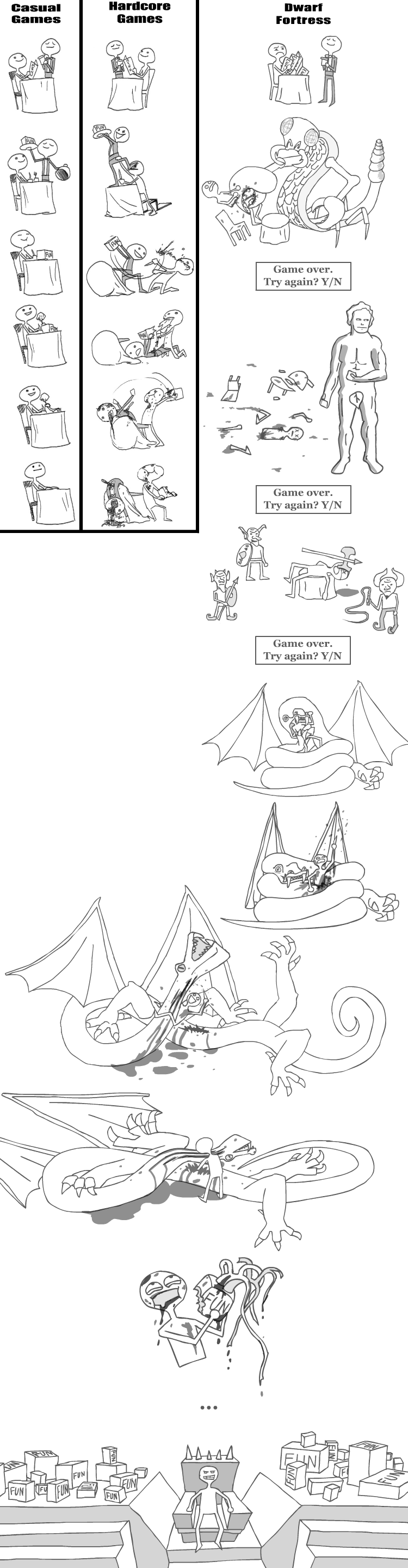
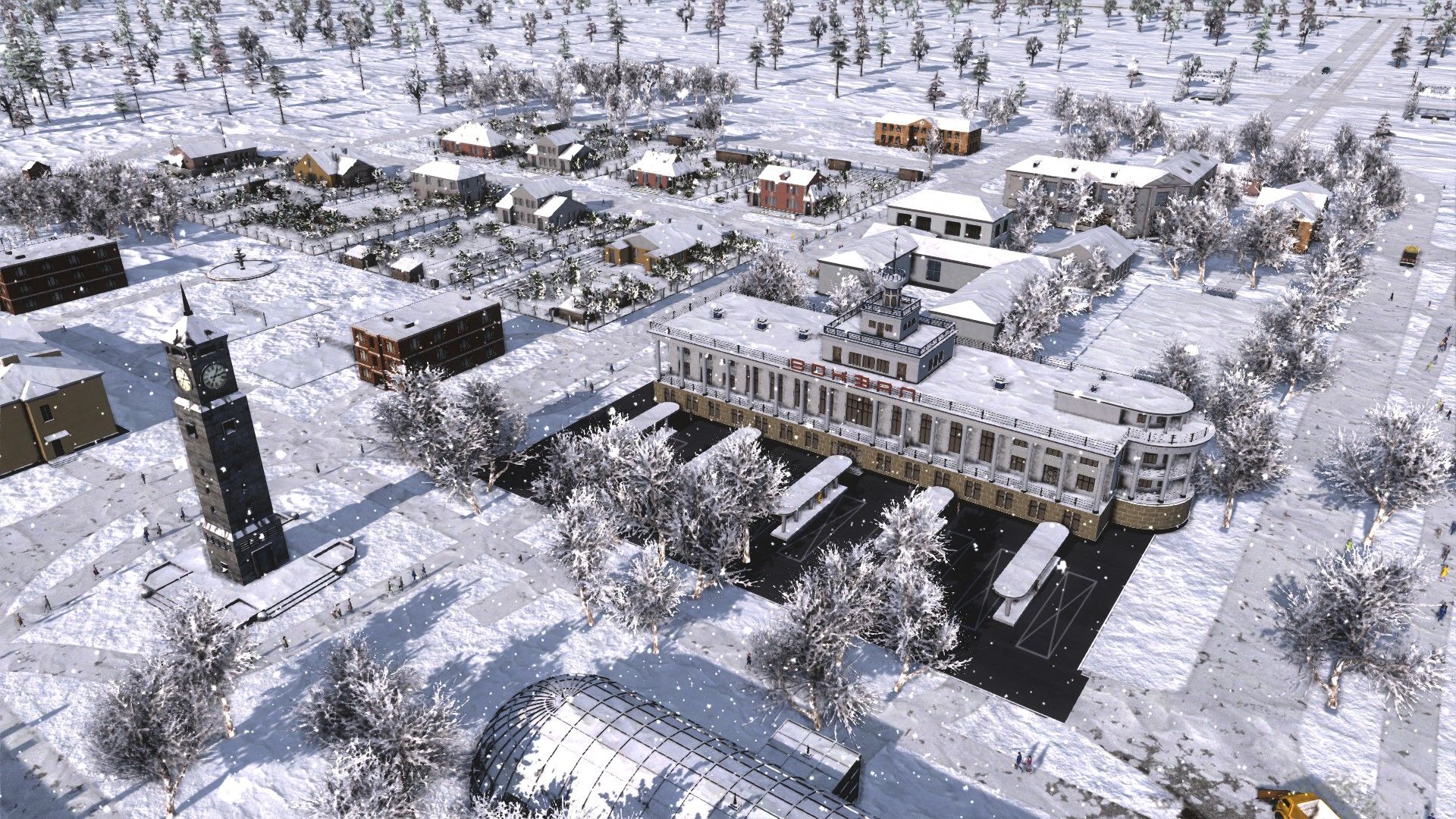
Workers and Resources: Soviet Republic is the most complex, and thus obviously the best, city builder ever made. For those who know the genre, consider the sophisticated supply chain optimisation of Factorio or Satisfactory plus the managing population demands of Banished or Surviving Mars (complete with oh-god-you-screwed-up-everyone’s-starving-to-death failure spiral) and a fair bit of the classic trains-and-logistics TTD gameplay. It doesn’t have a difficulty curve so much as a cliff, which makes the payoff of eventually getting everything working a lot like that old Dwarf Fortress comic about fun.

Continue reading “krai me a river”

blue powder monkeys

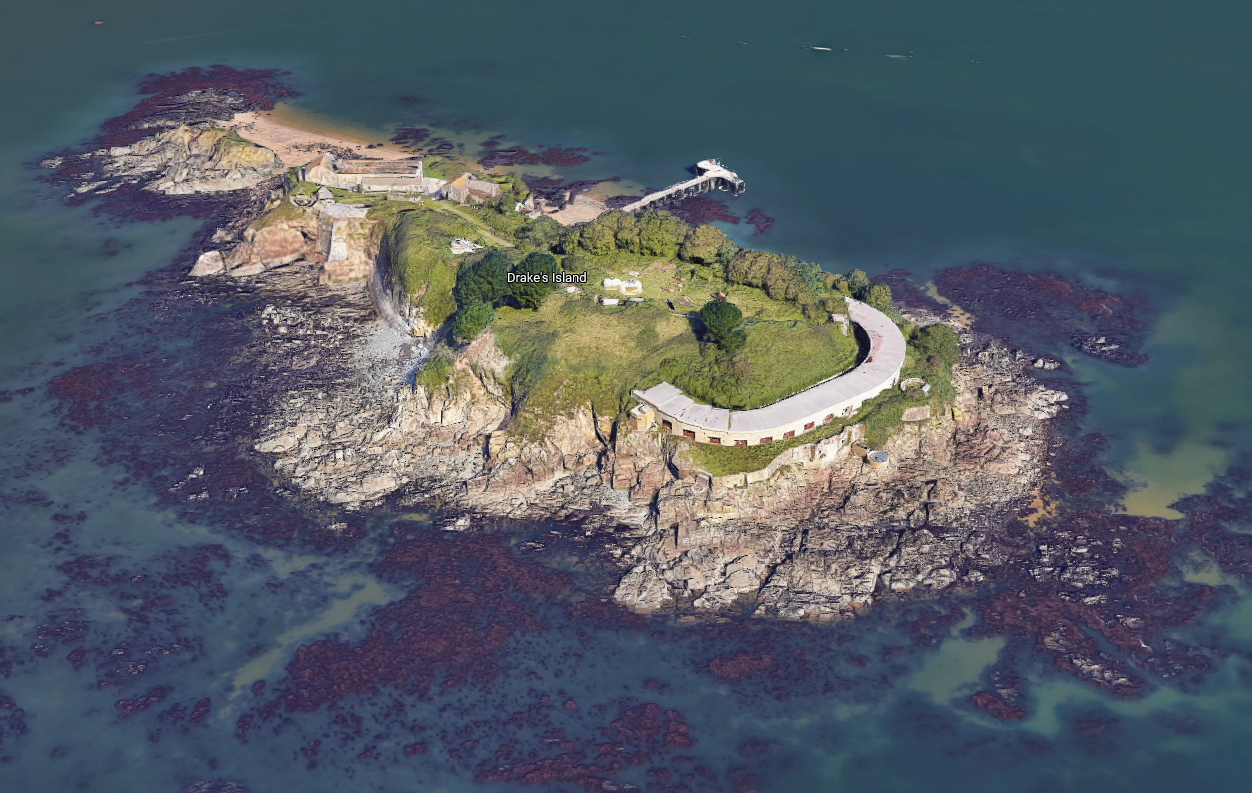
Drake’s Island sits in the throat of Plymouth Sound like a heavily-armed uvula. It has been densely fortified ever since a fortification could do more to passing warships than swear at them, making it the sort of nautilus-shell of accreted defensive architecture (1940s gun mountings on Edwardian emplacements on Victorian casemates on Tudor etc…) that’s irresistible to, well, me. There are a great many Plans in train to redevelop the island as more of a tourist destination (which normally gets me a bit worried, but the explanation of the plans on the day – not to mention the sheer quality of the people involved ­- was reassuring). To support this development the owners are running occasional paid tours – a sort of tourism-bootstrapping procedure, and a chance to see the unrestored parts in their current state of romantic decay. And happily, one was running when I was in Plymouth.

The island as it appears on Google Maps
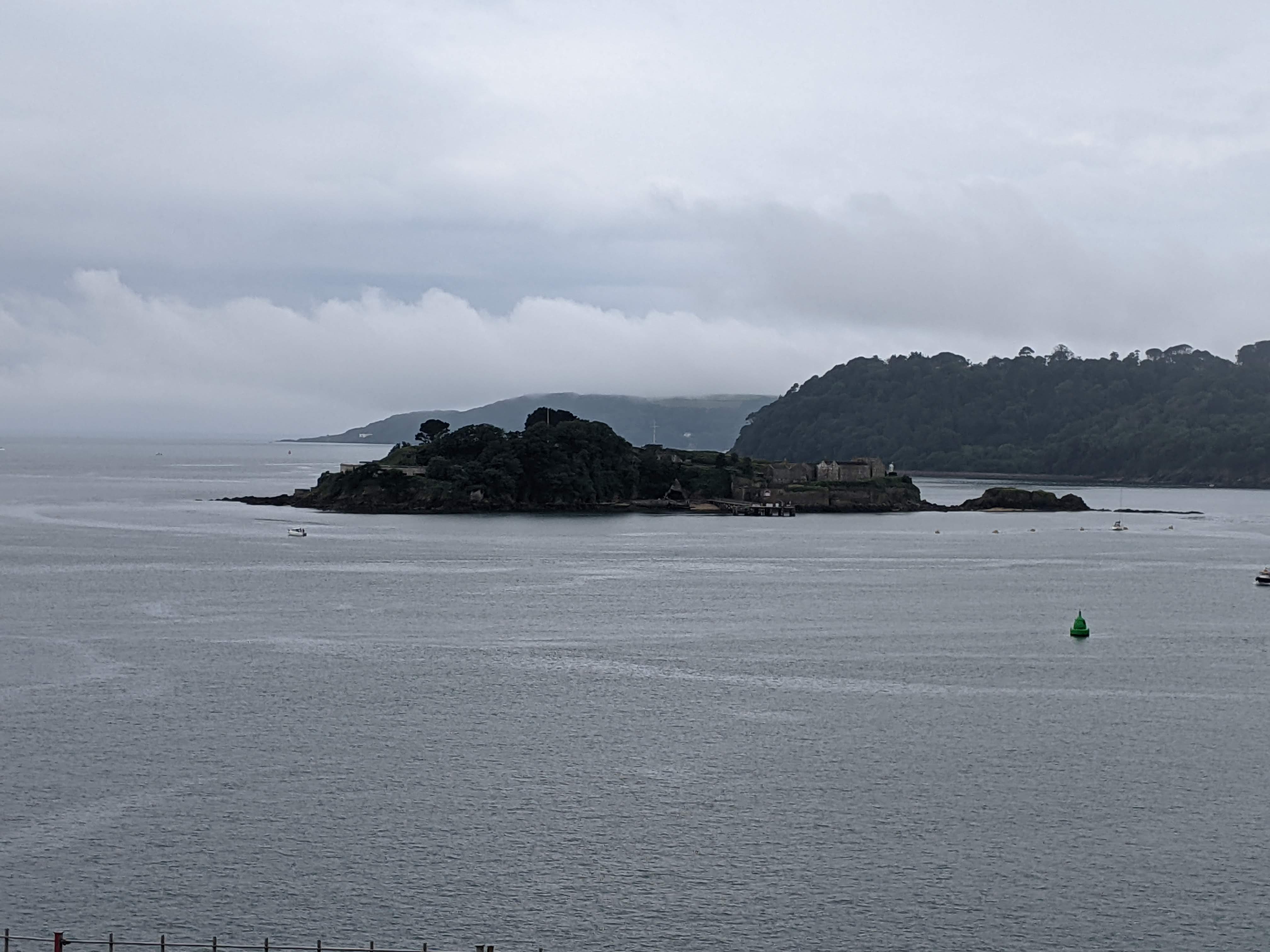
…and as it appeared one brisk August morning.

The ferry “Silver Crest” picked up a mixed group of welly-wearing enthusiasts from Mount Batten Pier and crossed the Sound, mooring at a pier charmingly plastered with DANGER, UNSAFE LANDING STAGE signs. Most of the visible structures – as well as the island’s current name* – are the fault of the Victorians, with a huge casemated Palmerston battery front and centre. However, the island was also refitted as an adventure camp in the 1960s, and the idea of being an unsupervised kid let loose among all this gives a deliciously life-threatening sense of vicarious adventure which really adds to the vibe, as does the visibly collapsing old boathouse.


The buildings – which will house museums and proper heritage exhibits, now that various oligarchs’ ideas of turning the place into a luxury helipad hotel have been denied planning permission – could definitely use some TLC but are probably no less habitable inside than they were in the 1870s, and the warden told enjoyably lurid stories of bored men, supply theft, Victorian colour sergeants and bumboat-women. Various casemates are going to be turned into cocktail bars,** but the best-preserved will be put into order as replicas of the actual gun positions. It was very encouraging to find that the warden not only really knew her stuff but actually cared about how things ended up.

“This was all covered in ivy not long ago – that’s gone now, thanks to Elvis the goat and his three wives…”
“The gun shields are in a lovely state! Are you going to try to replicate the rope mantlets?”
“Yes! We’ve got a ropemaker working on them right now.”
“Are you going to try to mount one of the guns up there?”
“No, those are 12-inch RMLs and the casemates are for 9-inch. But we’ve located one of the original guns in the States and we’re having it brought over once the paperwork’s all sorted out. You wouldn’t believe what a faff it is to import artillery…”

Underground the fort was the standard Palmerston design language of arched brick tunnels, separate chambers for lanterns behind windows, and magazines once filled with copper-hooped barrels; the main difference was a load of small tunnels overhead which, the warden claimed, were in the original spec used by children carrying powder. I’m honestly not  sure whether to believe this*** but they must have been bonkers-fun to clamber about in as a child in the (19)60s and 70s, if you made it out alive.

Back on the mainland, I enjoyed the “Mayflower trail” walking the houses of the old town, culminating in the Elizabethan House Museum. This was an utterly surreal audiovisual experience told from the perspective of the house (doing a creepy crone voice) as it was occupied down the centuries by spendthrift wigmakers, brutally exploited laundry maids, failed merchants etc etc, setting out a fun saga of bankruptcy, violence, misery, and going to Australia (voluntarily or otherwise) with a mix of maternal indulgence and witchy cackles. It was Something Else, and would have been more enjoyable if the tour group weren’t uncomfortably large and if I hadn’t bumped my head fairly hard on a doorframe built for malnourished sixteenth-century shrimp-people. I headed back to the hostel to rest, enjoying the Citadel and various war memorials and grand old bits of architecture.****

The next morning, I took a bus west to Saltash (and – just – Cornwall), the road bridge across the Tamar giving a spectacular view of Brunel’s huge Royal Albert rail bridge, which looks both very Victorian and strikingly modern. There are little parks among the bridge’s piers, and Saltash felt like it would be a charming day out if the pandemic hadn’t shut down everything, including the local museum and the Elizabethan cottage I was looking for. Down by the waterfront was a little talking statue of Ann Glanville, and the Union Inn, painted in a giant Union flag (no guesses where they stand on Cornish independence!) and adorned with the kind of ludicrously, aggressively over-the-top murals that (this side of the Irish Sea, anyway) go beyond nationalism into comedy and almost approach art.

I went back to the station and mounted up on a hilariously truncated Intercity 125 trainset doing local-rail duties. It was time to head east.


Out West 2021 

Out to Penryn – St Mawes and Falmouth – St Austell and PlymouthThe Forts of Staddon HeightsDrake’s Island and SaltashTotnes and Exeter


* The island has variously been named after St Michael and St Nicholas, with Drake (who was at least the island’s governor) only really getting namesake credit in the modern age of romantic nationalism.
** Hopefully with drinks called things like ‘Grapeshot’, ‘The Palliser’ and ‘HMS Devastation’. If you’re reading this and thinking of running a coastal artillery themed cocktail bar, talk to me! I can do this all day.
*** Not that I’d put anything past the Victorians in child labour terms, but apart from anything else this fort had the kind of budget to hire adults to haul powder charges, and the kind of guns that needed them to.
**** The Boer War memorial is particularly good – it’s nice that the government***** decided to do something to commemorate the poor bloody infantry for that time we sent 400,000 of them to fight 25,000 farmers and screwed it up so badly we only won by putting the entire population in concentration camps. It’s not like the squaddies saw any of the gold and gems we fought the war for.
***** JOKES it was actually funded by a diamond merchant, in the name of a prince.

costa packet(boat)

The tides were not with the “Park & Float”, so I took the bus down from Penryn (clean, modern, on time, reasonably priced and everyone’s wearing a mask. Also – so far the single positive from this pandemic – everything takes contactless.) It passed the almost Genoese-looking church of St Mary the Immaculate and terminated at “The Moor”, Falmouth’s main square, all stout Victorian municipal architecture, cheery bunting and the cry of the gulls.

Finding a large pasty for breakfast was no trouble; determining which of the many different boats from the pier I should be taking to St Mawes only slightly more (another piergoer gave me a tab from his ticket which knocked 50p off the return.) The wind was up, blowing black Cornish flags hard across a low, leaden sky, and the “Duchess of Cornwall” was the first boat sailing that day. We threaded through the great flocks of parked yachts in the Carrick Roads, past a huge floating crane and the Argus.

I’ll post separately about St Mawes, that most beautiful and perfect of all Device Forts, but it was a cracking time, and a great pleasure to bring my model right up to the real thing.

Back in Falmouth (the ferry is very regular; children were crablining at the harbour) I refuelled and headed to the National Maritime Museum (Cornwall), a huge weathered-wood structure that recalled the Vasa’s housing in Stockholm. Rather than one galleon, it was absolutely chock full of smaller boats – everything from racing hydroplanes to ornate Maltese dghaisas, preserved fishing boats and a tiny dinghy called “Optimist”. The accompanying galleries deftly told stories of maritime history in general and Falmouth’s in particular. After the Restoration, the town picked up the status of Cornwall’s most important port from Penryn (much to Penryn’s dismay). It was known from late 17th to the early 19th century as the home of “packet ships”, fast mail boats carrying small high-value targets. Falmouth’s location as the first good harbour in the British Isles from the southwest, and a reliable place to send off fast boats rather than worry about the changeable winds up and down the Channel (not to mention hostile warships and pirates) brought it  considerable prosperity. In the 1830s, steamboats (and prolonged peace with France) destroyed these natural advantages and Falmouth’s port instead handled holidaymakers, Cornish emigrants to Australia and the New World, and warships, including acting as the setting-off point for the demented St Nazaire raid of 1942.

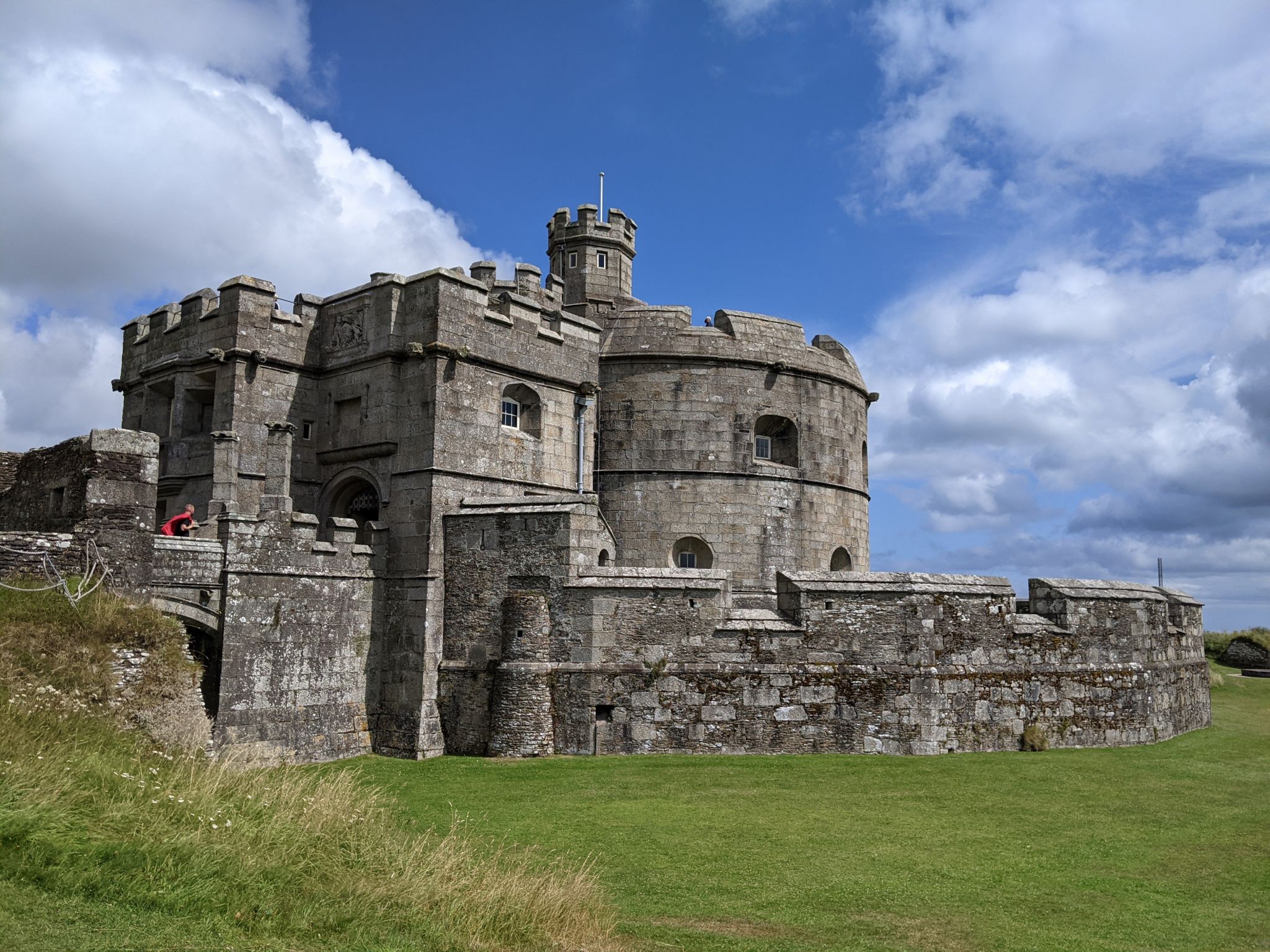
Leaving the museum, a stomp uphill took me into the sudden sunny calm of the west side of the peninsula, and along to Pendennis Castle. Pendennis is one of those marvellous old accretions of defensive architecture, with a Tudor core of similar size and vintage (though very different layout) to St Mawes sitting inside a giant 18th century bastion fort*, with Napoleonic barrack blocks, and that rare sight, Armstrong RMLs on classic looking fortress carriages.

The Tudor gun-fort itself has its original portcullis and the guide pointed out all the modern conveniences of value to the discerning mid-16th century king, like vents for powder smoke and internal loopholes for defence in depth. He also explained that the big square cutout below Henry VIII’s stone coat of arms was for the castle’s warden to put their own coat of arms in wood – a design feature I’d seen on loads of Device Forts but not made sense of before.

The fort’s perimeter has all sorts of wonderful pieces – a Victorian disappearing gun (the mounting wasn’t quite right but got the point across) and a fully equipped WW2 rangefinding station – the metal platforms for the depression rangefinders I’d seen in Gibraltar at last made sense. By using the rangefinder’s handles to aim its telescope at a target, the system would (through careful gearing) put a pointer on the exact location on a large map, giving you a ready-made firing solution. The Cornish translations of all the signs were charming – I now know how to say “dangerous explosives” and “little smasher” in Cornish.

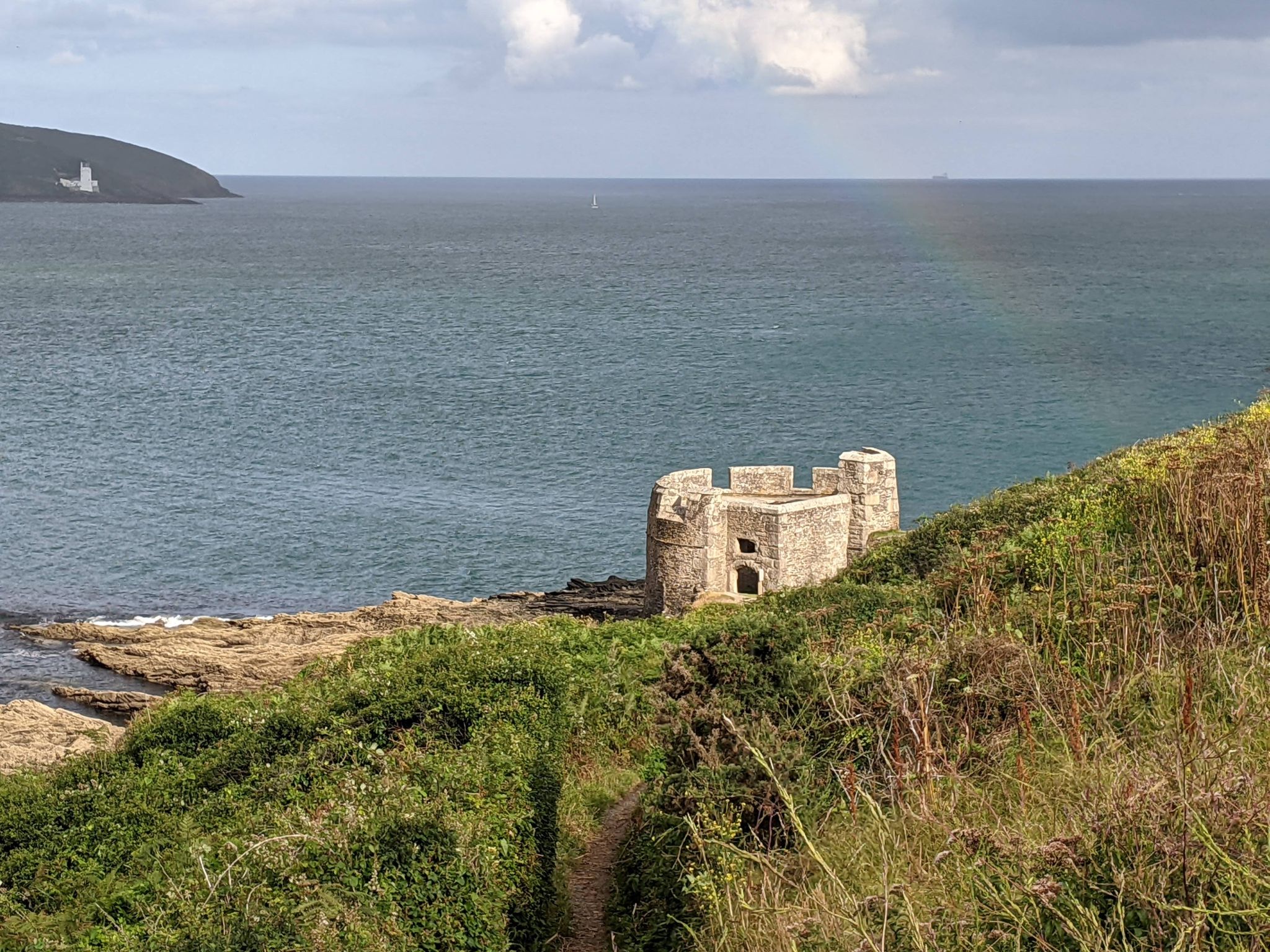
I took a circuit of the great sloping walls and descended to the southernmost point to visit the blockhouse “Little Dennis”, another Henry VIII survivor and one of the best preserved of his blockhouses (less substantial than a proper castle, more permanent than an earthwork battery; think a sort of 16th century pillbox) which now mostly only exist as floor plans. I sat in the main gunport for a while, enjoying the view across the Carrick Roads and the crazed strata of volcanic rock full of tidepools. As I headed back up for a bus home, the clouds, sun and rain conspired for a moment to pick out the blockhouse in glorious golden with a flash of rainbow behind it.


* Falmouth is one of a tiny handful of places in the British Isles with a proper star fort (of which I’ve seen Tilbury, Landguard, Fort George, Berwick-upon-Tweed and the barely-recognisable shambles around Sheerness.)

Out West 2021 

Out to Penryn – St Mawes and Falmouth – St Austell and PlymouthThe Forts of Staddon HeightsDrake’s Island and Saltash Totnes and Exeter


Not a Big Deal, part 3: Left to their Own Devices

If you’d like to purchase any of the results of this history-and-design experiment you can do so at my Etsy store here. Deal is up right now, Walmer will be soon!

“Three Castles of the Downs”, unknown artist, one of my main sources (both directly and for its obvious influence on other sources.) Also, GORGEOUS.

In producing these forts I’m striving to be as accurate as possible, but as any historian knows your conclusion can only be as good as your sources. Deal was ideal for several reasons: the overall structure isn’t nearly as mucked-about-with as other Device Forts (only St Mawes is really completely intact – Southsea and Walmer are barely recognisable) but the English Heritage page on its history is absolutely excellent and has a bunch of primary sources and historical depictions right there. For other castles I had to spend a while delving into other archives, mainly Historic England’s document library and the British Library. I also used some reconstructions in an Osprey book – but that had some problems, more on that later.

Floor plans

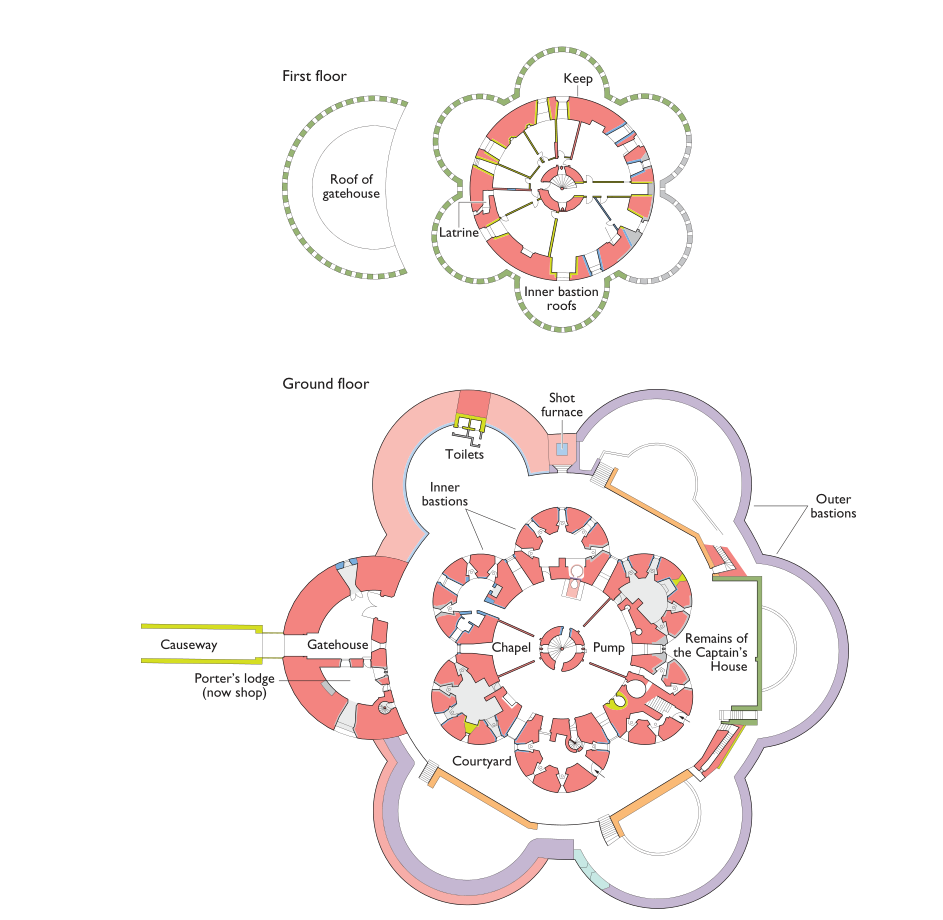
Deal Castle current floor plan (courtesy of English Heritage)

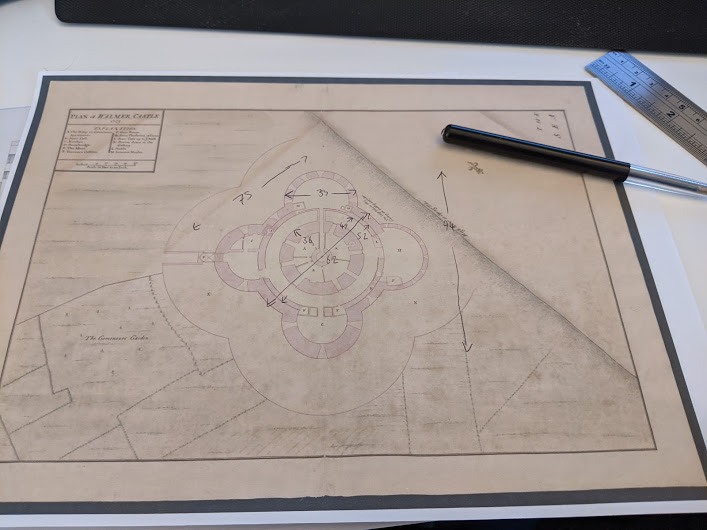
EH have a modern, lovely, very clear plan of Deal Castle right on their website, but for Walmer, the relevant page on the EH website is down and the structure has anyway changed much more radically in the last 470 years. In getting the dimensions for the base model and the layout of gunports etc I had to use much older, fuzzier maps; I made detailed measurements via the very old-fashioned expedient of printing off the plans and using a ruler for the relevant measures. (I found this ratio calculator really helpful for on-the-fly calculations.)

Working from a 1725 plan of Walmer Castle, the earliest good one I could find but nearly two centuries after its construction and shows Substantial Structural Mucking About.

Modern superstructure

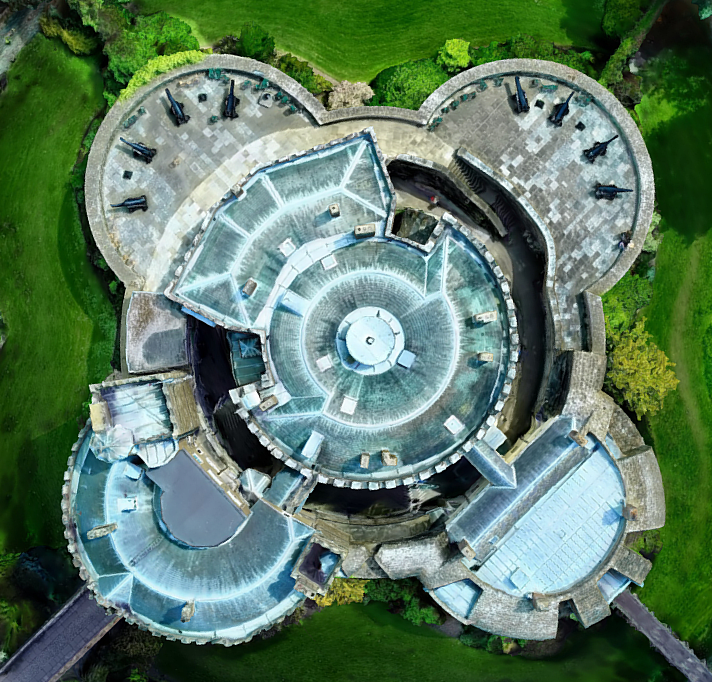
This was the easiest part to find good sources on, as, writing in the year of our lord 2021, drone overflights of interesting buildings are everywhere (have a look at this guy’s channel of remote Georgian fortresses and monasteries). For Deal I had a large number of high-res photos extracted from the unsuccessful photogrammetry experiment; for Walmer I found, as part of the same photogrammetry research, this exquisite 3d model produced from drone footage (this video, I think) which was itself great for checking tiny details.** However, this meant that I spent an absolutely silly amount of time on the roof tiles, chimneys etc etc which maybe I shouldn’t have.

Tudor superstructure

Three views of Sandown/Walmer before and during their later transformation.

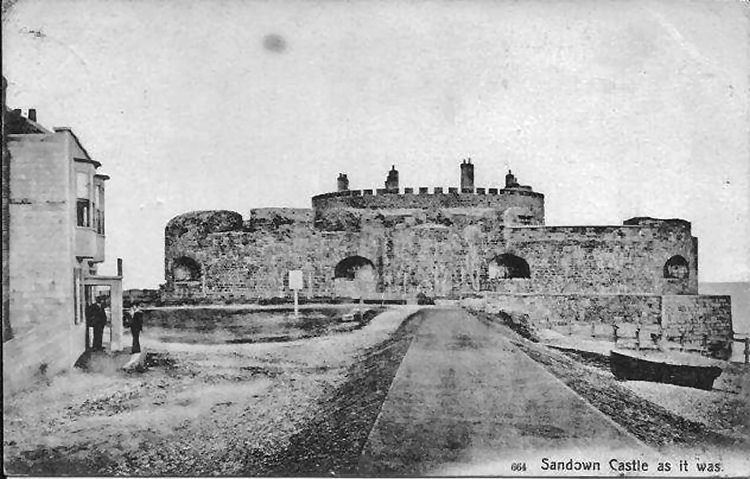
Now, this was much harder! There are loads of contemporary engravings showing the rough shape of the bastions (masonry parapets with rounded tops. and deep angled gunports), but a fair few of these are quite “figurative” and exaggerate certain proportions. Sandown castle was architecturally nearly identical to Walmer, so I had twice as many search terms, but there aren’t a lot of good plans of it about either. I did, however, find an 1860s photograph*** taken before it – as one source wonderfully put it – ‘became sport for the waves’.

I based my design for the ramparts on those on the left, as the design is exactly the same as in paintings and woodcuts but the proportions a little less ‘dramatic’.

I was able, from what little is left of the existing structures, to replicate the battlements and to conjure up a fairly convincing set of dimensions, but something that we may never be certain about is what the central keep looked like (although we know there weren’t any gunports in the sides). I’ve done my best based on the available sources and similar design features in other Device Forts, but it is sadly still a bit speculative.

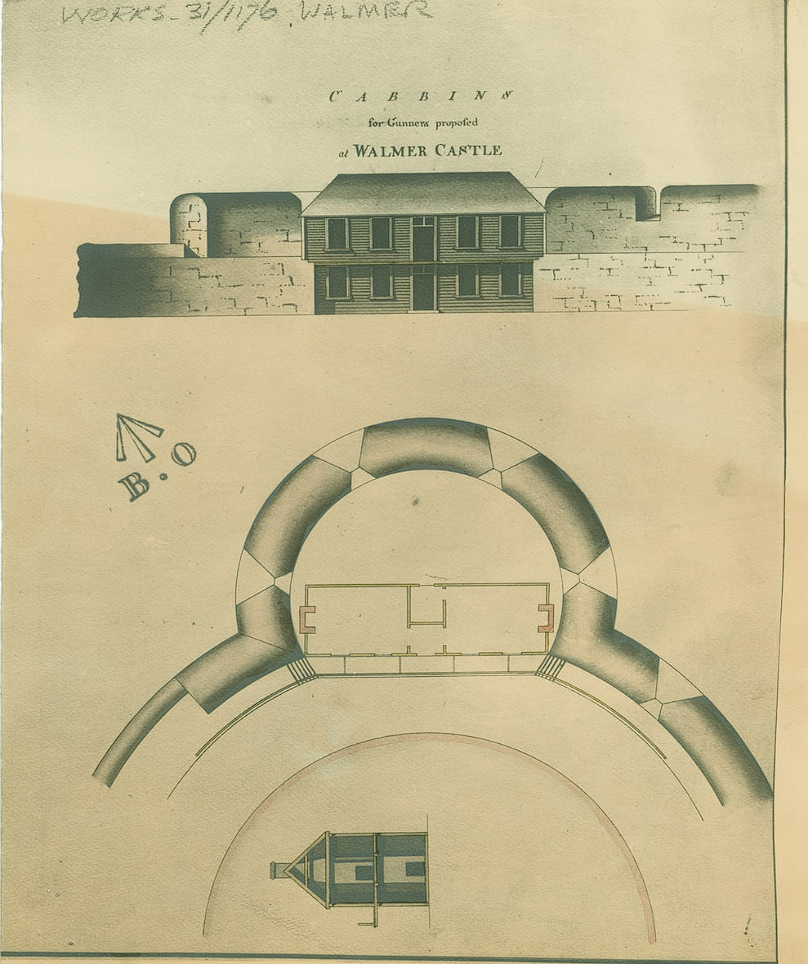
This is the only really good source I’ve found on both how high the battlements should be and what the original Tudor battlements should look like, from proposed construction work in the 18th century.


Historical Disagreements

Long time readers will be aware of my fondness for Historians’ Disagreements from way back in the A-Z of the IWOME. However, when it comes to assembling something from disparate sources, they are a huge headache! Here are two sources I looked at and dismissed elements of:

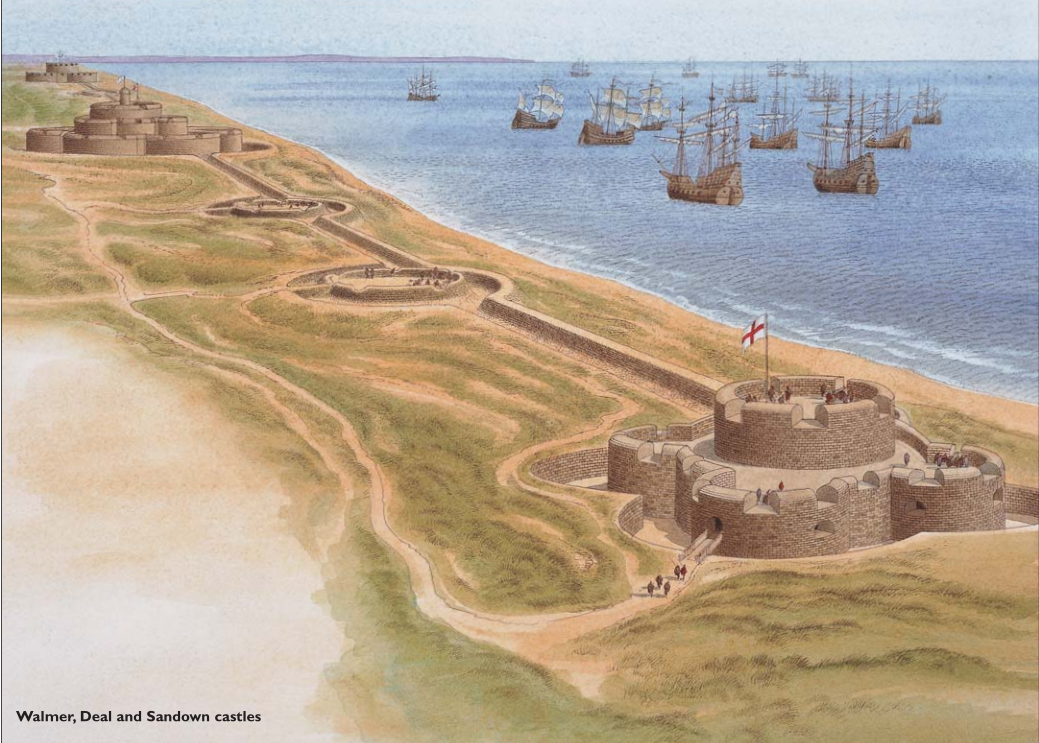
This is from the Osprey book linked above (generally quite good) and shows Tudor Walmer as part of a larger defence line. I think the general structure is roughly right but the number of gunports is wrong – it shows three per bastion when all other sources show four. I also think the central tower is too high.

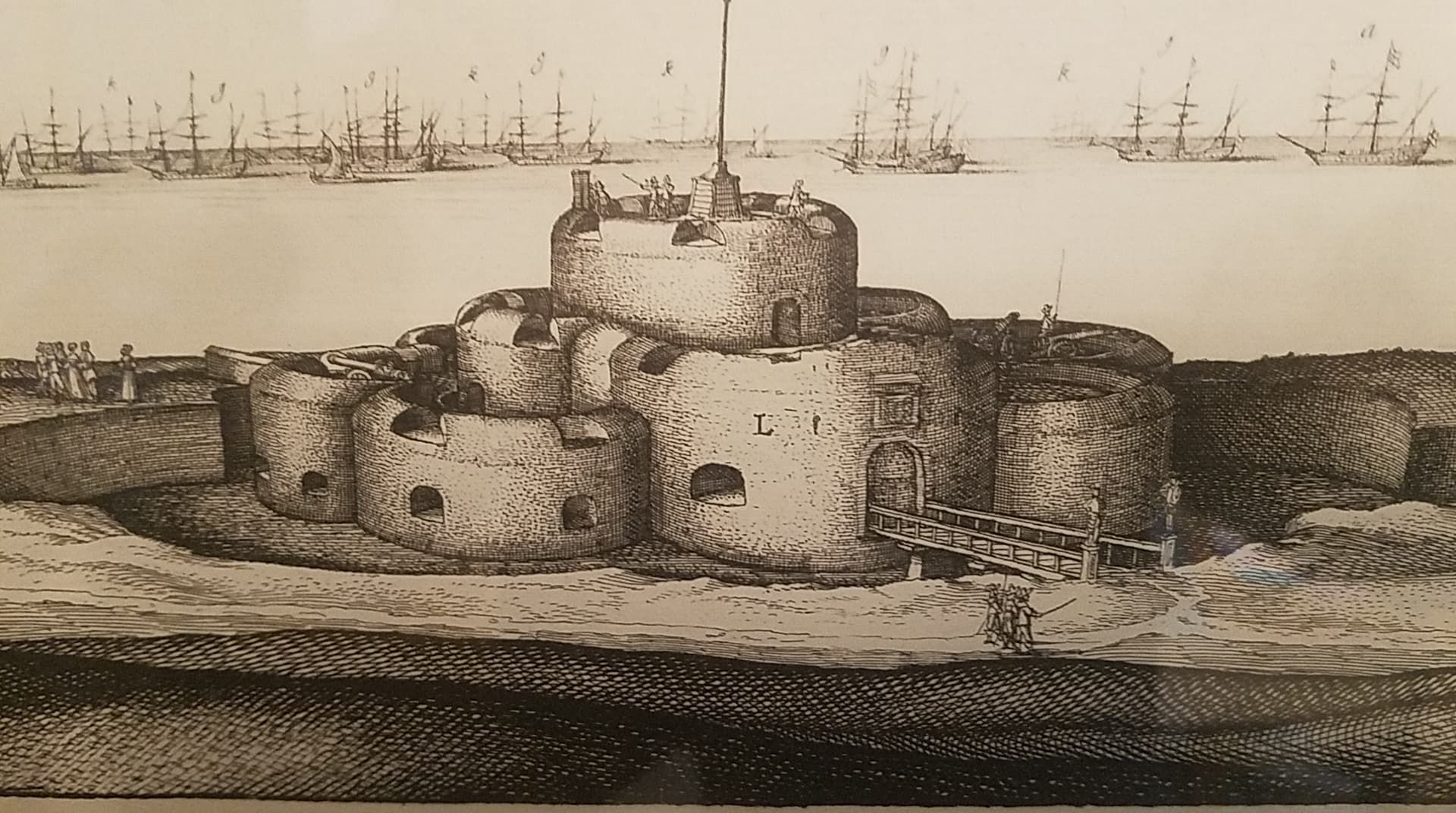
Meanwhile, this is an old engraving of Deal Castle which shows each bastion having two or three huge gunports rather than a bunch of small ones. This horrified me initially – but a fair bit of research, including helpful Youtube videos from tourists in the basement, convinced me that the original gunloops were correct and the engraver here had made a mistake (or not bothered to look closely at Deal’s base and just copied Walmer/Sandown.)This post has already got really quite long, so I think I’m going to split off the bit on 3d printing to a fourth and then polish up some old travelogues for a change. As a final note I’d like to recommend two websites: http://www.starforts.com/ and http://www.fortified-places.com/fortresses.html. I love these sites partly for their content, which is Really Quite Good, and partly because they feel like charming relics of a better, more innocent era of  the internet.*


* Also a time where we as individuals had more agency in choosing what we read, before it was all social meeja algorithms honing your feed for whatever makes you angriest. I realise this sort of whinge permanently consigns me to the ash-heap of crotchety old men railing against scary new changes, but what we have now really is terrible.

** But it says ‘free download 3d model’, I hear you cry – why not extract this and work from there? Because, being based on photogrammetry techniques, this is both more detailed and lower ‘resolution’ than I need, and uses a mixture of the model and textures to achieve visual fidelity. If I tried to 3d print this, it would have a chaotic mushiness to it – the overall shape would be OK but the fine detail would be no good for my purposes.

*** Wonderfully, this is from a local history site talking about pubs: http://www.dover-kent.com/Good-Intent-Sandown.html

Not a Big Deal, part 2: Tinkering with CAD

The Devices. I realised after posting these photos that Walmer/Sandown is actually slightly off scale due to an error in conversions (it should be about 7/10ths the width of Deal.) Ho hum.

There are an awful lot of 3d modelling tools out there; some are free, some are very expensive, almost all of them are quite intimidating. I took the lead from a chap on the Mortal Engines server, Alec Matthews (who makes magnificent little models for model railways and is the one who inspired me to get into 3d printing at all, really) and started using Tinkercad. I got a bit of stick in other channels for this as “baby’s first 3d design package”, but that’s fine because I’m a baby and this is my first 3d design package.

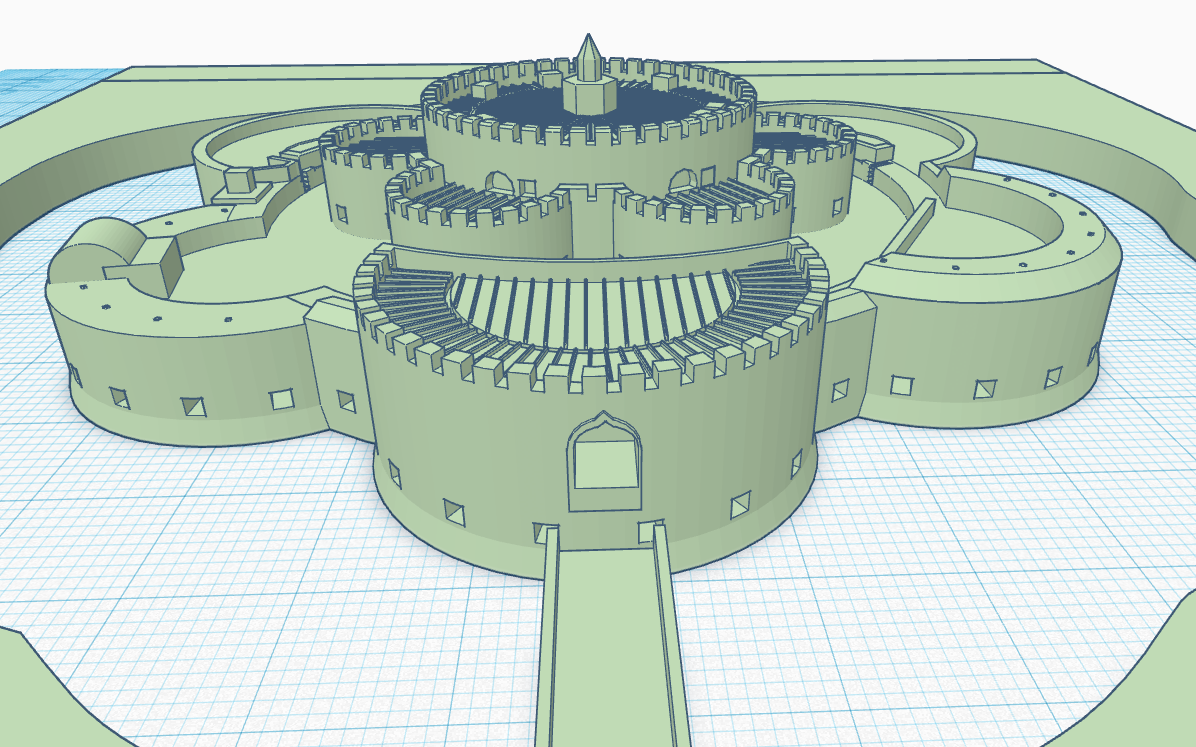
Tinkercad is free, web-based, and has one real pecularity: rather than the more common draw-and-extrude model, you can only create “negative” and “positive” 3d polygons and apply them to each other. So to make a more complex shape, like a Tudor arch, you need to construct it out of other simpler polygons and combine them; to make a crenellated tower, you need to create a cylinder, a smaller “negative” cylinder inside to cut it out, and then a lot of little cutout bits for the crenels themselves.

Two attempts at a Tudor arch in this system: the first a very poor showing using a rectangle for the doorway, a flattened cylinder for the arch, and a rotated square for the point. The second, after looking into the actual architectural principles of Tudor arches, correctly uses two cylinders for the corners of the arch, a flattened square for the centre, and two more squares to create the doorway and fill in the gaps. These parts can then be combined into an “object” which can be used, positive or negative, to create appropriately shaped holes in things.

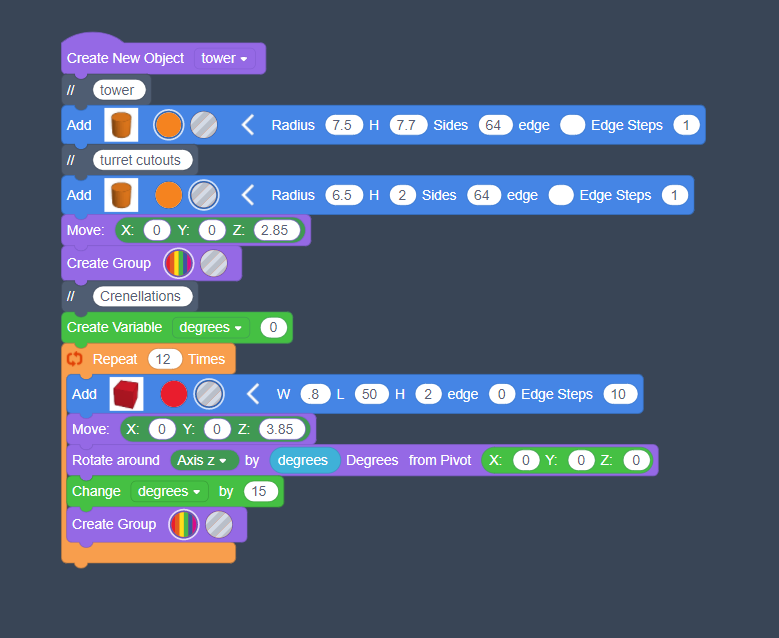
This is about as far as I got with the hand-drawn stuff; I was close to giving up and trying a more advanced tool when I discovered Codeblocks. Tinkercad has a function where, rather than wiggle lots of polygons around with keyboard & mouse, you can use code (pre-assembled blocks rather than actually typing it) to create polygons, move them around and apply them to each other. Like a lot of things about Tinkercad, it’s got a difficult, unpolished UI and a Fisher-Price aesthetic, but it’s also very easy to pick up.*

This is how that turret up there was made, for instance. (I’ve actually discovered a more elegant way of doing crenellations since, but this was about day two.)

Tinkercad’s limitations aside, this is ideal for repeated geometric structures like the Device Forts. It took about a week of tweaking Deal Castle into multiple stages and assembling the final parts “by hand” (there’s a limit of 200 ‘primitives’ in each codeblocks setup which limits quite how elaborate you can be), but the end results were really quite pleasing.

I realise posting this screenshot that it has a problem with the alignment of the gate, which I fixed in the final model but never took a picture of. Ho hum.

I am going to have to bite the bullet and learn a better tool one day, but for now it’s enough. The eagle-eyed among you will note that there are actually three castles up at the top, of rather different configurations, and next week I’m going to talk about the experience of 3d printing and every good historian’s favourite topic, SOURCES.

The tiny nubbles on the two lower bastions flanking the gatehouse are too small to come up in my 3d prints, but they’re THERE.

* There is something irritatingly half-arsed about the implementation of a lot of features in Codeblocks; in particular, the way it handles shapes which aren’t cylinders or cuboids is absolutely demented. You create a “polygon” and you can determine its shapes and smoothness, but you can’t actually set a size for it, only apply a “scale” modifier which doesn’t correspond to any actual units. It’s purely eyeballing and trial-and-error to get it to the right size.