millbank headwind

Returning to London as a cyclist is like coming home. When I was little we’d often cycle as a family – down to Dulwich to visit grandparents, or every week to the Sumics music group off the Caledonia Road; every school morning for two years my dad would put me on the back of the tandem and take me down to Essex Road station, and my mum had taught me to handle the Old Street roundabout (killer of a dozen cyclists a year) aged about ten (which was, on reflection, genuinely insane.)

However, as an adult doing his own thing fifteen years later, this is a new and exciting world. Lessons learned among the Velocipede Squad:

  • The “cycling superhighways” are actually genuinely fantastic. My first ride from Paddington down to Vauxhall had maybe five hundred metres of road shared with vehicles; all the rest was segregated cycletrack, almost all of it offroad. It’s an approach I’ve never seen in Britain before, done properly: cyclists are treated like actual people. No, better than people. Like cars.
  • A lot of London cyclists take it seriously. The cult of spandex is in full force here, and its adherents are everywhere, dolled up in fetish gear and humping two grand of carbon fibre at warp five. The Millbank peloton makes me feel small, slow, afraid, low-vis and unreflective. It stings.
  • Fortunately, the Dutch/Danish baseline approach of “it’s too far to walk and too nice a day to get the metro, let’s use this legitimate method of two-wheeled transport with our normal clothes” isn’t extinct. Boris bikes (which should really be named Ken bikes, but what the hell) are a very important and very visible enabler of this, and comprise maybe a quarter of the bikes on the morning commute.
  • Probably due to a lack of proper hills, many London cyclists have no clue how to use their gears. There’s always some dipshit standing on his pedals. Always.
  • The Millbank peloton forcing its way onto the MI5 roundabout, against right of way and in the face of actual motor vehicles, by sheer force of numbers and overwhelming impatience, is a bizarre and terrifying thing to see.
  • There are some truly superb calves and arses on display on my usual route to work. Given the unisex nature of cycling cult gear, it’s often hard to ascertain the gender of their owners, which probably badly confuses and upsets some people.
  • HGVs on London roads move gently, tentatively, clearly very aware of the terrible damage they can do. People are surprisingly polite to buses, and buses are surprisingly polite in return. There is an intense, passionate mutual hatred between cabbies and cyclists.
  • There’s a neat little initiative Lambeth Council are running, creating cycling spaces out of parking spaces with custom-made lockable sheds you can ask for a space in. I registered a request when I first moved here, was told to expect a response soon, and several months later haven’t had it. Apparently there’s a vast backlog because the contractor doing it is the only one in the UK capable of building lockable sheds, and Lambeth are utterly unable to compel any sort of performance out of them. Classic public-private partnership.
  • There are still far, far too many prick cyclists who think they’re too cool for red lights and will sail through in full view of everyone, including across surges of moving traffic and through pedestrians crossing the road. Annoyingly, they usually survive, so I move for a programme of public crucifixions.
  • My boss pointed out that most drivers in central London are professionals: chauffeurs, bus drivers, van drivers, taxi drivers, lorry drivers. On reflection, it shows. Private vehicles are actually in the minority, which is a blessing. I don’t want to be either in or around a regular car.
  • I’m not really frightened of cars hitting me, because in the tight confines nothing goes fast enough to do any serious damage. I am however terrified of being crushed between them, and the godawful lanewreck around Parliament Square requires being between lanes for most of it. Not fun.
  • Either the lanes on the southbound side of Whitehall heading onto Parliament Square need better marking, or they’re putting something in the water, as there’s not once I’ve followed it without five idiots in the wrong lane indicating and trying to shoulder their way in.
hey ho, on the devil’s mount


"Sorry, your listening post is on another hill."
“Sorry, your listening post is on another hill.”

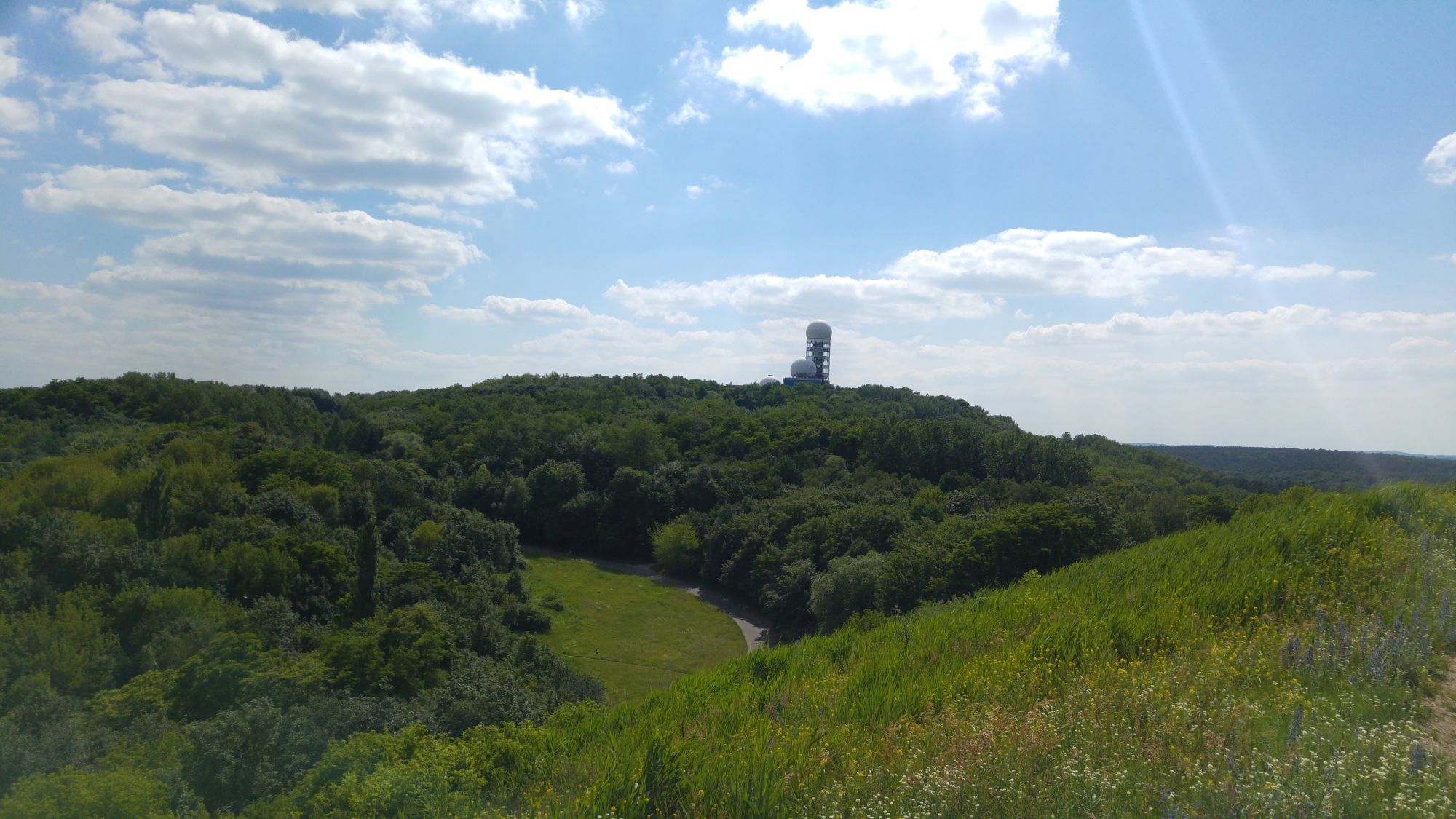
In Grunewald, overlooking much of west Berlin, stands a steep green hill called Teufelsberg. This means “devil’s mount”, and while the ominous associations lift for a moment on learning the name was after the nearby Teufelssee (“devil’s lake”), they return full force on learning that the hill is not natural, but artificial, built from the ruins of a dead Berlin. Between round-the-clock aerial bombing from the RAF and USAAF, and the Red Army taking the city a street at a time with rifle, hand-grenade and 203mm siege howitzer, Berlin was more rubble than city in 1945; and when the Cold War began in earnest, the blockaded West Berlin had no way of shipping its remains beyond city limits. Thus: a giant hill made of piled-up destroyed buildings, with an indestructible Nazi training college underneath it, and an odd observatory-looking NATO listening post on top.

20160620_152954
I hadn’t even intended to go to Teufelsberg, but the Technikmuseum and the Gatow airbase were both closed on Mondays for whatever weird Berlin reason, so Plan C it was. Navigating was more difficult than it should have been; Google Maps’ listed paths are almost, but not quite, entirely unlike reality. Realising this and adopting the traditional hill-climbing method of “up”, I accidentally stormed up the smaller Drachenberg instead, and after spending a while catching my breath on the windy open plateau there, had to come halfway down again in the blazing sun. Still, it was a lovely walk; trees have been planted on Teufelsberg, the leafmould and wild grass have covered the detritus of the war. It feels like any other wooded hill, but where the path wears away to the bones of the land beneath, it’s not rock that is exposed, but brick, concrete and rebar.

Count how many times the fence has been broken and then repaired. Or, go insane trying. Either's good.
Count how many times the fence has been broken and then repaired. Or, go insane trying. Either’s good.


Ascending the much more heavily wooded Teufelsberg, for real this time, I couldn’t work out what the actual status of the listening post was. A website offering tours said it had shut down and I couldn’t find its successor; Wikipedia gave a very muddy and uninspiring account; and coming to a fence at the top, whose many, many repairs showed evidence of a constant, vicious running battle between fence-maintainers and people with wire cutters, made me no more optimistic. But persevering along the path I found a gate, where several extremely scruffy-looking people with beanbags and a small child asked me for money. As it turned out, the complex has been overrun with hippie-ish squatters who charge entrance based on no authority whatsoever. They said €7, €5 for students (and had a clipboard to make it seem all legit). I said I was a student and showed them my young person’s railcard. They were in no real position to argue.

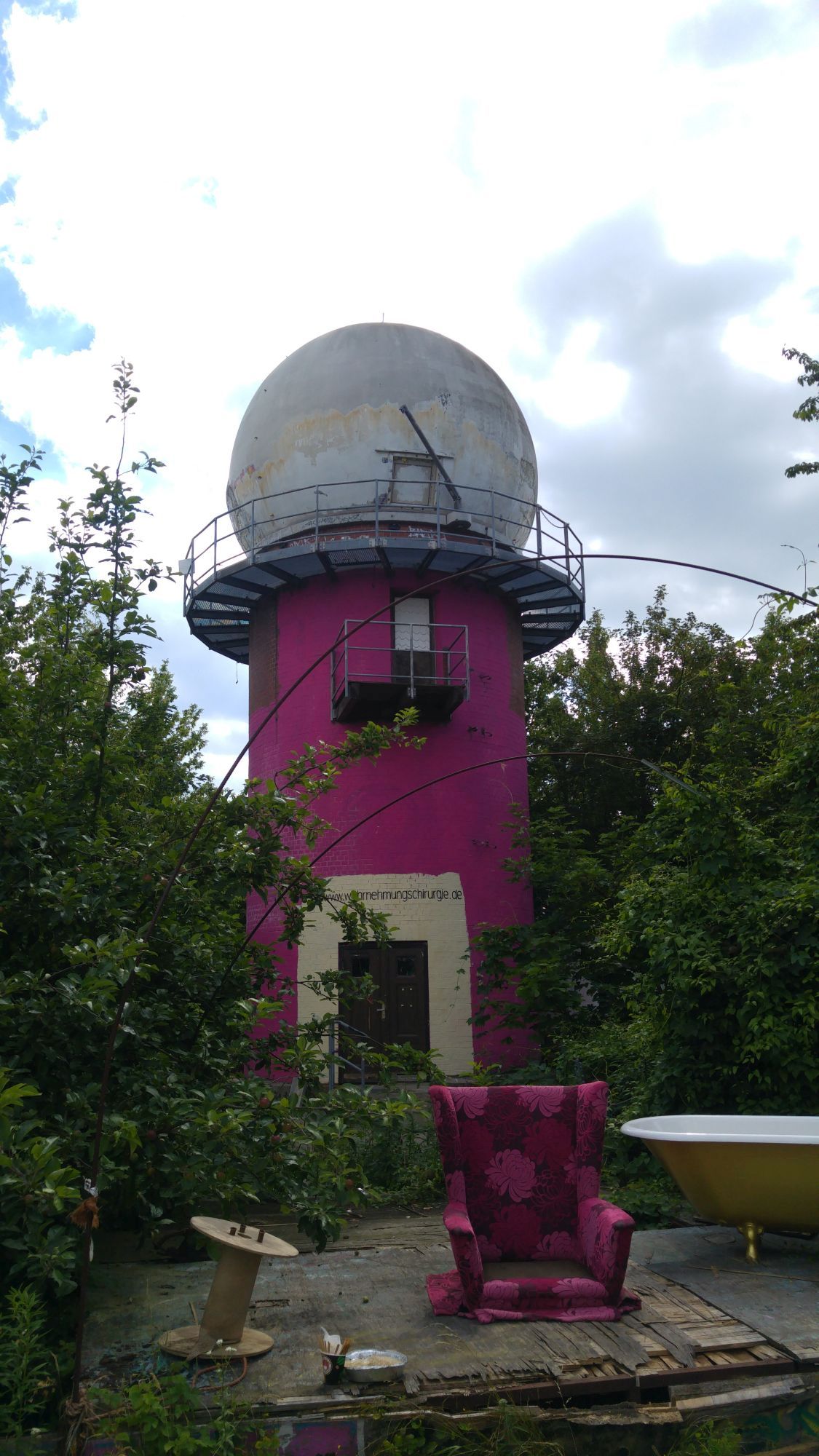
Sub-dome with matching armchair.

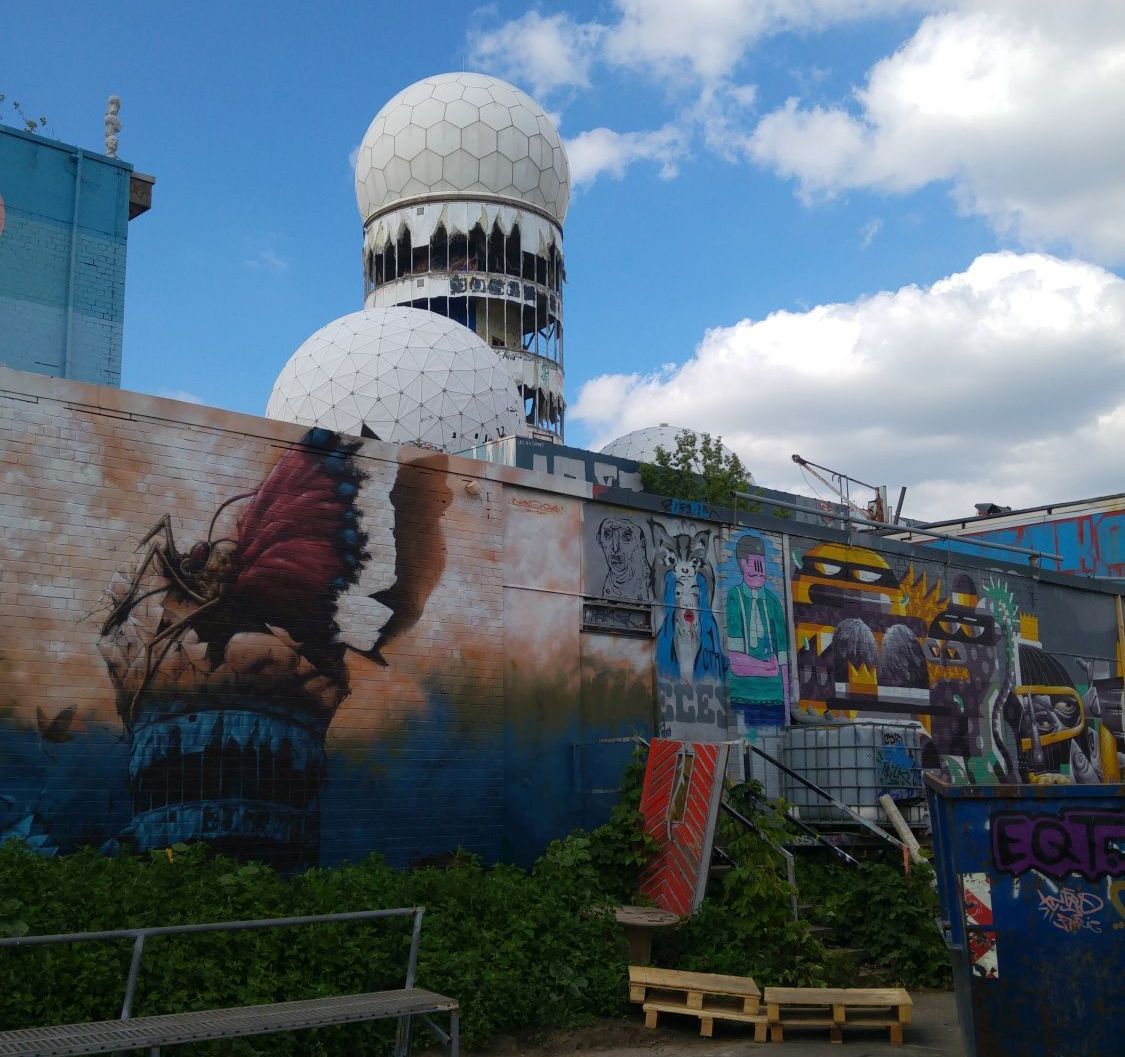
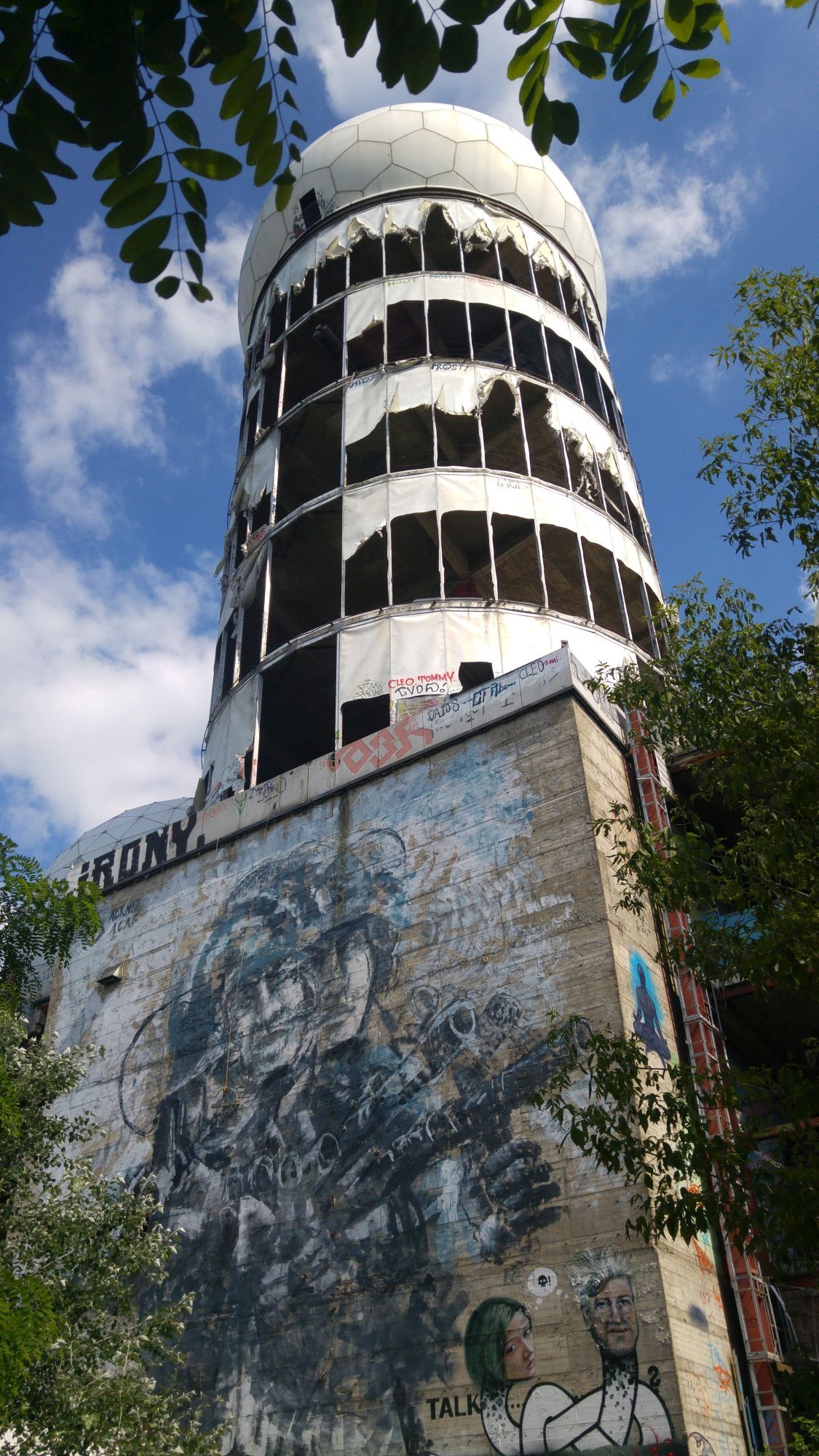
The squatters have padlocked most of the buildings up (the fucking hypocrites), but what remains is an intriguing post-Cold-War sprawl of lovingly-if-messily maintained gardens, recycling stations and hoards of furniture arranged with Germanic pedanticism, all in the shadows of huge dead NSA structures sprayed with really quite impressive murals in all sorts of lurid colours and degrees of fatuous countercultural nonsense. I don’t know the engineering behind the listening station, and all the significant kit is long gone, but what remains is a series of tall buildings capped with puffball globes made of fibreglass hexagons. The highest and largest building has two lesser globes on the roof of a squat office building, and a single greater one between them, on a tiered column lined with shredded tarpaulins.

Above: Domes. Below: Popular theory as to purpose of domes.
Upper left: Domes. Lower left: Popular theory as to purpose of domes.

Said main building is easily accessible and is basically a graffiti gallery; all very run down, but not stinking of piss, which is a mercy. The roof has been lined with a fence made of wooden forklift pallets, there are separate bins for different recyclables and you just know they empty them every day; very German squatters. There’s no electricity, though, and health & safety is generally thoroughly Ukrainian; to get to the highest point, inside the top dome, you need to climb about fifteen flights of stairs in pitch blackness (thank heaven for the LED function on modern smartphones. The dome itself has almost no views, just a port in it, but the echoes are incredible, and I spent a good fifteen minutes up there whacking pieces of detritus into each other and stamping my feet to see how it would sound.

Leaving, I discovered the fridge of drinks by the clipboard hippies was on an “honour system”, so I donated a euro for a rainbow-labelled COLA-MIX in order to a) rehydrate b) maintain my self-destructive habit of buying oddly named sweet drinks in foreign parts. It wasn’t that bad, in truth. Going downhill was even more of an odyssey than coming up, as I once again put my trust in Google Maps and was once again betrayed. Trying desperately to follow my phone’s directions along paths which weren’t there, I ended up on mountain bike tracks which testified to the daring, not to say total suicidal lunacy, of local mountain bike riders, and ended up at the right place by luck as much as judgment. Overall, I had the time of my life, but it’s probably a good thing I didn’t have anyone else with me; between the steep hills, mild peril and totally improvised navigation, I suspect most companions would have got quite annoyed with it all. But I’ve always found that the best way to have an adventure is to point yourself in the vague direction of something interesting and follow your nose.

20160620_155418

Berlin & Northern Germany, 2016
ProraPeenemündeTeufelsberg


*

the colossus of Rügen

(Click on the images for higher-res versions!)

North of Berlin, the autobahn ran through dense (but orderly) forest and then opened out into broad fields under the grey morning sky. Wind turbines have sprouted across Mecklenburg-Vorpommern like daffodils in spring, their blades striped orange. Occasional showers came down, brief but intense, but by the time we reached the island of Rügen the day was bright and the sky blue. Over the bridge by Stralsund, with its striking Marienkirche and picture-perfect Hanseatic seafront, was Rügen itself, with an unexpected number of of car dealerships and railway lines, and on its east coast, Prora.

20160618_153757
Youth hostel in Block V, bottom left; Block IV, largely abandoned, centre; Block III, mostly museums, top right. There are eight blocks; the entire complex is nearly 5km long.

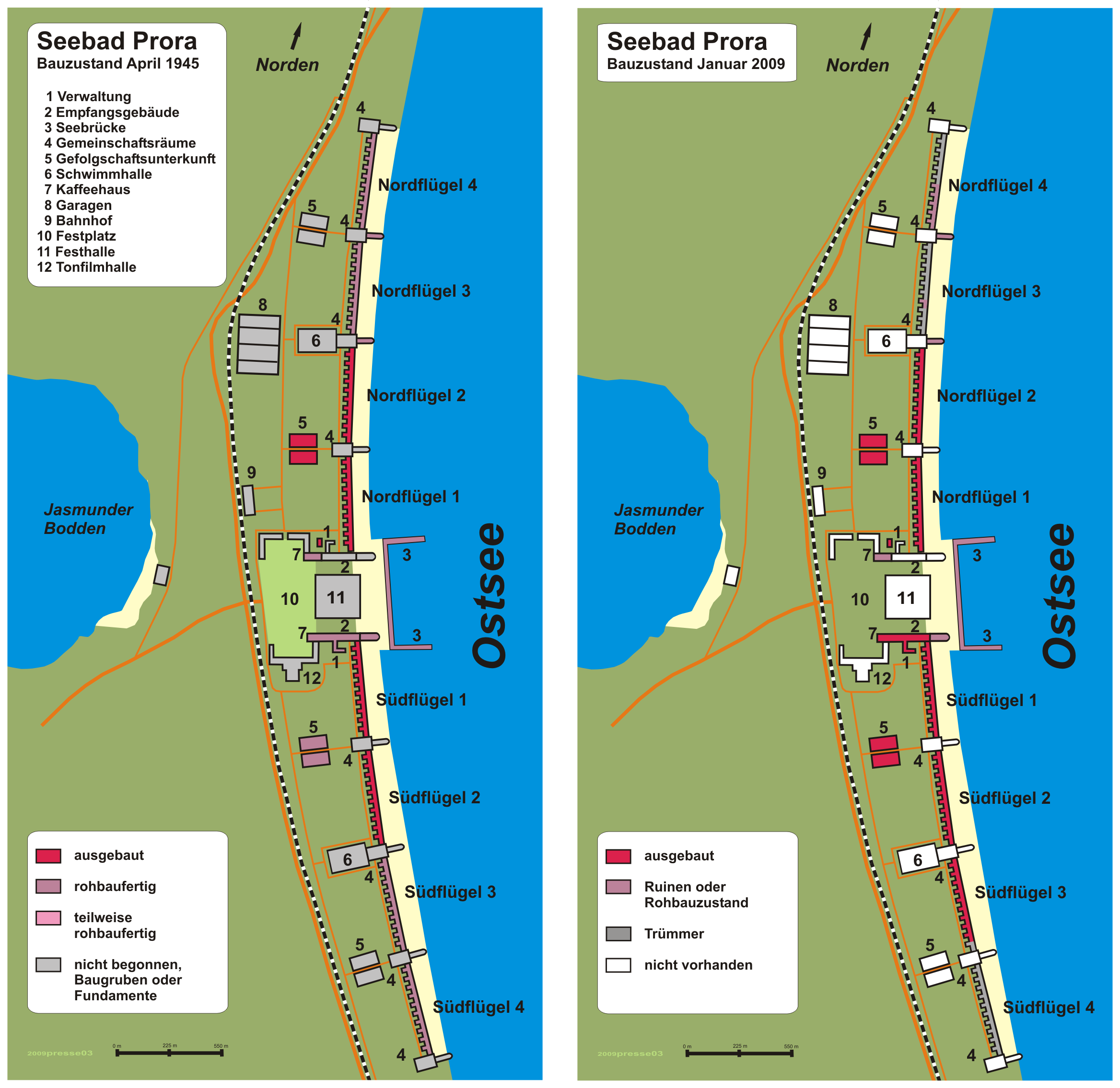
Prora is a holiday camp of cyclopean proportions, envisioned as a key point for the Nazis’ “Kraft durch Freude” (Strength through Joy) organisation -a mass tourism initiative intended to overcome class divisions by uniting the German Volk in affordable but healthy holidays, with lots of outdoorsy pursuits, hiking, sea cruises etc etc. (It appears that Hitler learned of the Butlins camps being built in the UK in the mid-late 1930s and, more or less, turned to Albert Speer and said “outdo them.”) The result was a resort built for 20,000 people, continuous blocks of flats punctuated by piers overlooking a huge crescent-shaped beach on the east coast of Rügen. Its completion interrupted by the war, it was used in a vague way by East Germany and mostly abandoned, with large parts in ruins. Part of block V contains the largest youth hostel in Germany; we were in Room 101 (gulp), which as Block VI is now rubble stands as the northernmost surviving part of Prora.

20160618_163833
It goes on like this for miles. Literally miles.

(The pier structures joining them up were never completed, so the most Prora has ever been is eight separate gigantic blocks of flats; the southernmost and the two northernmost are ruins now, and the remaining five are now numbered, south-north, I-V. With me so far? Good. Here’s a map, the surviving blocks are red on the right.) That block, of which the youth hostel occupies less than a third, is well over half a kilometre long.

The hostel felt rather in keeping with the original KdF intentions – clean, austere, healthy, affordable but with no emphasis on class, with the implication that this was merely for hiking, swimming naked, etc etc etc. * Initially, though, our hopes of exploring Pripyat-like abandoned ruins deflated; the place was much busier, much more orderly and much better fenced off than expected. Sets of Nazi-built bungalows were in regular use, now basically just suburbia; stern, efficient German fencing covered the rest of Block V, and most of what we could see of Block IV had already been redeveopled into some surprisingly nice flats. The foundation of the pier structure between V and IV was just an inaccessible foundation which I barked my knee trying to climb, and the railway-and-technology museum, by the time we reached it, was only open for another half hour and wanted €10 for its single room of cars and trains (although it was a big room, and they did look like quite good cars and trains.) We returned to the hostel for an early dinner, bockwurst and kartoffelsalat – a typically German cheap meal, the sausage nondescript flavourless meat, the potatoes lost in a sea of mayonnaise, but it filled us up and didn’t cost much.

20160618_212846_HDR
The idealised German tourists, their complexion a healthy bronze.

We set out again, looking to make the best of it. The pier foundation by our room, between block V and the now-gone block VI, was at least accessible if nothing more than a cartouche of sea-wall overlooking the beach; a statue of two very naked bronze German holidaymakers (the woman with massive shoulders and tits-as-an-afterthought, the man horse-faced and standing, silver spray paint on her nipples and his cock) watch over the actual, considerably less sculpted (in every sense) holidaymakers on the beach. We strolled down the white sands, full of little shells and leftover sandcastles – you can see nothing of the resort from the beach, the foliage has grown up quite a bit since Hitler’s time.

20160618_182520
Harbour structure – now just sand, bricks and spray paint.

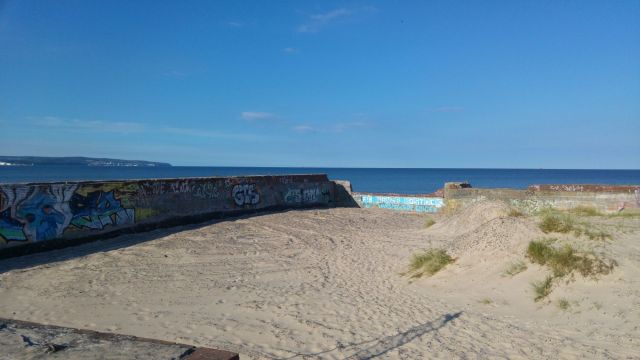
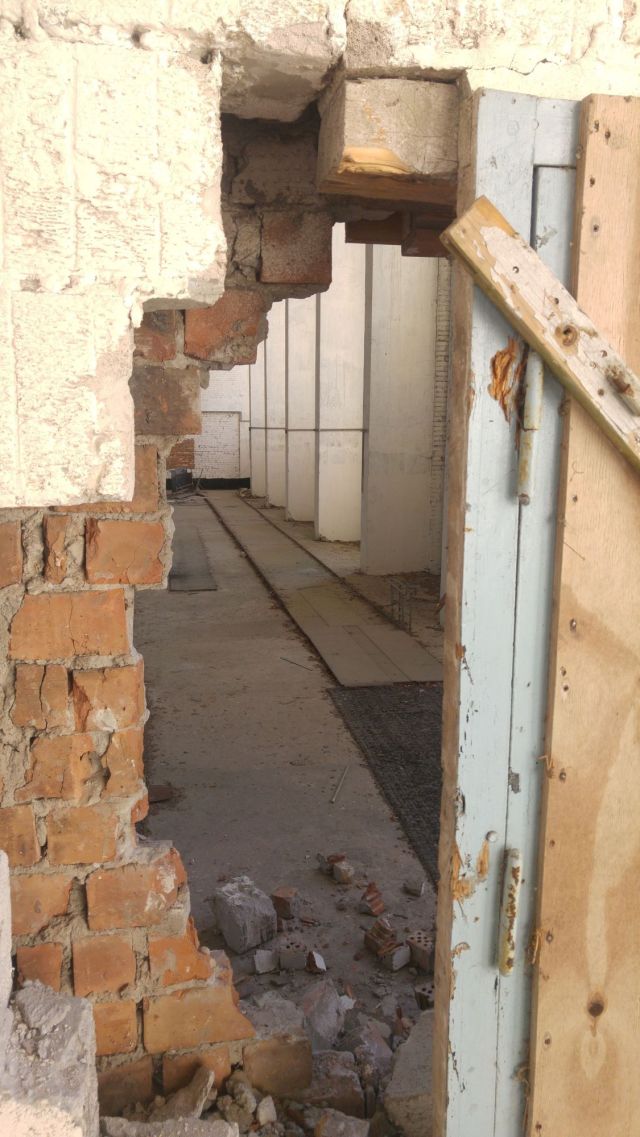
At the very centre of Prora’s crescent, between blocks III and IV, stands the pier structure which was meant to take Baltic cruise ships; the superstructure and the jetties were never finished, all that’s left is a graffiti-stained redbrick wall, and inland the site of the Festhall is a tangled wilderness of little pine trees and fragrant pink roses. But, pressing on, we found a proper half-built structure with that tasty crumbling STALKER feel; a look through a shattered window found some sort of abandoned bowling alley, a wriggle under the fence and negotiating with a shattered wall got me in (it was, indeed an abandoned bowling alley). That was a bit better.

20160618_184802
Bowling alley! (Of course I went in.)

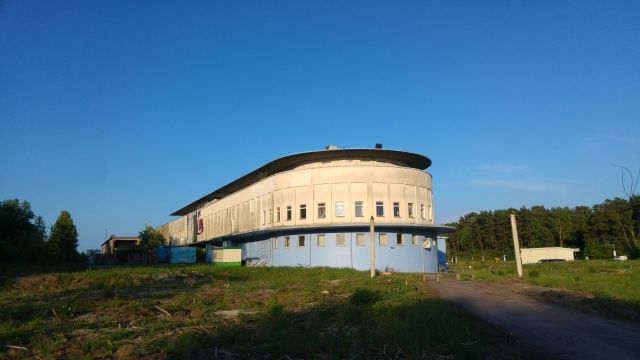
Moving inland along the building revealed the only one of the pier structures actually completed, a long curved Nazi-deco building which contained a fish restaurant and something which advertised itself as a nightclub but looked extremely closed. Beyond it, in Block III, were several now-closed museums, one trying much too hard with its signage to attract us in, the other barely trying at all, and an empty adventure playground/agility course, where healthy young Germans can move from tree to tree along zipwires and suspended platforms, in a death-defying fashion. Moving further along down the coast, we found Block II, half-converted into flats with nice glass balconies. I’d seen some cranes, far, far to the south, from the Block V pier and assumed they were in the town of Binz, south of Prora. They were actually working on Block I – and Block I isn’t even the southernmost part. “Bloody hell, but this place is huge,” I thought, for neither the first nor the last time that day. Even the abandoned ones were quite emphatically fenced off, and mostly building sites; still, we’d seen enough that the trip didn’t feel wasted, and headed back home.

20160618_195846
It’s difficult to imagine, but there were meant to be sets of these piers at the end of each block. They were double-ended; this is the landward one, but opposite it one would have jutted out into the beaches. As far as I know, this is the only one ever completed.

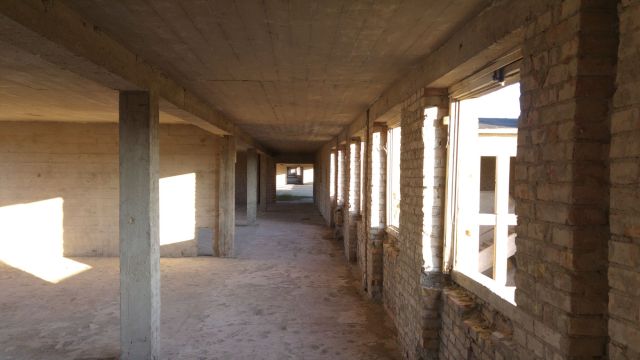
But at last, coming back, we lucked out: the southern end of Block IV, in the process of redevelopment: gutted but accessible, and we wasted no time in going in, climbing to the top floor and wandering around the huge dusty concrete emptiness, enjoying the crumbling construction and the views of the brilliant blue Baltic. There were holes in many of the staircases, it was all thoroughly enjoyable, and we came back to our room late in the long dusk to drink tea and look out over the sea.

20160618_202920


* What? It’s not a bad idea just because the Nazis liked it. Hitler was a vegetarian, remember, and I don’t usually accuse my veggie friends of Nazi sympathies.

Berlin & Northern Germany, 2016
Prora – PeenemündeTeufelsberg

the redoubtable beast has had pegasus pills

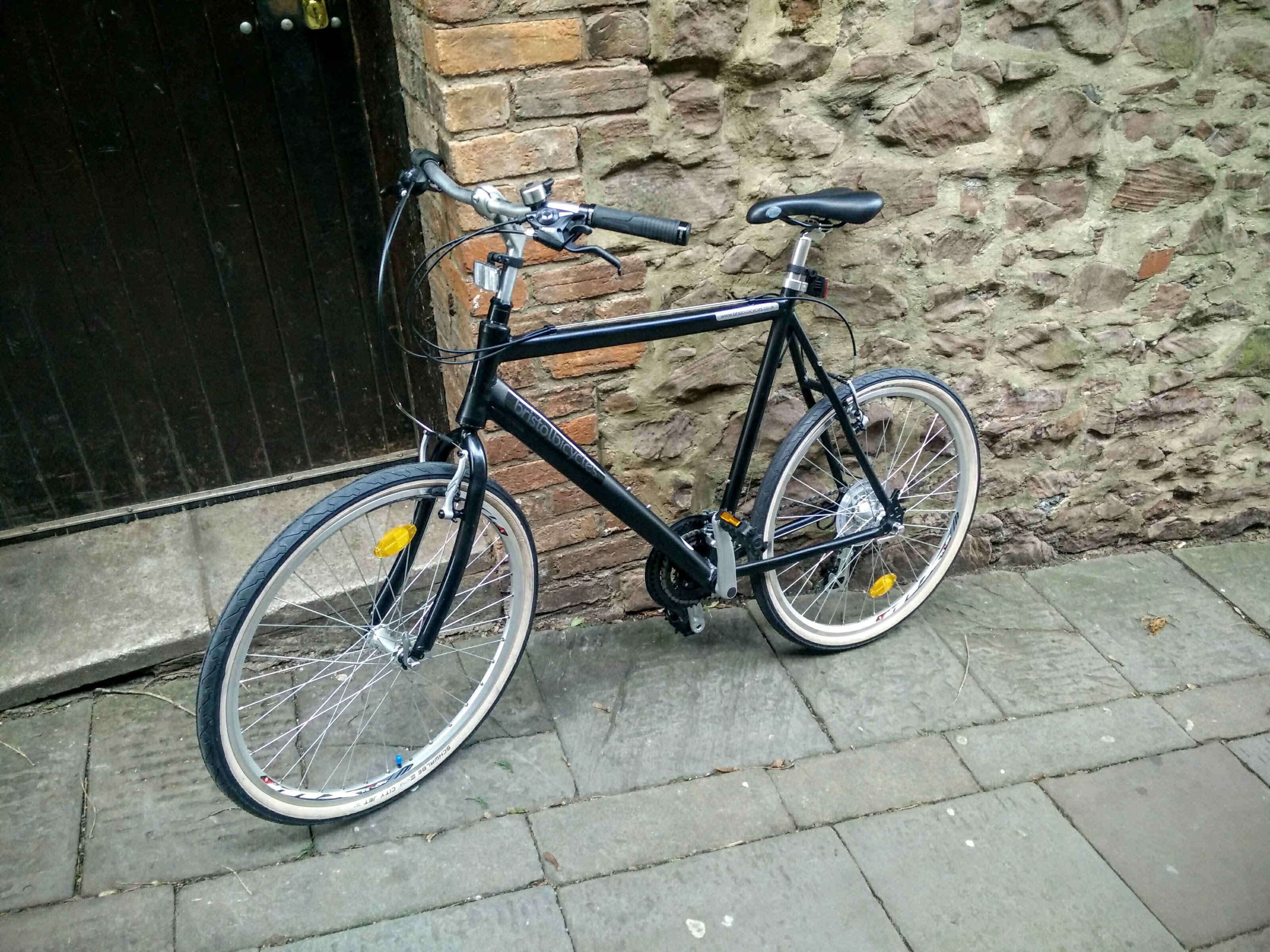
Following that time back in January I managed to write five hundred words about a backpack, A Materialistic Love-Letter to a Physical Object II: THE BICYCLE.


IMG_20151121_145148~2

I’ve never actually had a new new bike. Various second-hand/hand-me-down/shared family bikes (and the tandem) have done me for most of my life and family cycling holidays, with a brief, memorable ride to the Giant’s Causeway on some ankle-shredding pieces of crap we hired from some Ulster wide boy, and a characterful little clunker once borrowed for a few euros to pootle around Tempelhof.  For the first year of uni, I borrowed my dad’s zippy Marin, but he took it back in the end.

At the start of second year, I was given a nearly-new second hand bike by my wonderful un-godparents, which served very well for nipping around campus and taking me to various hellish corners of Birmingham for my census work. It was my mainstay for a long time, the first machine I as an adult felt any ownership of, with aftermarket aluminium pedals I fitted when the plastic ones fell apart, and a little green zip-tie round the headtube identifying my right to lock it to things around Mason Halls. But it was quite heavy, and was never really the same after Dad jammed it into the back of the car when shipping out for third year: the derailleurs clicked in spite of endless fiddling with the levers and cables, and the brakes seemed to be useless despite one replacement after another. But it served well (if decreasingly frequently) over the next couple of years, until I locked it up in the city centre when going off to Ukraine, and came back to find it missing.

Feeling a bike-shaped hole in my life, I went around shops and poked listlessly at the internet – there’s a strong second-hand market on Gumtree, but it seems to move very fast, when the one thing I don’t want to do is rush. Demand moves fast at the various second-hand places in Bristol, too – everything I could find was some combination of the wrong size, the wrong shape, rather expensive, or fitted with those stupid sodding frame-mounted gear levers for racing hipsters. If I were feeling somewhat flush, my choice would have been a Bristol Bicycle, from local legends Jake’s Bikes, a wonderful setup which also happens to be right next door to my current office. They’re designed as city bikes, rather than mountain bikes or racers, and have a real thought-through appeal to them: you get a very strong sense that some blokes who work at a bike workshop have been making notes of issues their customers have for a long time, and set out to put together a bike which addresses them.

Not long after Ukraine, I started my temp job at the bank, and when I got made permanent recently one of the Proper Employee benefits I was keen to take advantage of was the Cycle Scheme, which lets you buy a new bike from pre-tax salary sacrifice – ie, you avoid paying income tax or NI (so savings north of 30%) – and which Jake’s happily offer. The process developed into a massive struggle, with repeated problems with their online form and, once I’d actually ordered the bike and attendant lock, pannier rack and mudguards, our idiotic work systems cancelled the whole thing and demanded I go through the process again – so, feeling a) flush from a tax refund, b) thoroughly cheesed off at the whole silly system, I just went down to the shop and bought the thing outright.


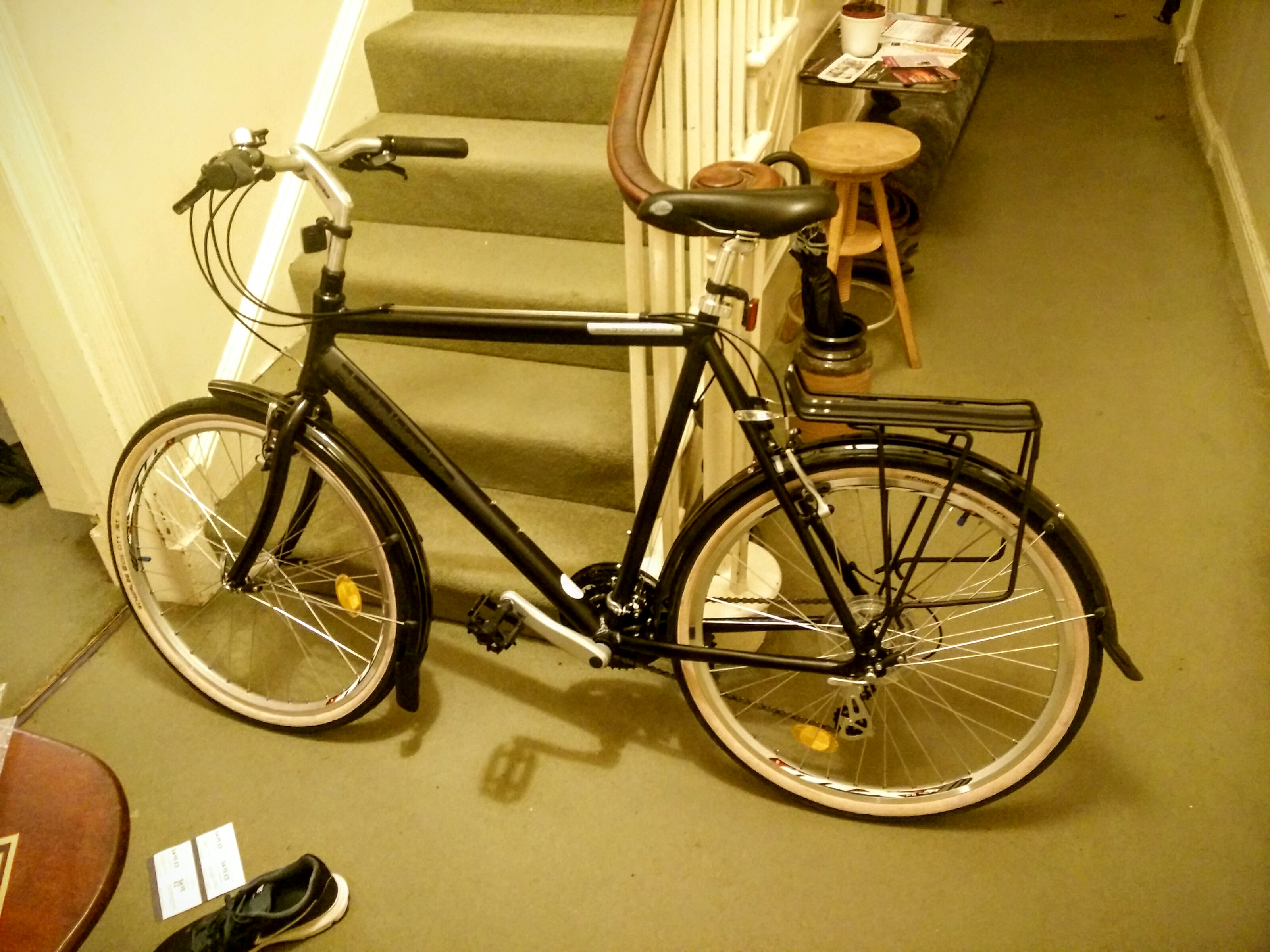
The new toy, now with mudguards and pannier rack
The new toy, now with mudguards and pannier rack.

It’s a “Park Street”, crisp black and silver,* with smaller wheels than I’m used to but excellent gears and a light, compact aluminium frame; the brakes are superb, the posture natural. I was struck on my first ride how odd it felt to have a bike all tuned up and silent, with no clicking or rattling anywhere, no stick in the controls or idiosyncrasies in the gear levers. It felt… nice. I don’t actually need it for my current trip to work – which is fairly hilly and takes exactly half an hour, my cutoff point for where the extra faff of cycling (especially needing extra clothes and kit, which you really do with these cold dark winter afternoons) outweighs the travel time saved. But it’s very nice to have, for the future, a machine which absolutely fits my spec and feels right, one which is, for the first time, something just for me.


* The Bristol Bikes are matte black with plain metal fittings, and no fancy or show-offy bits; Jake explained to me that he wanted them to be very un-flashy, to avoid attracting thieves’ attention. While I agree with the rationale, I think it’s gorgeous and would totally nick it.

in the present, nothing lasts

“True Detective” series 2: Everyone says it’s weaker than the first one. Everyone is wrong.

It has everything that was good about series 1, to be sure: the cinematography, production values and atmosphere of weird underlying menace are perfect, the leads are all brilliant in their roles, and the general sense of Place (both in terms of magnificently shot scenery porn, and in feeling as though this world is alive, and its characters are actually adrift among its modern troubles, rather than just being pieces in a narrative of convenience), though that Place is the California valleys and the interplay of dying industries and new high-speed rail, rather than Louisiana wetlands where everything is simply rotting.

But, unlike the first series it actually has a plot. Things happen (for a reason!), and while our characters ooze overwrought melancholy in every scene, there is more going on than character studies in grizzled manpain. S1 had lots of good things about it but also some huge flaws: it was one of those shows which tries to be Art through deliberate obscurity, and ends up as a chore to watch (while failing to come anywhere close to the actual artistic high water mark of HBO drama, The Wire); its overriding theme was “masculinity”, which, yeah, just read the Iliad instead, nothing has changed; its plot didn’t matter, and its final twist didn’t actually make any goddamn sense. The plot was there to service the manly grimaces, not the other way round.

Here it’s the right way round, and although it starts a little weakly and ends a little predictably, it’s a wonderful example of the density of plot, character and detail you can force into a show while still having a pace that is resolutely unhurried. The fare is a bit more commonplace (political crooks, gangsters and PMCs rather than sisterfucking bayou satanists) and the hardboiled stereotypes are more modern but just as broad (crooked cop with custody issues, hard-as-nails lady cop with one of Those backstories, closeted veteran caught between who he is and his sense of who he needs to be, gangster kingpin learning that nobody really leaves the game); but it winds its threads around each other with great skill and concentration, and succeeds in its real goal – which is having the audience take it seriously, though perhaps not quite as seriously as it takes itself.

the death of the ball turret gunner

“A ball turret was a Plexiglas sphere set into the belly of a B-17 or B-24, and inhabited by two .50 caliber machine guns and one man, a short small man. When this gunner tracked with his machine guns a fighter attacking his bomber from below, he revolved with the turret; hunched upside-down in his little sphere, he looked like the fetus in the womb. The fighters which attacked him were armed with cannon firing explosive shells. The hose was a steam hose.”

past the square, past the bridge, past the mills, past the stacks

A very cool thought which occasionally occurs to me: in a world which contains both the Channel Tunnel and the Trans-Siberian Railway, I can hop on a train on any station in Britain and, eventually, find myself in any other station in Europe and Asia, without ever leaving the railway network. And Railhead, the forthcoming book from the explosively talented Philip Reeve, is that thought writ on an enormous scale, where you can get on a train and find yourself on the other side of the galaxy.

It’s a return to more grown-up books for Mr Reeve, whose work over the last few years has been aimed at younger readers, with the jolly good (if snot-focused) Goblins series and the even younger, wonderfully illustrated collaborations with Sarah McIntyre (Oliver and the Seawigs: recommended even if you aren’t 8). Mortal Engines, which came out a bit before either the “YA” or the “steampunk” trends really took off, has been retroactively pigeonholed into both of them; arguing about genre is the dumbest thing ever and I won’t do it, but Railhead is Proper Sci-Fi by anyone’s definition (and presumably to be marketed as YA, because there’s murder but not sex), set in the future with spaceships and robots and stuff. A lot of modern science fiction trying to set space opera in The Future has been caught slightly flat-footed by how, between various bits of microtechnology and the internet, the modern world has basically become science fiction, and so needs to make up alternative histories to keep things analogue enough to force Star Wars into – but Railhead deftly builds on what we have now (drones and miniaturised terminals, the Datasea and its “spam-sharks that would hack your mind and fill your dreams with adverts”) without letting it get in the way of being a great big space opera where things explode excitingly and the right man in the wrong place can make all the difference in the world.

There’s a great cast of major and minor characters: our hero, Zen Starling, a thief trying to be tough but who really doesn’t mean badly; the magnificently named Threnody Noon, a thoroughly sympathetic spoilt-heiress type who develops hugely over the story; Flex, a gender-fluid graffiti artist who reminds me of Tim Maughan’s fantastic very-near-future science fiction; terrifying killer trains (you read that right), burned-out cops, monks made of insects, nuanced aristocrats, a man in black looking to pick a fight with the gods themselves. And the sense of detail and texture is superb: every concept has an underlying story, every glum little failed economy sits on a well-told history of how it ended up that way. This is (thankfully) not one of those books which has capital-T Themes, but touches quickly and convincingly on lots of them – automation and androids destroying jobs and livelihoods; great economic forces washing over worlds and societies, chewing through them and abandoning them; a power vacuum and the subsequent politicking between factions, shot through with the uneasy relationship between civil legitimacy and military force. Which makes it believable, because even when it’s about galactic emperors and hyper-intelligent close-to-goddesses, you can see echoes of the real world underneath.

And it’s full of great little Reeve-isms, double meanings and references to books and old bands and everything else. Robots are called Motorik, which sounds good in its own right, has a lovely double meaning if you know what it means in German, and an even better triple meaning if you know far too much Krautrock-related terminology. (Or Google it, as I did.) That sort of namedropping often comes off as a bit smug and trying-too-hard-to-be-clever in books (and especially games), but here, like in Mortal Engines (with “is this your first time on a harvester?” and an airship called Idiot Wind) it all fits seamlessly into the worldbuilding and adds texture and detail despite being a reference. A logo consisting of a pair of rails crossed by a lightning bolt carries a joke that will sadly be lost on non-Brits, but is still a perfectly good symbol for a future police force patrolling the rails. What I’m getting at is that this is a universe where trains are the most important form of transport, ruled by someone nicknamed the Fat Controller, and it’s a good nickname and gives the reader something even if they didn’t catch the joke.


I won’t spoil the plot (any more than the above vague allusions already have) but it’s very satisfying, twisting and turning without losing momentum, and culminating in the best sort of climax, a great explosive set-piece of resolutions and revelations where you can’t be sure, from page to page, who will come out on top – or who you really want to.

It’s due to arrive for real in October. I hope there’s another one along soon.