Finally watched Elysium. Ambivalent about it. Aesthetically, it’s perfect: almost every shot feels like a classic Chris Foss sci-fi novel cover, shining primary colours and blocky-but-detailed buildings and spaceships with big numbers on them, but all realised in lovely modern HD and with odd bits of characterful South African flair rather than the usual American boilerplate. (And the guns were great, which is always a plus.) There was a definite feeling of fanfic-y wish fulfilment underlying it (“so now Sharlto Copley the grizzled mercenary villain with the regenerating beard is dramatically leaping, katana drawn, over a precarious walkway in the underfloor refinery district of a giant space station. Reckon we can shoehorn in some drifting cherry blossoms? Also, combat droids with tacky golden bling”), but that’s fine when coupled with a decent imagination and production values (see: why Jupiter Ascending was not a completely worthless film.)
But the worldbuilding is just a bit too OTT and silly, and it all ultimately falls flat, because taking a Hot Button Issue, dressing it up in loads of sci-fi and turning all parties involved into absurd caricatures of themselves doesn’t actually count as “commentary”, even less so with a panacea ending. District 9 had the same problem, but halfway through it gave up on the documentary premise and the “aliens are here, but they’re really shit and we have no idea what to do with them” social metaphor to turn into a brainless but solid action flick with an Afrikaans twist. This… doesn’t manage it, not because the action is weak, but because space is a lot less compellingly new and weird to the Western moviegoer than Johannesburg.
Also, it’s an obnoxiously Tumblr look-how-right-on-I-am thing to say, but why would you write your Spanish-speaking working-class-hero, who was raised by Mexican nuns, who represents Mexico in the agonisingly obvious metaphor (“undocumented spaceships”, really?), whose pals (including the cute one from Y Tu Mama Tambien) are all Hispanic gangsters… and then cast Matt Damon, the most generically Aryan man ever?
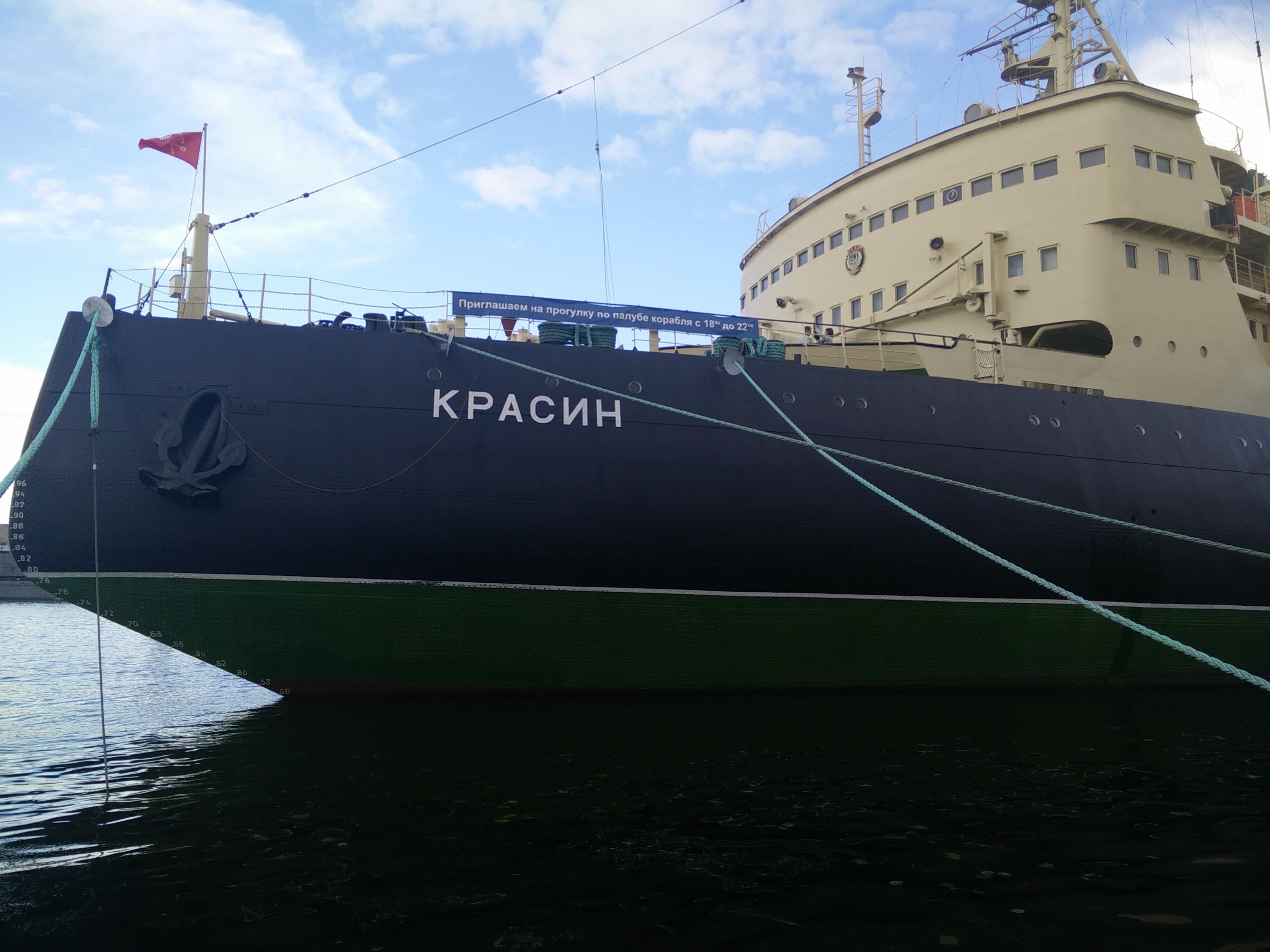
(Click on the images for full-sized versions. I’m trying something new with a gallery for the Krasin pics, too…)
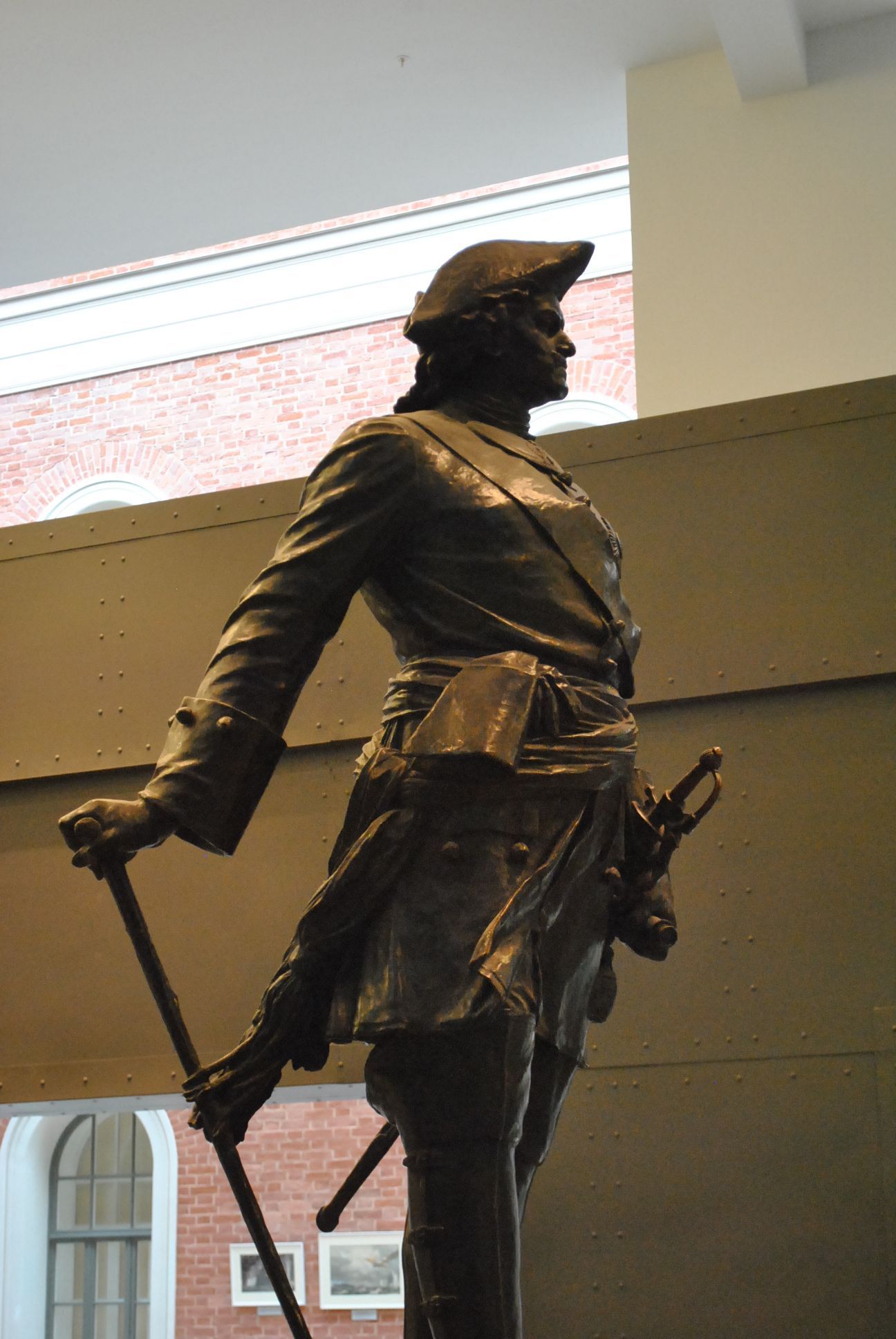
Peter the Great, without whom “Russian Navy” would mean as much as “Mongolian Coast Guard”.
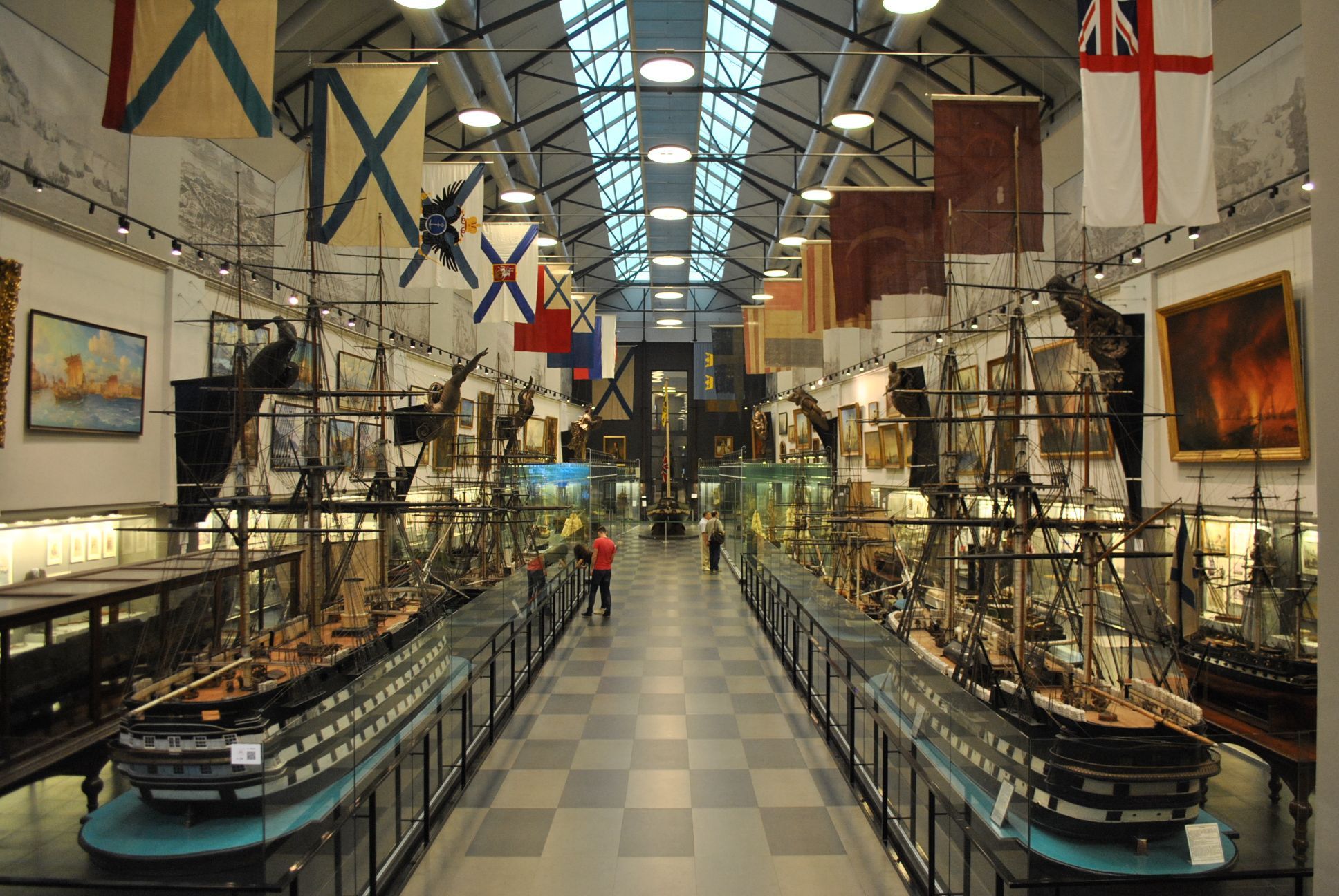
The Central Naval Museum in St Petersburg is, in the Russian style, the largest naval museum in the world. It plays the same cheeky shit regarding “Tickets: 400 ru! билеты 150p” and then not having any signs in English; but thanks to Misha the first wasn’t an issue, and thanks to Dr Boff, there is nothing which floats and kills whose function and history I can’t at least make a decent guess at.
These, for instance, are model ships.
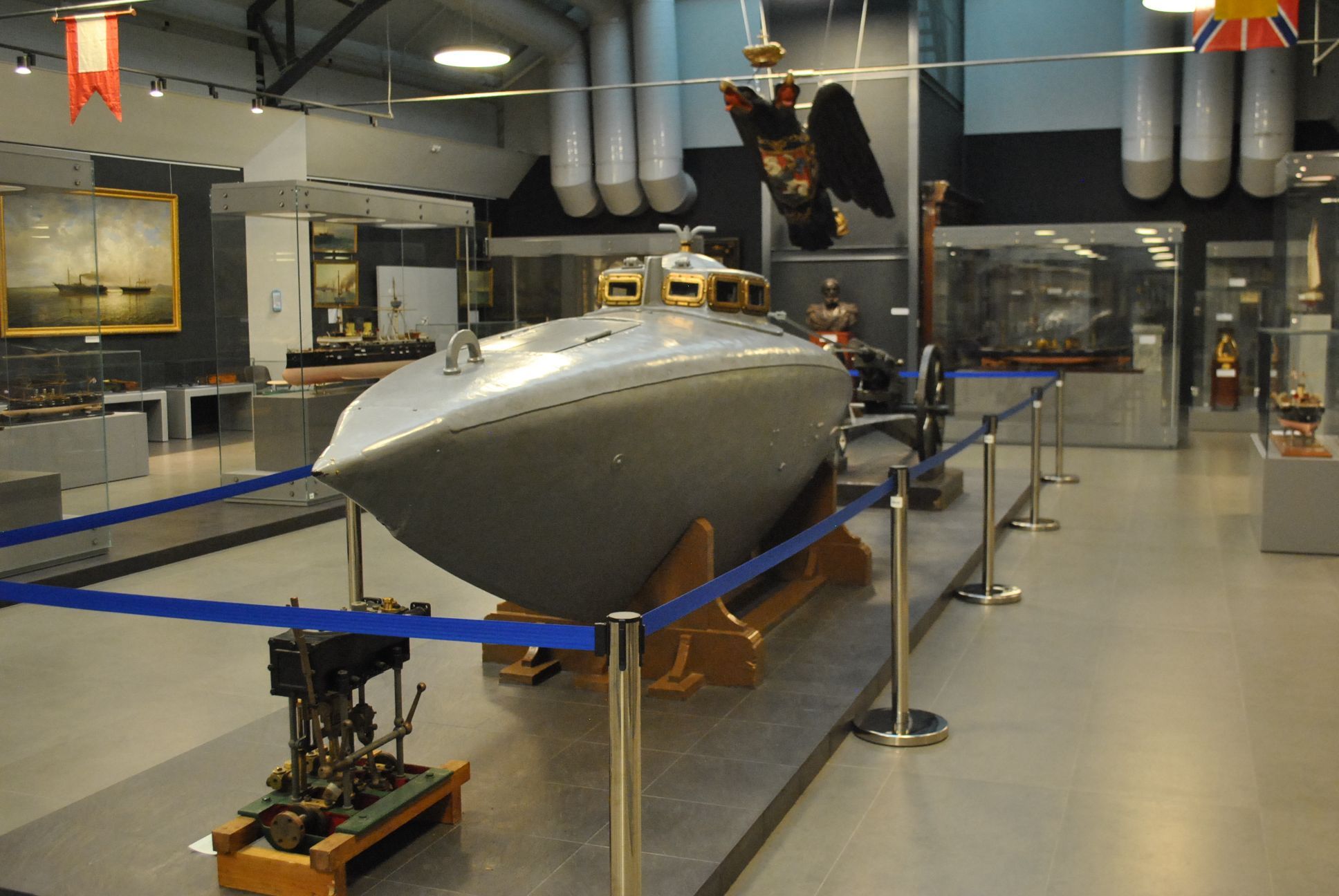
The galleries were mainly ruled by model ships, some as big as minibuses, crowded around the fringes by one-in-the-world historical artefacts: massive two-headed eagles, a showcase full of undersea telegraph gauges, stout brass Gatling guns, kayak-sized midget submarines. They had an actual spar torpedo, a model of a ship designed to use them, and a painting of one in use – I had a lot of fun explaining the utter insanity of spar torpedoes to Misha and Olga.* Rather than the comely lasses with big bare knockers Britain favoured, Russian figureheads seem mainly to be large hairy men with holy books and phallic weapons. Draw your own conclusions.
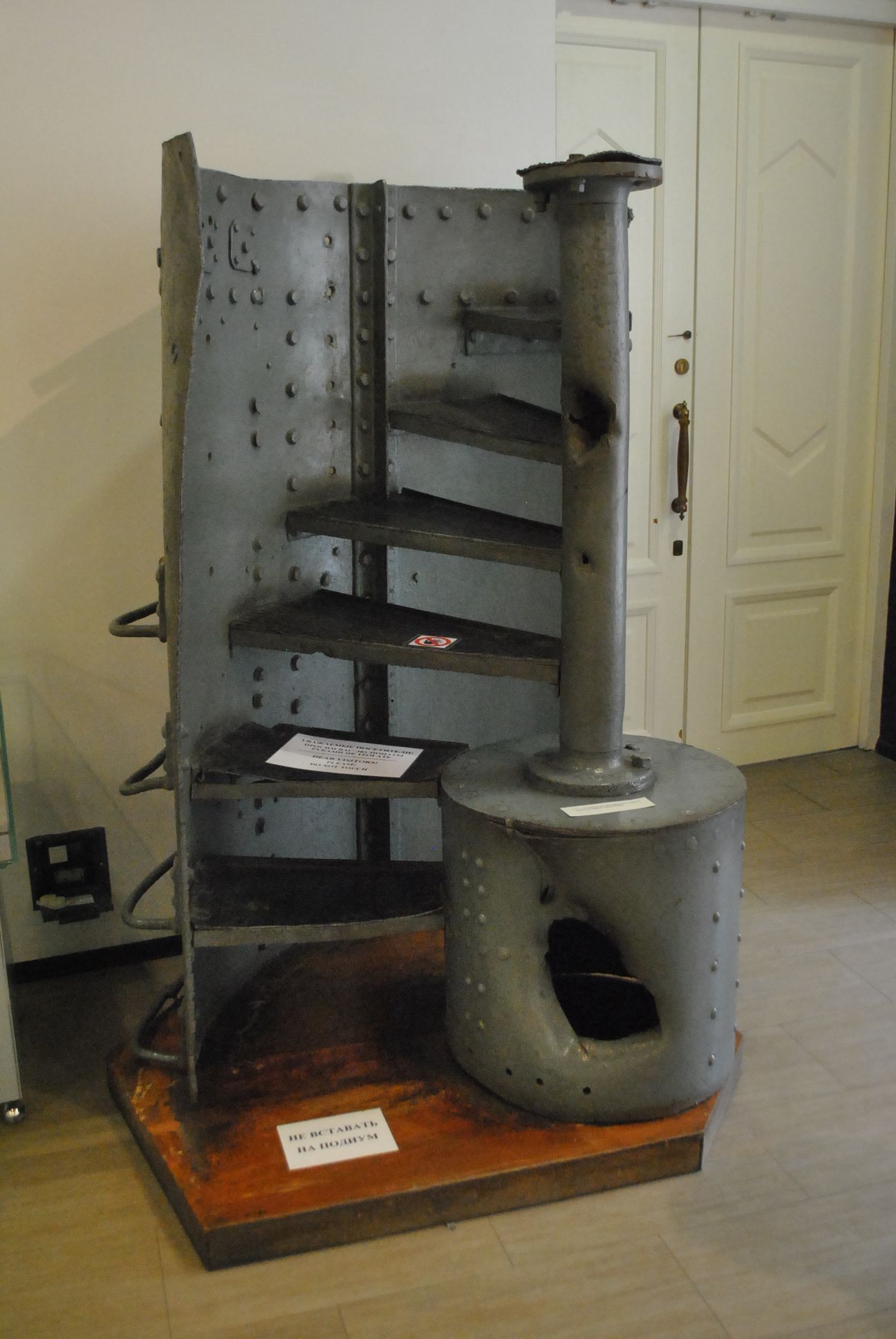
All I know about Russian naval history is the endless violent tragedies and disasters, and the museum was brilliant for filling in the rest – especially Russia’s Baltic struggle with the Swedes. But there were plenty of disasters too; the Russo-Japanese War display was particularly good, one room for the ships that got bottled up and wasted at Port Arthur and Vladivostok (with sad poignant paintings of dozens of masts and funnels poking up from the bottom of a bay) and another room for the ships they sent to rescue them, which got slaughtered at Tsushima, with lurid propaganda posters of exploding pre-dreadnoughts.** There was a spiral staircase off the battleship Potemkin (namedrop!) with some shell holes, and an entire gallery of Aurora memorabilia.
The Potemkin Steps. No, not those Potemkin Steps. The other ones.
We had some borscht and sandwiches in the cafe, then drove west down Vasilievsky Island’s southern embankment. This part of St Petersburg has a genuinely nautical character rather than just happening to be a city on the sea; the cruise ships like to moor here, the western horizon is crowded with immense forests of dockyard cranes, and on the far shore, immense flo-flo mobile dockyards and dismembered sections of submarines sit gently rusting. With limited time, we had to pick how to round off our navy day: the submarine S-189 or the icebreaker Krasin.
Note the weird ice-humping hull shape and unbelievably strong hull.
The Krasin has been everywhere and done everything. Her original hull was built in Newcastle, as the Svyatogor; her most expensive refit was in the USA during WW2, and most of her superstructure and modern fittings are East German postwar reparations, but most of her life has been in Russian service crushing Russian ice. She was jacked by the Royal Navy to fight the Bolsheviks during the Revolution, scuttled to blockade Arkhangelsk, then raised again and, on His Majesty’s service, used to crush submarine barriers around Scapa Flow. Handed back to the Russians in a deal negotiated by one Leonid Krasin, the Svyatogor was renamed after him in the twenties. In one of the true adventure-novel moments of the twentieth century, she rescued a lost Italian polar expedition when their airship crashed, and at another point rescued another icebreaker which wasn’t icebreaky enough. She’s been about as close to both poles as it’s possible for a surface ship to be; during the war she took a trip across the entire US for refit and gave the Panama Canal a rare sight of an icebreaker, on her way to armed convoy duty in the Arctic circle. In declining years, as the new generations of nuclear icebreakers replaced her and changes in the world meant ice just didn’t need as much breaking, she was reduced to hauling used cars; she was only saved from the breaker’s yard by Russian historic nostalgia. But she’s been refitted magnificently, all polished brass and lovely wooden panelling, and is apparently now back to working order. Not a fitting end: a fitting continuation.
This slideshow requires JavaScript.
* It’s seriously just a massive bomb on the end of a stick. Many larger, more heavily armoured ships of the period were designed to simply ram instead – no guns, just armour and engine. Mid-late 19th century naval tech was weird.
** Fun fact! A significant proportion the ships on both sides of the Russo-Japanese War were built in Britain. You really can’t trust perfidious Albion.
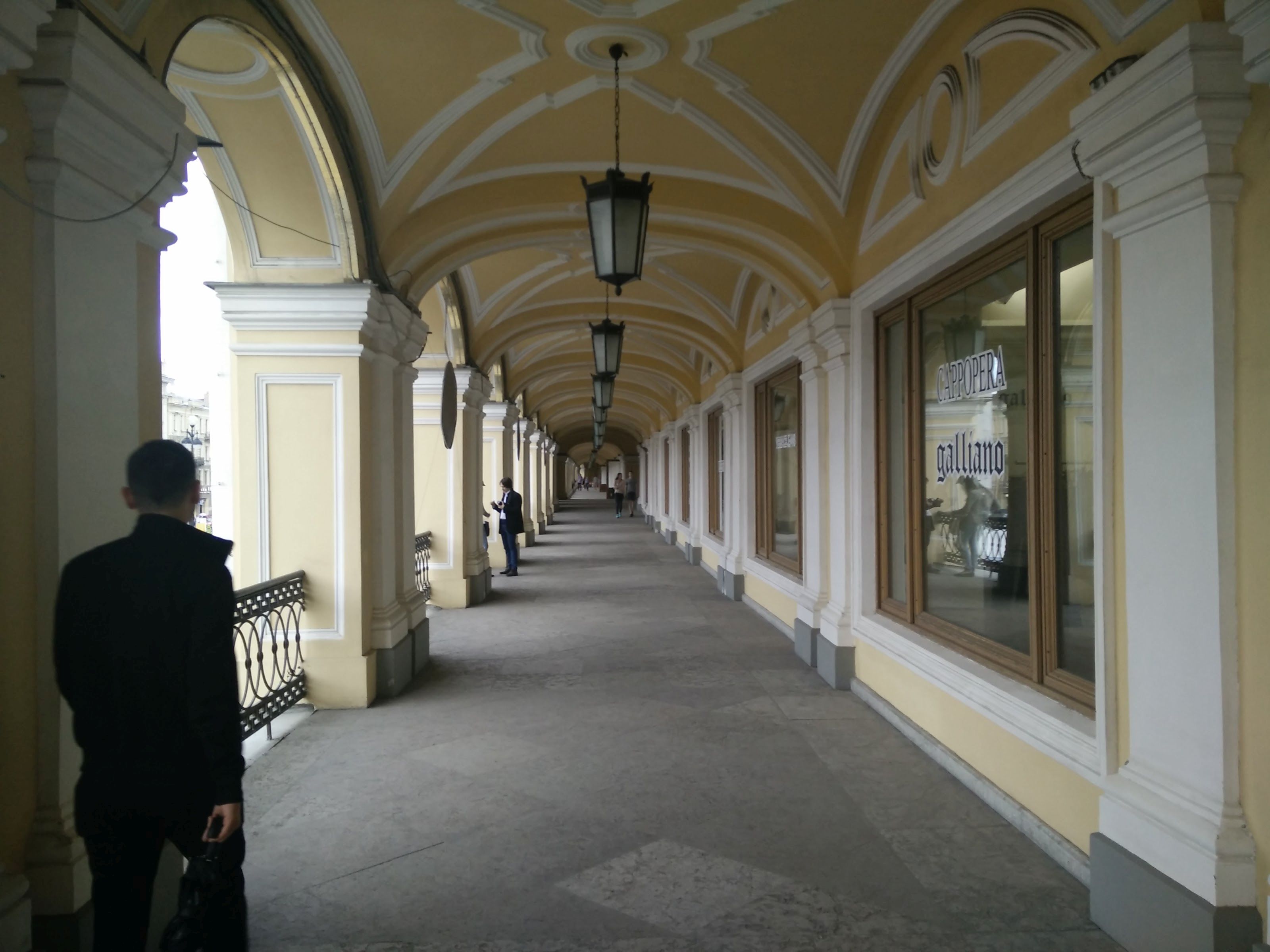
Nevsky Prospekt! St Petersburg’s high street, the gold-spired Admiralty building at one end, the long journey to Moscow at the other. The prospekt never sleeps, said Gogol in his short story of the same name,* and it’s as true now as it was 180 years ago. By day the eight lanes growl with ceaseless traffic and the pavements are thronged with shoppers; at night, a million coloured lights illuminate the grand facades and the swarms of happy drunks. Colossal buildings of varied architecture and great beauty, mostly unchanged since Tsarist times, line the prospekt: the glorious art nouveau Singer building;** the imposing St-Peter’s-Basilica-of-the-North Kazan Cathedral; the Great Gostiny Dvor, an 18th-century shopping centre whose cream-and-yellow arcade seems to go on for miles and miles.
and miles and miles and miles (nb: this is the shortest side)
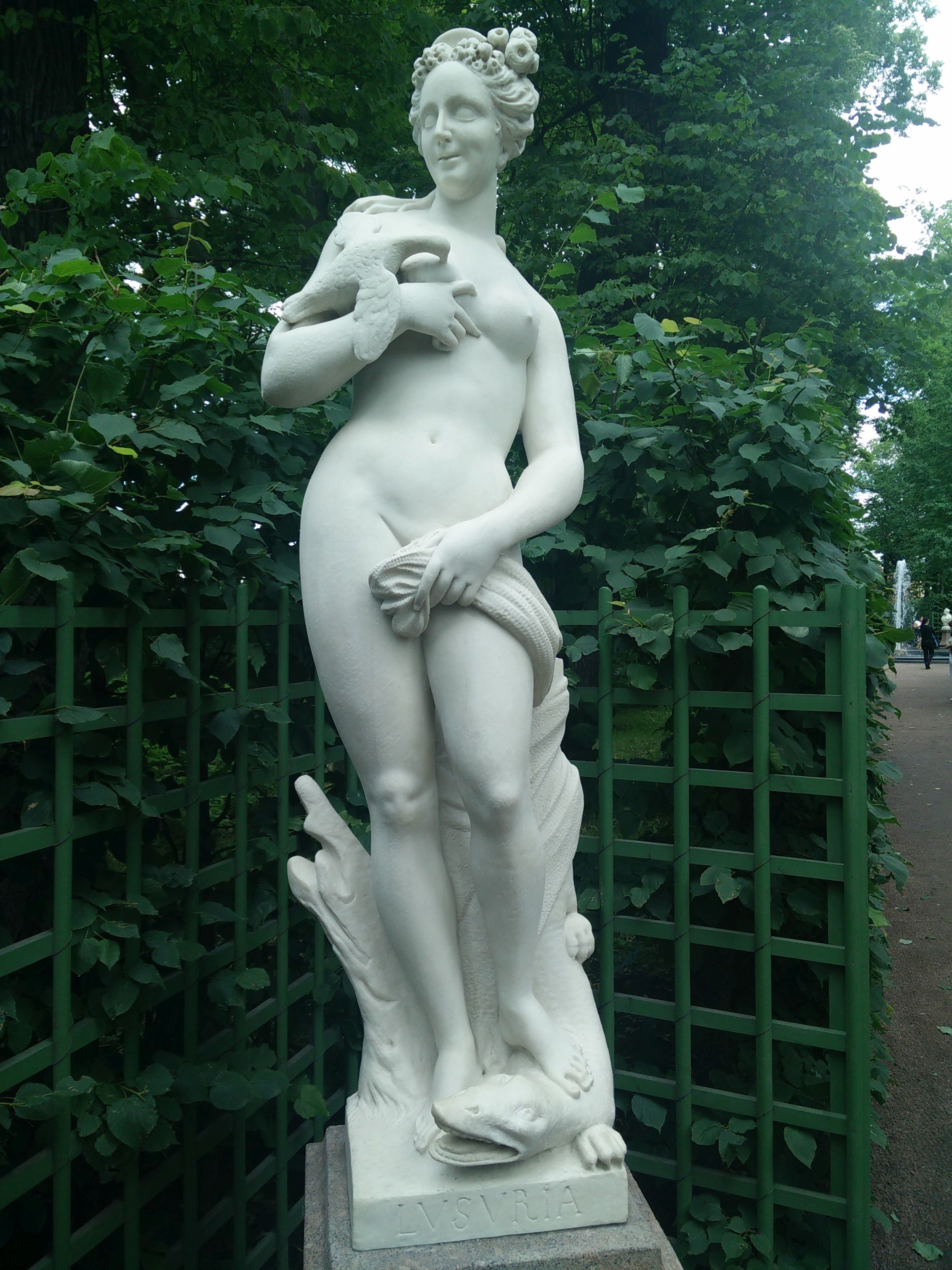
We started by the statue of Chizhik-Pyzhik, a little bronze siskin on a plinth jutting out of a canal wall; locals drop coins on the statue for good luck, hoping that one will stay on the little platform. Nearby, the Summer Gardens, a lovely formal maze of trellises and fountains, is scattered with weirdly bad imitation-classical sculptures; various lissom Ladies of Legend with bulging eyes and inconsistent detail pose on plinths, having their marble nipples bitten by doves and asps. As it turns out, the statues are recent replicas, with the originals (Venetian, from the 1710s) moved indoors.
It’s not “I could do better than this with a spoon in mashed potato” bad, it’s just not great. Especially by local standards.
Via the Field of Mars (once the Place of the Victims of Revolution, once the Tsarina’s Meadow, once the Amusement Field; these places have as many names as Transylvanian border towns) and Millionnaya Street, lined with unusually ornate buildings even for St Petersburg, we crossed the vast Palace Square, passed through the triumphal arches built into the General Staff building, and turned onto Nevsky Prospekt itself in time for lunch.
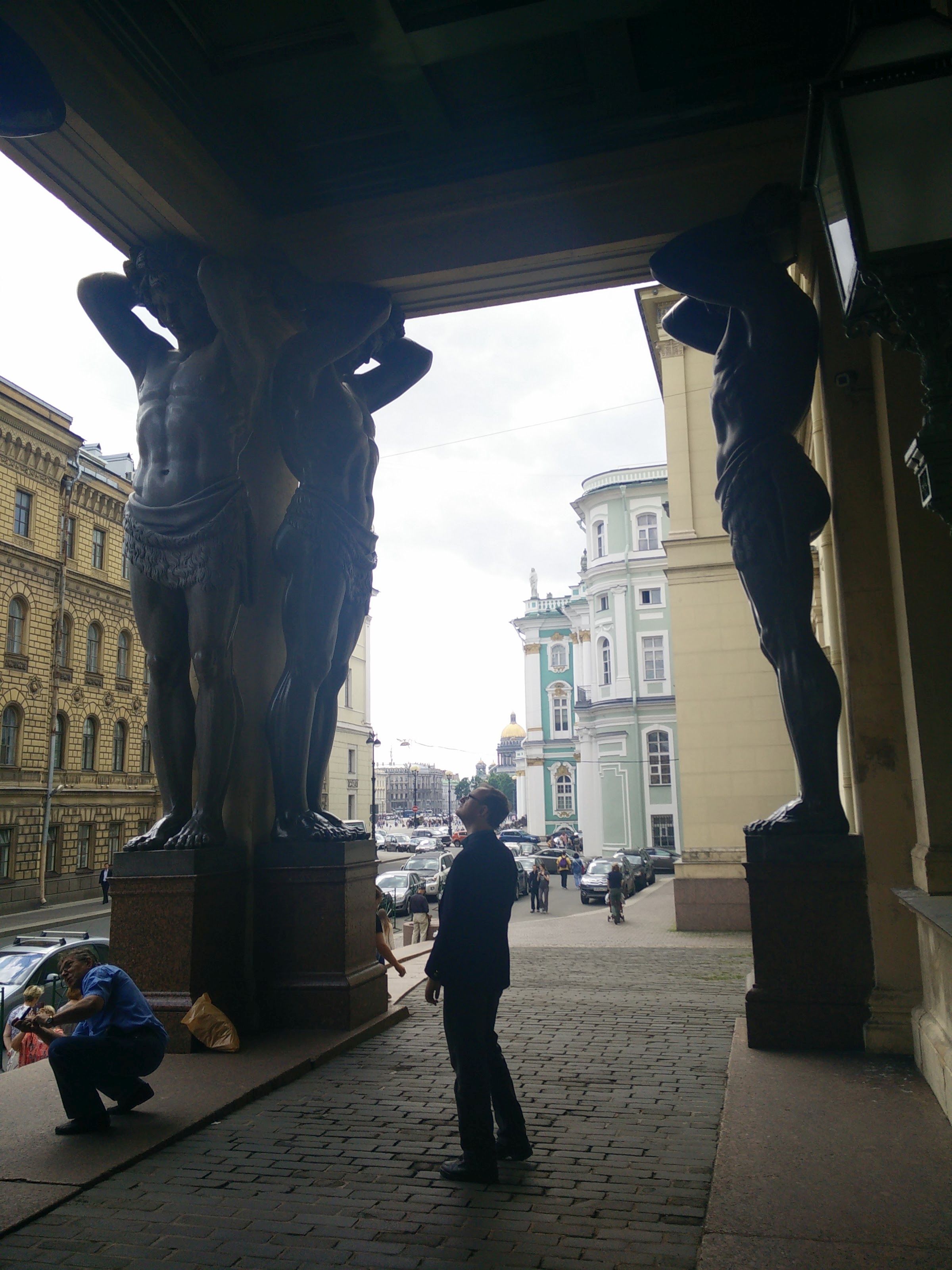
Atlas statues at the Hermitage, at the end of Millionnaya Street.
Declining a “traditional English pub” (with your-face-here boards starring Queen Liz and a Beefeater), we had blinis from a blini hut in on a side street, and were accosted by a pack of quite fearless sparrows. Exploring a bit, we found that most curious of things in Russia, a shopping centre with 1920s-style architecture.*** Further on, construction hoardings hid most of the once-glorious imperial stables, across a yard full of tourist buses from Jamie’s Italian.
Not-St-Basil’s, feat. paintings of itself.
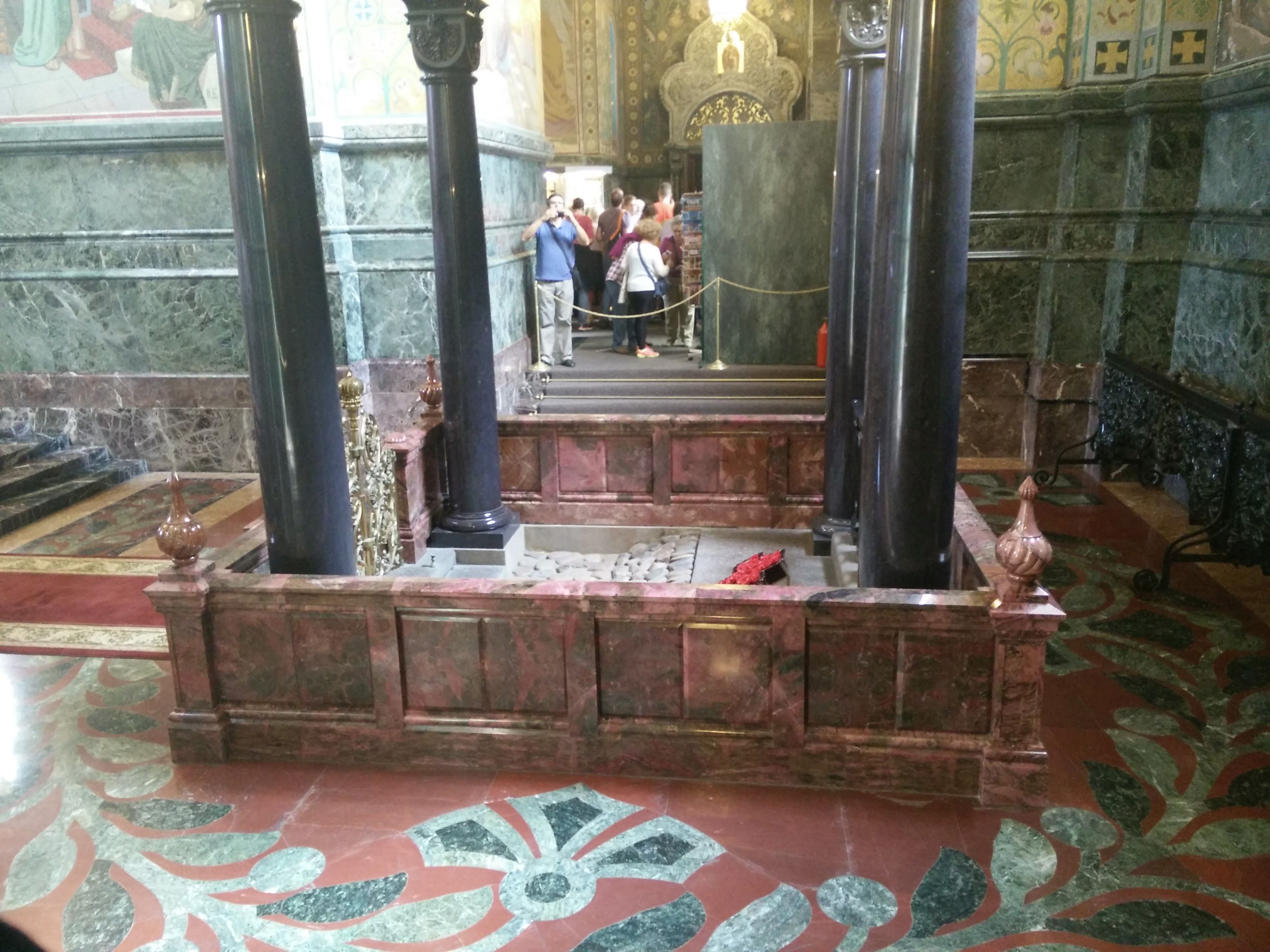
The Church of the Saviour on Spilled Blood (henceforth Not-St-Basil’s) is a magical thing, clearly taking some design cues from a certain giant red cathedral in Moscow, but both more muted in its colours and even more insanely ornate in its detailing. Not-St-Basil’s is recent; when Tsar Alexander II was grenaded by an anarchist in 18whenever, it was considered only proper to reroute three roads and a canal in order to build a gigantic billion-rouble pimp-cathedral on the spot, which has stood ever since. The centrepiece is a shrine over the original cobbles where Alex II was fatally wounded. The communists, with their usual utilitarian churlishness, used it to store potatoes.
Inside, it is (like everything Orthodox), fabulously ornate; the structural design is quite simple, with flat walls and wide arches, but every surface is covered with mosaics of staggering beauty. The central screen is a medley of gorgeous precious and semi-precious stones, with information boards in several languages explaining where all the different fancy rocks came from. The canal beside it is lined with market stalls selling Soviet tat, painters flogging canal views, buskers playing violins and musical saws, a woman trying to get people to ride the pony she was leading around.
It was actually the second attack, too; Alexander got out of the carriage to shout at the failed first bomber, and the second shouted “it’s too early to thank God!” and naded him.
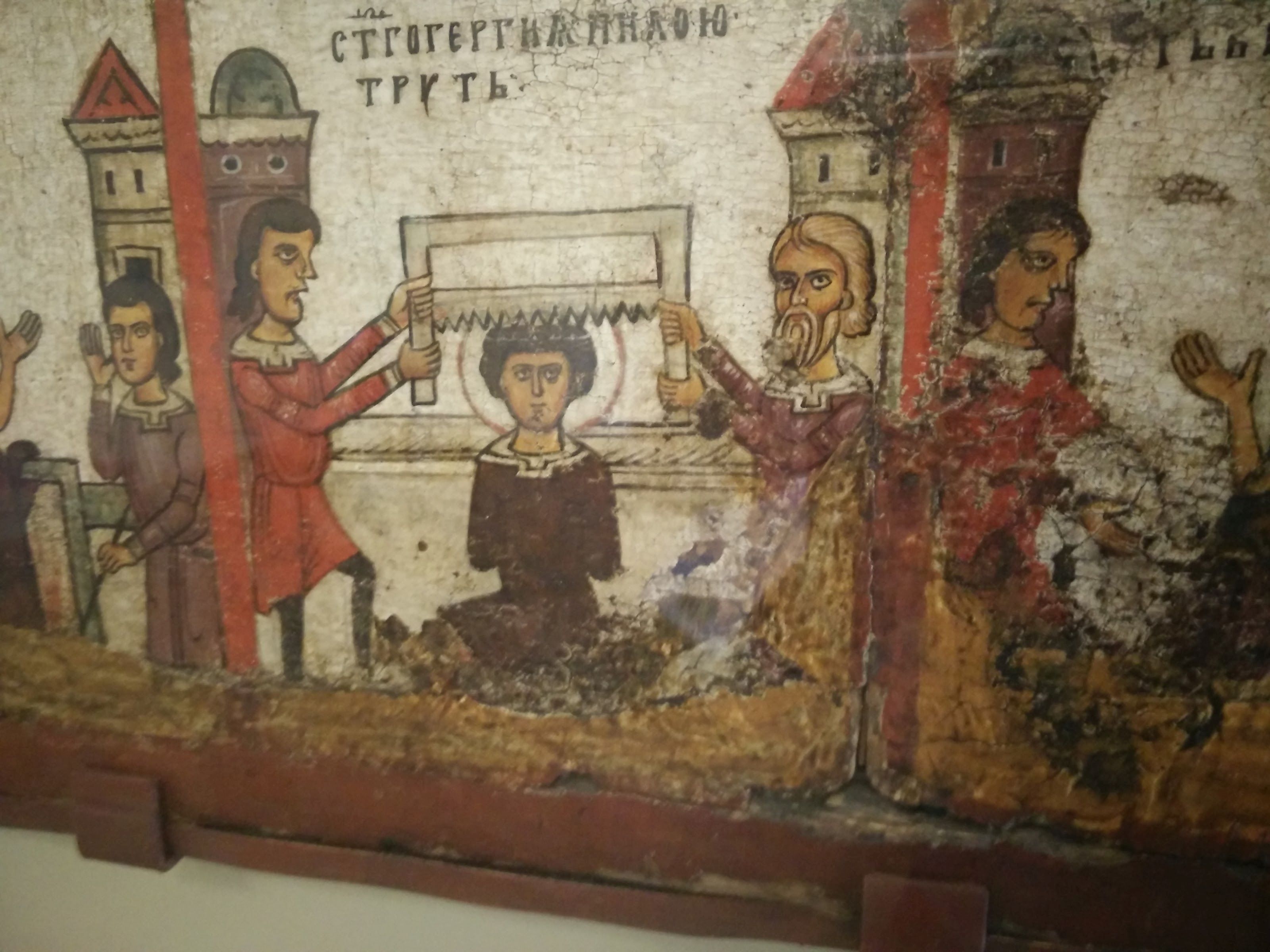
Wandering through the dvori (courtyards/mews at the centre of residential blocks), with their graffiti, hidden churches and statues of Pushkin, we stumbled on the Russian Museum by happy accident. Despite the name, it’s a thoroughbred art gallery, its collection incredibly varied and deeply Russian: paintings and statues of centuries of ugly nobles, wooden altarpieces of blank-faced saints being hideously tortured, paintings depicting the ever-smiling Suvorov urging his men over the Alps, or fleets of stripy 18th-century warships like seventy-four-gun humbugs. It’s all fairly recent, Russian Russian rather than Novgorod or Kievan, the only real pre-Peter stuff being the green-skinned, fish-eyed Mary and Jesus altarpieces from a time before anatomy.
“This is fine. I’m fine.”
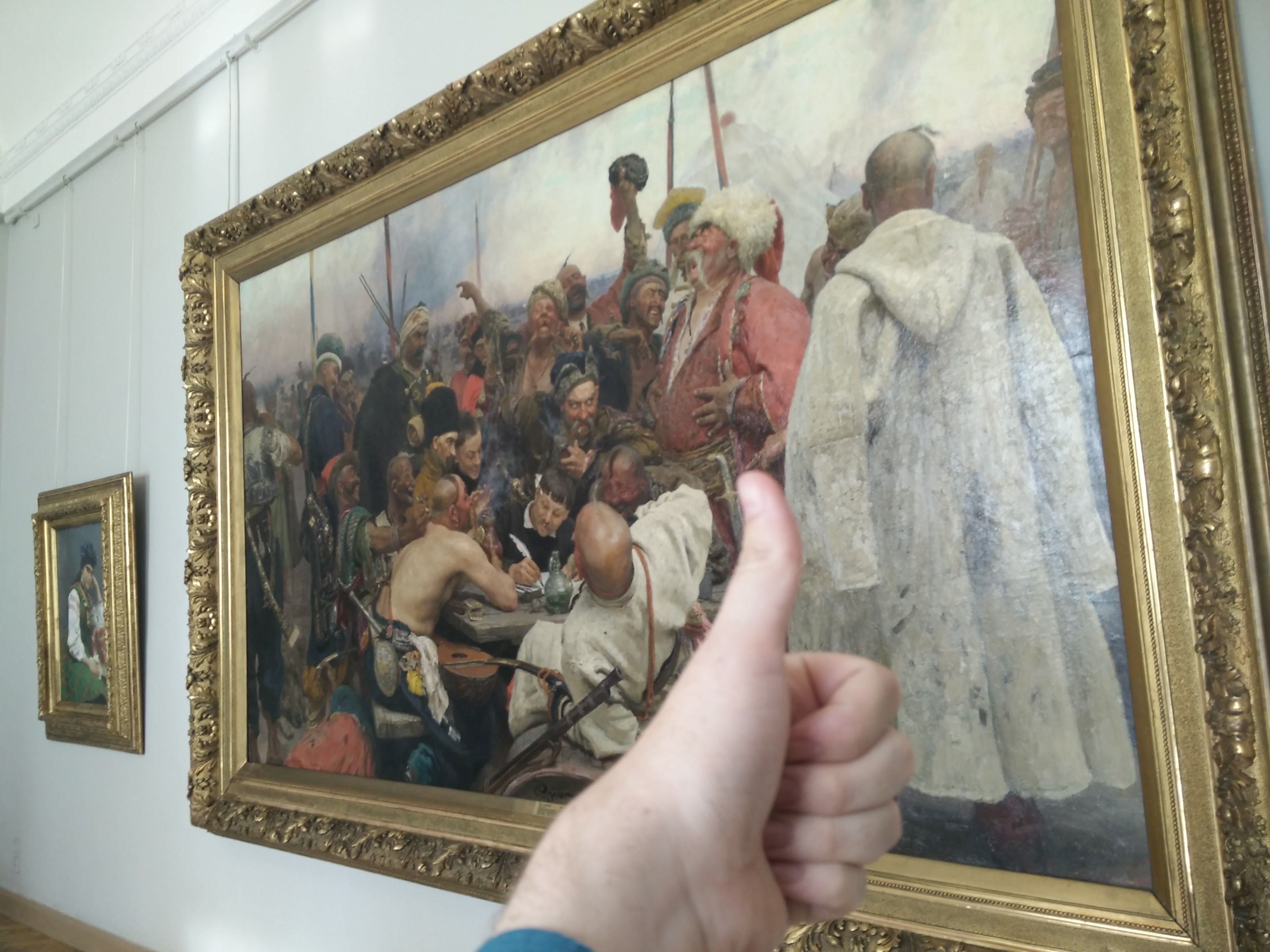
As well as the tsars and tsarinas, it celebrates Russian creators: we found a jovial, flaky-looking bronze of Repin, a smooth, blank-eyed marble of a shirtless Gogol. The taste for openly sexualised depictions of underage boys was a bit odd, but I suppose that’s the 18th century for you. On a plinth, under a glass dome, is a plaster cast of Peter the Great’s surprisingly tiny head. The prestige piece actually took me by surprise: the Reply of the Zaphorozian Cossacks, which [for my money] is the joint best painting (alongside Ivan the Terrible) by Ilya Repin, who [for my money] is the joint best painter to come out of Russia (alongside Vasily Vereshchagin). Do click the link – the story behind the painting is hilarious, and the painting itself – even in digital format – is an incredible mix of expressive characters.
Reppin’ Repin.
Oddly for such a prestigious collection, most of the paintings are very poorly lit and displayed; many (including the Cossacks) hang opposite windows, meaning you get terrible glare off the shiny oilpaint and aren’t able to appreciate the whole painting at once. I’m used to the National Gallery, which was purpose-built to house art and has its lighting overhead, while the Russian Museum is a converted palace and so can’t help its window placement.
It had rained while we were in the gallery, and a rainbow shone over the prospekt; the Singer building and Kazan Cathedral both looked striking in the golden post-storm light. Footsore and arted-out, we headed on home, dreaming of black tea with honey and bowls of candied cranberries (Russia has found a way to make cranberries edible: coat them in so much sugar they resemble mint imperials. It’s genius.) Behind us, Nevsky Prospekt bustled with ceaseless life.
* Which is hilarious, and definitely the most Russian love story I’ve ever read. The short story is worth tracking down, but if you can’t be bothered, the Wikipedia summary is almost as funny.
** As in, the sewing machine company. I only know about them because my mum had one.
*** Odd, because the exterior looks very 1920s-30s, a period when Russia’s new management were not the type to build shopping centres – they didn’t even acknowledge the necessity of money for a while. I did some research, and it turned out to be pre-Revolution; the almost-Art-Deco architecture was simply ahead of its time.
We started the day with a brief visit to Mikhailovsky Castle, the personal project of Tsar Paul I, one of the more sad and useless Tsars of the 18th century (his father, Peter III, being another of the “sad and useless” category; his mother, Catherine the Great, reigned between them and was extremely effective.) Mikhailovsky is architecturally very cool, with a huge octagonal courtyard at its heart and an exterior designed to display a different architectural style depending on which direction it’s viewed from. It was built mainly as a result of Paul’s paranoia about being assassinated in the Winter Palace. It didn’t work: he was assassinated at Mikhailovsky six weeks after moving in. His son and successor Alexander was actually in the building at the time, and immediately after doing Paul in the assassins came over to Alexander and told him “you’re it, boyo. Don’t disappoint.”
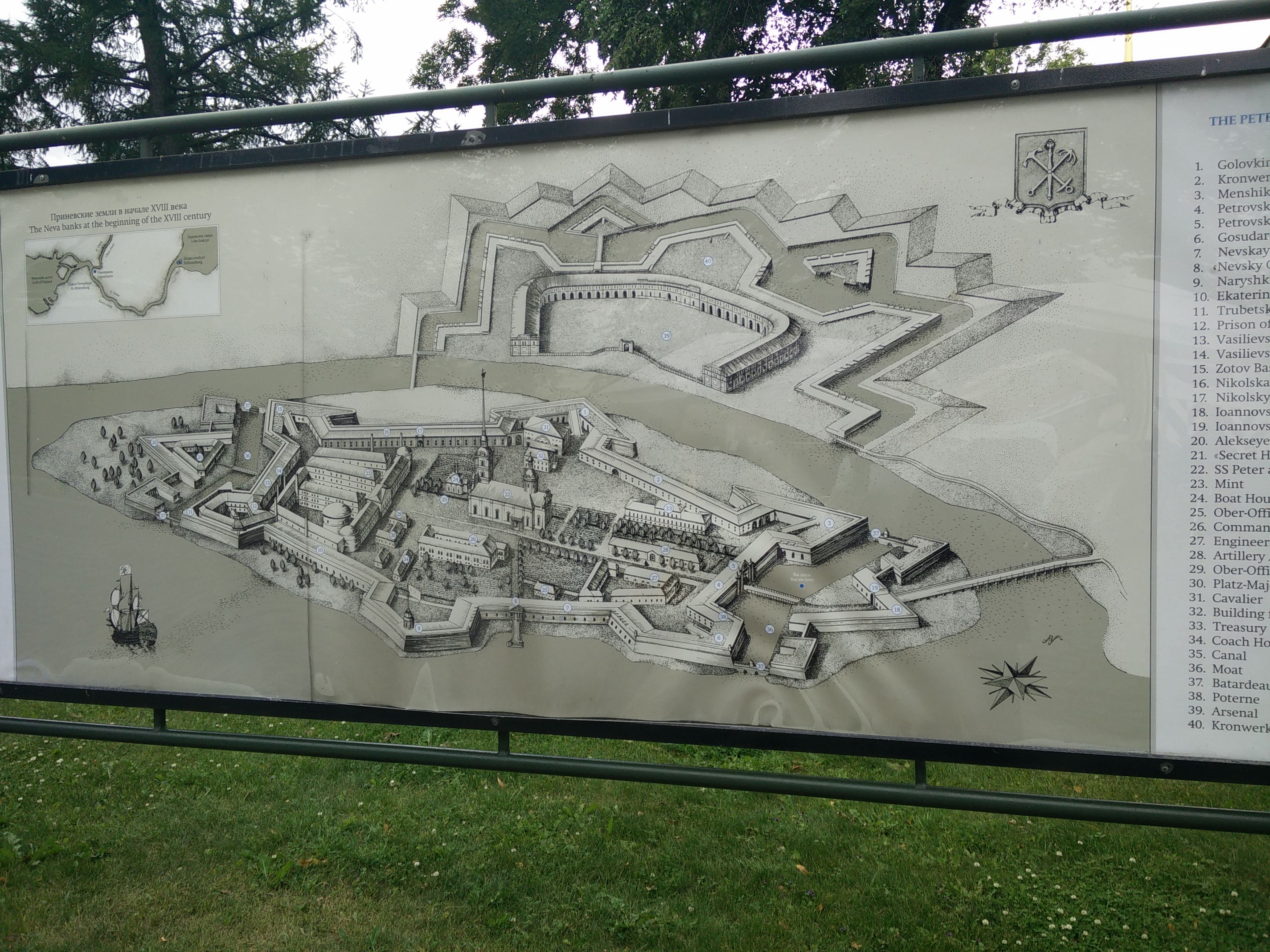
Fortress of Peter & Paul. The crownwork (horseshoe-shaped building at the top) houses the Artillery Museum.
Right at the heart of St Petersburg, on its own island, is Petropavlovskaya Krepost – the Fortress of Peter and Paul. It sits across the Neva from the Admiralty and the Winter Palace, a big old trace-italienne fortress (literally, as Italian designers were brought in to lay it out): squat, angular, and still pretty formidable-looking after three hundred years. We walked along the sandy beaches around its sheer wall; artists were putting the finishing touches on entrants of a sand art competition and smart-looking Russian crows were playing and squabbling on the fortress’s walls and among the bits of driftwood the Neva brings down from Lake Ladoga.
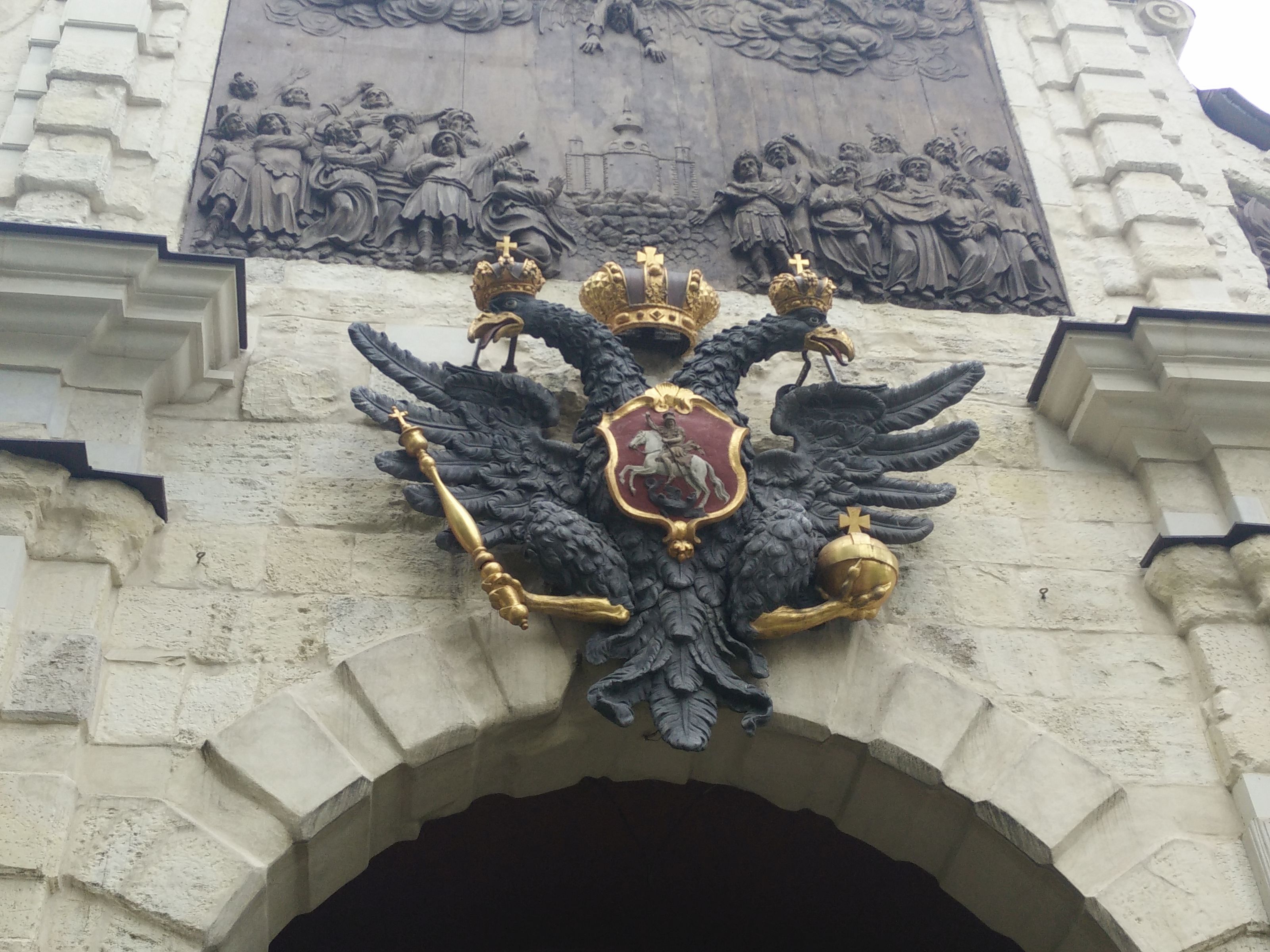
Big ol’ eagle above the fortress gate.
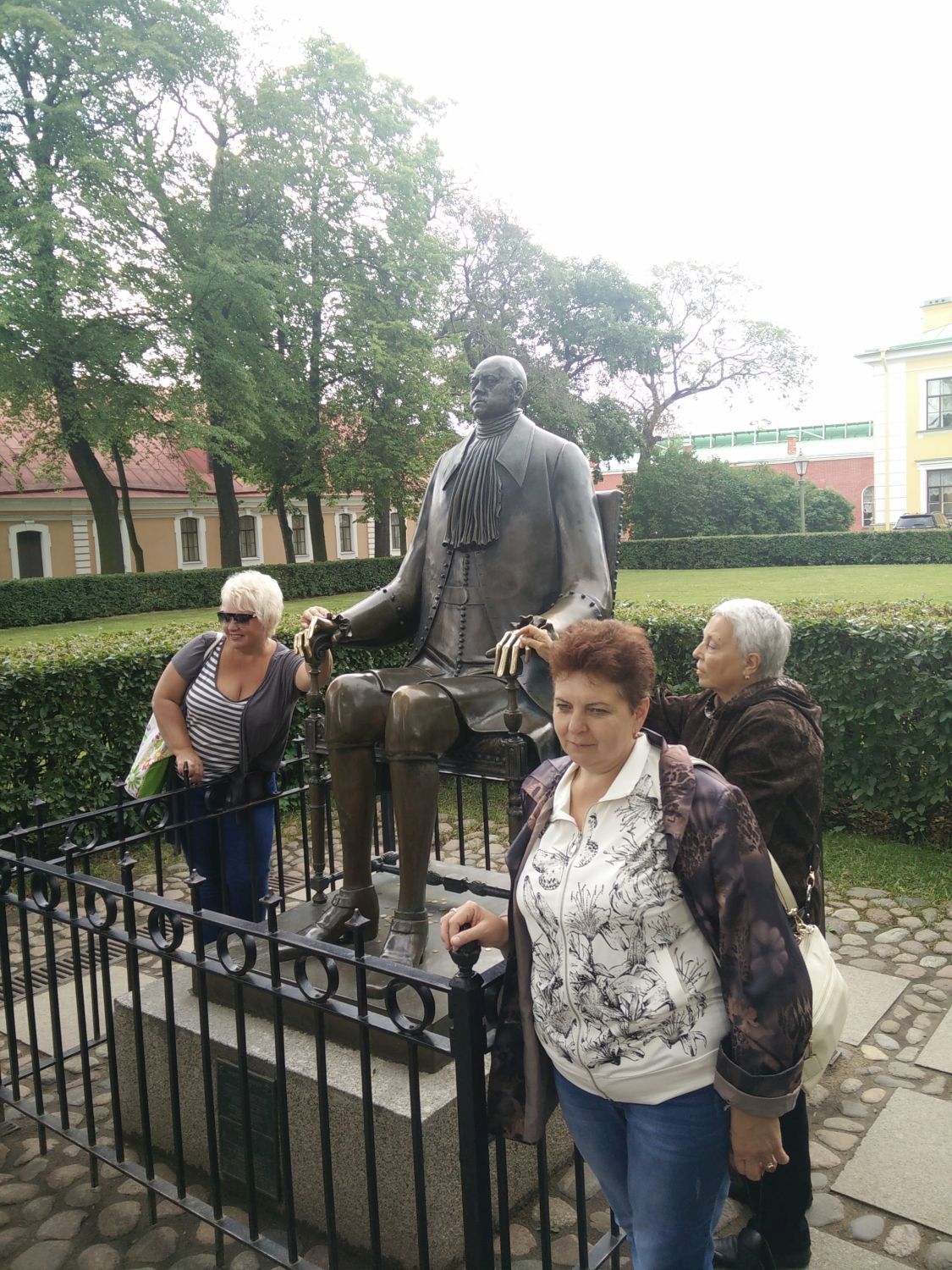
Within the walls are a number of nice old buildings, mostly in the classical Russian white-and-pastel style which always reminds me of cakes. Among several buildings with attractive rococo domes is a very yellow church (a cathedral, technically) with a very tall, very gold spire; across the cobbles from it is a bizarre “anatomically correct” seated bronze of Peter the Great, a barrel-chested homunculus in a many-buttoned uniform with a tiny shrunken head and terrifying long spidery fingers worn bright and shiny by tourists inexplicably holding his hands. Brr.
Peter the Great. Note his mutant spider fingers and inexplicable female fanclub.
We got some kvass from a street seller. It’s a sort of beery drink made of fermented bread, so low in alcohol that it counts as a soft drink under Russian law. I actually really liked it – the taste was oddly honeyed, although there’s no honey in there. Most of the museums inhabiting the walls and buildings looked both a bit pricey and a bit small-time, so we didn’t go into any of them, but the Mint shop buried in one of the walls had an intriguing selection of shiny, pretty coins.
“And the war came, with a curse and a caterwaul…”
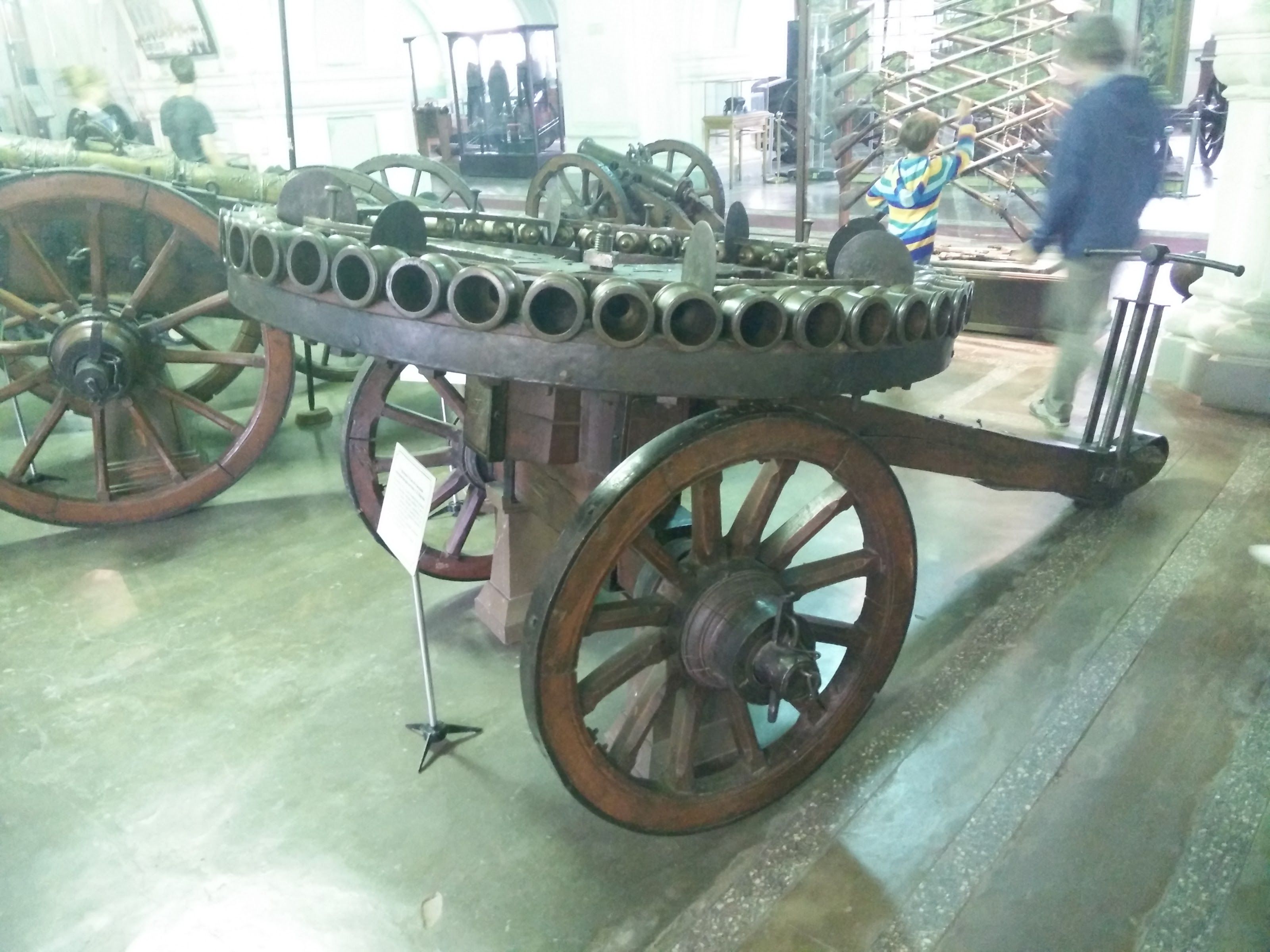
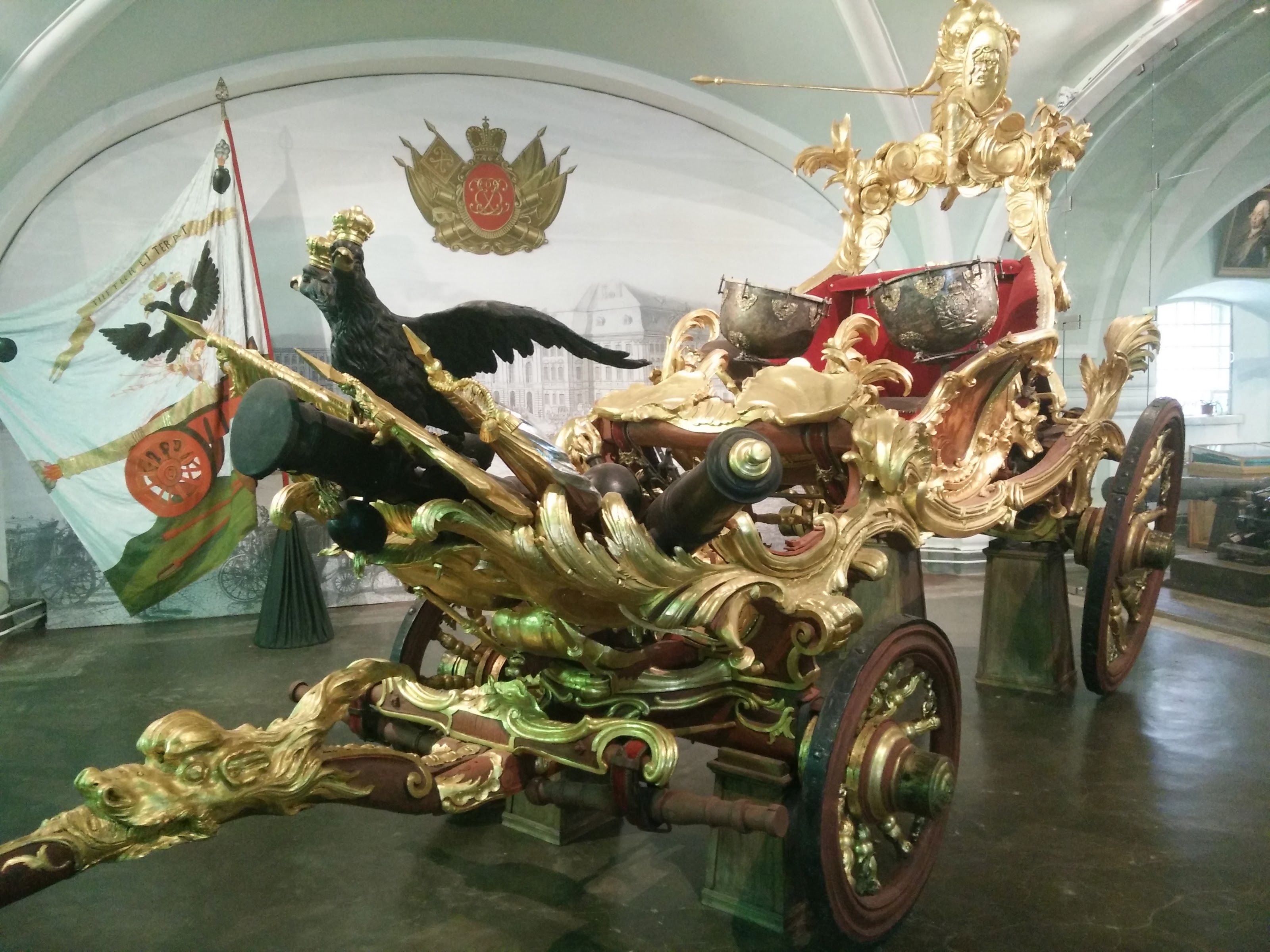
The crownwork north of Peter & Paul is inhabited by the biggest and best collection of giant weapons I have ever seen in my life. It takes a lot – and I mean a lot – for me to go “cor, what’s this? Never seen one of those before…” at a military museum, and I was doing it roughly every five minutes of the hours we spent in the Artillery Museum. As the exhibition winds through the building’s huge wings, you work through a history of Slavic heavy weapons in chronological order – ancient handgonne-looking things, early muskets and cannon with angular Cyrillic letters cast on their bronze barrels, various weird and wonderful devices of the 17th and 18th century (a repeating grenade launcher with forty-eight little mortar cups mounted on top of a cartwheel), the heavily blinged semi-modern kit of the Napoleonic wars, guns and cannon from the World Wars and at last a huge indoor gallery full of truck-mounted rocket launchers. Highlights included a room containing every member of the Kalashnikov family, a giant statue of Pyotr Bagration down a side corridor for some reason, and the silliest artillery-themed ceremonial carriage ever: a sort of mad Cinderella fairytale thing slathered in gold leaf, its prow a two-headed eagle sitting on a nest full of cannon.
I see literally no way this could possibly be a bad idea.
“Pimp my ride” just isn’t adequate to describe this.
That was the interior, of course; all the guns too big to fit inside or weatherproof enough to be left to it are outside in a courtyard, and could collectively waste a city in one salvo. Off to one side I found the Decembrist memorial, a grey granite obelisk; next to it is a row of very old, very beautiful bronze cannon, no two the same, cast with the symbols of failed empires and forgotten kings.
This one’s Swedish, I think.
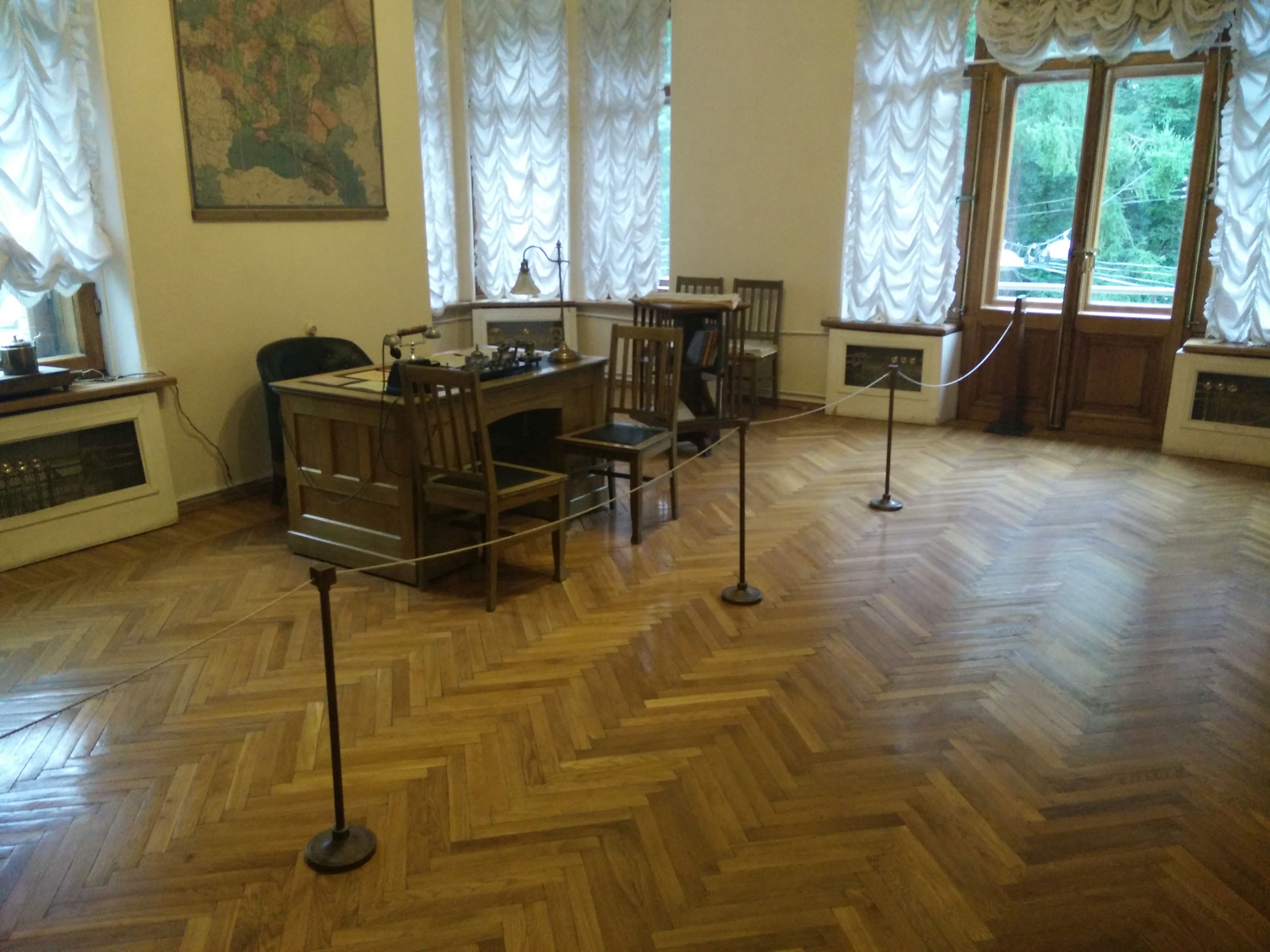
We were in the area, and the Museum of Political History a short walk away (through a park where, of all things, some Native American buskers were doing their thing), so we headed there next. Outwardly a gorgeous art nouveau mansion,* inside it’s a very nice, modern, well-maintained if oddly laid out museum. The successor to the communist-era “Museum of the Revolution”, it’s been rebuilt with great care and attention and solid English translations; I wouldn’t want to be the one explaining the impossibly tangled clusterfuck of the Russian Civil War in my own language, let alone someone else’s (and, to my great joy and approval, they got the right rifles for all the various forces – Red, White, Green, Black, British, American, Japanese, Canadian, Czechoslovak Legion etc etc) and had some good artifacts (look, Richard Sorge’s greatcoat!) For my tastes, it was still just a bit weaselly with certain bits of history (particularly a description of the partition of Poland which described the Nazi side as an actual invasion, and then hedged with “the Red Army commenced military operations in eastern Poland that week”) but generally quite bloodless and even-handed, and very sensibly avoided dealing in detail with anything that’s happened since the 1990s. Parts of it were closed, but the Revolution and Civil War bits, which I was most interested in, were open and wonderful – but it it took until I got into actual Lenin’s actual office that I realised that this was the room the Revolution was planned in, with the balcony Lenin’s speaking from in all those paintings. That was quite something, really.
“I want to be in The room where it happens, The room where it happens, The room where it happens…”
* The Bolsheviks used it as their HQ for much of the Revolution, having taken it from the famous ballerina Mathilde Kshesinskaya, a lover of the Tsar. She didn’t do badly, though; she ran away to Paris, married a prince, founded a ballet school and died aged 99.
(Click the images for full-size versions, rather than hideous artifacted thumbnails.)
St Petersburg is a planned city, only three hundred years old; unlike the older great cities of Europe, the core is not a medieval labyrinth that all accept as being basically stupid to drive in. Unlike, say, London or Moscow, it also doesn’t have a “central business district”, just business areas scattered around the city; these areas are, according to Misha, not very well served by its Metro (which is much less extensive than Moscow’s or, while we’re on the theme, London’s). It does, however, appear at a glance to have great road infrastructure, with the main prospekts that radiate out from the Admiralty building all being huge eight- or ten-lane monstrosities for most of their length.
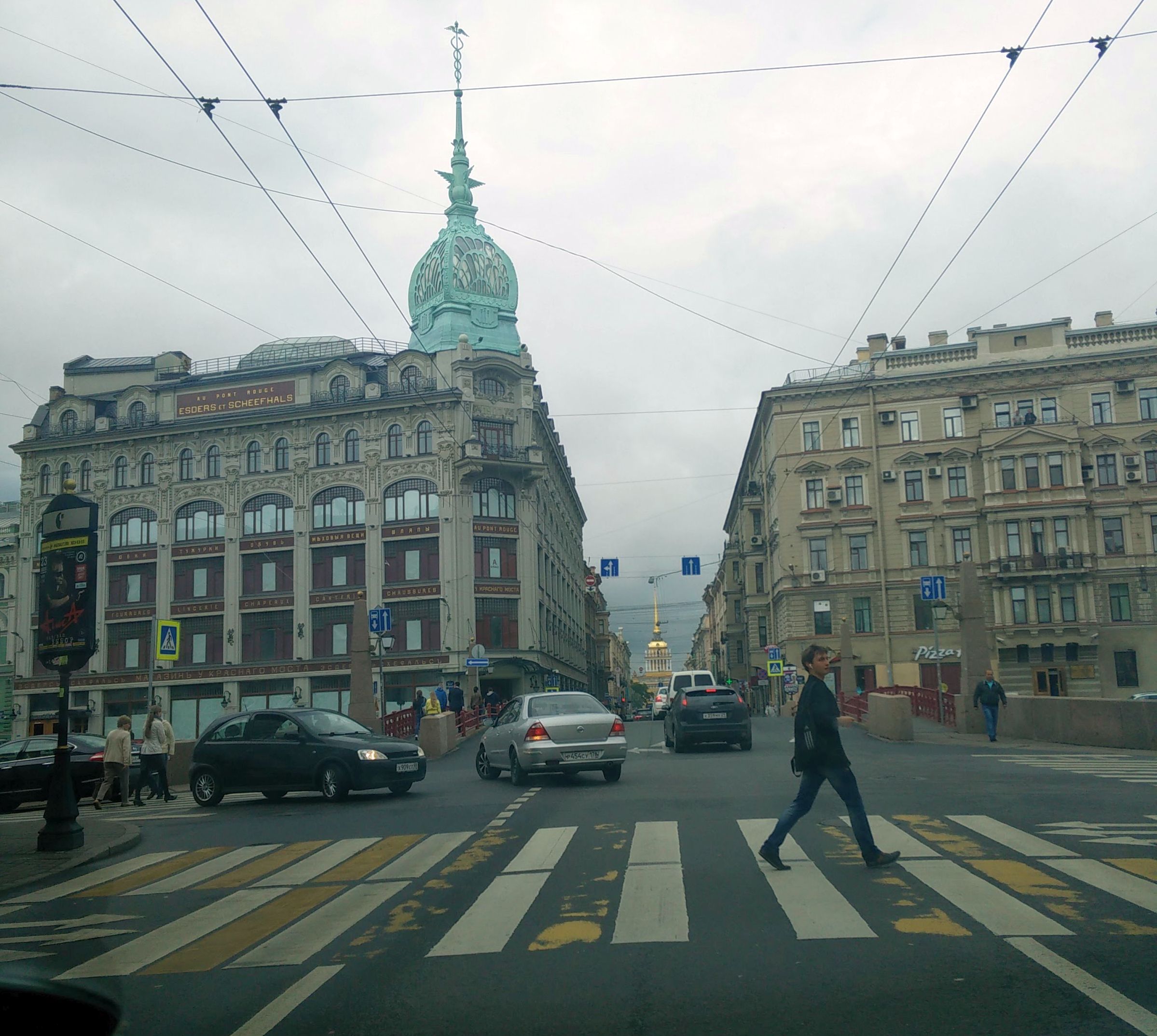
One of St Pete’s many, many nice buildings. Note the golden spire of the Admiralty building in the distance.
Thus, everyone tries to drive to work. This alone would be mental in any dense city of five million souls, but Gogol’s line about Russian roads is still relevant 150 years on. So even hours after rush hour, the immense prospekts are a clotted, potholed struggle of grumpy car-bound Russians, exacerbated by failed signage, random roadworks or some plonker taking up a lane by lurking with hazards on, looking for a parking spot. Oh, and the actual traffic accidents; they drive a lot less violently than Muscovites here, but we saw a few of those as we attempted to drive to St Isaac’s and, even worse, attempted to find parking.
“Why is this place so fucked up?”
“You mean the junction here, or Russia in general?”
“That as well.”
St Isaac’s.
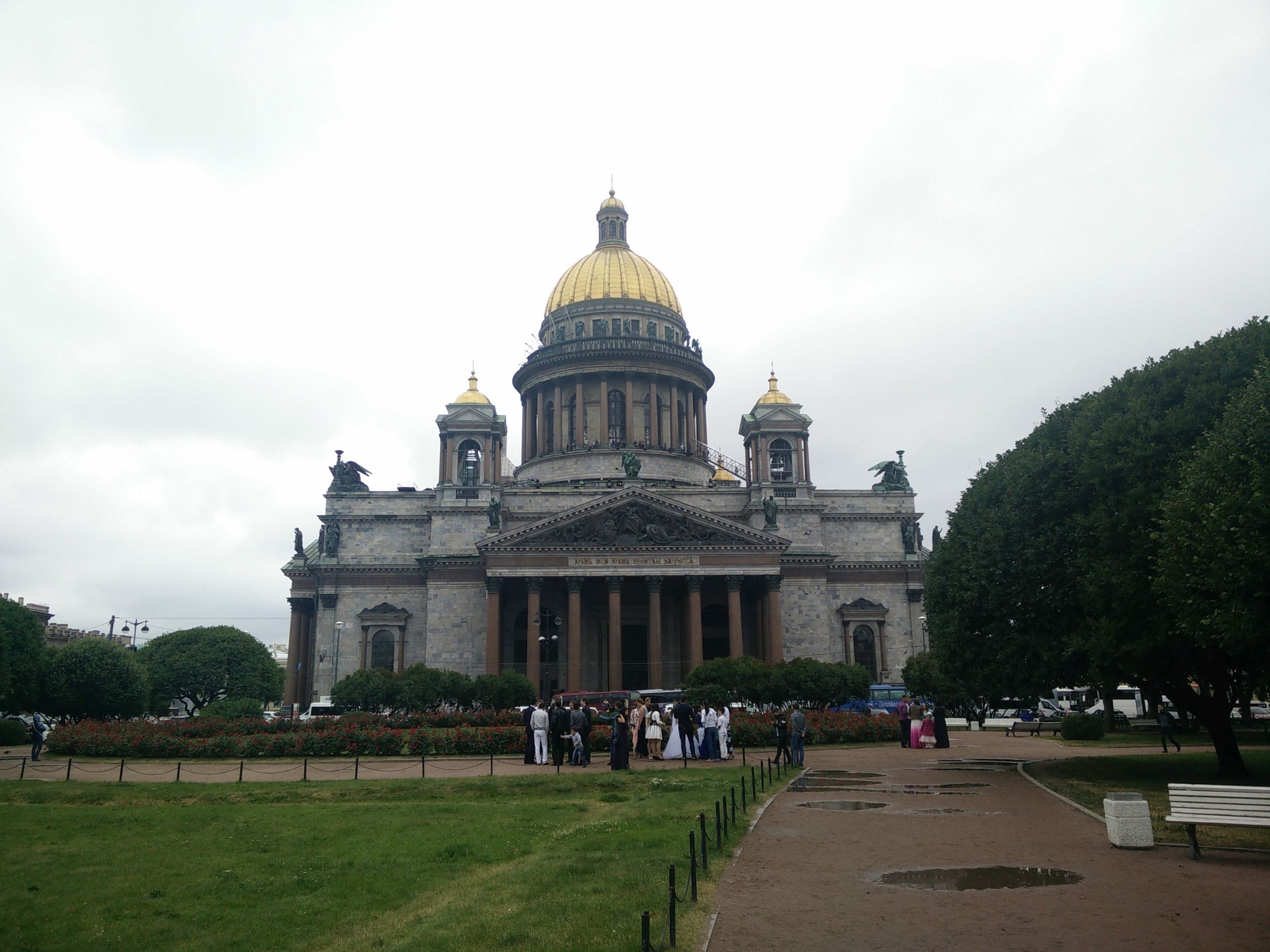
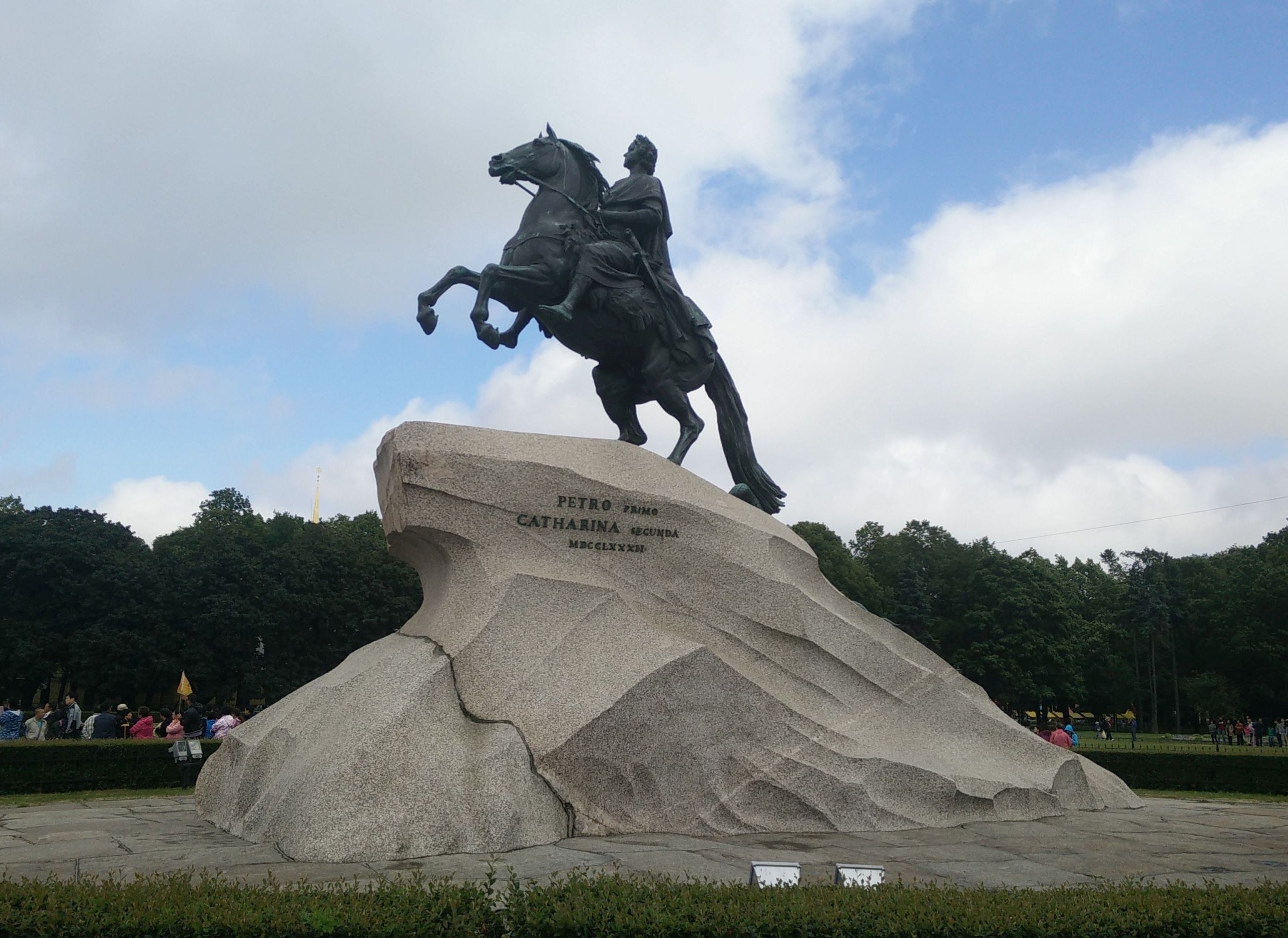
There’s a [citation needed] on St Isaac’s claim to be the fourth biggest cathedral in the world, but it is certainly not small, and the views from its high tower (its foundation ten thousand tree trunks driven into the ground) were glorious, even in the intermittent rain. It’s an unusual building, Orthodox by way of Russian neoclassical, resembling a foreshortened St Paul’s with a much cooler colour scheme – patchwork marble cladding, chocolate-coloured granite colonnades, acres of green-black bronzes and the obligatory vast golden dome. One side bears scars from Nazi shelling, but it was mostly unscathed; Misha told me the fascists left it up as a landmark to navigate by, and the internet told me the Russians used it to help triangulate on German artillery positions. Nearby is the Bronze Horseman, on the “Thunder Stone”, which is meant to be the heaviest monolith ever moved (but is surprisingly small), and the gleaming golden tower of the Admiralty building, which all roads lead to.
View from St Isaac’s, looking directly towards the Winter Palace (the mint-green building in the centre); the gold spire is the Admiralty building, with Petropavlovskaya fortress behind it.
One of the striking things about central St Petersburg – the old pre-Communist part – is the level of detail and decor lavished on the buildings. The most mundane structures are palatial in their trimmings as well as their size – here an apartment block has a mural of horsemen chasing each other, and Doric colonnades on the balconies; there a building with an apothecary in the ground floor sports the sculpted faces of Hippocrates and all his friends, with a rod of Asclepius standing proud on the highest level of its turret-like corner. And it’s everything, every building – no boring cubes, nothing which doesn’t look like a lot of time and money was spent on blinging it out. An endless series of decadently decorated baroque, neoclassical and Empire style palaces, in pastel shades of yellow and orange and pink and green, all trimmed in white to look like expensive cakes. Above the streets, there’s a huge, constant tangle of wires – tram and trolleybus power cables lower down, then cables suspending strings of streetlights, and finally the endless cobweb of telephone cables.
The Bronze Horseman on the Thunder Stone. “To Pete, from Cath xox.”
As a result of all this finery, buildings which anywhere else would be hellishly impressive – the Admiralty building, an 18th-century fortified naval arsenal filled in with new administrative buildings sporting giant anchors and the heads of the Argonauts; the Winter Palace, a spearmint fantasia of white, green and gold; and the General Staff building, a pair of immense yellow blocks fused together by triumphal arches – are only slightly more fancy than the old residential districts we walked through to get to them. Due to the architectural difficulties of Petrograd being basically built on a marsh, they’re mostly not even any taller; only the golden spire of the Admiralty building, topped with a shipshape weathervane, rises above the rest.
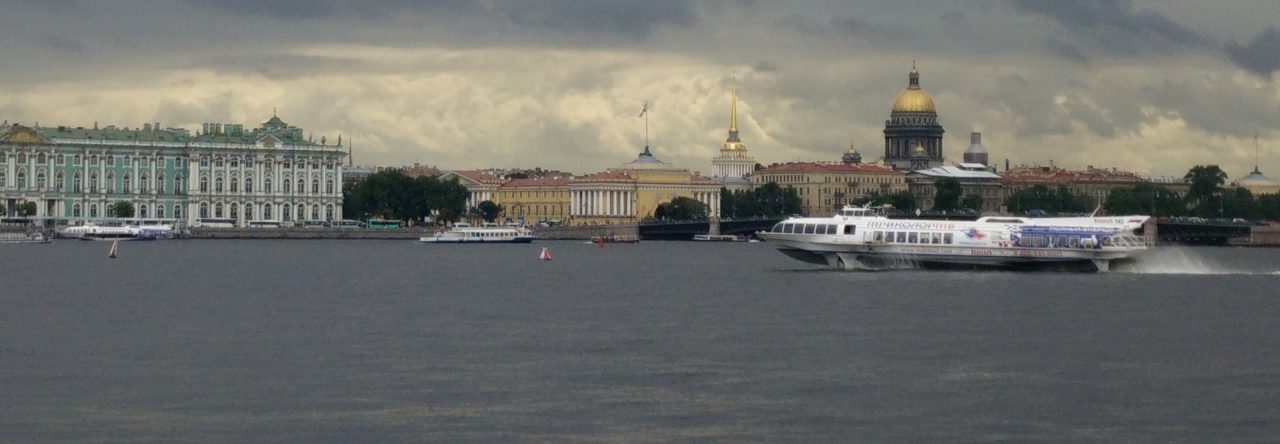
Hydrofoil. (Winter Palace in the background.)
Crossing Palace Bridge for a better view, we saw the squat bastions of the Peter & Paul Fortress over the choppy steel-blue Neva. Hydrofoils from Peterhof decelerated and settled back into the water, with names like МЕТЕОР on their streamlined hulls. Huge, weirdly low cargo ships were sliding under Trinity Bridge on their way to the Baltic; all the Neva bridges are capable of lifting up, but you wouldn’t know to look at them, or at the boats. Across the bridge on Vasilyevesky Island is the old Bourse, Peter the Great’s stock exchange – a decayed classical temple of money, turned over by the Communists to the worship of military history instead but sadly closed for refurbishment. Either side of it are two rostral columns, huge hideous red things with stylised bronze galley prows sticking out of them. (Googling what a rostral column is makes the horrendous, gigantic, universally loathed Peter the Great statue in Moscow make very slightly more sense.)
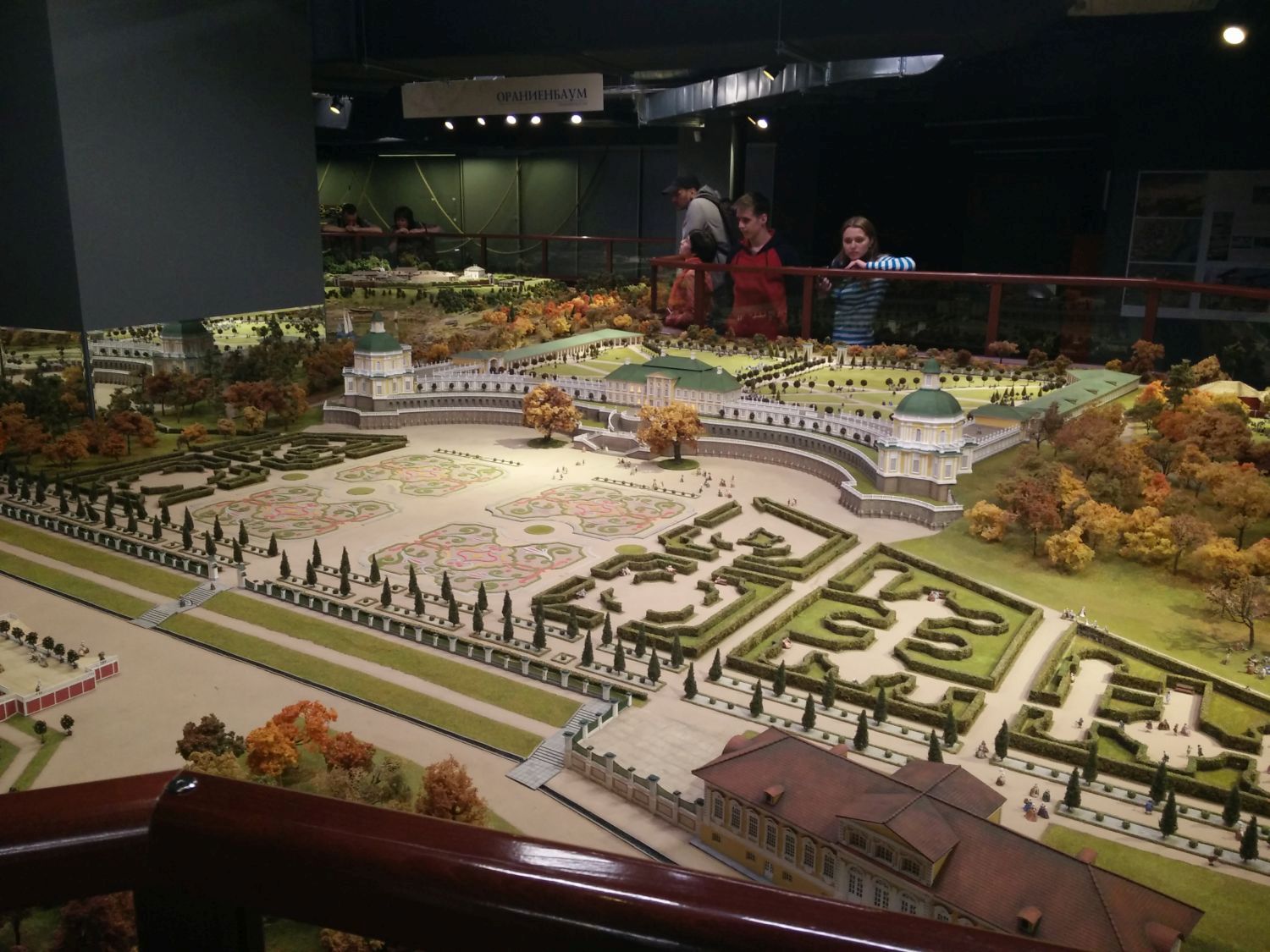
We surveyed the Hermitage and General Staff building in the pissing rain, then retired to “a place I know, it’s kind of hipstery” for tea and dinner – I had beef stroganoff, in sauce that tasted like that creamy IKEA stuff, Misha had a fragrant, many-spiced curry which recalled the taste of genuine Indian but with none of the fire. Then, seeking something sheltered to kill the evening, we found that “Peter’s Aquatoria” was nearby and didn’t close til 10pm. It is one of those places which words don’t do much justice to: a big exhibition room with 1/87 models of large areas of 18th-century St Petersburg and surrounds, arrayed around a central pond (geographically counterfactual, but whatever). The Admiralty building, still fortified and full of half-built ships, ice-cutters and sleds frolicking on the frozen Neva nearby; the Twelve Ministries and what’s now the Kunstkamera, back when half of that was fields; Kronstadt; Peterhof Palace, with 2cm-high figures dancing in the gardens; the now-gone “Peterstadt” that Peter III (the weedy, useless one who lasted six months) built for no reason, all realised in unbelievably complete detail, with ships and carts moved around by subsurface magnets, smoke issuing from chimneys, windows and lanterns lighting up as the day-night cycle rotated – a set of wonderful miniature aerial views of Petrograd as-was, which you could normally only get with a time-travelling helicopter. We spent hours taking in the detail. At the end of the exhibition they showed us a rack of fridge magnets, which had been printed with photos of ourselves taken without permission; this struck me as staggeringly creepy, but Misha bought me one and I accepted it as a generous gift from a good bro.
I installed the new Google Photos app on my phone, and it unilaterally decided to create a video from all the shit I’d taken at Tankfest. Apart from the massive inherent creepiness of this, the hideous hipster instagram filter, and the totally unfitting music, it’s actually quite appropriate.
ADDENDUM: Ben has uploaded his excellent Tankfest photos to Flickr – you can see them here: https://flic.kr/s/aHskf7Pmnh
After a cramped ride in the sweatiest train ever (it took me a while to catch on that it was Glasto weekend; I broke with common train etiquette and actually asked to have my reserved seat, and the bloke I displaced got kicked out twice more by other people with reservations,) I arrived at Ben and Jenna’s lovely new (and I mean NEW – they haven’t finished the road outside yet) house, for a chilled evening of tea and homemade onion-soup-flavoured burgers. Then after a sleep under my favourite London Underground duvet, we were up for a drive to Bovington, and TANKFEST.
Cadets in the same boots as me herded cars into their slots with quasi-military precision, and we moved towards the big tank arena through a vast camp divided into two areas: the collection of stalls selling Airfix kits, toy guns and militaria, and the semi-fortified encampment of worryingly earnest-looking men in a variety of period uniforms peering at us over mounted machine guns. Nazis were, as usually, thoroughly overrepresented (albeit quite a few shaggy-looking Volkssturm, a nice contrast to the common there’s-nothing-dodgy-about-this SS jackboot fetishists) and there were hundreds and hundreds of WW2 GIs, but there was also a good Korean War showing, and a PTRS among the Ivans, which was unusual. The older bloke next to it waved around a weathered en-bloc clip of 14.5mm rounds and told anyone who got near him the story of how the verdigrised brass and pitted steel bullets had been found in a swamp in Russia all together. By the gate were a replica Mark IV and A7V some ambitious types had made out of tractors and steel plate.
We found a place with a view in time to see a little GoPro-toting quadcopter start hovering above the arena, and the director being driven out in a gorgeous dark green Rolls-Royce armoured car to open the ceremonies. Then, with an enormous roar of Leopard 2 engines, it was ON. After the three Leopards drove around at speed, kicking up dust and diesel fumes and generally being huge and noisy to a Rammstein soundtrack, there was an entire convoy of old British CVR(T) vehicles with their various S-themed names: Saracen, Saxon, Samaritan… One of the Scimitars broke down and had to be roped up and towed away by a large number of burly men with ropes. But it was alright, as at that point a Spitfire showed up and distracted everyone with some fun rolls and turns to a loop of Battle of Britain theme music.
We explored the reenactor camps (I got to play with a bloke’s FG42!) and the recently opened Vehicle Conservation Centre, full of nose-to-tail armour from everywhere and everywhen in every state of repair; then it was the modern British Army display, the smug announcer being joined by a nervous young-sounding captain who paused a lot in between naming individual soldiers and trying to sound enthusiastic about Army 2020. All five vehicles we’ll still have under Army 2020 took to the stage: the newish Jackal (“they’ve left the roof off”), a Scimitar with camo nets hanging from its slat armour and swishing like skirts as it drove about, one of the new upgunned Warriors, an enormous Challenger 2 which shook the ground as it passed, and one of the hideous Mastiff MRAPs – “it has been and will be a workhorse in Afghanistan, and for the British Army”, the announcer said, speaking of an incredibly specialised system designed specifically for a theatre we’re meant to be out of. What does he know that we don’t?
The Trojan AVRE drove around waving its digger arm, twirling and posing like something out of Robot Wars, and then tried and failed to pick up its fascine; it was saved from complete embarrassment only by the bridgelayer, which drove around kicking up dust to hide the Trojan as it flailed around like a frustrated bloke at an arcade claw machine. And then, the Sea King with a huge ROYAL NAVY sign on the side that had been flying low and trolling for most of the morning proved that it wasn’t, dropped a fast rope and dumped a job-lot of Royal Marines into the arena. There followed (eventually) a highly unrealistic battle scene where a British Army section and four Scimitars popped away with quiet blanks at three opfor blokes (holding SA80s) for several minutes before they dramatically keeled over, and then it was lunchtime.
We ate horrendously overpriced burgers from a van, drank tea from thermos flasks and watched an earnest American mortar crew sending out a barrage. World of Tanks is sponsoring Bovington and Tankfest extremely heavily, with a big truck handing out promotional tank codes, T-shirt goody-bags and cardboard VR headsets. Then I went into the museum itself, which had been shifted around a bit and, this weekend, was full of random market stalls selling cupcakes and memorabilia underneath the guns of huge war machines. I looked in vain for the Tortoise, which had moved – how you lose an eighty-tonne steel brick with a 32-pdr sticking out of it is beyond me, but it wasn’t where it used to be. Back out into the perfect summer sun, I was extremely glad for the prescription sunglasses I got free from Specsavers – the day would’ve been impossible otherwise.
A display of post-war armour grumbled about in the arena – Chicom and Soviet, postwar British, three Shermans who starred in Fury (including the main one, still decked out with the name chalked on its 76mm), and a line of sandy Nazis opening with a Kettenkrad and closing with Tiger 131. A surprise Hurricane swept down and buzzed us a couple of times while reenactors dressed as Fallschirmjaeger and Volkssturm set up barricades, and then a pyrotechnics-heavy display ensued as forty or so GIs (I heard one of the “American” sergeants urging his men on with a broad Brummie accent) attacked them, backed up by the three Shermans. And then Fury saved the day by flanking the Tiger, just like in the MOVIES. It was all very fake, but fun. I located the Tortoise – hiding at the back of the Conservation Centre – then we were back to Southampton via the Poole-Studland chain ferry (a journey which lasted just long enough for a heartfelt rendition of “I’m On A Boat”) for delicious homemade pulled pork and general chilling.
Aw shit!
Get your tickets ready, it’s about to go down
Everybody in the place hit the fucking platform
And look for your motherfucking COACH
We’re boarding this, let’s go
I’m on a train
I’m on a train
Everybody look at me cause I’m riding on a train
I’m on a train
I’m on a train
Take a good hard look at the motherfucking train
I’m on a train motherfucker take a look at me
Straight riding on a train through the green country
Busting 125, windows streaky with the rain
You can’t stop me motherfucker cause I’m on a train
Take a ticket scan, I’m on a train, man
I’m drinking tea that was poured out by the trolley man
I got my power socket and my table seat
Reserve the quiet coach, it’s well hard to beat
I’m in the bathroom, trying to wash my hands and shit
The tap here’s broken, it’s getting me all wet
But this ain’t a cheap train, this is dear as it gets
I’m on a train motherfucker, don’t you ever forget
I’m on a train and, it’s braking well hard
I got a 16-25 young persons railcard
I’m the king of the rails on a train like Thomas
…we’re really slowing, getting worried if I’m honest
Fuck cars, I’m on a train motherfucker
Fuck beds, I sleep in seats motherfucker
Stopped the trolley, I’m buying treats motherfucker
At least I’ve got plenty to eat motherfucker
Hey mum if you could see me now
The train in front is fucked up somehow
We’re stuck in farmland, I’m staring at a cow
Thought I’d be on time, now that’s impossible
Yeah I never thought I’d wait on a train
A clunky overpriced metal pain
Richard Branson, look at me
Never thought it’d be this way,
Now I’ve been stuck on a train all day
Believe me when I say,







 underneath the open sky