Eurovision 2015 Summaries

Slovenia: Good dancing with cyborg electro violin, forgettable music.

France: Your wine-drinking aunty sings about devastated computer graphics from the 1990s, accompanied by naked Napoleonic drummers.

Israel: 90s rockabillies sing about cheating on their girlfriends (“pull me baby you’re my trigger, you know that my love is bigger”)

Eesti: Monochrome couple sing glum ballad about smiling to dogs and staring naked at phones.

UK: Caravan Palace knockoffs neon it up. At least it’s not a ballad.

Armenia: Purple witches’ coven sing incredibly overt genocide allegory. It is as happy as you would expect. Good lightwork though. (They could have replaced that with “Fuck you Turkey, even the Pope is on our side” and it would have been no less subtle.)

Lithuania: I like her dress, but that’s about it. It feels like they cut away from the double gay kiss pretty quickly to avoid annoying the Russians.

Serbia: Po-faced fat acceptance ballad explodes into a dubstep burlesque show. Just what Eurovision should be.

Norway: But what did he actually DO?

Sweden: Smug man in casual top and bondage trousers, accompanied by creepy marching Pinnochio legion, takes it way too seriously.

Cyprus: Sad hipster song which would be perfectly at home in a Starbucks but, as with every ballad, is a completely missed opportunity for a massive gay breakdance party.

Australia: Fantastically in the spirit of it, we should’ve invited these people sooner. What? It’s hardly worse than Israel!

Belgium: Minimalist creepy robot twinks want to rap-pa-bab tonight.

Austria: I think they’re pretty determined to avoid winning twice in a row. They did, however, set their piano on fire.

Greece: DRAMA DRAMA DRAMA BALLAD /wrists

Montenegro: 5girls5fascinators

Germany: Cell Block Tango with all the charm replaced by searchlights.

Poland: A forgettable ballad under the sakura. Impressed at the tailoring involved in making a dress which works with a wheelchair, though.

Latvia: Literally the only good part of this was the title.

Romania: I… actually sort of like this.

Spain: why did they subtitle “EEEieEEO” translated into “EEEieEEO”

six times
Hungary: FUCK OFF/Wait, giant tree of guns, I’m happier now!/I take it back again, this is absolute shite, go away.

Georgia: AND YOU THOUGHT THE UNIRONIC GOTHIC POWER BALLAD WAS EXTINCT? HAHAHA, FOOLS [tears of molten lead drip down from massive kohl eyes]

Azerbaijan: total eclipse of the care. At least we have half-naked people gyrating in dry ice.

Russia: “don’t mention the war please don’t mention the war”

Albania: The best thing about that song was the flag.

Italy: Little quiffed fops singing far too dramatically in front of classical sculptures and somehow making it work. How very Italian.

the land beyond the forest

A BRIEF INTERLUDE ON THE HISTORY OF TRANSYLVANIA
for anyone wondering why I keep talking about Germans and Hungarians. Wasn’t I in Romania?

In ancient days, the place we now call Transylvania was part of the Kingdom of the Dacians, of which much is claimed. In the early second century, Trajan’s legions overthrew the last king of the Dacians, Decebal (“strong as ten men”) and made it part of the Roman Empire for a few centuries. When the Romans withdrew, Transylvania (as with most of Europe) was overrun by a succession of large groups of violent nomads who didn’t leave many written records. Last in this sustained sequence were the Magyars, proto-Hungarians, who settled in the Carpathian basin under István I, but over the next few hundred years it spent as much time acting independently as it did as being part of the various Kingdoms of Hungary. This put it in an interesting position throughout the eons of horrible warfare between Christendom and the Ottomans, and Transylvania took both sides at various times (Vlad the Impaler’s modern-day rep is firstly Dracula shit and second his penchant for killing tens of thousands of people and sticking them on spikes, but he was also famously a highly canny and effective operator who played both sides) but largely falling within the Ottoman sphere of influence as a generally-unreliable vassal state.

The Ottoman Turks, who once occupied almost all the Balkans, went steeply downhill after the enormous Battle of Vienna in 1683 (which also featured a real-life version of that ridiculous cavalry charge in LOTR) and were cleared out of half the Balkans in the next few decades, although there would be centuries of fighting before the issue was completely settled. So for the eighteenth and nineteenth centuries, Transylvania was part of the Habsburg empire, a highly multi-cultural, multi-ethnic entity notable for its enormous longevity and great stability despite a legendarily inbred ruling family and a habit of haemorrhaging money, men and power by losing wars against basically everyone, basically all the time.*

The Habsburgs encouraged craftsmen from all over their vast holdings to settle everywhere, so as well as a majority of ethnic Romanians (known as Wallachs at the time), Transylvania had a substantial population of Hungarians and Germans, and countless minority groups of Serbs, Croats, Poles, Jews etc etc etc. These were largely concentrated in the cosmopolitan towns, or alone in small monoglot villages.

The modern Romanian state is a successor of the Socialist Republic of Romania, which itself was created from the Kingdom of Romania. This kingdom, like the countries of Italy and Germany, came about in the romantic-nationalist wave of the mid-late 19th century,** built around a shared language, a largely invented folk history, and a German prince. Due to shared Wallach heritage, it always had its eyes on Transylvania, and its chance came at the end of the Great War; Romanian troops seized the area from the Austro-Hungarian Empire, which had been militarily ruined by the Russians, and the occupation was formalised by the 1920 Treaty of Trianon (which gutted Austria-Hungary and [literally] Balkanised the resulting territory).

Modern Romanians, for reasons varying from basic Wallach ethno-linguistic majority to claimed kinship with the Kingdom of Dacia, claim Transylvania is and has always been theirs by moral right. But all over Transylvania there are towns which frontiers have swept across dozens of times, towns with five or six names in five or six languages, the graves of people called Schmidt and Esterhazy in the churchyards, echoes of Saxony in the architecture, a long, long history of complex and frequently violent racial tensions (most of which were only really resolved, and the “solution” here usually had a certain final quality, in the Second World War) and, above all, an absolute shedload of fortifications everywhere. This was for centuries the happy hunting ground of raiding parties, the Military Frontier in the war for the soul of southern Europe, and the playground of noble rivalries, ethnic rebellions and local wars in the off-season.

* It contained the hundreds of little independent states that made up most of modern Germany until Napoleon tore the Empire apart in the 1800s. After his defeat, they were courted by both Austria and Prussia, eventually snapped up by Prussia in the 1860s and 70s for German unification.

** For the casual reader: in the 19th century most of Europe was swept up in nationalist movements, cultural memes where everyone decided that the language you spoke and ancestors you claimed added up to a collective National Identity, and as with most group identities, everyone decided to celebrate it by attacking different identities. This wasn’t much of an internal issue in places like England and France, where the dominant ethnic/linguistic group had long ago destroyed or overwritten local smaller groups like Cornish or Breton and created fairly homogenous “countries”, but a lot of Europe – especially in the East – was far more messily diverse and state boundaries had little to do with ethnic/linguistic ones. The upheaval led, eventually to a very different (generally simpler) map, a lot of attractive nationalist bling, a lot of fakey fake folklore, a lot of murderous, violent sectarian tension, and the occasional apocalyptic war. Some of the most brutal excesses of the world wars resulted from small ethnic groups left on what had become the “wrong side” of some border or other, and it’s echoed in recent ethnic cleansing in the Balkans; same shit, different decade.

Romania 2015

Night Drive through Oltenia – Severin, Iron Gates, Baile HerculaneRoman Sarmizegetusa, Castelul Corvinilor, Alba IuliaTurda salt mines, Sighișoara, BrașovA Brief Interlude on the History of TransylvaniaBlack Church, Peleș, Bran Castle

an der schönen blauen Dunărea

Ionut’s parents live on the first floor of their block – three flats to a floor, fifteen to a staircase, with a pretty Orthodox church visible through the kitchen window. It was nice to have the vague stereotype of bleak communist hab-units completely refuted: the place is spacious, comfortable and clearly very well-loved. Breakfast was vast and amazing: chicken soup, salt pork, white bread, salată de boeuf made of mayonnaise and pickled vegetables, another lovely salad of smoked aubergines, salty white cheese, all the murături we could eat. Pickling vegetables is a Romanian tradition. A fantastic one.

After sleeping all morning, we went on a wander across Severin in the bright spring sun. Through the school district – educational establishments for all ages clustered around a nicely made pedestrian boulevard, shining silver Socialist-realist statues and bronze busts of various Romanian greats – and to the old water tower, a fetching piece of 1910 gothic, now empty of water but full of paintings by local artists and with views of all Severin from its balcony. And it had free wifi. By the police station, where Adi was sorting out his week off, a wild dog – there are hundreds of them – came and snuffled around the car. Fifty metres down the road, a car pulled up to two prostitutes by the side of the road, and one got in.

At the centre of a roundabout on the edge of town, there’s a huge piece of public art: a scale section of Trajan’s famous bridge, the remains of which are just downriver from the city. But we were headed west, upriver, past huge empty factories and the skeleton of the old port district, Ionut and Adi pointing out various models of Dacia cars, Romanian-made. Vehicles on the other side of the road flashed their headlights at us – a warning, police ahead, and once we passed the white squad car we flashed our own lights at the oncoming traffic. A most courteous people.

Past a forest of electrical chicanery on the side of the river, the vast Iron Gate I dam rises sixty metres above the blue water. The complex is immense, more than a kilometre wide, with separate ship locks and power stations on the Romanian and Serbian-nee-Yugoslavian sides, and tall border towers watching the road across its back. There was a museum at its base that we were all excited to see, but we’d arrived only a little before closing time, and the guard was in a bad mood, so we piled back into the Adimobile and carried on.

Past the dam the Danube rises hugely, shockingly – as we snacked on pears and homemade ham and cheese sandwiches the Cucus told me about a drowned village down there, whose spire is visible when the waters are low. (http://en.wikipedia.org/wiki/Ada_Kaleh Further reading – a wonderful historical curio.) A heavy river tug pushed a clutch of empty barges by. At the port town of Orșova, where the Cerna flows into the Danube, locals gave us directions to the monastery of St Anne, and the winding road into the hills took us past another church whose entire roof and tower were burnished golden metal.

The monastery was serene: squat buildings made of varnished pine logs on three sides of a courtyard, sun shining off the silver metal roof and the two candle-boxes for the living and the dead. Nuns all in black, a couple of bearded priests, and inside the dark chapel a beautifully painted interior in the “Orthodox bling” style, long-faced saints staring down with sad oval eyes. Opposite a beautiful old mosaic, a nun sold embroidered priest robes, bibles in many languages, metal plaques, little plastic devotion plates and glow-in-the-dark plastic rosaries. Next to the gift shop, men in blue overalls and leather hernia belts had a Romanian car, a Dacia Logan, up on three wheels and a log. We drove away past a carved memorial to the dead of the World Wars, a Romanian flag flying above it.

Heading upstream, the road grew narrow and winding, with many areas cordoned off – rockfalls on the hill side, subsidence on the shore side – and littered with fallen rocks, some large enough to be alarming. The narrowest point of the Danube, the “Cazane” (“cauldron”), consists of two very narrow passes with a broader basin in between them, where vast rocky cliffs tower above the turbulent water – not grey here, but churning green-brown. My phone pinged a “Welcome to Serbia” roaming notice. On the Serbian side of the Cazane, the road is well above the river level, but on the Romanian side it’s on the shoreline, and so falls beneath the forbidding gaze of the enormous carved face of Decebal, once King of the Dacians and a major figure in Romanian nationalism – built by the late Iosif Drăgan, petrol magnate and also a major figure in Romanian nationalism (promulgator of the idea that Romania is the cradle of civilisation.) Decebal is forty metres high; his big square moustache and nose are a slightly different colour to the surrounding rock. Under his scowl is carved “DECEBALUS REX/DRAGAN FECIT” – “Decebal, King/Drăgan made me.” We took selfies, watched a tugboat flying a Ukrainian flag shepherd its barges through the Cazane, and threw stones into the churning water.

Back to Orsova, behind huge log trucks and hunters’ Dacia pickups with excited hounds in their flatbeds, and then turning left away from the river, into the Banat. While we argued about whether water could flow uphill, the journey took us past roaring rivers and high, rocky mountains, through dilapidated villages where the only two-storey building was the Orthodox church, and around a road curve which is apparently the longest in Europe. A freight locomotive hauled a massive string of oil tankers inland.

We came to the town of Băile Herculane (Aqua Herculis in Latin or Herkulesbad in Deutsch, if you need a hint) around dusk: a spa town nestled in the mountains, featuring a grove of enormous Communist-era multi-storey hotels. There was a hotel Ionut remembered as having good mineral baths, but that was no good in the off-season, so we took a room for three at the towering Hotel Afrodita (there also being a Minerva, a Diana and at least two Herculeses), and, after tremendous amounts of dickering with bored and incompetent hotel staff (some professional pride from the White Hart came to the fore) enjoyed its pool and jacuzzi for a while before descending to the town and having a dinner of schnitzel, chips and polenta. Full and clean, we streamed a B-movie about Dracula over a bottle of wine with soda water, and turned in.

Romania 2015

Night Drive through Oltenia – Severin, Iron Gates, Baile HerculaneRoman Sarmizegetusa, Castelul Corvinilor, Alba IuliaTurda salt mines, Sighișoara, BrașovA Brief Interlude on the History of TransylvaniaBlack Church, Peleș, Bran Castle

but our glitter days are coming soon

IMG_20150105_160824

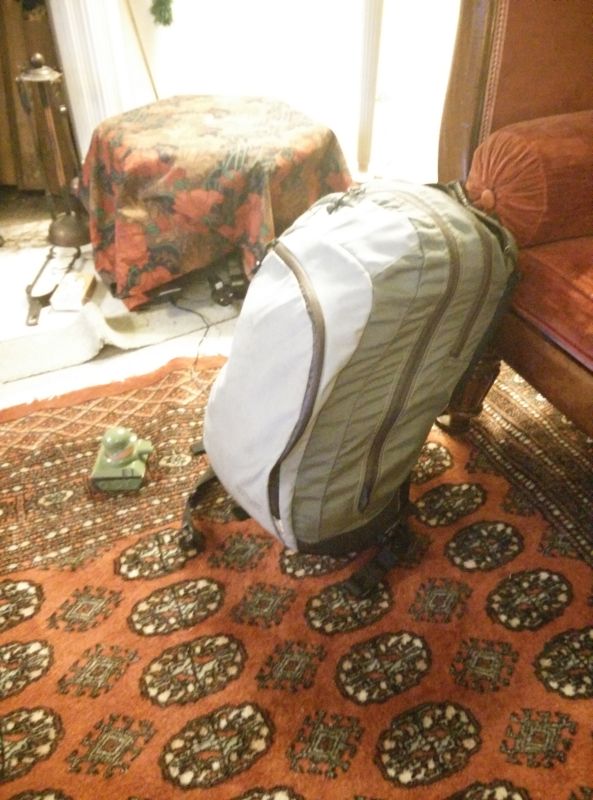
It is with great sadness that today I bid goodbye to My Backpack, faithful companion all over the world for the last six or seven years. I don’t tend to get that hung up on physical objects, but it is the best bag I’ve ever had, a perfect 32 litres of black and grubby feldgrau, with a padded central pocket for laptops, a spacious mainbay for general goods, and a little top pocket right at my shoulders for wallets, phones, keys, headphones, batteries, memory sticks, train tickets and all those other little things. It’s been with me on every one of the travelogues I’ve written; it’s probably spent more time with me than any other person or object in the last decade. Friends, phones, countries, pairs of spectacles have all gone and come, but the bag has remained, eternal.

It has hauled heavy sixth-form textbooks with a heavy heart and university materials with a joyful one; it has taken laptop, charger, spare shoes and spare tie to Her Majesty’s crown courts and hard drives full of declassified material back from military archives.Its side pocket has carried Christmas presents from one end of Britain to the other, water bottles across warm days in Budapest, Vienna, Copenhagen and Delhi, and my dinged-up steel thermos flask to and from the University of Birmingham campus day in, day out. Its grey-green fabric has carried the dust of Rajasthan and Alpha, been stained by the grime of the Moscow Metro and the Berlin U-bahn, and washed back more-or-less presentable by the midsummer rains of Cairns, the snows of Yamagata prefecture and the endless drizzle of Yorkshire. It has taken bro-picnics to Lenin’s tomb, and carried my material life out into the lonely heart of the Queensland outback and back out again.

It’s falling apart now, has been for a while; the interior lining is going to pieces, the shoulder seams are strained, a couple of the zip toggles are missing. So when my mum presented me with a bigger, blacker replacement this un-Christmas, I looked sadly at The Bag and agreed that, well, it really did need replacing. The new bag was perfectly nice: spacious, well-made and chosen with love… but it didn’t have the laptop enclosure, or the shoulder pocket, or even the bottle holder, and when I started packing everything up to go back to Harrogate it was clear that it wasn’t exactly ideal; we could both tell what I really wanted was the same again.

And after a little googling and a phone call it turned out the Kathmandu at the top of Park Street had a “V3” of the exact same bag, with some very slight improvements (new zip toggles, a little internal sub-pocket, fewer dangly straps), only in black, and half price in the January sales.

So hopefully that’s me sorted for the next few years and countries.

IMG_20150105_224629

PLEASE REPORT TO THE SEA FOR DROWNING PRACTICE

“Sir, You Are Being Hunted” – The whole tweedy steampunk/affected “chappishness” aesthetic does less than nothing for me, and I raise an eyebrow at anything which advertises its “Englishness” as a selling point, because it usually means awful pandering-to-Anglophiles apples’n’pears kitsch. SYABH was a tough sell on that alone. But I gave it a try, and I’m extremely glad I did.

You start (with a disappointingly un-plummy voiceover) in the middle of one of five procedurally-generated islands, each realised according to a different beautifully designed “biome” (misty rural, redbrick industrial, Dear Esther cragland, wide open fens, National Trust Scheduled Ancient Monument in t’woods), and each of which has a few smoking pieces of the inventory-filling macguffin you need to take back to the standing stones in the centre of the main island. Increasing numbers and varieties of creepy steampunk robot patrol the islands as you progress.

You’re alone, initially unarmed, foraging for food and equipment among the junk in villages empty but for mechanical killers in tweed. If one sees you, he’ll call others. If you shoot him, the gunshot will bring cyber-toffs from miles around. Running and hiding are the order of the day, inventory management is critical, weapons are clumsy and ammo is scarce. If this sounds like DayZ, it’s because it is, and has the same in-your-face survival mechanics which made DayZ so compelling (despite it being an utterly and increasingly broken game).

It has a great deal of what I like about the STALKER series (which are without a doubt my favourite games ever): a wide-open sandbox where you can see enemies miles off, limited player resources, a total lack of scripting (NPCs have actual AI and move around of their own accord), and fearsome NPC lethality. These all combine to give you a hugely immersive degree of player freedom and player responsibility: you make your approach on your own terms, engage based on your reading of the situation – but if you’ve misjudged or missed a cue, if you’re a little clumsy on the approach or slow on the draw, at best you’ll waste a lot of your limited resources getting away alive, but most of the time you’ve had it.

Most of the time, fighting is not the best option. Much of the time, fighting isn’t even a practical option. That late-game stage when you’ve accumulated enough of the rare guns and ammo make the robot-smashing spree infinitely more satisfying than if they’d given you a piece to start with – but most of the time you’ll be crouched in a field motionless as blazing red eyes sweep the long grass and beeping killers clank back and forth, clutching a half-empty gun for comfort as much as practicality and praying they don’t trip right over you. It’s a game of patience, judgment, and total concentration.

The atmosphere is superb, and the game takes full advantage of its bleak (but frequently heart-stoppingly gorgeous) setting. Much of the game initially feels pseudo-Victorian, but as well as the ruined cathedrals and grim red-brick chimney towers there are wind turbines and modern road signs; it’s a handful of brutalist tower blocks and Business Development Parks away from reality. The enemies, for all the surface silliness of the “haw haw let’s have ROBOTS smoking PIPES” concept, are also genuinely threatening, from the poacherbot who sneaks around in the woods setting traps, to the fox-hunting cyber-toffs on rocket horses and the slow, horrible, two-storey-tall Landlord who stamps across the moors keening mournfully and shrugs off bullets like rain. The audio design is really, really excellent, informative but subtle, and relentlessly atmospheric.

Despite the procedural generation, I’m not sure how much replay value there really is to the game – past a well-designed but limited selection of weapons and tricks to deceive/blow up your robot pursuers, and a menagerie of robots which are differently horrible but all basically to be avoided as much as possible, there’s not that much really in there. Loss of inventory on death coupled with respawning mechanics for items might add a bit of return value, as when you die you load a previous save with all the useful kit (maps, artifact-scanner etc) you had then. But it’s absolutely worth playing through the first couple of times.

I wasn’t expecting “STALKER: Shadow of Northumberland”, but I got it, and it was a very nice surprise after Betrayer (which seemed like it could be “STALKER: Call of Roanoke Colony”) turned out to be such a letdown past the intrinsic coolness of fighting demon conquistadors in monochrome 1604. I’m very glad I played it now, after it’s had a while to mature past Early Access stage, as middling-to-negative reviews elsewhere seem to indicate that it was a bit shonky on launch.

not that we may see the stars, but that the stars may see us

“Interstellar”: It’s not often (the only other example I can think of is Cloud Atlas) that a film manages to feel like a thick ol’ novel, willing to take on massive generation-shifting relativity subplots and the continuation of the human species, and use them as its subject matter rather than background fluff for gunfights, chases and an inevitable unconvincing romance.
Unfortunately, it’s not a very well edited novel. The essential central plot isn’t too bad but there are far too many plotholes, some minor (how is it their dinky li’l SpaceShipThree shuttles need a Saturn V knockoff to clear Earth but can SSTO out of 1.3G?), some glaring (I suspect the “it’s the Oklahoma panhandle in ’34, but everywhere, forever, and somehow this hasn’t led to universal war” setup was handled so vaguely because any more details would make it even more pathetically unconvincing) and some so over the top you can’t even be bothered to argue (really though, what the zog happened at the end?)

However, despite being absurdly long it didn’t outstay its welcome, and it was one of those rare films which actually drew me in to the fiction and got me emotionally involved. Probably because the soul-sucking, imagination-torturing terror of space travel, with limitless nothingness in every direction, is what got me into science fiction in the first place, and this has that in spades.

Good performance from Jessica Chastain, OK from the McConaissance and Doe-Eyes Hathaway, hardly feels like anyone else was in it.

The place with the waves was such a massive missed opportunity to have a melancholy, long withdrawing roar for minutes (/years), though.

…that “we don’t need engineers, we need farmers” line is still getting on my tits. All modern farming – all agriculture at a higher form than hardscrabble subsistence – relies on some form of engineering, from mile-long centre-pivot monstrosities fed by dams beyond the horizon right down to steel ploughshares and harness to haul them. Engineers have been bringing water to the dry land since at least the time of the second Scorpion King (and look up qanats, they’re awesome). A farmer without engineering is a fucking forager.

Brief Lives

Nick is a barrister – a very well-heeled one,
Hugh is an actor on a very fast track,
James is a surgeon with rooms in Harley Street,
And Jeff is an out-of-work hack.

Hugh was a dandy in an Eton collar,
James was at Westminster and flew sky-high,
Nick was a Wykehamist and classical scholar,
And Jeff was at Liverpool High.

James had rooms by the river in Magdalen,
Nick played cricket and rowed for The House,
Hugh got ahead by merely dawdlin’,
And Jeff was a hard-working scouse.

James had a maisonette in Little Venice,
Nick took the room at the end of the hall,
Hugh shared a bed with a boy called Dennis,
And Jeff cooked and cleaned for them all.

Hugh got an agent and lived on promises,
Nick ate dinners in Lincoln’s Inn,
James bought a skeleton and studied at Thomas’s,
And Jeff joined a rag in King’s Lynn.

James marched about with a ruddy great stethoscope,
Nick passed his finals and went to the Bar,
Hugh got a break and a part in a telly soap,
And Jeff wrote for Which Abattoir?

Hugh got the lead in the new Robert Redford,
James made his name in the transplant field,
Nick won a famous murder case in Bedford,
And Jeff got the boot and appealed.

James has a place in Mustique where he winters,
Hugh went to Hollywood and never came back,
Nick got a peerage and dines with the Pinters,
And Jeff’s still an out-of-work hack.


(from Now We Are Sixty, by Christopher Matthew)