We found a place on Via Germanico to leave our bags for the day, an unmanned locker room where you pre-book a timeslot online and present a QR code to the computer terminal to pop open a door. There were no human staff, no coin slots, no keys, just a bunch of shiny yellow doors and a highly effective computer system. I expect I will look back on this fully-automatic service as completely normal, but in the autumn of 2017 it is still slightly odd.
From far off, or from photos, the Piazza San Pietro looks like a huge open space where Papa can address his spiritual children, ringed by saints standing on its immense double colonnade. The reality on the ground, however, is a bewildering mess of bollards and barriers, some to pen in the crowds for the blessing, some to delineate the queues for the basilica, some with no obvious purpose at all. We identified the correct (long, long) queue to get to the basilica; half an hour in, a small gang of smelly German teenagers shouldered their way a little way front of us and received ferocious tuts, death looks and murmurings of international contempt from all around. Some did at least look a little shamefaced. About an hour later (grr) we were finally in.


The basilica is, to give it its due, very impressive. It is quite stupidly big, and feels curiously unoriginal, possibly because it is the original, the masterpiece of counter-Reformation form and decoration that hundreds of subsequent churches riffed on. It’s also quite tasteful (with the incredibly strong qualifier “for a 17th century Catholic mega-cathedral”), with precisely the right amount of awe-inspiring polychrome decoration and sufficient breathing space for the various individual chapels and memorials.
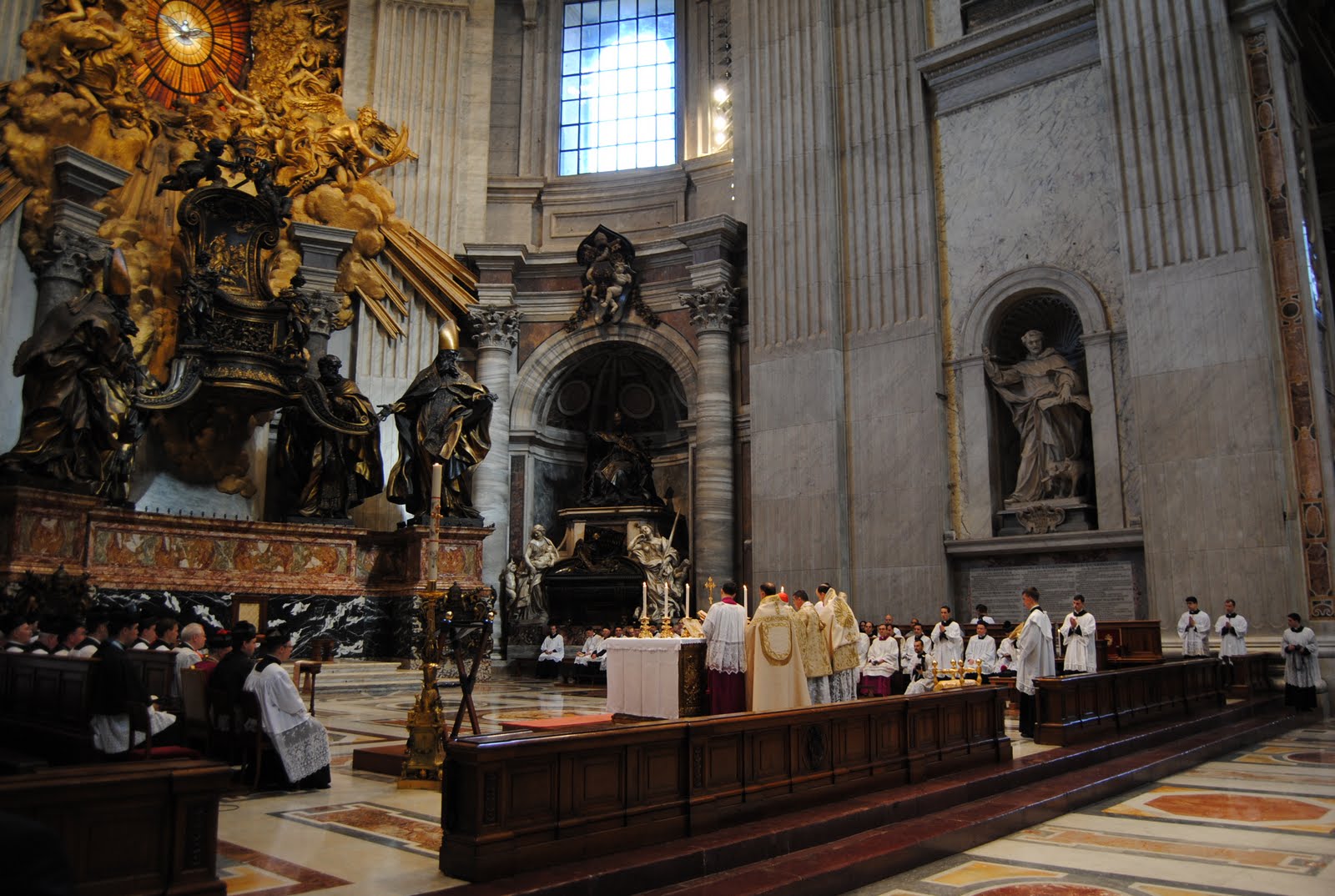
It’s not boring, but the most interesting parts were the flourishes of proper Baroque weirdness: the brass skeleton of Time and/or Death suffocated by a blanket of red stone at one pope’s reliquary; the insane curly-wurly bronze columns supporting the centrepiece canopy; the magnificent, unnerving Chair of St Peter, a glaring golden window which bursts into waves of gilt sculptuary that spill out over the columns around them, throwing gleaming clouds and sunbeams crawling with angelic hosts to support a giant floating chair marvelled at by four gigantic bronze saints. (My pictures didn’t come out well, so here’s a better one. For scale, please note that the blokes at the bottom are around seven metres high.) Also rather original are the grottos full of dead popes underneath – a curious leftover-feeling space – and the Swiss Guards, a few in the tasteful but still very 17th-century blue uniforms, many in the eye-wrenchingly garish puffed-and-slashed tricolour ones, like Romanian flags put through a shredder.


The wrought iron bars of the Ponte Sant’Angelo (built as the Pons Aelius, eighteen hundred years ago) are too thick for the obnoxious love padlocks to infest it as they have so many other bridges. But a couple of larger loops had been attached in places, with other smaller locks latched onto them in clusters like weird brass tumours. I would love to be the man with the bolt cutter. The Gelateria del Teatra was a regular feature in the top 10 of on Roman ice cream blogs (I had no idea those existed) and I’d happily rate it the best place we found. Certainly it’s the most adventurous, with intriguing herbal flavours: raspberry and sage, chocolate and red wine, white chocolate and basil.
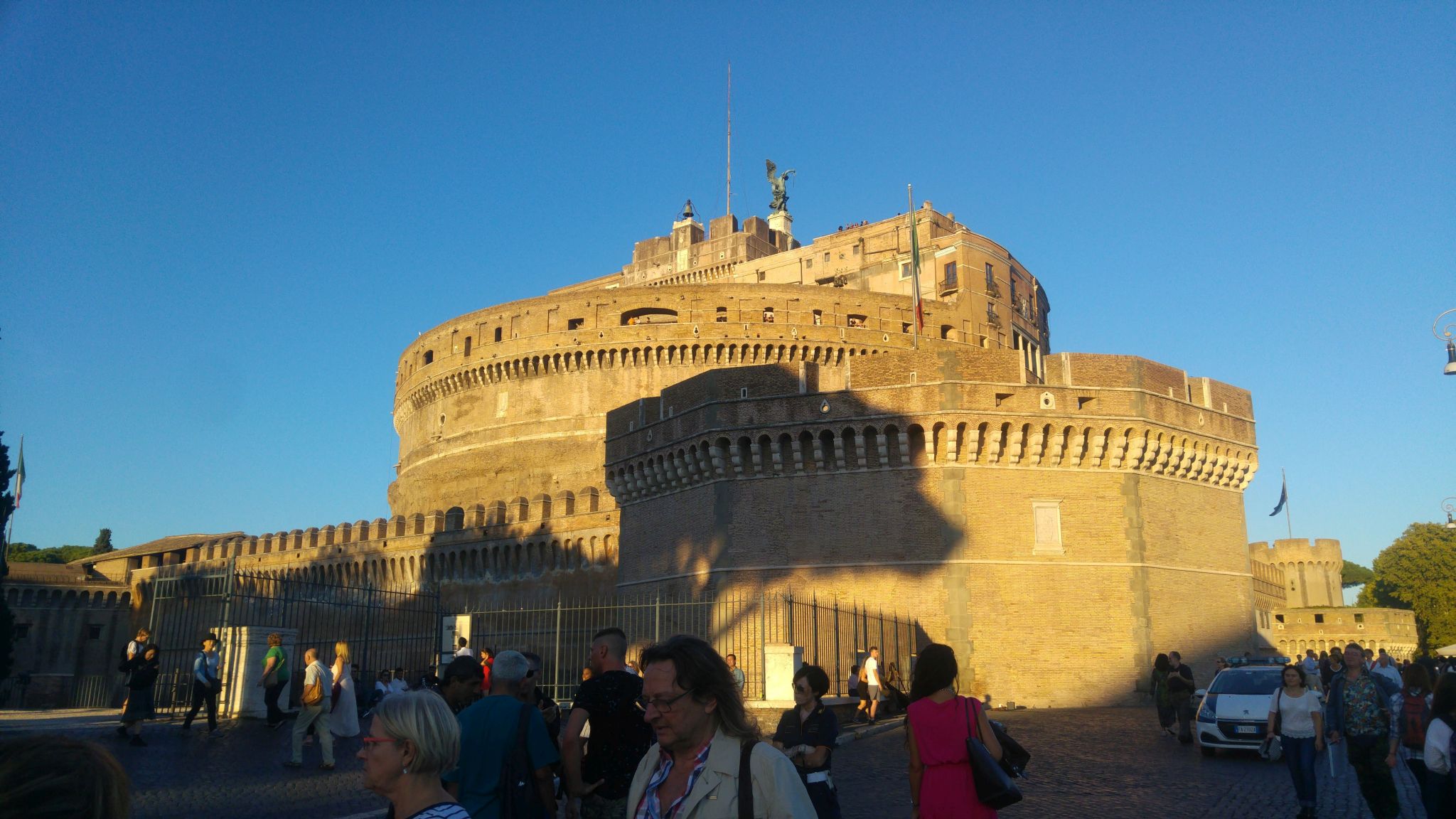
Castel Sant’Angelo combines almost everything I can possibly find cool in a building. It’s distinctive – a weird, towering drum sitting in a crenellated square like a militarised cake. It’s absurdly old, built almost two millennia ago to house the ashes of the most powerful man in the world. It’s a fortress, a slab-sided fighting tower ringed with gunports and set in a crown of triangular bastions, its ramparts crowded with catapults and cannon, its guardrooms with halberds and morions. It’s a palace, with exquisite interior decoration painted in an age of incredible artists. It is concentrated history: in its decline from imperial mausoleum, to source of building materials, to defensive keystone of a frightened successor state, to papal bolthole and shag pad, to otherwise purposeless tourist attraction, you can read the decline evolution decline of Rome in one building. It has secret passages, great views, and is crowned by a statue of a vengeful archangel. It is basically perfect.


You arrive across a drawbridge and tour the ramparts (armed with a tumbledown collection of dusty originals and rusty replicas) before ascending in a path that cuts through through the grand drum, through the columbarium chamber where Hadrian’s ashes were once kept. Even after a week of glorious interiors, the papal apartments are rather excellent, one glorious main hall featuring baboons, muses and a painting of Hadrian with an expession that clearly said “what the hell are you cockroaches doing to my grave?” We had a nice coffee under the leafy trellises of the upper drum, and I was pleasantly surprised to find a small but excellent armoury full of Risorgimento curios next door. The labelling is generally excellent.
In one treasure room, massive iron boxes once held the Pope’s ready cash if Rome looked likely to fall (“I wondered about hiding €20 contingency money in my bag, but thought it would be a bit unnecessary. This guy’s contingency money was a chest the size of an elephant.”), in one tower was the entrance to the fortified passage to the Vatican, used in war on two documented occasions. The lurid murals of the papal bedroom depict, among other things, “the story of Cupid and Psyche”, with an incredibly unconvincing label explaining the pious Christian justification for decorating the Pope’s sanctum sanctorum with pornography.


We descended the spiral used for the funeral processions of emperors, bare brick now, with only a plaque talking about travertine and mosaics to suggest its original beauty. On the way out (foolishly) there is a fantastic set of wooden models showing the castle through its various ages, which would have helped enormously. Out, onto the banks of the Tiber, where the touts roll up their blankets and peg it whenever the polizia roll by. As dusk began to settle, it was time: we recovered our bags from the inhuman locker room, wolfed a quick gyros and shouldered our way onto the metro for the sky, and home.


 underneath the open sky