

Gdańsk is a Baltic city, built to look pretty under leaden skies and gentle drizzle, which was just as well under the circumstances. The old town has (as usual) been thoroughly rebuilt after being flattened in the war, but it has a very different character to Wroclaw. This was always a very different city, a Hanseatic trading port which looked to Dutch and Scandinavian influences instead of Mitteleuropan and Italianate; but more importantly, its somewhat idealised postwar rebuilding very deliberately stripped out all its German elements. Politics aside, the final effect is gorgeous and quite convincing (much more so than Warsaw’s old town); it really wasn’t easy to tell reconstruction from original, although one building conspicuously sported a date of 1953.


After a hearty, not to say stodgy, breakfast at another bar mleczny sort of place (served by Ukrainian ladies), we wandered down the Long Market, the city’s main street, to the city museum, housed in a totally rebuilt town hall. The museum has all sorts of interesting historic elements – a rebuilt audience hall is lined with accomplished 1990s copies of old portraits of kings of Poland. There are some truly spectacular old survivors, a late 17th century staircase and doorway and a magnificent complete guildhall room which was broken down and taken away ahead of the Russians’ vengeful advance in 1944. But in all too many places, “nothing of the old furnishings has survived to the present”. There is a pervasive mournfulness to all this stuff, a respect for these fixtures as symbols of resilience as much as works of art, and – like the housefronts – as icons of a pre-war (and illusively “pre-German”) conception of the city.
A brief history: Danzig/Gdańsk was founded as a trade port under the Polish Piasts around a thousand years ago, then violently taken over in the early 14th century by the Teutonic Knights (of which more next post). As a seaport, it was an important member of the Hanseatic League, that interestingly modern medieval trade combine which dominated the Baltic for centuries, and became a rich and sophisticated city (with a largely German-speaking population) acting as an entrepot for overseas trade into Poland up the Vistula river. Like most of the Hansa it declined in the 18th century, was taken over by Prussia amid the butchering of Poland and ended up in the German Empire. When the Polish state was resurrected after the First World War, and needed ports, the new League of Nations created the “Free City of Danzig” with the idea that it would be an independent city-state belonging to neither Germany or Poland. This was less intrinsically weird than it now sounds – places like Hamburg had been proudly independent city-states within living memory –but was a fudge that pleased nobody. The nationalism genie wouldn’t go back in the bottle, the vast majority of the city’s population identified strongly with Germany and against Poland (the Poles had to create a whole new port city, Gdynia, further up the coast as Danzig couldn’t be trusted), and fell in enthusiastically with Nazism (its own police joined the assault on the Westerplatte.) After the war, the surviving Germans were violently evicted and a largely new Polish population shipped in, themselves evicted from what’s now Belarus. The anti-communist Solidarity movement was born in Gdańsk’s shipyards and Solidarność iconography is all over the city today.


At the top of the town hall there is an entire gallery of Free City of Danzig memorabilia, filled with the paraphernalia of an artificial state which was almost universally despised for its two-decade existence. Walking through it, reading about its progressive healthcare system and currency pegged to the British pound, is a deeply peculiar experience. We shook this off and enjoyed a gallery of local art – the delightful steampunk confections of Jarosław Jaśnikowski re-imagining local landmarks, an engaging portrait of the progressive mayor Paweł Adamowicz, murdered in 2019. The weather had improved by the time we reached the top of the bell tower; we discussed whether its arrangement should be considered an instrument rather than just a set of bells, but dismissed the argument as carillon baggage.


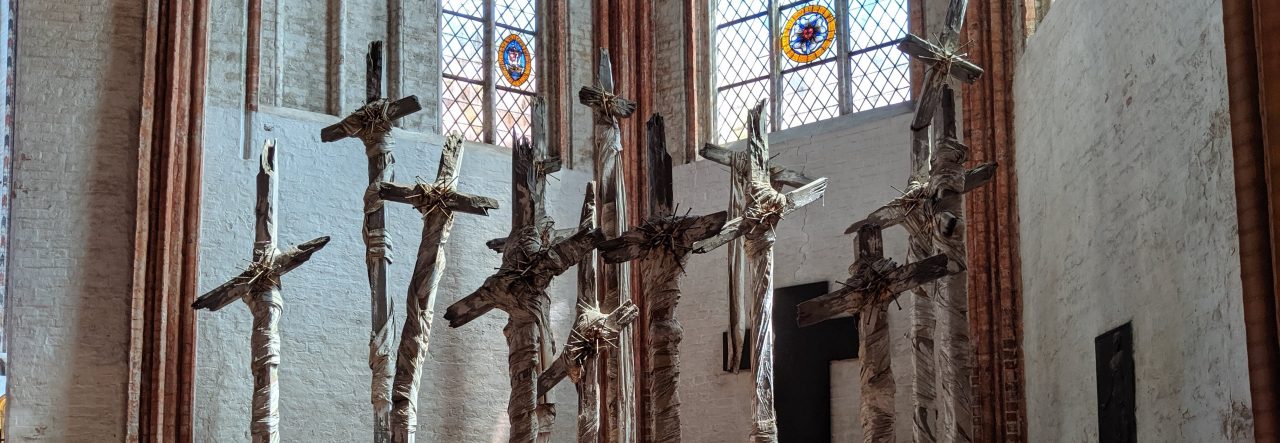
We had coffee and cake off Mariacki Street (anti-gentrification graffiti read “Don’t cut down the old trees”), enjoying an unusually exuberant fountain and its bronze lions, and entered the Mariacki – the Church of St. Mary – itself. It’s an unusual building, its ceiling all at the same height (rather than with lower side roofs for aisles, transepts etc), and its boxiness manages to make it feel much more imposing than the (actually vastly larger) St Peter’s Basilica; the giant marching whitewashed columns quite dwarf the usual immensely impressive collection of organs/family monuments/astronomical clocks/war memorials/angelic choirs/bronze fonts with wall-eyed allegorical figures of virtues/alabaster reliefs of the land giving up its dead at the end of time. The overall effect is to leave you feeling very small before the majesty of God, or at least the majesty of 15th century bricklayers. Danzig had a relatively calm Reformation, not throwing the architecture out with the bathwater, so there are lots of lovely pre-Luther survivals.


We headed to the maritime museum to pad out our knowledge – and its collection all seemed very magnificent, but unfortunately, the time we had left before closing simply wasn’t enough, and I have a vague blur of model ships and in my mind and on my phone, and a lingering sense of resentment at the incredible Soviet passive-aggression of museum staff who visibly did no work all day hurrying us through so they could close up and knock off ten minutes early.


Finally, the Westerplatte. We ordered a cab and headed north through the immense dockyards and loading areas, a haze of black dust hovering over the coal terminal (I initially put the wrong directions – there are two Westerplattes and, confusingly, thanks to canal rebuilds the one we wanted is to the east of the river – but our nice young Uzbek Uber driver was very helpful). The Westerplatte is where the first shots of the Second World War were fired,* and its torn concrete fortifications and eloquent signage describe an overture of the ghastly, one-sided horror about to be replicated across all of Poland. A tiny Polish garrison, outnumbered twenty-to-one by a Nazi force including a battleship,** held out for a week.
As well as the smashed buildings there’s a weird, strikingly socialist-era granite memorial, muscly abstract soldiers and sailors.*** Unlike the vaguely awkward, helpless monument at Auschwitz, I felt it still has great power, but, like with Mother Motherland in Kyiv, poses complex symbolic questions about the triumphalist design language of one totalitarian oppressor celebrating victory over another. Just as the Ukrainians are reclaiming the Kyiv statue by replacing her Soviet symbol with the trident, the Poles have supplemented the memorial with an arc of Polish flags and a plaque with a 1987 quote from Jan Paweł: “Every one of you, young friends, finds in life some sort of your own Westerplatte. Some dimension of tasks, which one must undertake and fulfil. Some order of rights and values. Which one has to uphold and defend. Defend them – for yourself and for others.”
“That’s pretty hardcore for a modern Pope,” I observed. “He was Polish,” Gosia replied.


Past a bunch of tacky tat-stalls hocking plastic toy Kalashnikovs and hand-grenades to schoolchildren, we headed back into town, for an evening of burgers and cherry-related alcohol. The bus took a roundabout journey around the sprawling docks, filling up with tough looking blokes with short hair and puffer jackets who would all have fit perfectly into series 2 of The Wire, and wondered if any of the ships we passed were unloading British tanks for the next war.
The Lost Wawel – Barbican, Celestat, Auschwitz – From Wieliczka to Wrocław – Racławice, Ostrow Tumski, Museums of Wrocław – Książ Castle – Gdańsk – Malbork
* Using the traditional Polish-British-French war timeline which starts in September 1939, rather than the Russian one which starts in June ’41 when the Nazis (who they’d been openly allied with and supplying for several years) turned on them, the American one which starts in December ’41 with Pearl Harbor, or the Chinese one which has several plausible start dates much earlier in the 1930s.
** To be clear, I’m not doing the journalist thing of calling anything grey and armed a battleship: an Actual Battleship, with old but enormous guns.
*** Really awkwardly, I can’t see the soldier and sailor in the upper section without it making a face resembling the bloke in that big stone Armenian sculpture.








 underneath the open sky