This is the last post in a series; you can read it in reverse order through the tag or start in Penryn here.


Dartington Hall is a lovely medieval estate, currently very much at the top of a historical sine wave of investment and decline. Built in Plantagenet days, it endured centuries of this before some rich oddballs bought it in the early 20th century to adapt into a sort of Bloomsbury Group combo of agricultural and domestic education college, artists’ retreat and back-to-basics proto-hippie-commune with elements of monastic self-sufficiency (it’s just down the road from an actual monastery, Buckfast Abbey, which mostly seems to make enormous amounts of money as a conference venue and selling bottles of what-the-hell-are-you-looking-at to neds.)* On a bright summery day it was quiet and felt extremely Proper. The main courtyard of grey, licheny three-storey buildings sets off the massive front of the hall itself, which inside has a really very good hammerbeam roof and some weird modern banners.


Through into the gardens, a great sculpted bowl of earth claimed semi-convincingly to have once been a tiltyard; a huge staircase was spaced in flights like a miniature Odesa Steps,** a carved stone otter had been munching on the same stone fish for who knows how many years. In the fun sprawl of the gardens, odd little doors led into the hillside (probably housing lawnmowers rather than hobbits) and plants bloomed out in an absurd diversity of shapes and colours. Set in a graveyard of overgrown stones with half-decipherable names, we found the Spookiest of All Trees: a yew so knotted it resembled a rope fender sized for the Ever Given. Only the brilliant sun stopped it all from feeling Proper Haunted. (Will we be seeing it in the new Utterly Dark?)


We visited Totnes for a nice brunch and a trip to the castle (working out my pandemic-underused CSSC membership). The castle, a fourteenth century stone enhancement of a Norman motte-and-bailey, is now basically just a little double ring of stone and earthworks, its guts all gone centuries ago leaving little to really engage with. Totnes, however, also boasts a perfect town museum in a Tudor house, with hundreds of exquisite, specialised artefacts each evoking memories of the town as a highly developed hub of trade and industry: tin, slate, pilchards, timber, the manufacture of coins, pottery, medicine, imports from Spain, Russia, the Low Countries. It’s a reminder of a very different world, before virtually everything that involved the creation and movement of physical objects was moved far out of town (and, ultimately, largely out of the country), where towns themselves were where things were made. The modern, Guardian-reader Totnes of cream teas, second-hand bookshops and new age tat that inhabits its buildings now feels as close to the Totnes of the museum as a hermit crab is to a sea snail: a completely different creature that just happens to live in the same house.***


Exeter showed to advantage on another blazing day. The local dark red sandstone comes heavily grained with veins of quartz, leaving the ancient city walls looking bizarrely like fat-marbled raw steak. Within those walls (crossing a Yaroslavl Bridge, which reminded me pleasingly of bits of Kutaisi and Newport being named after each other) it was a bright, cheerful place, a mix of really quite ancient buildings and modern shopping arcades all bustling with the life of a society trying its best to get out of under the pandemic. A trendy coffee shop provided some high quality shortbread, a castle complex rather at the bottom of the neglect sine wave provided a fun walk. Naturally, we had to go to the city museum (properly the Royal Albert Memorial Museum). One of the last recipients of serious pre-austerity investment in such things, the museum is another treasure, a pleasing mix of bonkers old artifacts and modern cultural appreciation for them, with some admittedly jarring moments like a Victorian staircase full of stone carvings painted hot pink. Outstanding pieces included a lot of echinoderms (especially if one’s companion is an author writing about 19th century science with an emphasis on sea horrors), and an immensely detailed 18th century model of the entire town. (The museum’s own link is dead but in looking for it I found a wonderful then-local blogger who posted about it and many other Exeter treasures – have a look!)


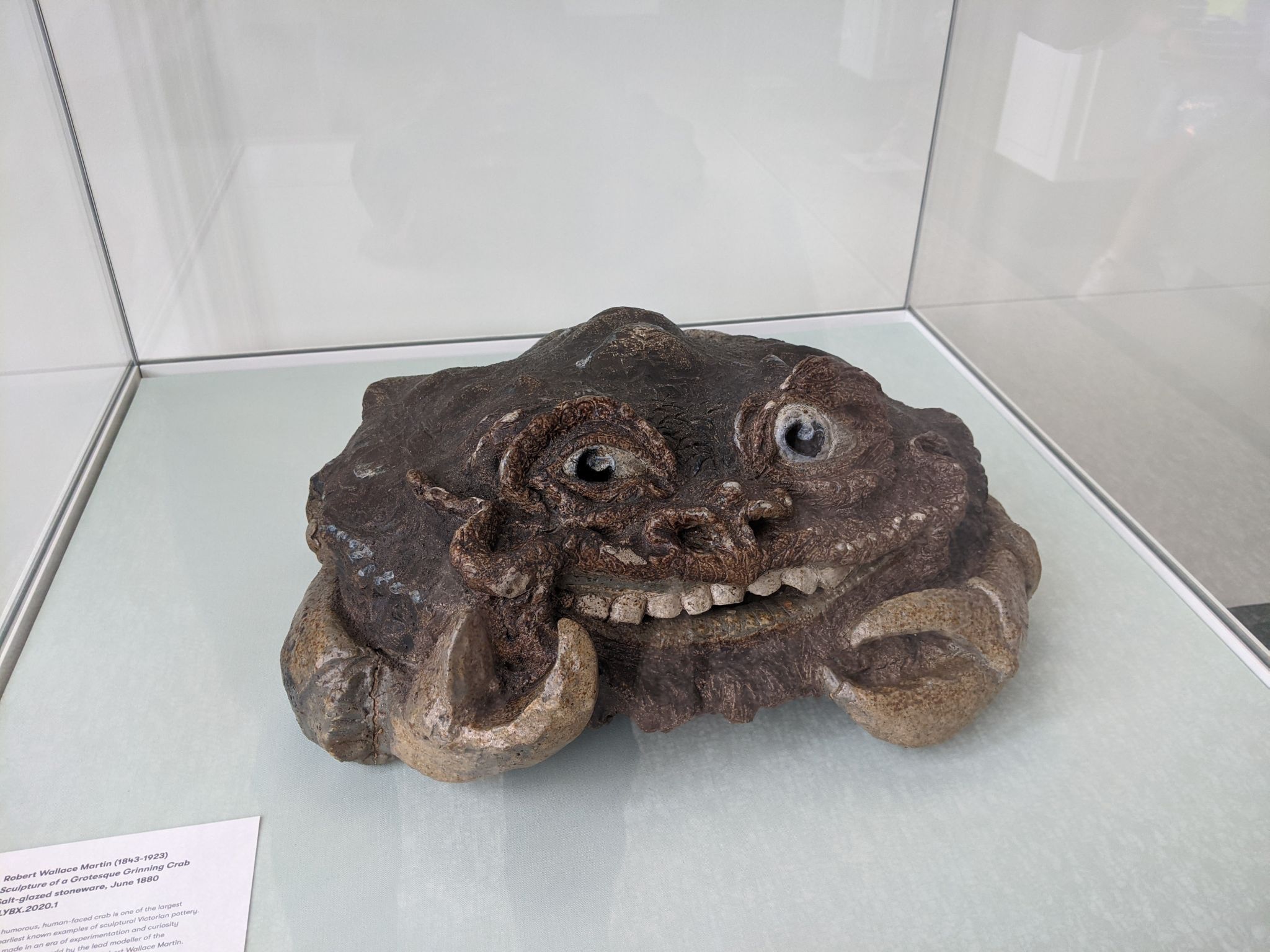
A Chinese money cat looted during the Opium Wars; a lascivious scallop; a c.1900 Nigerian caricature of a European officer; an 1850 engineering diagram explaining how Chinese characters could be sent through a telegraph; a warning of the dangers of blogging; and some characterful ceramics by the same chap as that crab back in Plymouth.
Finally, the cathedral. I have never really met a cathedral I didn’t want to be friends with, and this one Has It All. Happily spared much of the iconoclastic vandalism of the Reformation and Civil War, and the frosty machine-cut rectitude of later Victorian sensibilities (though not the war, which annihilated a lovely chapel), it is a joyful splurge of bright colour, gilt and over-the-top high-relief zaniness, with mawkish memorials from every century. An astoundingly detailed wooden choir boasts an elephant misericord dating back to Henry III, and a side chapel to Hugh Oldham is literally entirely owls. Enjoyably, it’s the home of an absolutely mad number of Green Men, whose upsetting, leaf-sprouting faces can be found all over the place, especially in the many ceiling bosses. I am certain at this point there were more depictions of the Green Man in there than there were of Jesus. (All quite high up and hard to photograph, though.)


This story trails off a while, as many of my logs do, because the remainder isn’t really of public interest. I stayed a little while longer on Dartmoor, enjoying a poodle chasing himself up and down the drive, bunnies on the lawn, ill-considered waltzes up tors in driving rain, and very good company. It was time to go home (and get a new raincoat.)


Everyone is fond of owls.
Out to Penryn – St Mawes and Falmouth – St Austell and Plymouth – The Forts of Staddon Heights – Drake’s Island and Saltash – Totnes and Exeter
* The Wikipedia article for Buckfast Tonic Wine has probably been stripped of everything fun by now, but essentially it’s a surviving example of quackish Victorian ‘tonics’. The drink combines a lot of alcohol, caffeine and sugar in a glass bottle, meaning the person who has got to the end of a bottle is drunk, awake, energised, and armed. I don’t know if any of this is still current but it once caught a fair bit of flak for intensifying anti-social behaviour in deprived parts of Scotland, and when I tried to buy some near Inverness for the memes I got IDed despite looking about forty. It didn’t taste good.
** The Potemkin stairs are carefully designed so that looking from the bottom you can only see stairs and from the top you can only see landings. This staircase sort of managed it.
*** To be clear: I’m really not actually nostalgic for a world of small-scale, local, inefficient primary and secondary industry and all its comorbidities. I’m personally fine with a Britain which allows me and a very large number of other people to shuffle data on a screen for seven hours and then have an afternoon off rather than spending twelve hours trading fingers for lung and skin diseases in a factory. It’s just fascinating to think of how impossibly different the economic landscape was even a hundred years ago, and how transitory our own seemingly settled world of said pointless data-shuffling might be. My actual problems with a system where food, goods and tangible value are all created elsewhere and most economic “activity” in the West is just increasingly complex and baroque ways of sharing that value are: how unequal the current formula is, how it just puts the suffering out of sight and mind in the global south, and how much of it ends up hived off into parasitic rent-seekers and billionaires who don’t even do anything interesting with it.****
**** There are a lot of bad things one could reasonably write about, say, Armstrong, but he gave us some fantastic bridges, Nu-Bamburgh and Cragside. The current rich list are notable only in how incredibly banal their excesses seem to be.








 underneath the open sky