“only that they cannot come by sea”

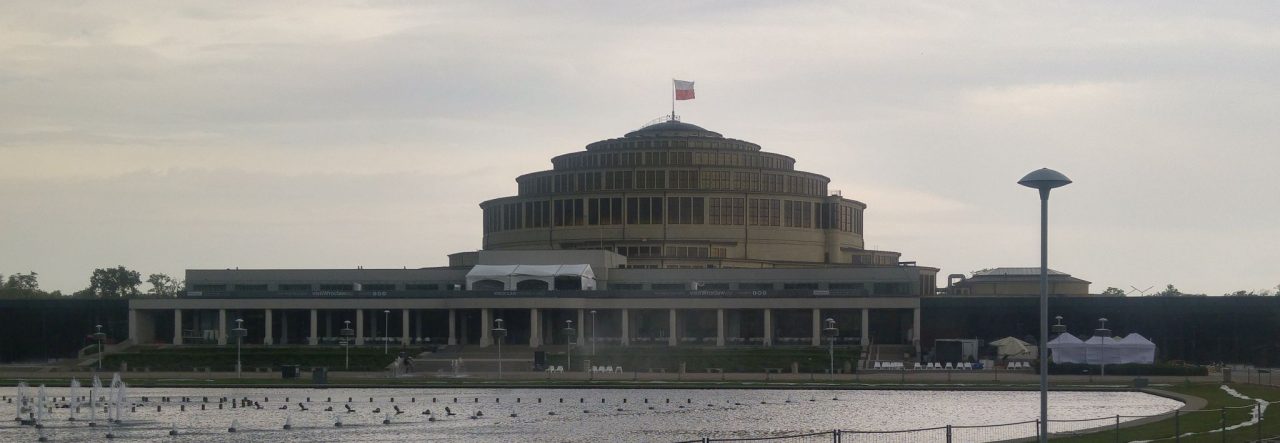
Of all Britain’s historical strata of castle-ish things, I feel the mid-19th-century Palmerston forts are the least known and least appreciated. They and their strange design language – near-invisible buried forts with immense defensive ditches, colonnades of steel-shuttered, granite-faced casemates like the broadside of a stone frigate – belong to that period of frenetic mid-late 19th century military development where bonkers ideas like guns that weighed as much as ships, hand-cranked combat submarines, pneumatic cannon hurling dynamite charges, ship-killing bombs on long sticks and the naval ram all appeared on paper to be plausible war-winners, were built, achieved nothing, and vanished into obscurity.* Like the rest of that list, the Palmerston forts were obsolete almost as soon as they were built** (which is what makes them such fun!) Unlike the rest, getting rid of them once they’d proven useless was so much hassle they’re largely still there. And Plymouth had twenty-four of them built in the 1860s.

The ferry dropped me at the old Royal Naval Air Station Mount Batten (named, it turns out, for an interesting 17th century naval figure – so my Lord Louis joke was rubbish). A noticeboard showed various exciting marine experiments with fast pinnaces, early flying boats, and TE Lawrence on a motorbike, next to a stone marker with a slightly cartoonish Sunderland. The Mount itself boasted a closed proto-Martello-tower, a round stub of stone from the 1650s.***  Nearby, a place called the Galley Kitchen, behind all its exciting signs, was actually closed. Up on the Heights, I could make out hints of forts and a strange, huge, angular silhouette on the horizon.

Along the coast path, wide, windswept fields were scattered with astonishing numbers of benches, their commemorative plaques giving the feeling of a curious latter-day graveyard (surely there are never enough punters to actually use them all?) The choice of high or low path was decided by signs warning the low path had collapsed into the sea. The high road climbed through shoulder-height gorse over an infinity of stout black plastic planks made from recycled bin bags; the trees closed in on both sides, and I only had occasional glimpses of the bay and the breakwater (with its own, chequerboard-painted gun fort perched on the submerged ridge that protects Plymouth Sound) until I was almost on top of my first destination, Fort Bovisand.

Bovisand was a defensive wedding-cake, a single deck of giant rifled muzzle-loaders daring any warship to get within range enhanced by several generations of newer,  fancier guns on the hillside above it. Like a lot of these places, it’s got an immense long list of failed bankruptcy-inducing development attempts to redevelop it into something.**** Unfortunately (for me, in the short run) the current one appears to actually be liquid and functional, and the front door to the building site is very well protected, so my usual intrepid trespassing urban exploring wasn’t an option, and I had to settle with the view from the heights and the overgrown (but still unbelievably good) defensive ditch.

Undismayed, I set off back up the Staddon Heights, the immense ditch to my left (a presence felt but not seen, a deepness beyond a wall of foliage), to the golf course. A seashell path took me to the brambly outline of Brownhill Battery, which while accessible doesn’t boast a great deal to look at (summer is a bad time to see these places): the afterimages of old generator houses in the concrete, and a Victorian stone building built into the bastion with a rope leading down into mysterious depths. I must be getting old: ten years ago, when faced with a risky descent in a so-overgrown-as-to-be-invisible corner of an abandoned Victorian gun battery, itself so remote as to only even be known by the more incompetent users of the local golf course, I’d have dived right in. I took photos, instead; there was nothing there but rubbish.

The golf course itself has the same upsettingly architect’s-model manicured feeling  as golf courses everywhere, but there are several good curios up there – a concreted-up gun battery visible behind a gate, a pattern on the ground which was once the footings of a barrage balloon. Best, and most visible, is the enormous stone backstop to a (now thoroughly golfed over) high velocity rifle range, looming over everything. It’s an astoundingly large and weird looking structure, and I do wonder what passing ships made of it (probably “oh, that’s nice, I do so dislike being shot” once its function was explained.) A white-bottomed (roe?) deer looked up out of the undergrowth and bounced away.

Near the entrance of the golf course is the imposing front of the still-MoD-owned Fort Staddon (which was finished but never armed). I took pictures, eavesdropped on a flaming row between some locals at the club building, and headed down the old military road in the lilac gloom of dusk, passed by swishing cars and a single high-speed, extremely radical gentleman on a skateboard to the final fort. Fort Stamford is a large, fully-formed polygonal fort now being used as a caravan park, its walls filled with slightly modernised windows and its interior crowded with those quote-unquote “caravans” that are just mobile enough to not pay council tax. Bunnies play on well-mown turf slopes and little cars park in bays once built for 9″ rifled muzzle-loaders. It’s absolutely charming, and the sort of place I’d love to retire to if it wasn’t deliberately built a safe distance away from anything worth firing a cannon at.

The yellow harbour ferry I’d come across on was, ominously, moored halfway across the sound, and I sat at the Mount Batten jetty listening to the dismayed shrieking of its caged pontoons rising and falling with the wave, until happily its smaller but perfectly functional little sister showed up. I walked back along Madeira Road and across the Hoe, the massive angular shadow of the Citadel against the sky on my right hand and a twinkling band of buoys across the Sound on my left, and flopped at the guesthouse, legitimately shocked at how many blisters I didn’t have.


Out West 2021 

Out to Penryn – St Mawes and Falmouth – St Austell and PlymouthThe Forts of Staddon HeightsDrake’s Island and Saltash Totnes and Exeter

* I don’t mean to be too dismissive here – at the time none of these would have been notably more or less bonkers than, say, ships made of metal, powered vehicles, revolving gun turrets, self-propelled torpedoes or sending messages down a wire using electricity, all of which went on to change the world.
** In this case strategically obsolete, rather than technologically; the underground, artillery-armed descendants of polygonal forts became less competitive but still worthwhile until the Second World War, which opened with a creative use of gliders and shaped charges by the Nazis against Eben-Emael, and ended with atomic bombs. But the French threat the Palmerstons were built against was comprehensively ended in 1870 by the Prussians annihilating the Second French Empire.
*** Actual Martello towers, as any fule kno, date from the Revolutionary/Napoleonic Wars realisation that even the Royal Navy wasn’t big enough to always have a ship on station combined with a Corsican escapade in 1794 where the 16th century Genoese “Torre di Mortella” proved frighteningly resistant to cannonballs. Mount Batten Tower is younger than Mortella but older than  its misspelled namesakes.
**** When the magnificent Ian V. Hogg was writing Coast Defences of England and Wales 1856-1956,  the fort was still under military use as a diving school and was in his opinion the best preserved Palmerston fort left standing. I do hope they’re looking after it.

Out West 2021 

Out to Penryn – St Mawes and Falmouth – St Austell and PlymouthThe Forts of Staddon Heights – Drake’s Island and Saltash – Totnes and Exeter
The Hundred of Hoo

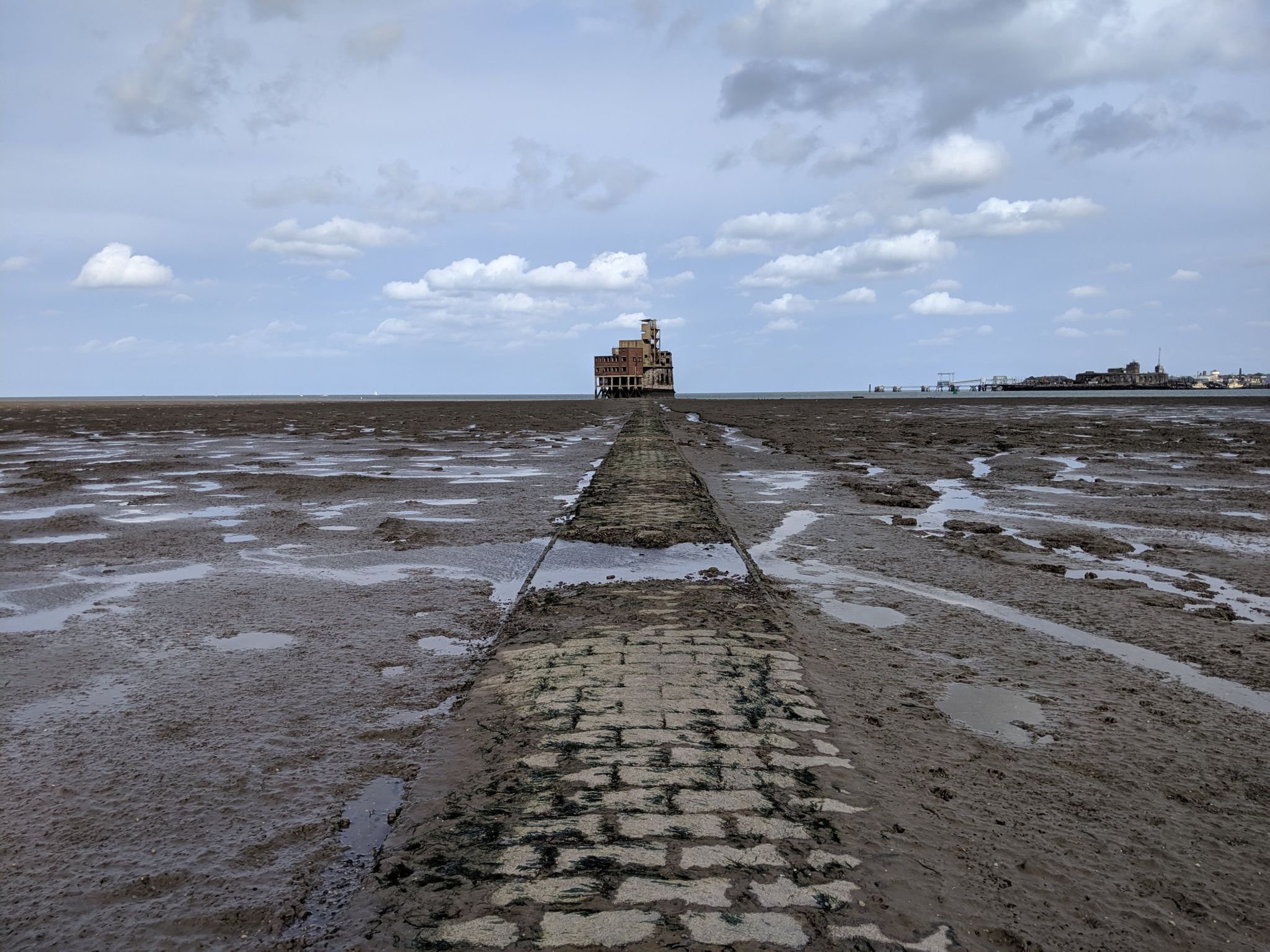
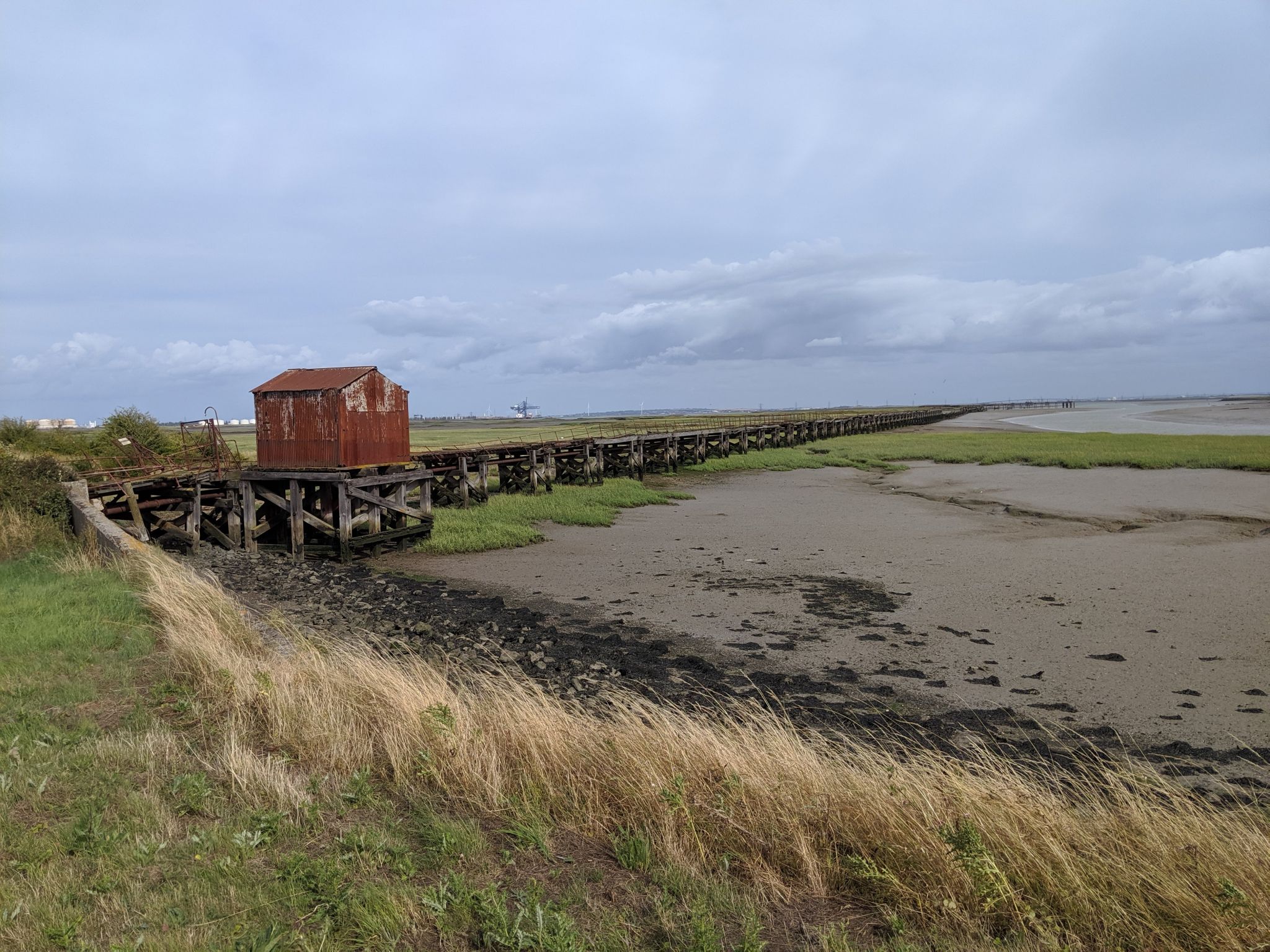
This is the second part of a trip around the Medway estuary in the summer of 2019. The first half is here. As ever, click the pictures for full-size versions. We fortified ourselves with sweets and Irn Bru and set out north and east to Hoo: a low-lying tongue of land between the Thames and the Medway, fringed by tidal marsh. It’s a weird, windswept, empty landscape – there are very few trees, so only low scrubby bushes obscure the cyclopean structures that loom on the horizon, made more intimidatingly huge by their distance: a rank of cranes, a clutch of gigantic storage tanks, a petrogas* power station, an Amazon fulfillment centre. A place of low land and low land values, populated by big, cheap things which London needs but doesn’t need to see. We parked the car on a stub of unfinished roundabout and found the Bee Ness jetty. The jetty is an oil pier, the last surviving piece of a 1930s refinery ruined by the 70s oil crisis and now no longer extant. (There were once quite a few more of these on Hoo, and you can still see the ghosts of their storage tanks from aerial photography.) It’s a huge spur of steel pipes overlaid by wooden planks, sticking out into the Medway via two and a half kilometres of dense mud flats so deeper-draught oil tankers could unload directly. The gate at the base of the pier rusted off its hinges long ago, but a formidable patch of brambles has replaced it as the pier’s protection; getting around it required a funambulesque encounter with an 8″ wide sea wall, enough of an obstacle to keep things interesting but not enough that I wasn’t on the pier in two minutes, investigating the contents of the shed at the pier’s base – an antique bit of wiring and the wreckage of an old cork life ring. I strolled along the pier itself, but quicky encountered a section of missing planks,  which turned the experience from “excitingly rickety” to “unacceptably dangerous” (and, not much further along, “awkwardly underwater”), so I didn’t proceed further. There’s a wrecked U-boat somewhere out in the marshes, but we didn’t have a hovercraft to get us there. We continued east to the coast and the village of Grain. Grain Tower, like a pocket-sized knockoff of Mont St Michel, is reached by a causeway across a tidal mud flat: the causeway is made of wide, rough-grained bricks secured into their mortar by diamond-shaped undersides, except where it isn’t and is just mud. The Tower itself is a small but solid example of the “Palmerston forts”, whose frowning granite gunports and cast-iron shutters are scattered all over the Channel coast. Like many of its siblings, it has some extensions slapped together in a hurry during the World Wars; a brick barracks on stilts and rickety-looking concrete observation post leave the tower looking like it’s wearing a backpack and a stupid hat. There’s no ground-level access (it would be sea-level at high tide), but some kind soul had secured an aluminium ladder with a loop of plastic rope, next to an enormous barnacled chain wrapped around the tower’s base, which was once a boom chain running to the Garrison Point fort at Sheerness, cutting off the mouth of the Medway. The Tower is clearly regularly visited by local kids, with its fair share of graffiti and litter; the Victorian gunports are blocked up, and there are more modern shell hoists to feed the familiar QF gun emplacements on top. The main emplacements are brick and fine Edwardian concrete; later embellishments, including the highest tower, are the usual crummy just-good-enough WW2 invasion panic stuff, and look like they’ll fall apart within the next few years. The safety railings have rusted away to the point of being safety hazards all by themselves. From the top of the tower, the sunlight make the mud flats shine a filthy silver, the causeway cutting clear through them the half-kilometre back to land. Back at the sea wall, we headed north looking for the remains of Grain Fort, and were largely disappointed. There are a few more WW2 observation posts and some concrete semicircles that were once gun positions. There’s a huge tunnel network in quite good nick still under there somewhere, but we didn’t feel like going for the beer-can-strewn possible-entrance we found, and the defensive ditches are so overgrown as to be abstractions. On the horizon, way out to sea, we could see a cluster of vague dots: the Red Sands sea forts. Heading back inland, we passed the obnoxiously medieval gatehouse of Cooling Castle, which was structurally curious enough back in the 14th century when it was next to the river, rather than being separated from it by kilometres of marshland. We couldn’t read the copper inscription which made us think that the the tower at least was original rather than Victorian reimagining.** Apparently Jools Holland lives there now; the barn advertised itself as a wedding venue. Imagine. I really hadn’t appreciated quite how many ruined, forgotten forts there are guarding the approaches to London. Cliffe, paired with Coalhouse (another post on that later), is another of the Palmerston-era ones, mucked around with during the World Wars: large, ambitious, and sinking gradually into the marsh, a slightly updated version of the old cautionary line about building a castle on sand. There’s a gravel quarry built around it now, and we took a long walk alongside a huge, still conveyor belt, watching the interplay of hawks and bunnies in the flatlands around and enjoying a series of bloodcurdling signs about the dangers of gravel pits. Another rickety WW2 addition reared above the fort’s huge stone shoulders. The fort is fenced off and meant to be inaccessible. In the matter of Victorian gun forts that normally means “challenge accepted” to me, but we were quite tired from a full day of Exploring, and the barking dog of a quarry security contractor who shouted at us to stick to the path in broken English and the half-sunken fort looked genuinely difficult. Fortunately, there were some very interesting accessible curios: the wooden guts of a derelict ship and the launch rail of a Brennan torpedo, a curious Victorian guided weapon powered, counter-intuitively, by pulling two wires out of its rear end at high speed.   (The odd jumbled concrete structures in the background of the last photo are actually the footings of the old Nore sea forts, dragged back up the Thames and demolished in the late 50s.) Our exploration was helped by the excellent “Beyond the Point” site, maintained by some local lads, which I’d recommend to anyone interested in exploring these parts, and for further reading on the historic sites of the Thames estuary.   * “Natural gas” is a marketing term and I will not allow it on my blog. ** It’s explained at the wiki article. I blame the degradation of gorgeous Carolingian minuscule into crummy illegible blackletter, myself.

in a gadda da vingland

Being the first part of an account of a lovely day trip in August of 2019, now written and illustrated properly in… 2021.

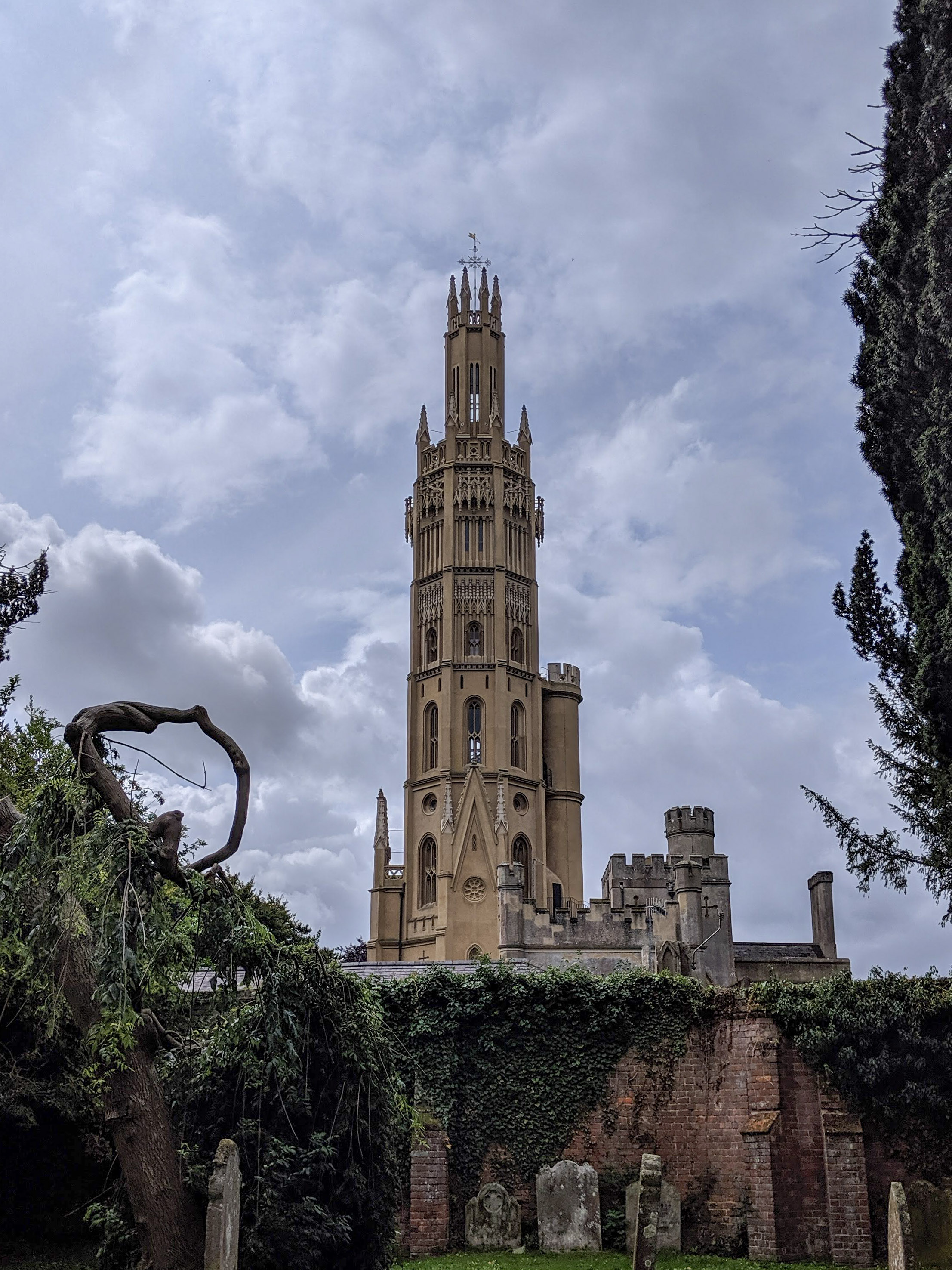
The day out started for me with a train to Redhill and a huge full English at a place called Poppins near the station; it almost continued, having met Charlie, at Ightham Mote, but a rammed car park early in the morning and a knowledge of many highlights yet to come kept us on the road. So the first real sight of the day was the Barad-dûr like spire of Hadlow Tower which, since the fall of Fonthill Abbey, is the premier example of the Gothick Ludicrous architectural style in the British Isles.

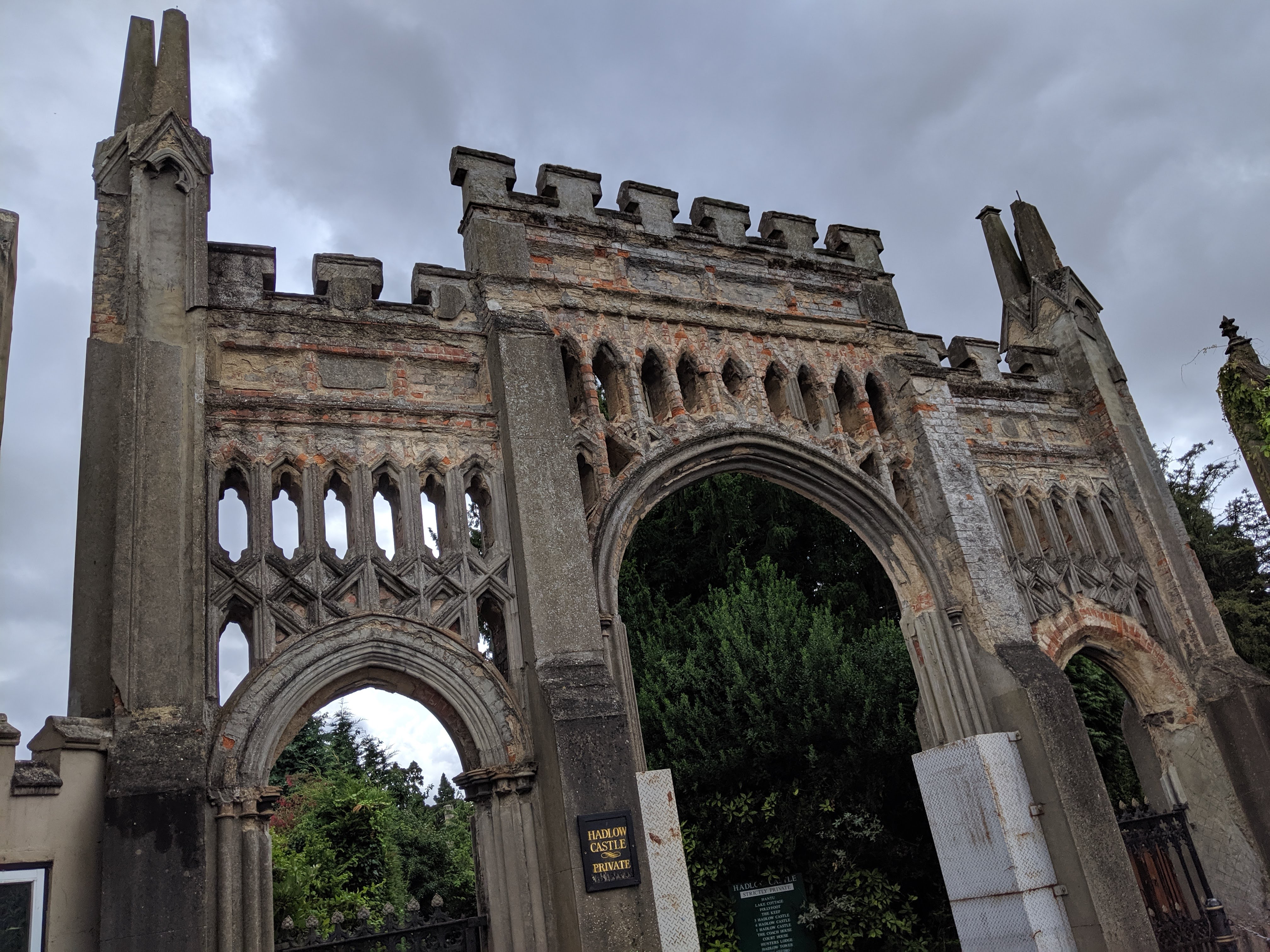
The tower is best viewed from the nearby parish church (a very nice example, and one which felt well loved and relevant to its community.) A churchgoer told us how the current owners did the tower up with lots of Heritage money (we looked up the interiors; they’re hideous) and then stopped letting people in. It’s now on sale again for three times the asking price. Yuck.

A really mediocre picture of the arch.

magnified, sanctified, be thy holy name

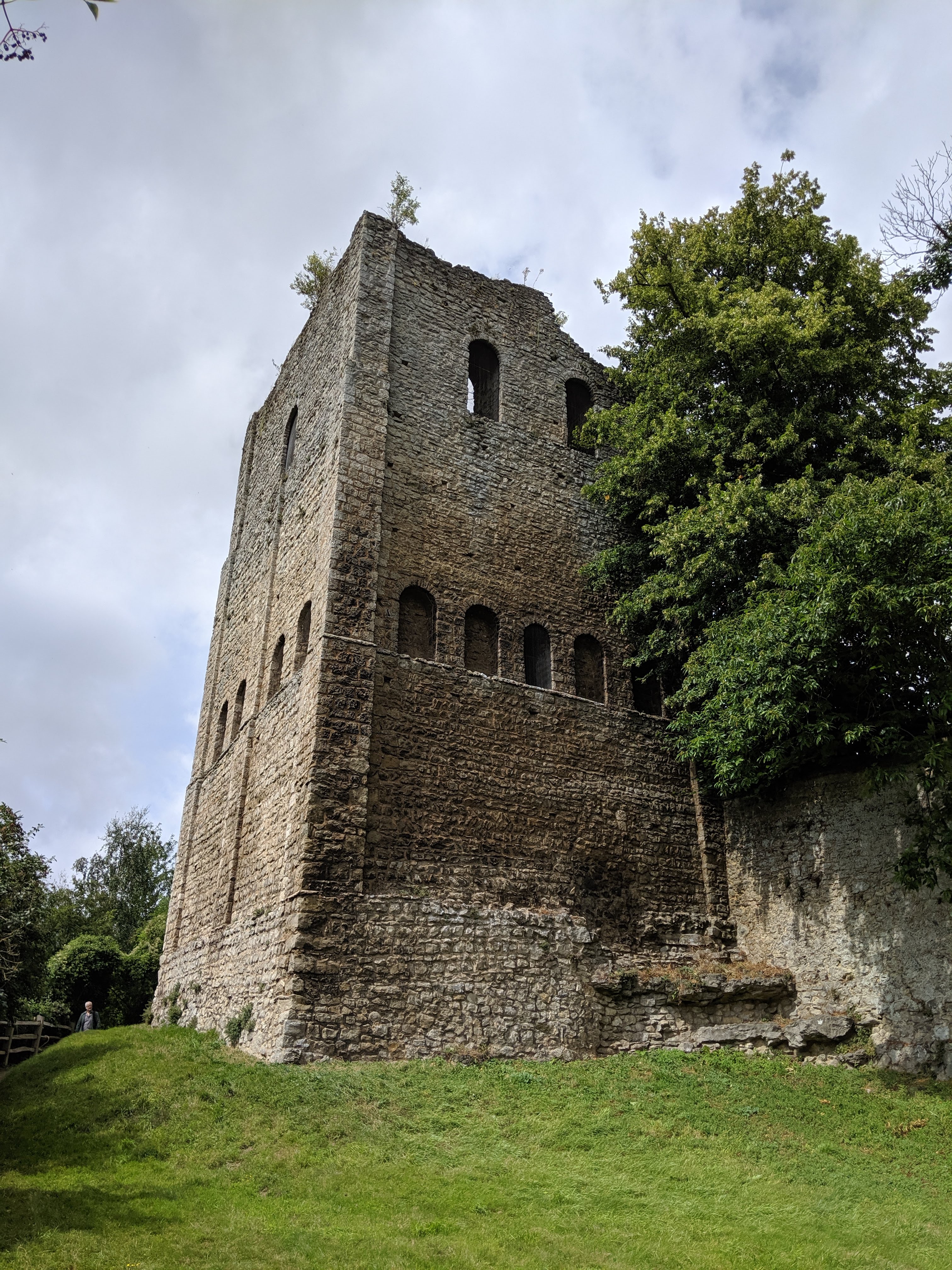
The next stop was St Leonard’s Tower, one of the many bits of fun 11th century oppressive architecture constructed across England as William of Normandy consolidated his invasion (although, as a helpful English Heritage board pointed out, the building’s lack of serious defensive features indicated it was probably more of a symbolic and administrative fort than average). There was nothing inside to see, but we agreed it was a very fine tower.

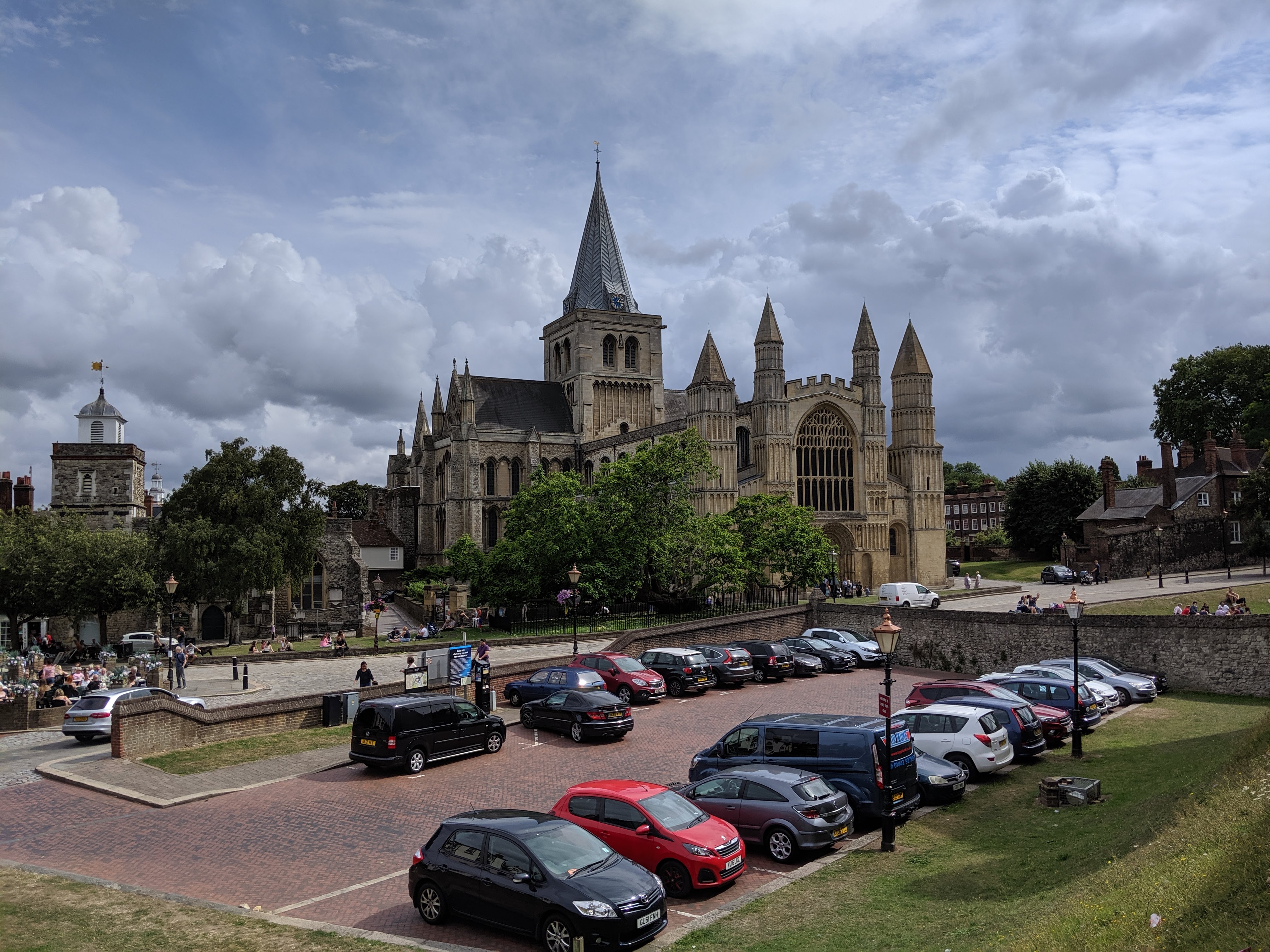
Then, we came to Rochester. Half the reason for this Expedition had been hearing that there was mini golf going on in the cathedral there, so we came for the memes, but we stayed for the really beautifully distinguished interiors.

I have had the good fortune to see a great many cathedrals, and this was an excellent example of the genre. There was a great mural with a very Eastern Orthodox feeling to the art (which made perfect sense when we saw in an info board that named the artist as Sergei Fyodorov – who had hidden a little picture of himself peeking from the side of the corbel, in true medieval style); memorials to men of Rochester fighting and dying in every corner of the world; an atmospheric crypt, glorious ceramic tiles. (We didn’t actually fancy the mini golf, so skipped it.)

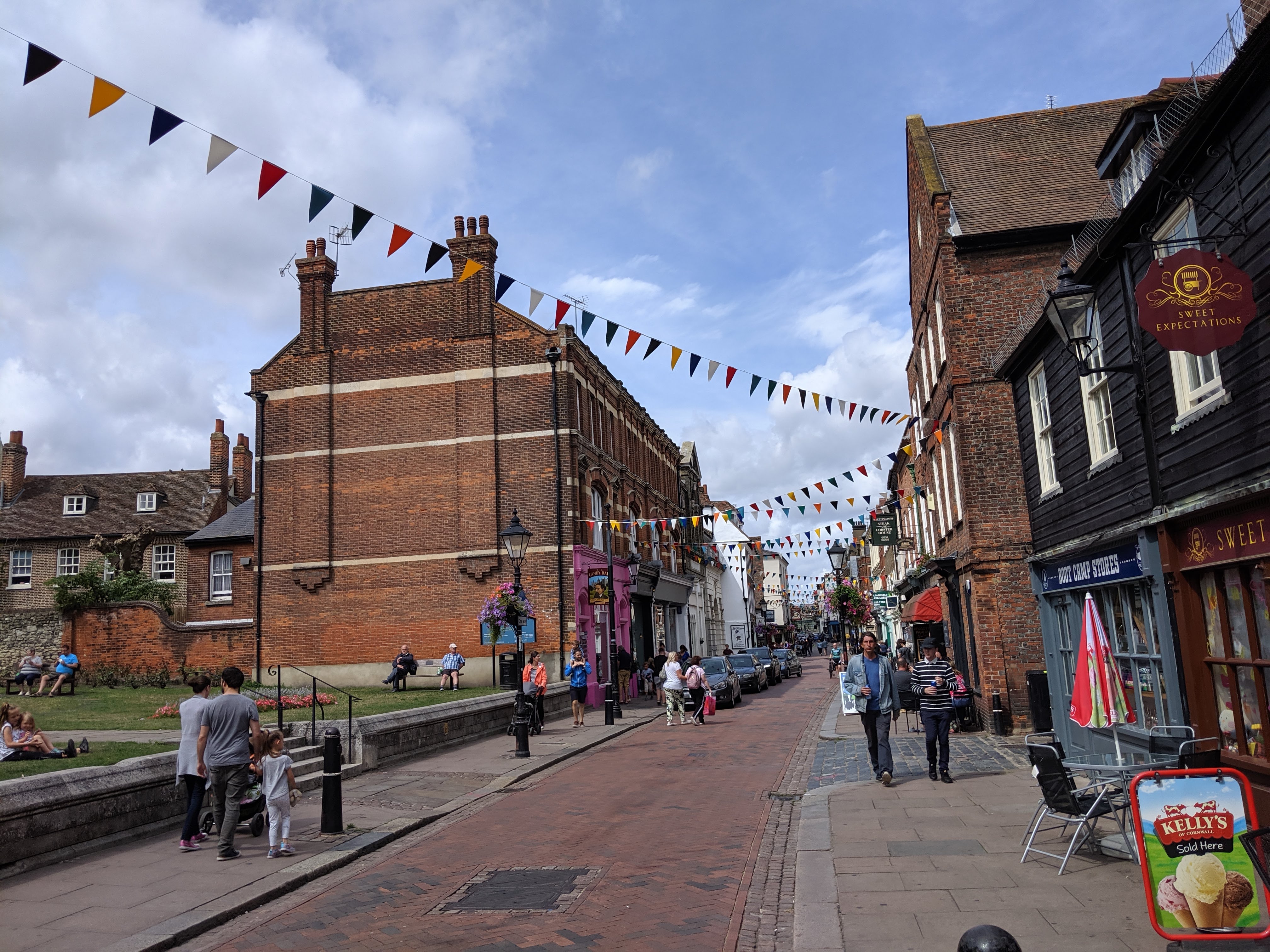
The High Street was very cheerful and active on a bright sunny day; we had fish and chips, and Charlie bought a mosasaur tooth. We took a turn around the excellent Guildhall museum – a perfect little town museum, made with absolute love and interest in the town’s considerable historical pedigree, with just enough budget to make it really work (a replica deck of a prison hulk padded out with mirrors was a high point.)

The High Street also boasted one of those huge, wonderful Hay-on-Wye-esque bookshops, which I escaped having spent only 10 with a book of architecture and an Ian Hogg illustrated history of artillery. Then, to the castle; I actually bumped into a work colleague on the way there – my CSSC membership doubles as English Heritage, so that’s me and a plus-1 in for free.

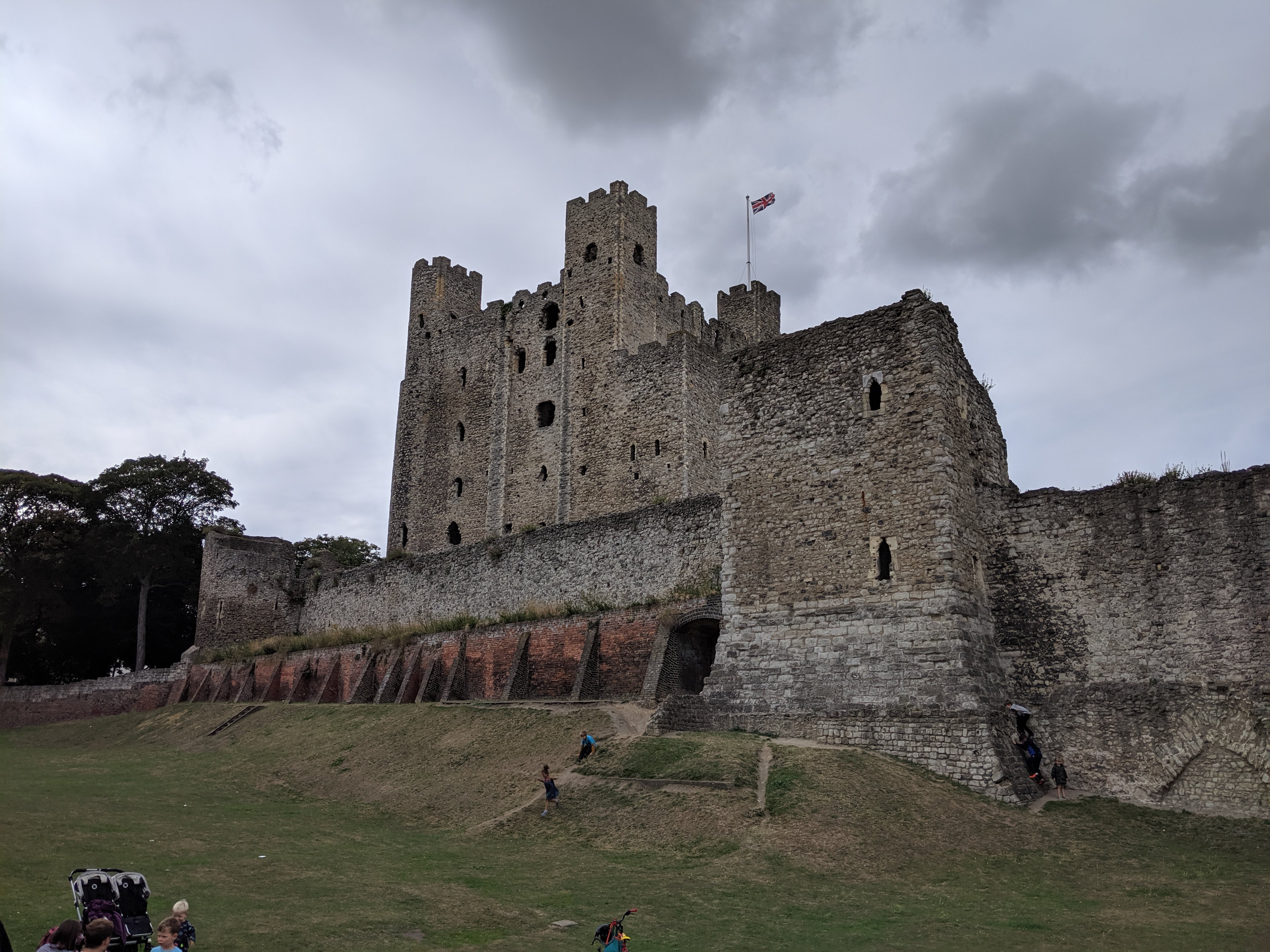
The castle is of the same basic design language as the Tower of London (although built a fair bit later): a huge solid militaristic cube with towers at each corner, within later rings of concentric defences. It’s in considerably poorer nick than the White Tower,  having had fewer prison/mint/arsenal side gigs in the intervening centuries and being completely obsolescent in its main role a fort by the 17th (which may have spared it from Cromwell’s general castle-vandalising after the Civil War). But this means that the interior hasn’t been mucked about with much, and, thanks to the lack of floorboards, you can see five storeys of gorgeously carved Norman arches and immensely impressive columns in the middle all at once. From the platform at the top, we can see the Garden of England in all directions, much of the visual interest coming from the Medway estuary with its rather lost-looking Soviet submarine.

Castled out, we returned to Charlie’s car for the second part of our adventure: north and west to the low, windswept Hoo Peninsula and its many fortresses.

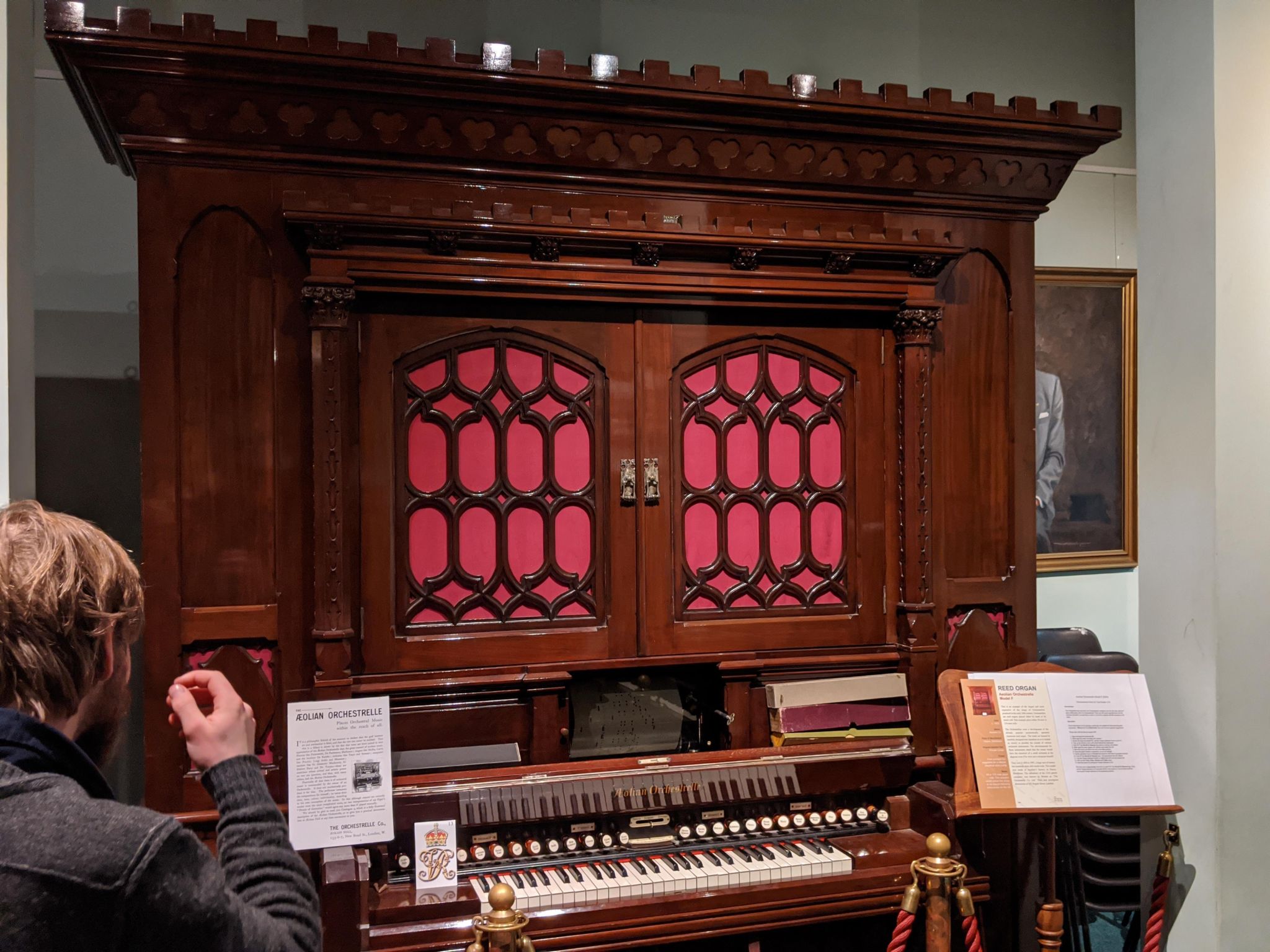
hail the æolian orchestrelle

I had known about the Kew Bridge Steam Museum, with its gigantic beam engines, ever since I was big enough to want to ride on a steam train, but had never heard of the Musical Museum just a little way west of it until, after our jaunt around Richmond Park, Tom and Bex took me there. It’s quite easy to miss, tucked away in a plasticky new West London housing development, and incredibly good. For this is a museum of musical machines: a collection, spanning the last century and a half, of dozens of different devices for recording and replaying noises which, magnificently, keeps them all in working order

I hope you’re hailing it.

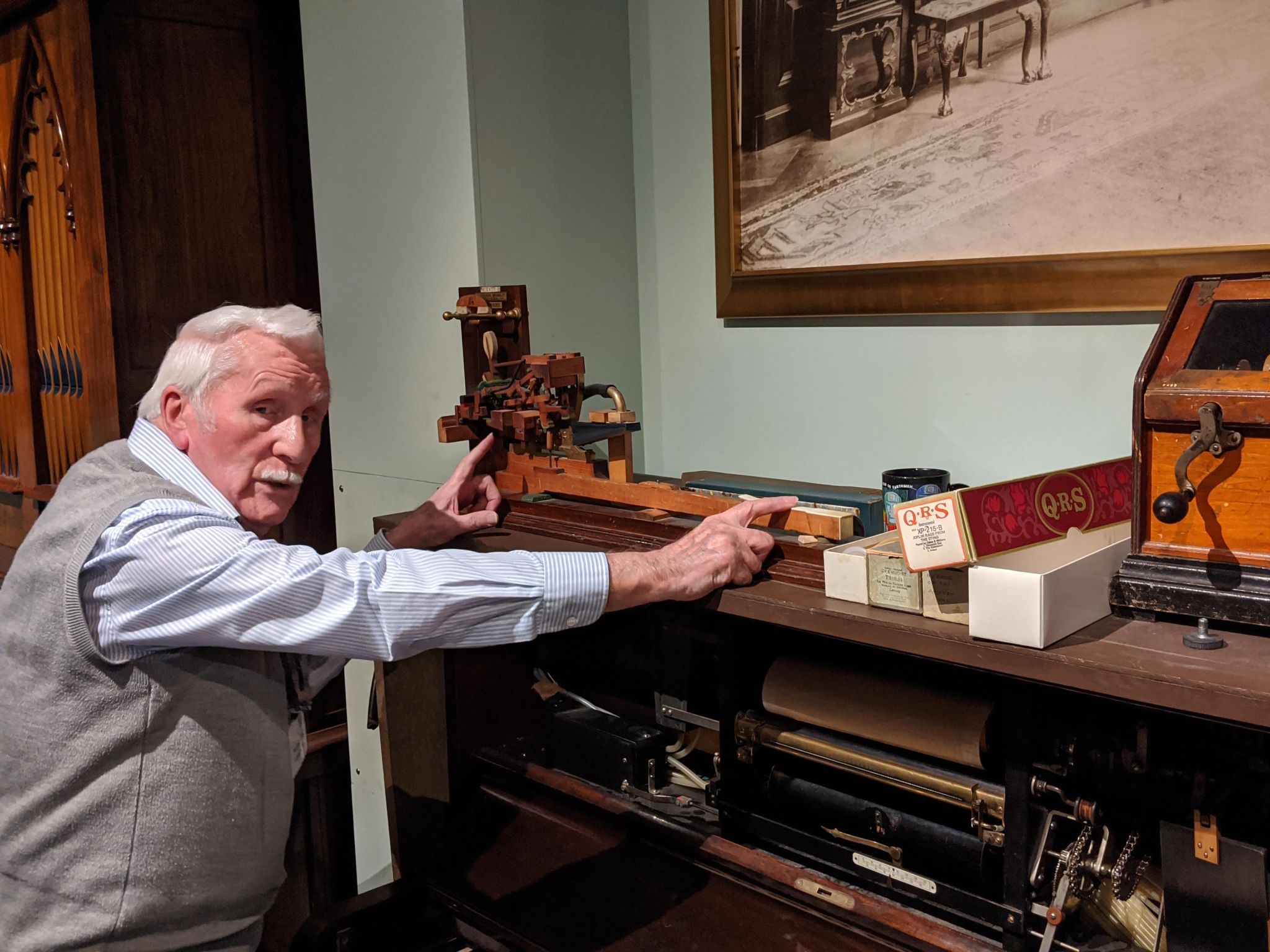
With a small group of mixed ages, we were shown around the collection by a wonderful old gent called Roy, who explained and briefly played each one. I’d grown up with Leonard de Vries’ incredible Victorian Inventions book on one shelf and The Best of Que Sera on the next, so was already vaguely familiar with wax phonograph cylinders and the like, but some of these were brand new to me: a very early metal disc (adjusting quite how old the gramophone record-laserdisc-CD-DVD-hard drive concept), various bonkers machines with actual chopped-off bits of violin and trumpet inside them, and increasingly sophisticated ways of getting music out of a piano without a pianist.

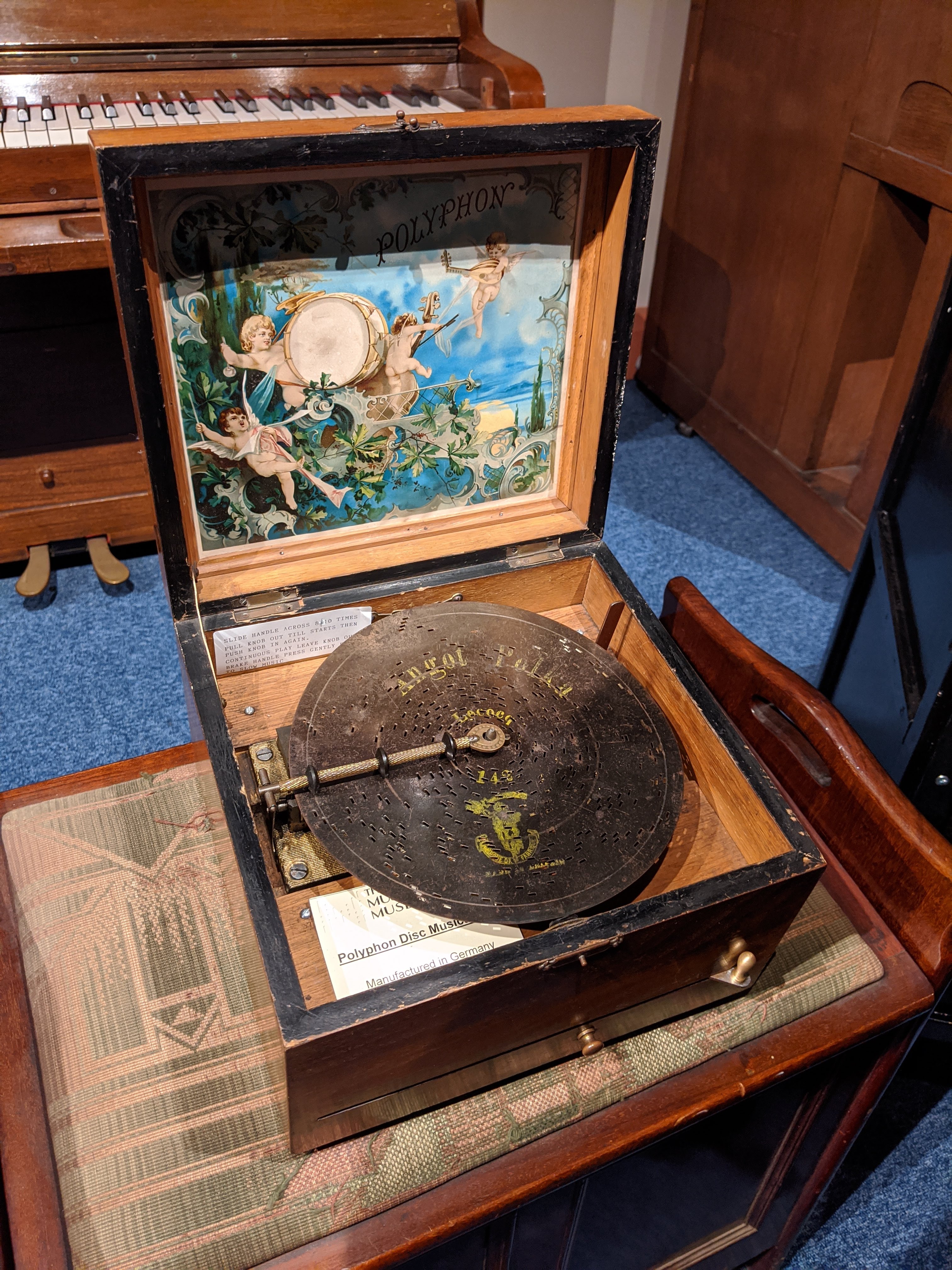
“Polyphon” metal disc, invented in 1870.
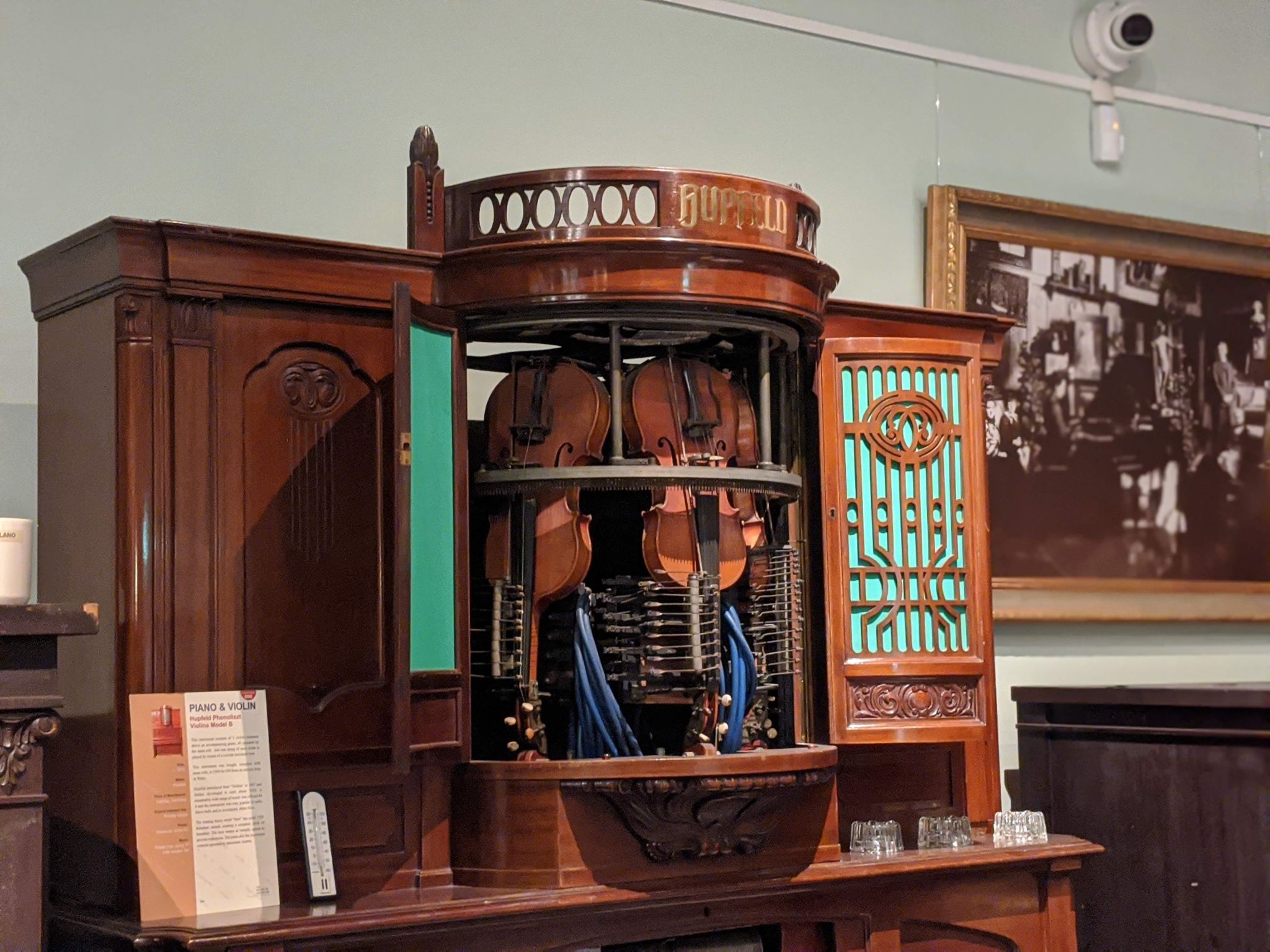
Now you can have a string quartet without needing any friends!
The excellent Roy.

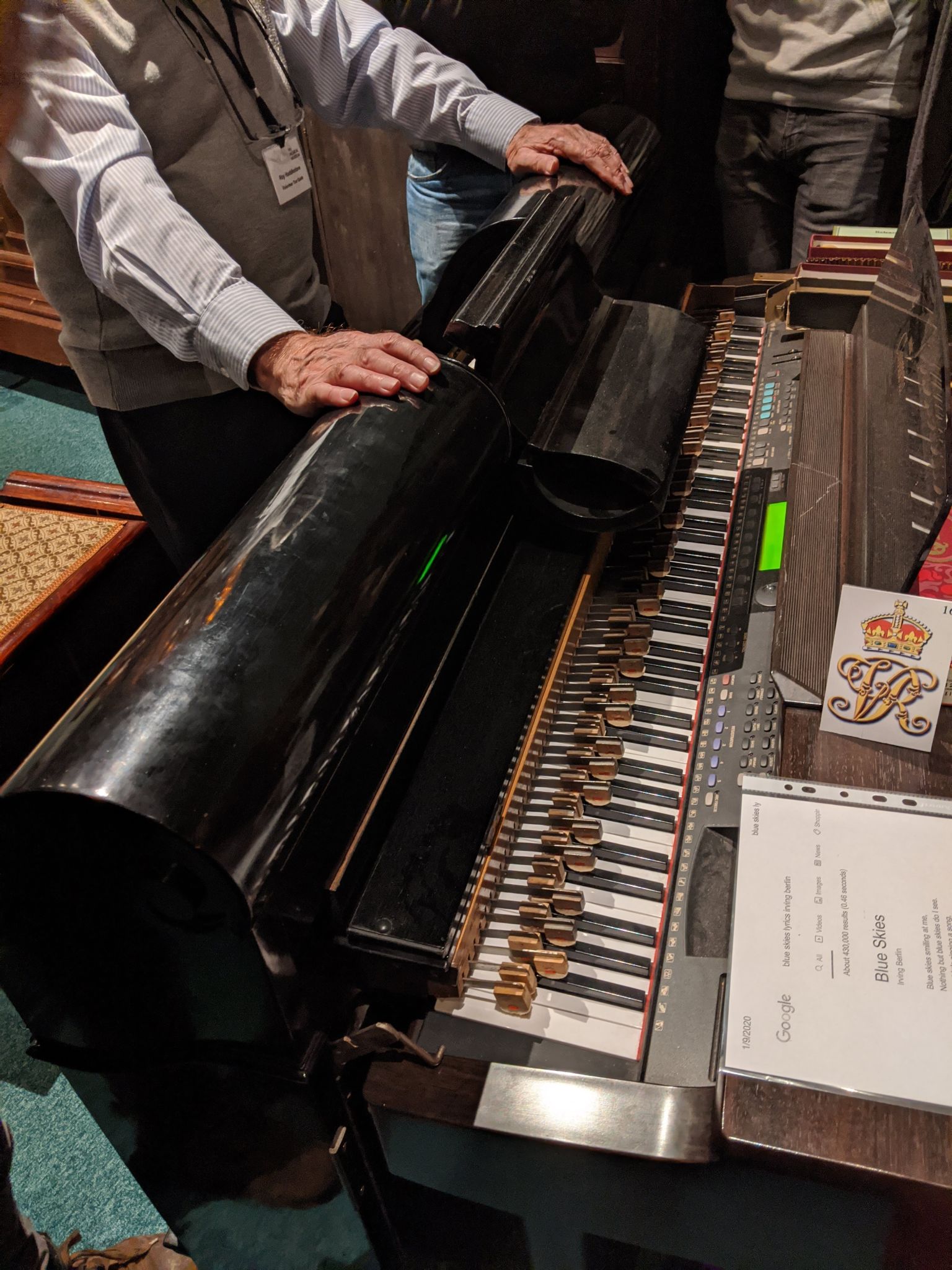
An early pianola: it’s a big set of mechanical fingers which play a piano for you, which was quickly superseded by teaching pianos to play themselves. But this can be applied to a modern keyboard to play ridiculous electronic parps.


Why you should hail it.

Piano-player was superseded by self-playing piano, and rolls which mechanistically struck notes on cue replaced by ways of actually recording a specific pianist, demonstrated by this utterly ghostly recording of Shostakovich (I… think?)


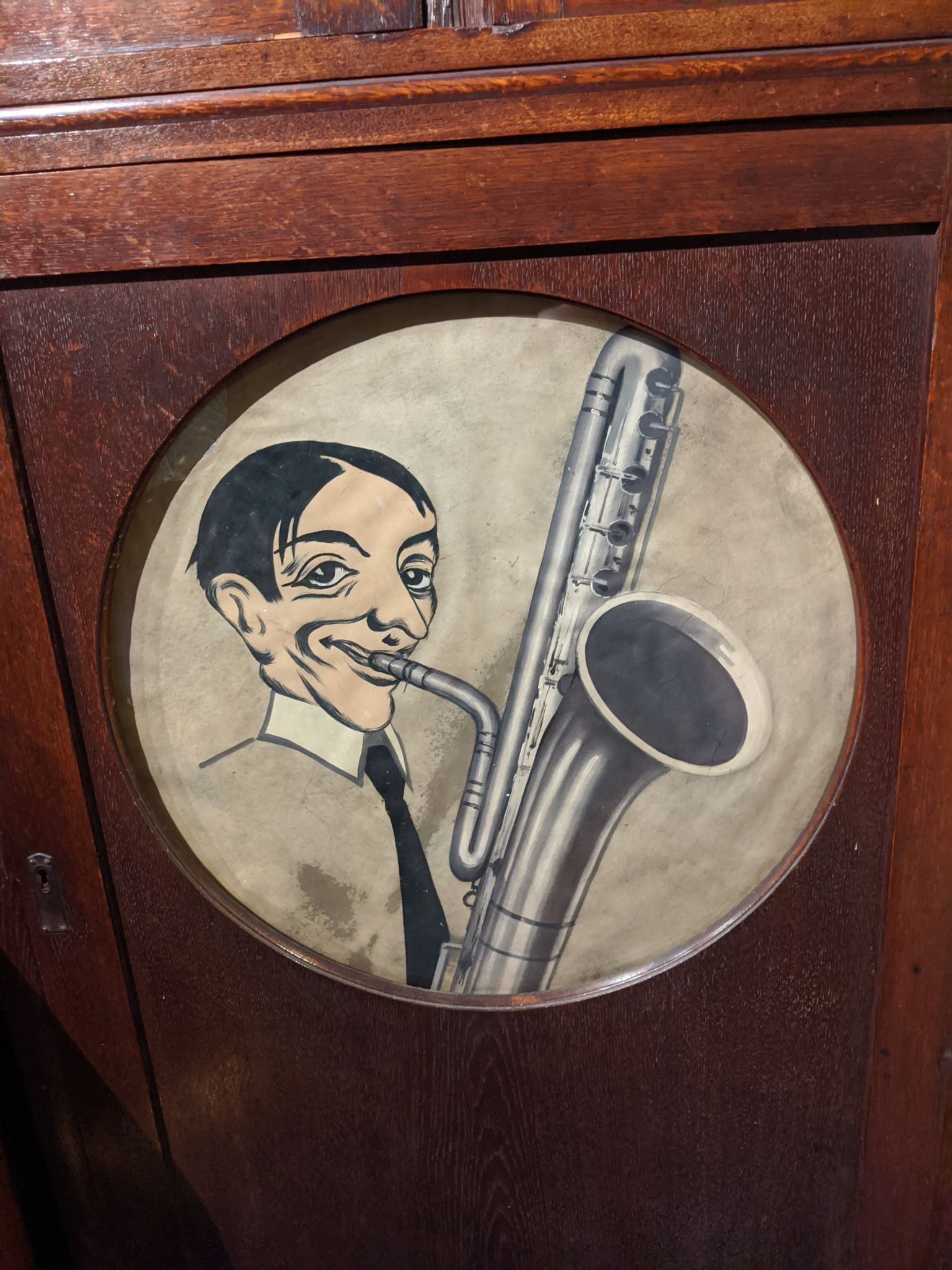
A side room had a number of slightly more modern devices – things I don’t recognise with MOOG written on them, a rotary speaker I more or less understand, a gloriously tacky early theremin, ancient batteries and a home hydro-generator for when houses had water but not electricity plumbed. Fancy! It also had this incredibly louche looking saxophonist.

And finally, after we had an evening coffee and parted, I found this hidden on my coat. I have no idea how on earth Tom made it.

The Musical Museum is obviously closed at the moment cos of the whole Pandemic Thing, but I look forward to taking certain family members back there, and highly recommend it.


PS: All this reminds me strangely of another machine that makes noise: Jolly Jack at the Hull museum. Enjoy!

a walk in the woods

This trip actually took place on 23 Feb 2020, but I’m posting it in 2021.

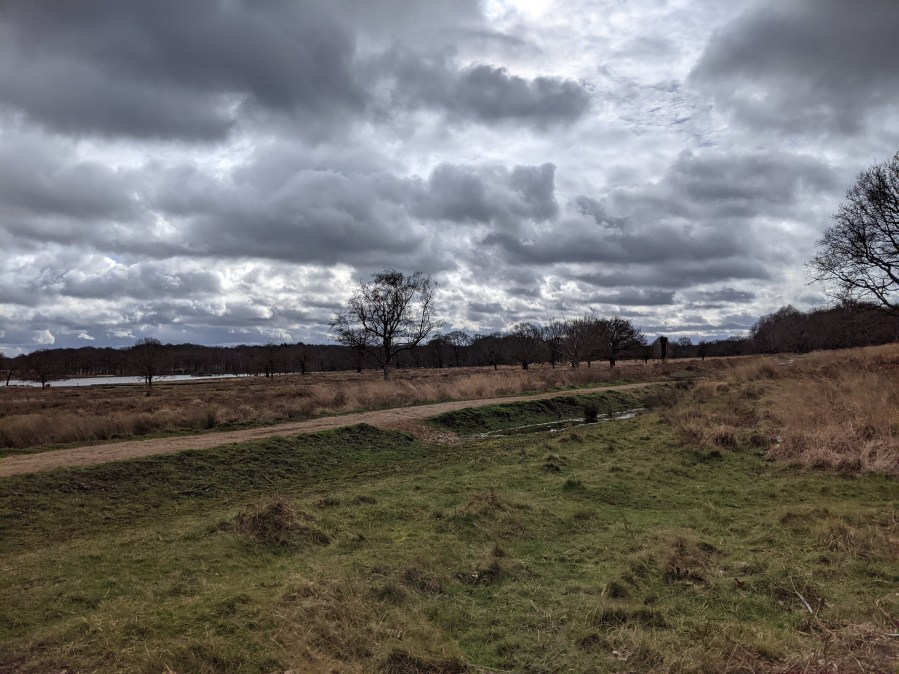
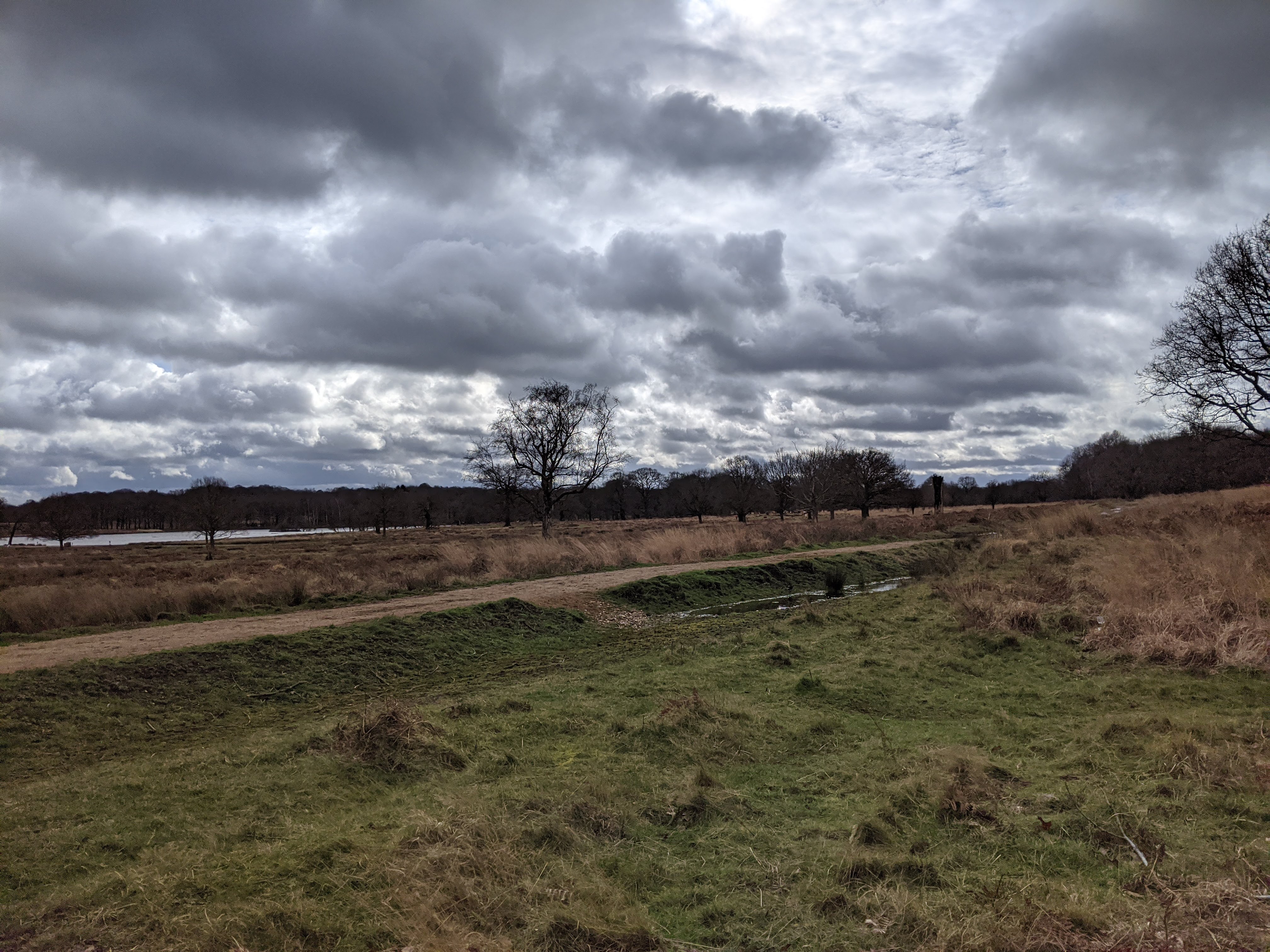
Richmond Park, designated as a hunting preserve by Charles I but far, far older, is the largest and easternmost of London’s royal parks. It’s big enough and wild enough that you can imagine yourself in the open country, rather than with London bustling all around – until you glimpse the glint of a skyscrapers on the horizon, or the jets coming into Heathrow break the silence. The trains of southwest London are abominable on a Sunday, with any number of lines just not working like they ought to, but I managed to get to Richmond station and, a happy surprise, was almost immediately hailed from a coffee shop by an old boss. London sometimes feels like a very small place.

I met Tom and Bex and we proceeded to the north side of the park, finding a map covered in wonderfully macabre old names – Gibbet Hill, Killcat Corner, any number of Copses better read with an extra R. It was a dark, windy day, with a stiff westerly swishing in the long yellow grass and the knobby grey trees, and hurrying dark clouds off towards the city centre. We came to a bunker-esque structure, plausibly an air raid shelter but small, overengineered and a bit in the middle of nowhere. A mystery.

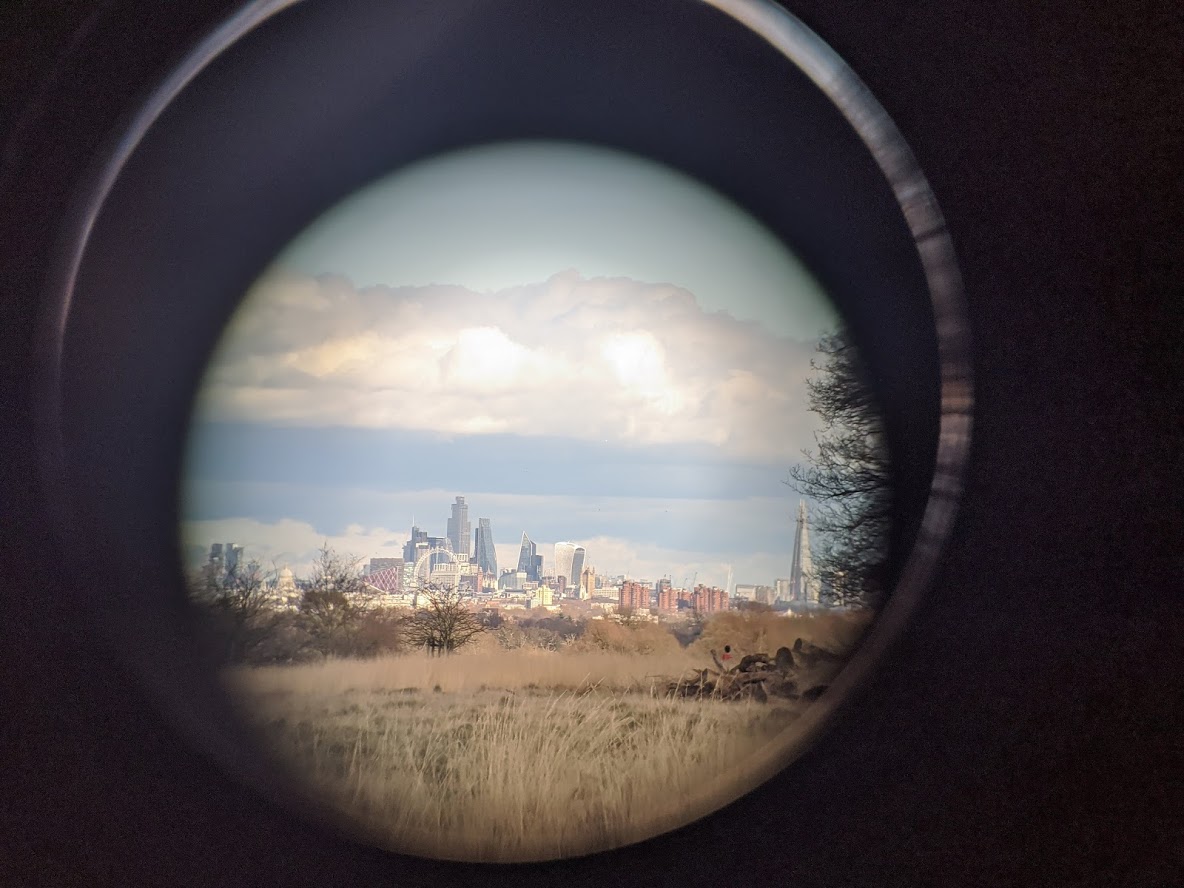
Cars are allowed to use a couple of roads through the park , but limited to a comical 20mph, which sadly hasn’t reduced their numbers. On either side of the slowly rumbling SUVs, grazing with supreme unconcern, were herds of the park’s two deer species: red to the north, fallow to the south. For photos, we improvised an optical zoom by holding phone cameras to binoculars, although they didn’t seem at all frightened of us. Both sets had grown antlers: short, reserved-looking horns on the red deer, much bigger, more antlery-looking antlers on the dapplebacked fallow.

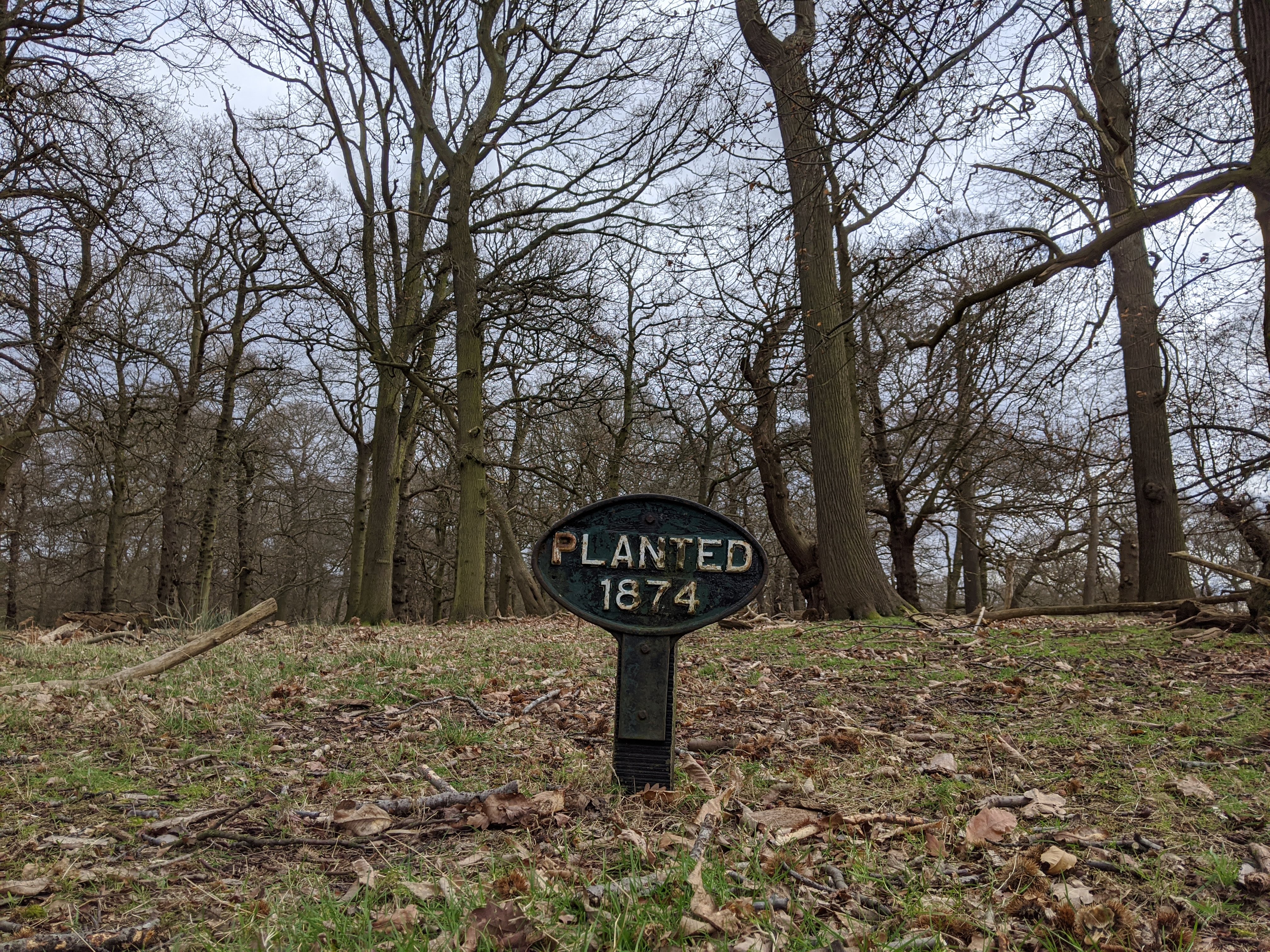
As we advanced into the ancient (and less-ancient, some trees tagged with Victorian plaques) forest, Tom discussed some theories in a book he’d read recently* about how trees communicate with one another (on most of which I’m not wholly convinced, but not wholly unconvinced either.) And, almost as a side note, how almost everything seems to hurt or kill trees, seen on a long enough timescale, and that they show symptoms which can be reasonably interpreted as suffering. This, in combination with a late-winter deadness, gave a strong, unexpected sense of being surrounded by death, an uncomfortable graveyard air that had never occurred to me before (and I didn’t help by bringing up the lignin theory I’d recently learned about, with its strange imagery of immense piles of dead trees, unable to decay.**) But then again, death is interesting: here, a bark-stripped body striated with wood grain, streamlining around knots and branches like a diagram depicting laminar flow; there a huge, half-decayed shipwreck of dead wood, riddled with beetle-holes. A few green shoots were coming in around the spiky chestnut litter; noisy green parakeets and small, glossy jackdaws were everywhere, and we talked about colonies of ants who formed in acorns, or twigs.

We mused on different theories of the “natural” state of the forest, the immensely old and wide anthropogenic geography; on the effects of clearnces and brushwood collection, and the more recent Victorian habits of cutting off low branches and removing dead trees out of a sense of tidiness. Looking at one grove of oaks, maybe a century old, I noticed that only those at the edge of the group had grown peripheral branches.

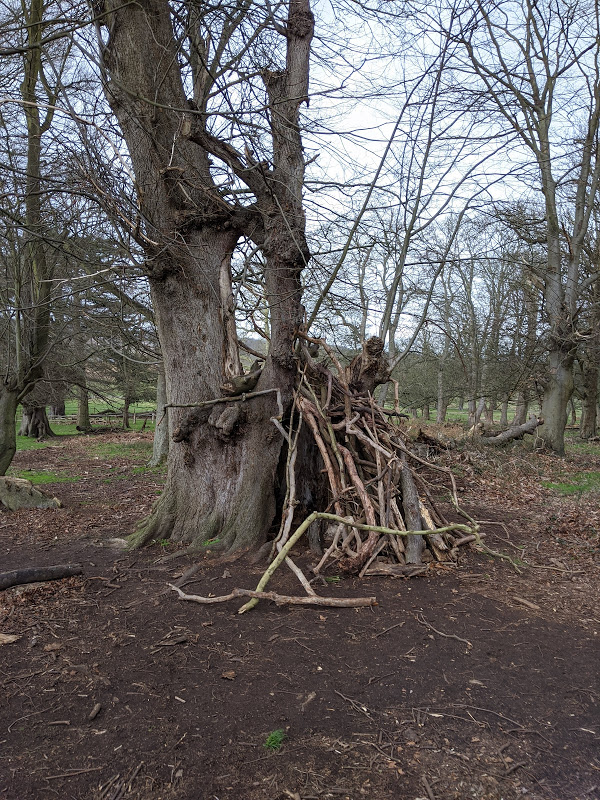
At a cold, grey, two-stage lake, strong winds blew little zephyrs of ripples away from us and a pair of swans held their heads low to look menacing. Someone, or several someones over some time, had been building shelters by stacking branches against hollow trees. We found one very nearly big enough for the three of us, and hid in it the rain suddenly swept in, drinking tea from a thermos and eating some excellent homemade banana cake.

And it was a grand day out.

* The Hidden Life of Trees by Peter Wohlleben. From summaries it seems like some genuinely interesting concepts with some big side orders of anthropomorphisation and pseudoscience, but I really want to read it now.
suffer naught to fate, hit the homeward road

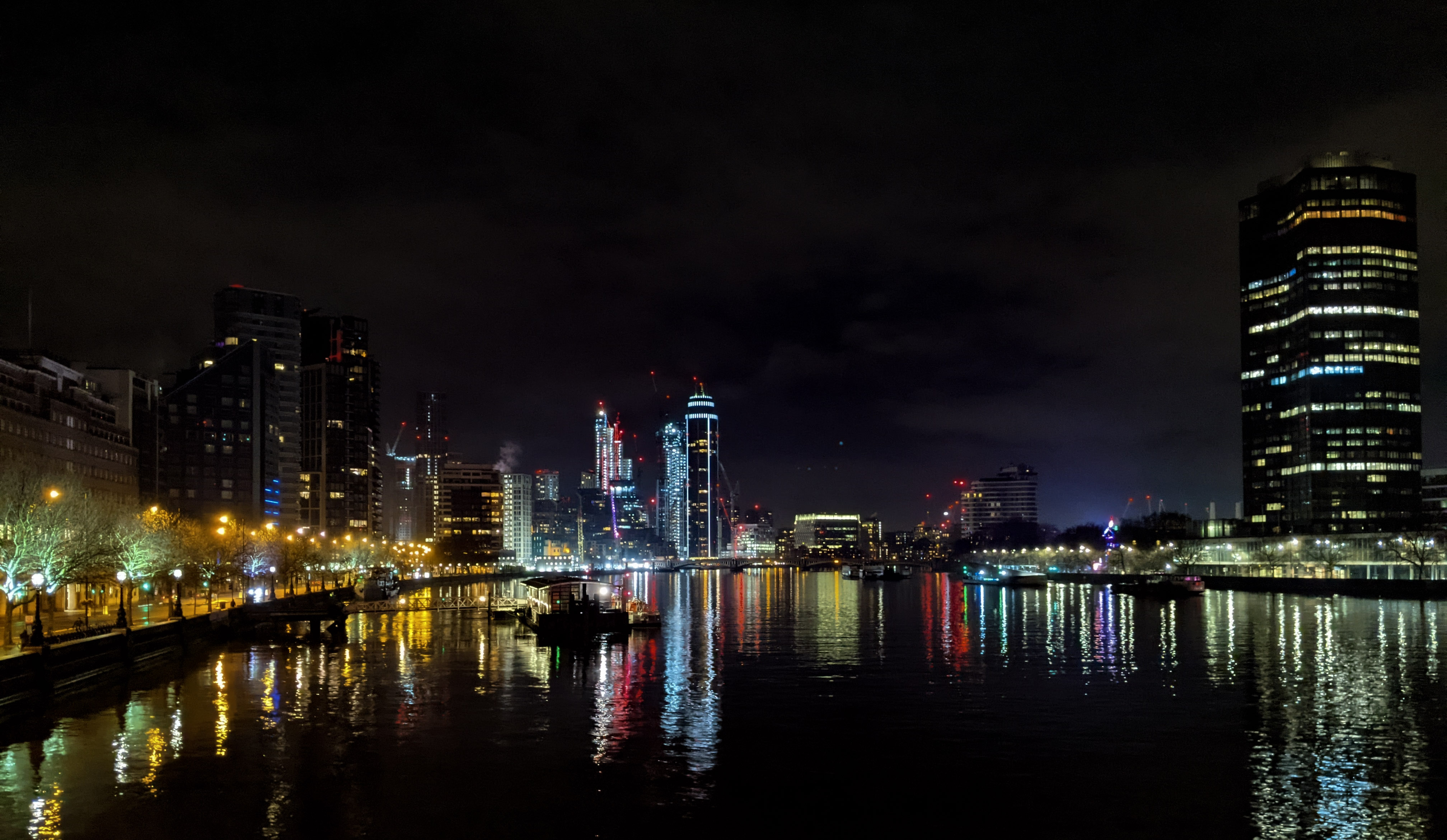
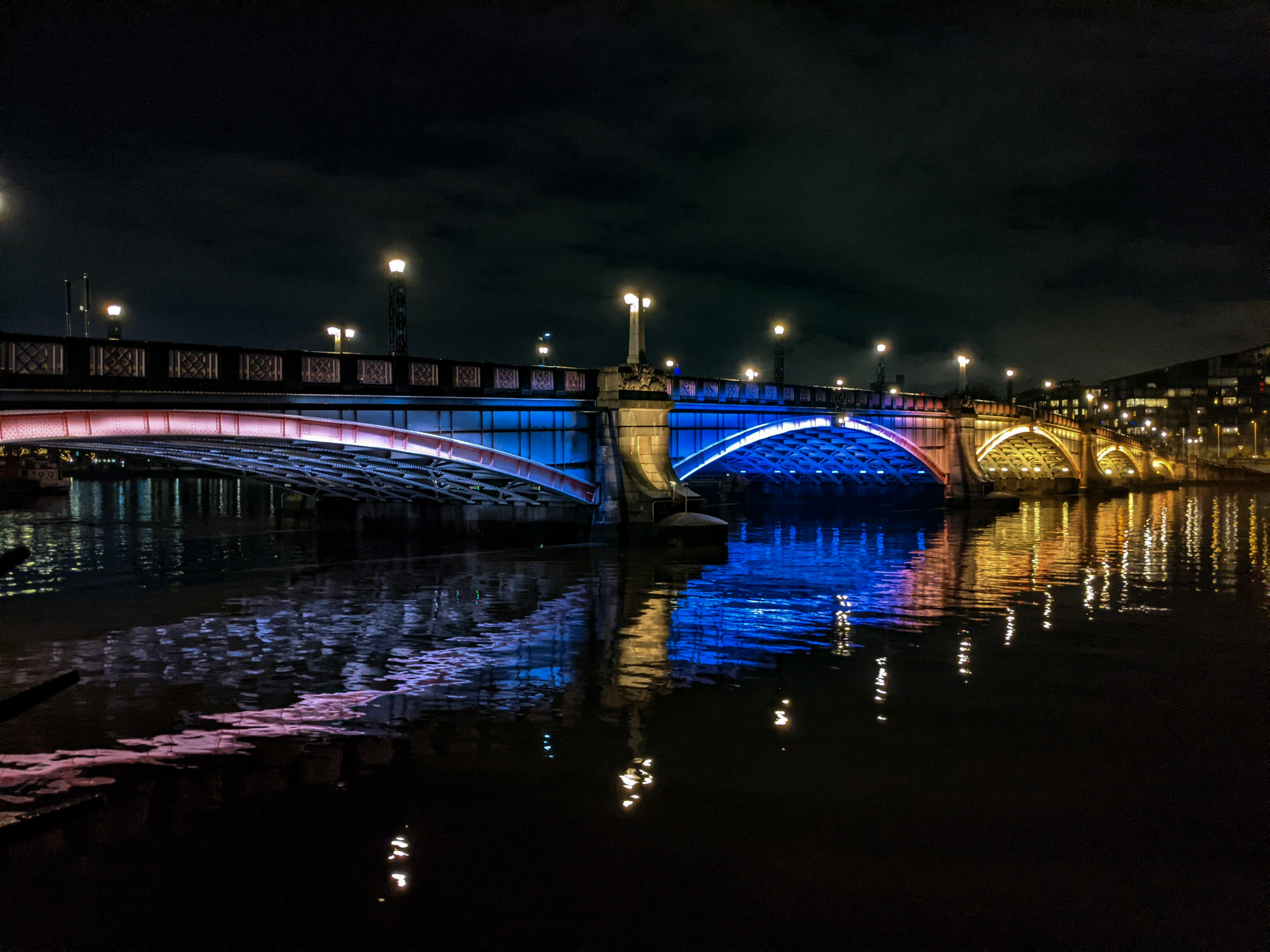
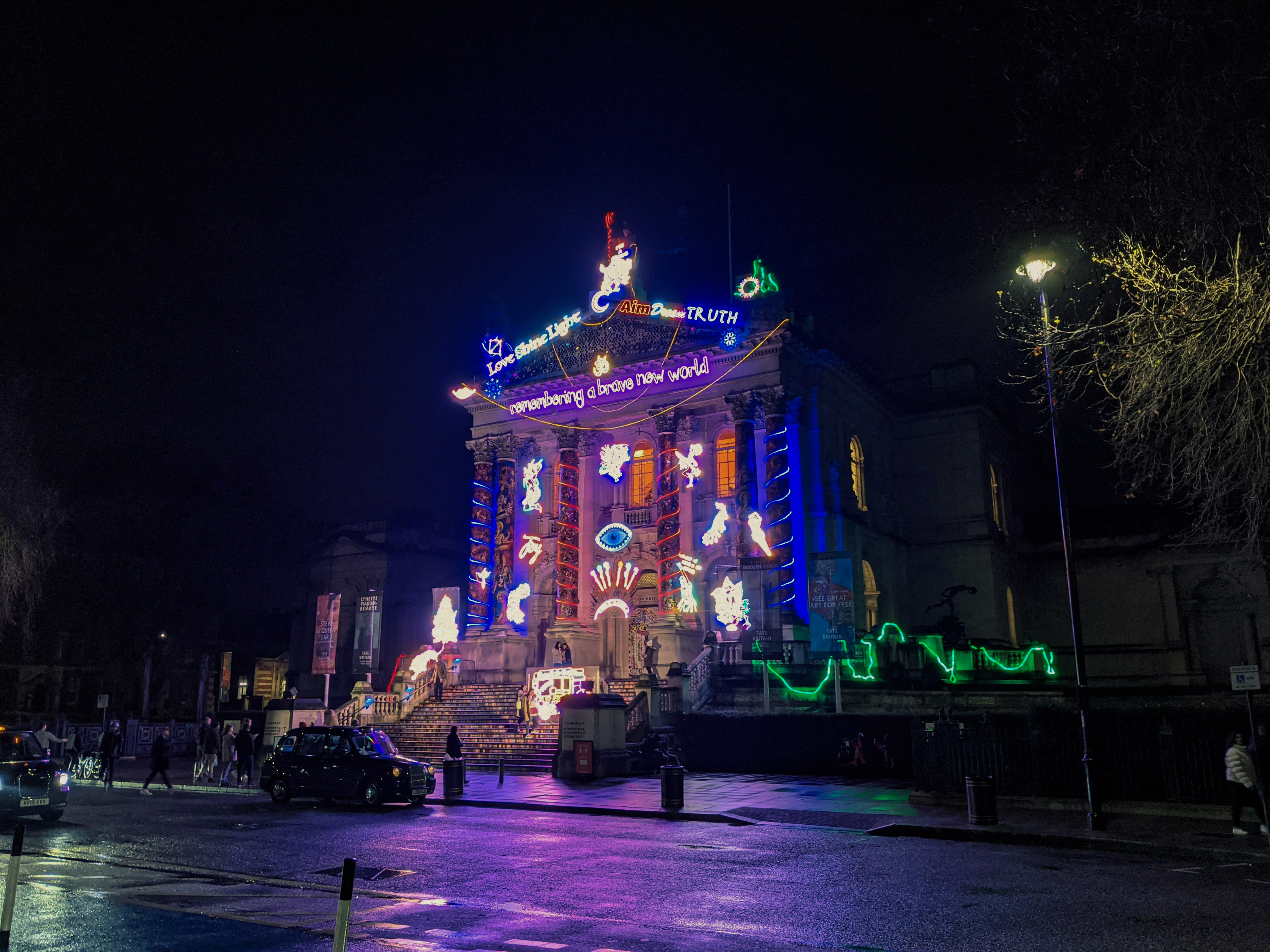
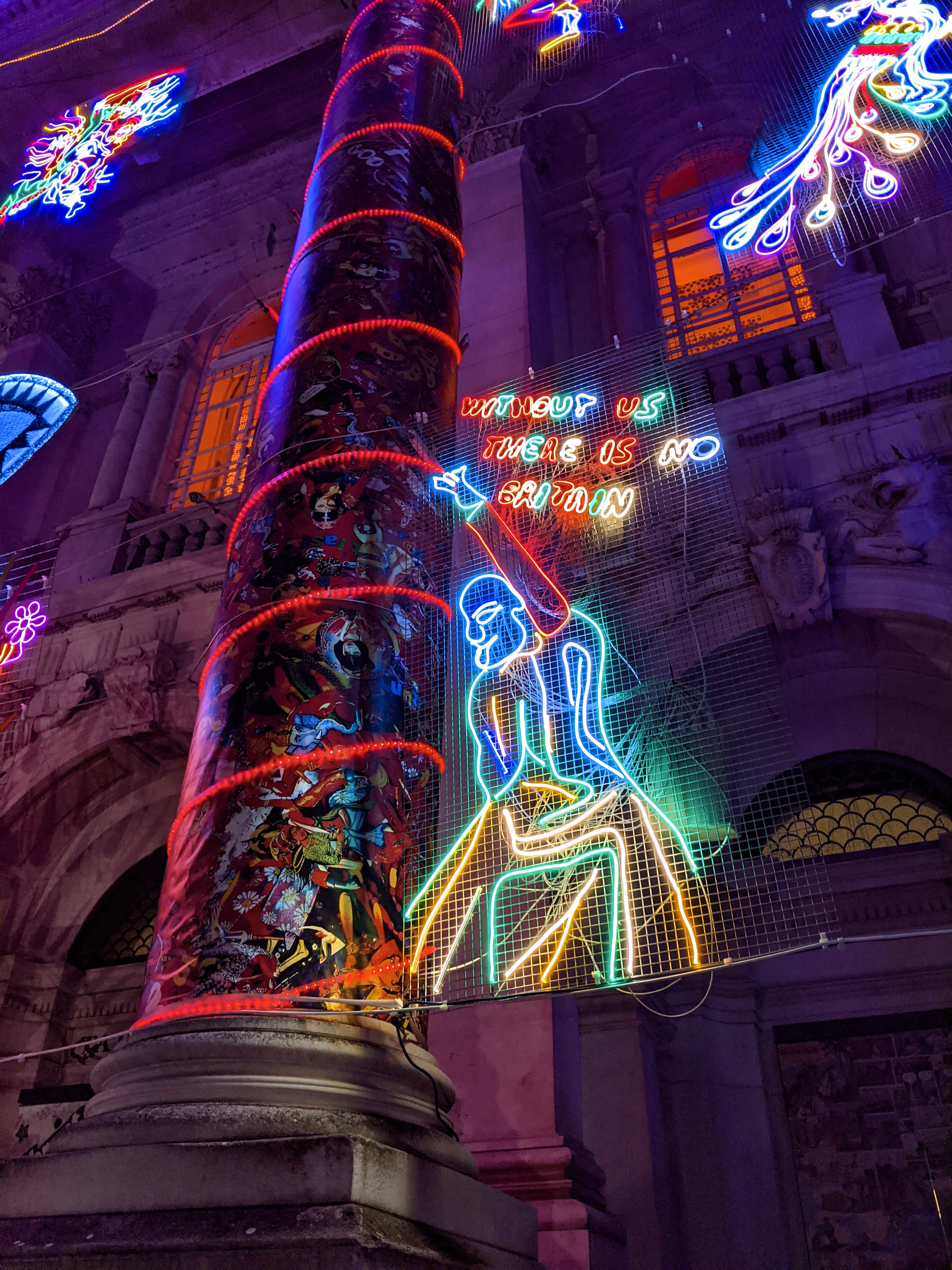
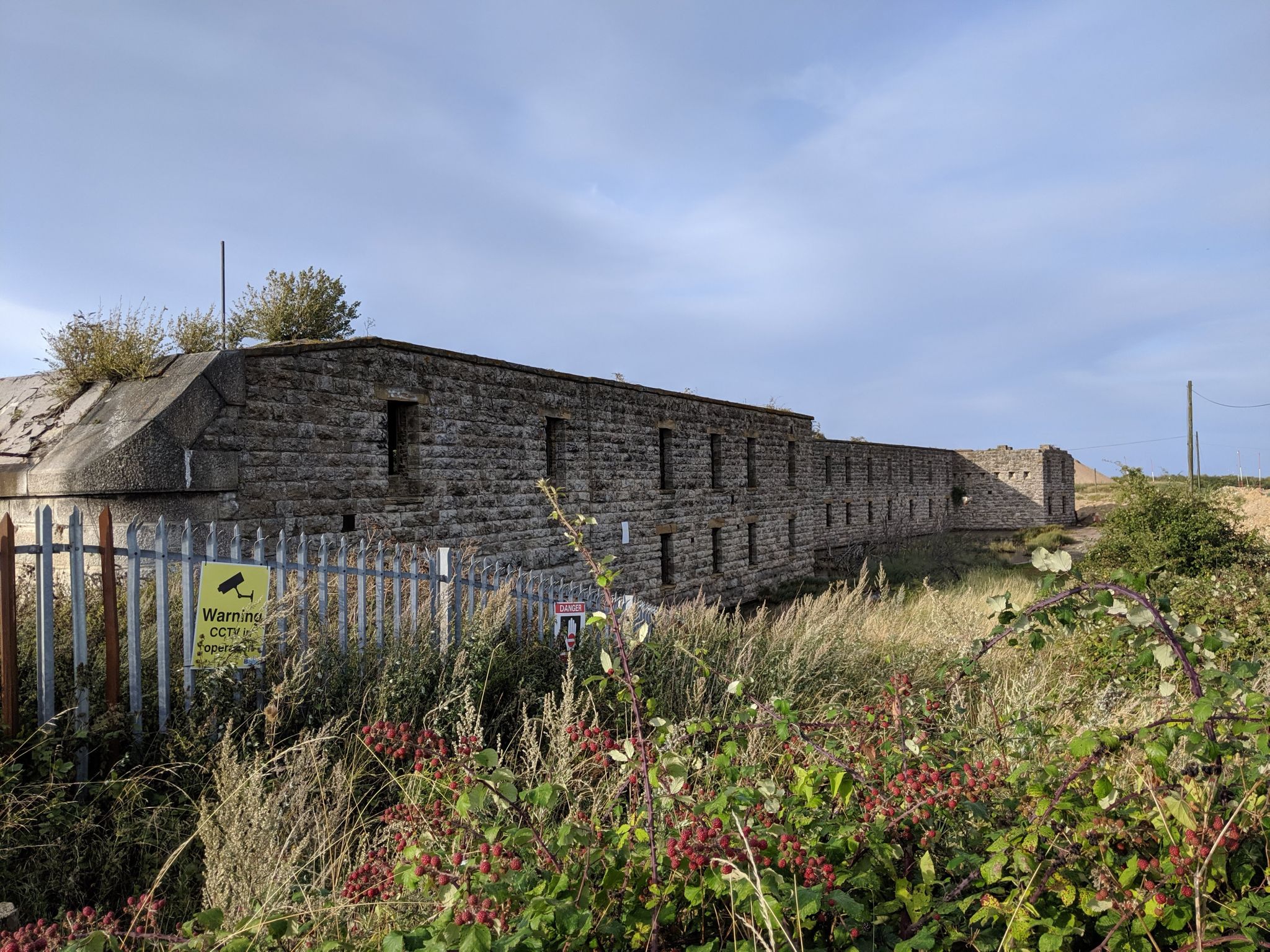
London was very picturesque the other night. (Shrunken WordPress pix look pretty terrible – click for full size, as always.)

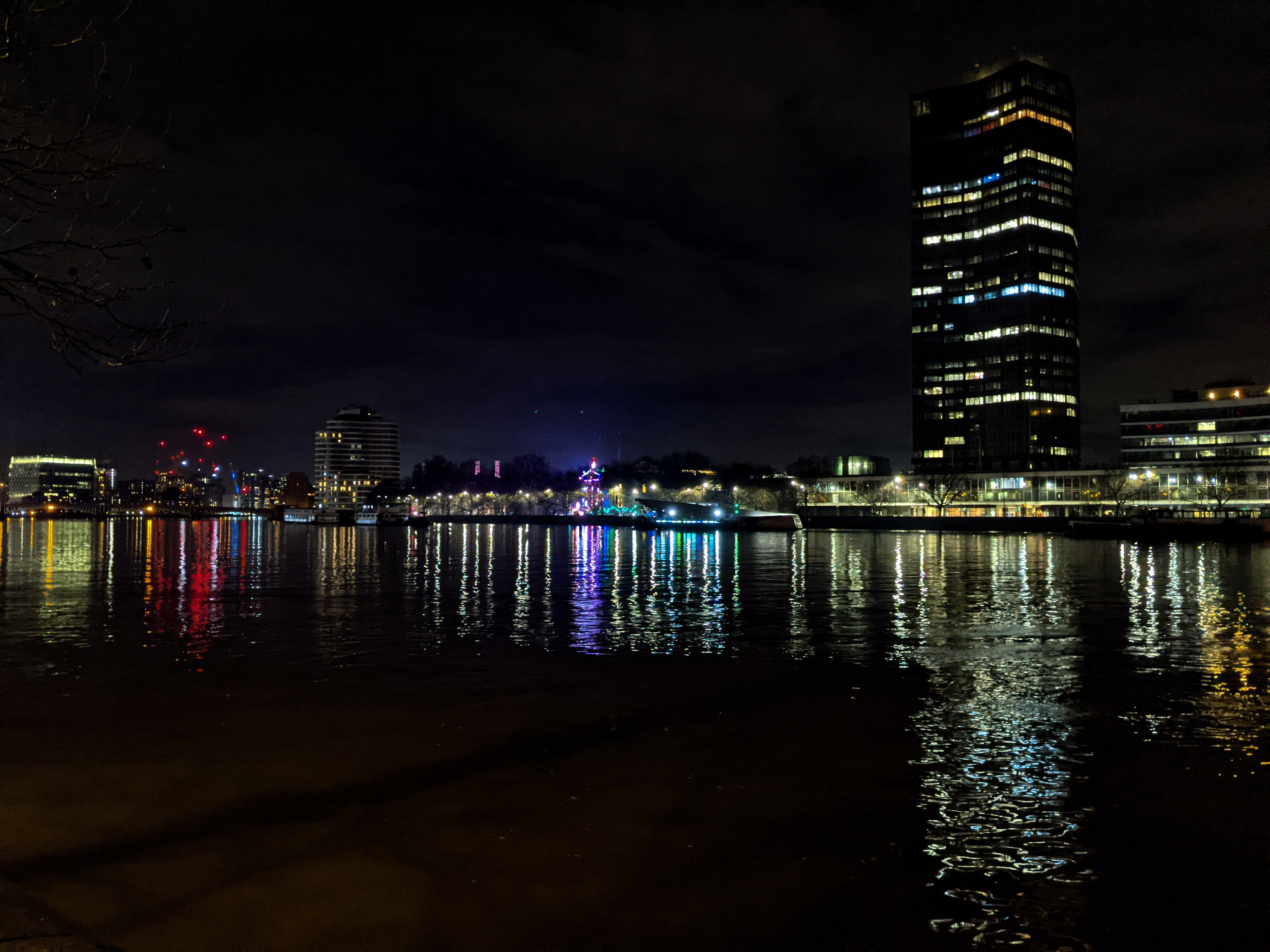
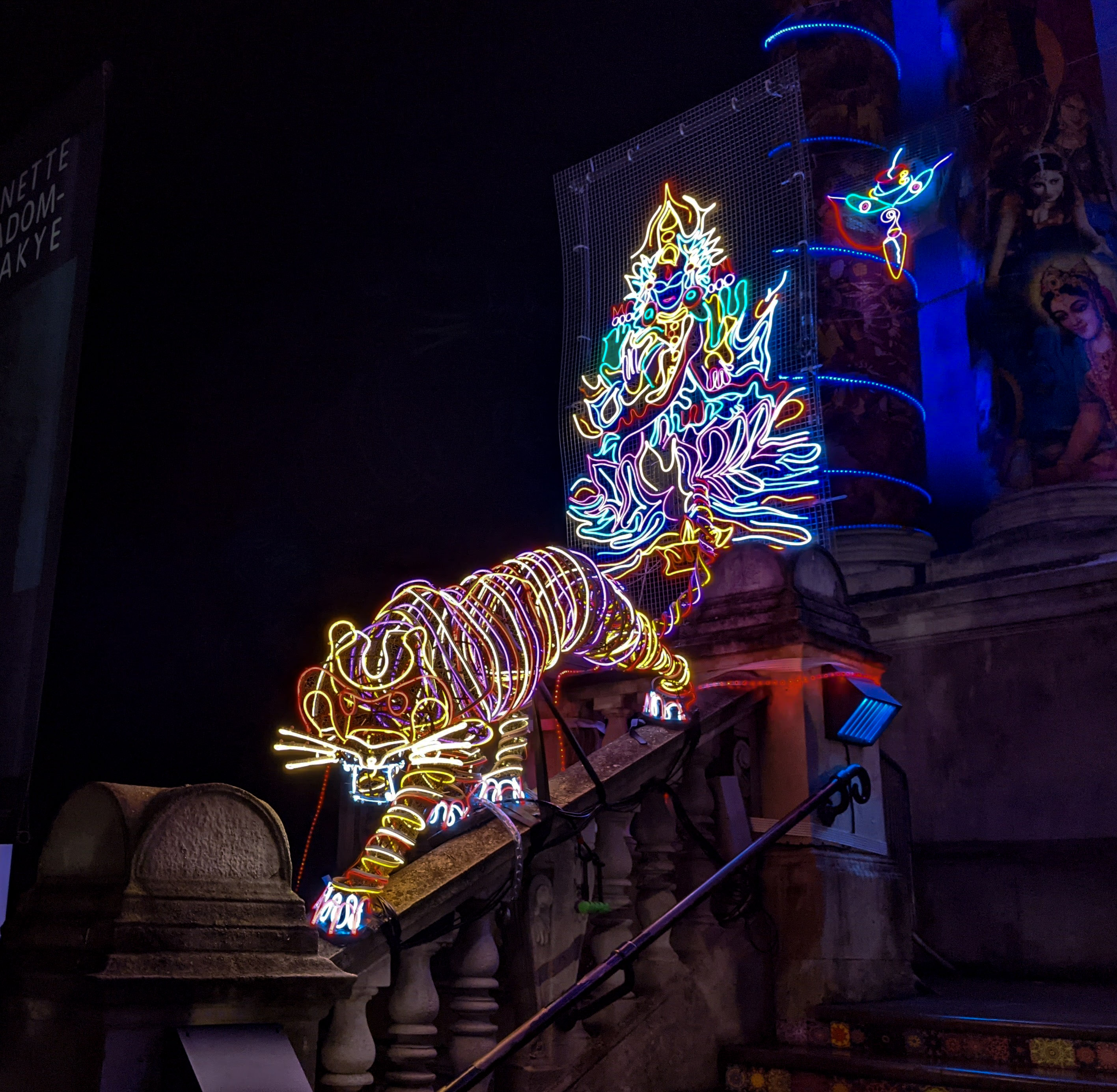
Millbank Tower and the Diwali lights on the Tate.

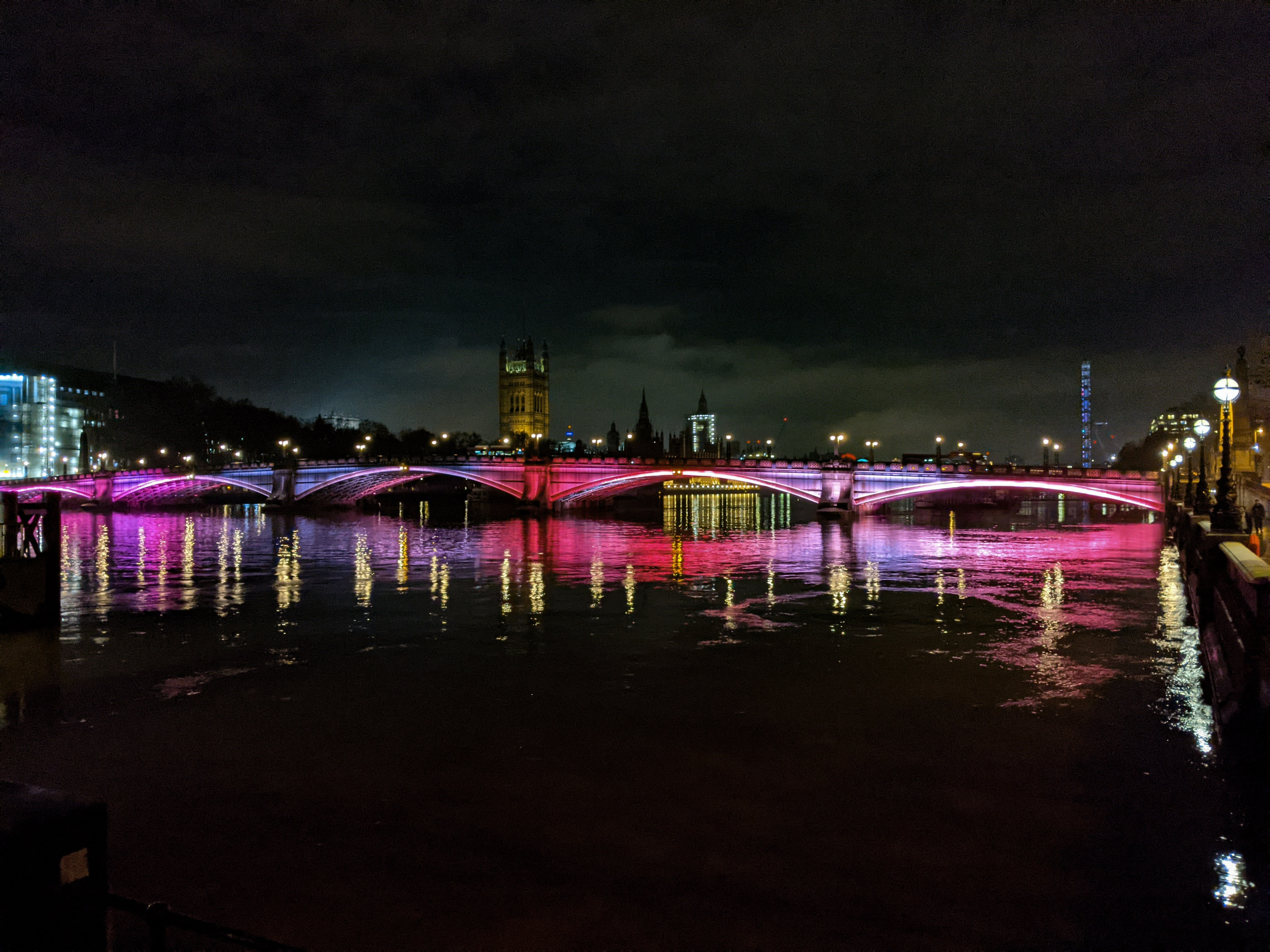
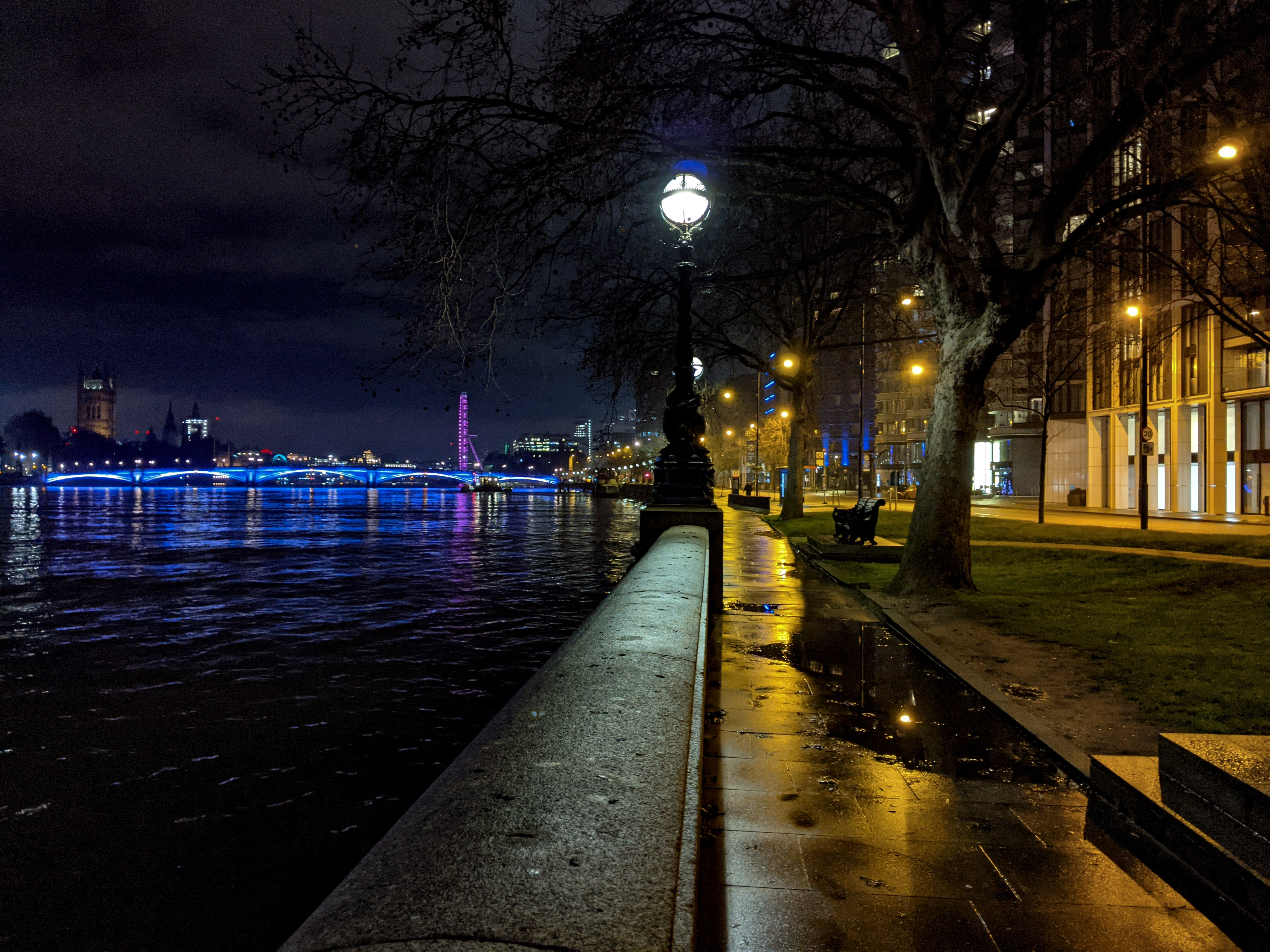
Lambeth Bridge, which lights up now for some reason.

Looking south towards the new Vauxhall skyscraper thicket.

Lambeth Bridge again.

The Tate Britain, done up for Diwali.

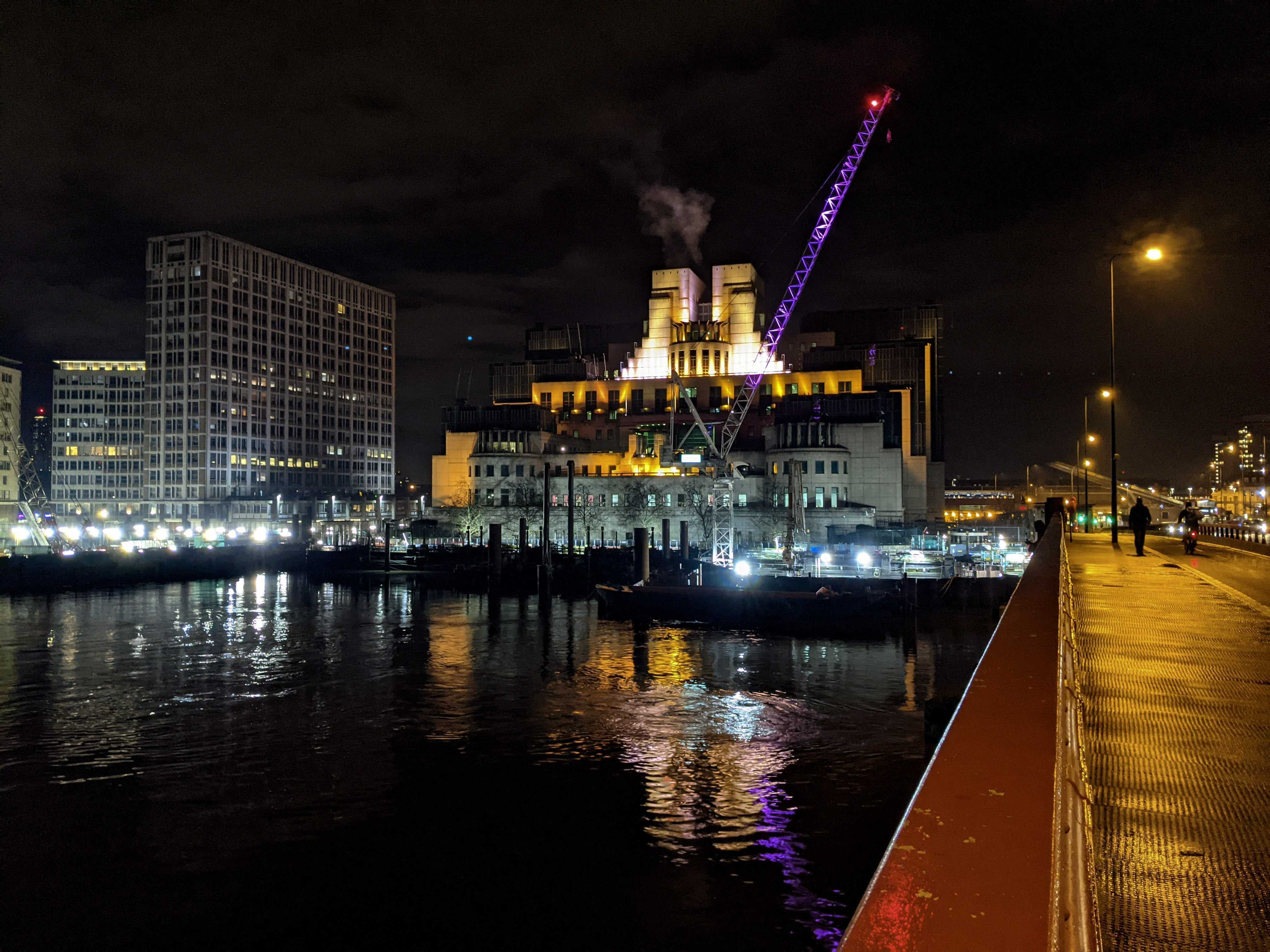
MI6 looking very evil.

Not looking at anything specific here, but I loved how the blue-lit river and orange-lit Albert Embankment contrasted.

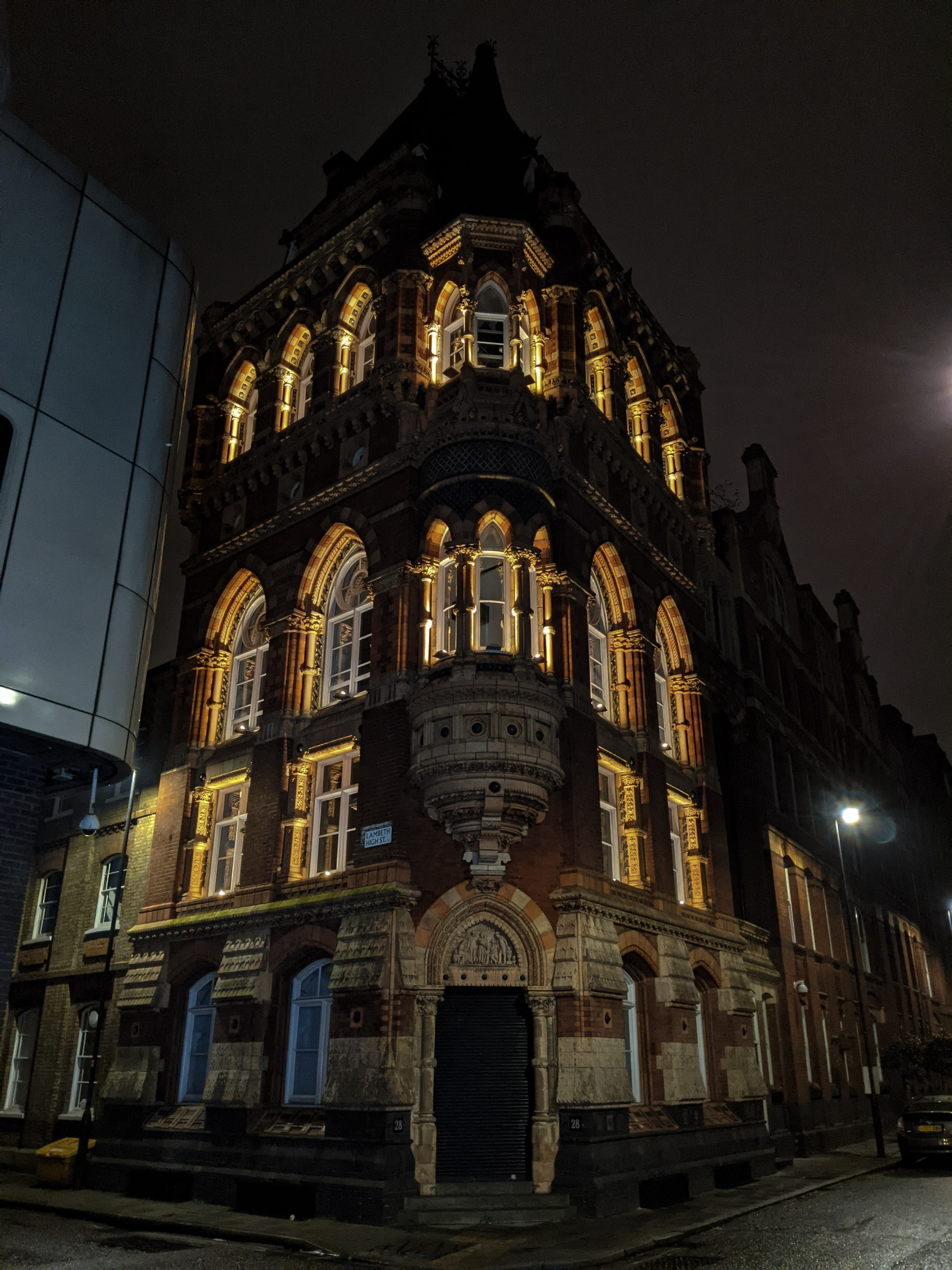
The old Royal Doulton headquarters.

vauxhall skyline

It was raining when I left the office today. The late winter sun, limbering up after so long away from its duties, conspired with the rain to present London with the most gorgeous evening light. Everything at street level glistened darkly; everything above it was golden and exalted, shining aginst a solid drift of lilac nimbostratus. A thick, solid stub of rainbow rose from Waterloo, a pale mirrored reflection a little way north. Creamy wisps scurried south beneath the great dark blanket; at Nine Elms I looked to windward and saw its edge, the horizon banded in dark grey and the most brilliant powder blue.