An A-Z of the Illustrated World, part 4

This series was originally jointly on my blog and Philip Reeve’s, but his has been overrun with malware so all four posts are now on my own site: Part 1 Part 2 Part 3

T is for Rob Turpin
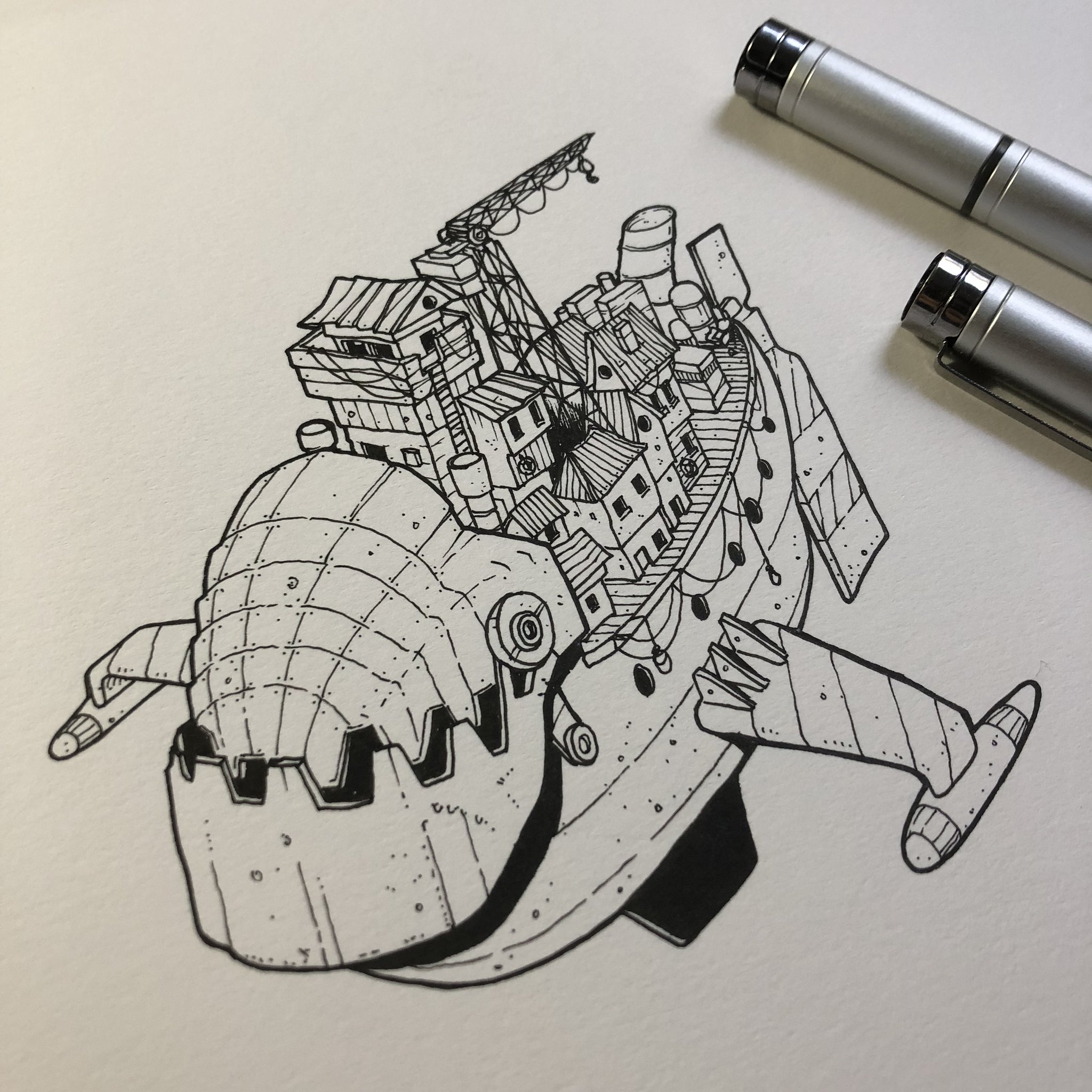
Early on in the development of the IWOME, it had more of an artbook-y feel: big, fancy full-colour works taking up whole pages at a time, with the relevant text on the opposing page and any empty space filled by fancy cogwheels (which ended up on the cover.) We wondered if we could make it feel more of a technical, encyclopaedic sort of thing, the sort of book which says “refer to Fig. 2a”, by adding more, smaller illustrations – perhaps little black and white ones…?

To which Jamie, the Scholastic design manager, said “Ah! I know just the chap!” Rob Turpin is an illustrator and designer from Yorkshire who has been living and working in London for the last twenty years. Mainly working in science fiction and fantasy, Rob has a love for spaceships, robots, imaginary places, and the colour orange…
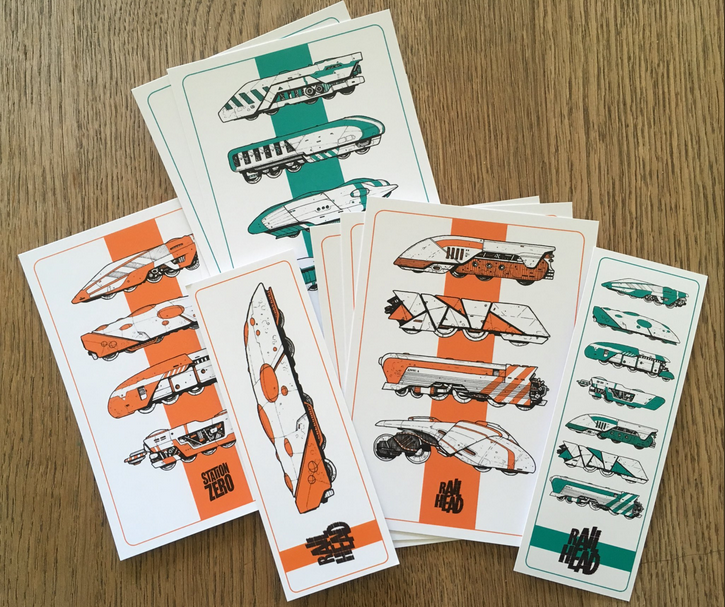
 

He also did a nice set of Railhead postcards for Philip.

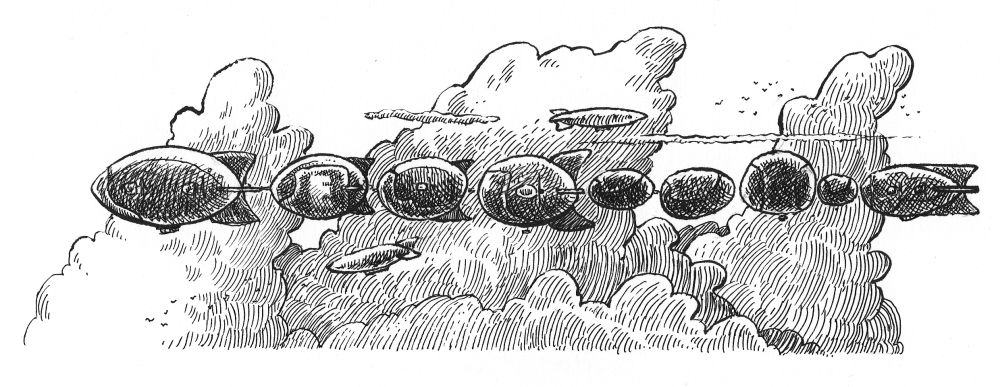
Rob’s lovely little cities, full of detail and personality, crowd the book and are all laid out in the endpapers. In particular, he’s taken on all the more bizarre experimental cities, like Panjandrum, Vyborg, Borsanski-Novi and Havercroft. Probably my favourite of these is the Nuevo-Mayan piranha town. We originally envisioned these as smaller than the first version he sent in, only about the size of houseboats, but the one he sent was so lovely we had to keep it in anyway, with a little squadron of smaller friends. And, absolute gentleman that Rob is, when I said it was my favourite, he only went and sent me the original art…

Rob is thisnorthernboy on a lot of sites: Twitter, InstagramWordPress, and ellipress where you can buy prints of his work. Give them all a look!

U is for Uncertainty, or Unsolved Mysteries – it’s all one.

The IWOME answers a lot of questions. Readers will come away knowing how London got from the end of Scrivener’s Moon to the start of Mortal Engines, how Tractionism spread to India, which was the largest moving city ever built, what on earth is actually going on down in Australia, and who originally used Nuevo-Mayan Battle Frisbees. They will also have a much better idea of the geography of parts of the world and how much the Sixty Minute War really reshaped things, which has been a source of great speculation and interest in the fan community.

But it doesn’t answer all of them. This isn’t an exhaustive encyclopaedia or comprehensive atlas; we have no interest in naming every Traction City ever built and categorising them all. The book leaves a great deal up to the reader’s interpretation and imagination; it’s a history as seen by people inside the world, which is still full of mystery and uncertainty. Hopefully, we’ve left a world that feels wider, rather than narrower.
V is for Philip Varbanov

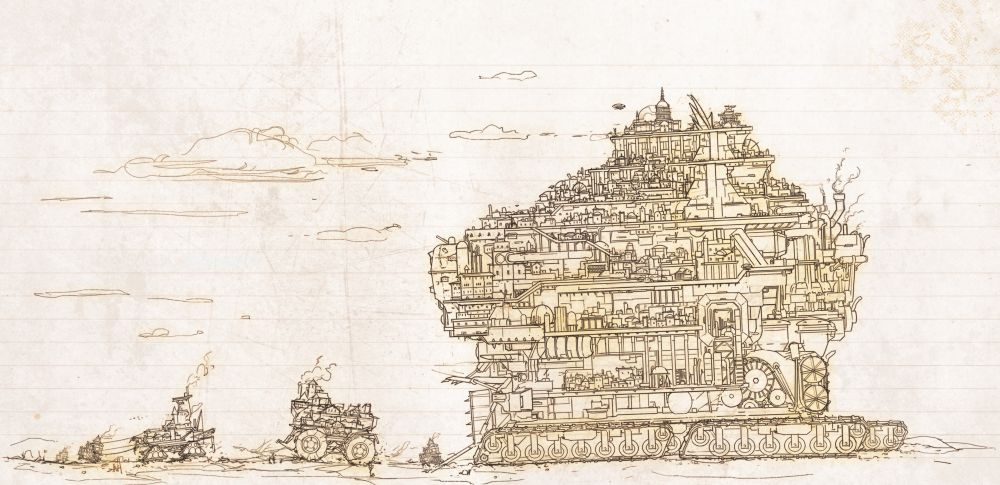
As mentioned in Exploded Diagrams in the first blog, something we were anxious to include from the very beginning was artwork which captured both the scale and the detail of a Traction City. And for that, Philip Varbanov’s work exceeded all our hopes.
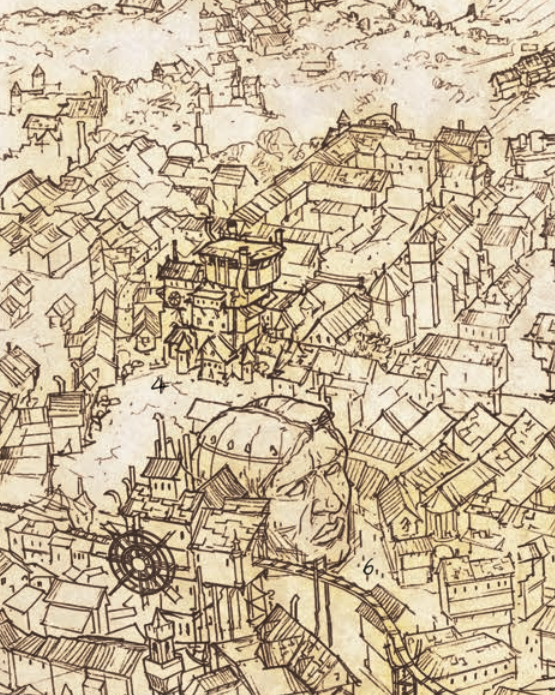
Detail of Philip’s Pre-Traction London, feat. the Barbican and Godshawk’s Head.

Philip is a concept artist and illustrator with a background in fine art and graphic design. He’s based in Sofia, Bulgaria, and works in the entertainment industry, specialising in environment art and production drawings. He illustrated the “Evolution of London” series at the start of the book, as well as several helpful cutaways of traction cities, an illustration of the Municipal Darwinist food chain and a stunning Jenny Haniver.

Philip’s works are striking for their great attention to realistic-looking mechanical detail.  His drawing of Fever’s London on pages 10-11 is a masterpiece – we were worried it wouldn’t be possible to get central London, Nonesuch House (which is well away from the centre, on the edges) and the Orbital Moatway (which is far off on the horizon) all into the same drawing satisfactorily, but Philip used space and perspective so cleverly the whole thing just works.

He tweets as @moobsius, and you can see his fantastic portfolio at https://philip-v.com/
W is for David Wyatt
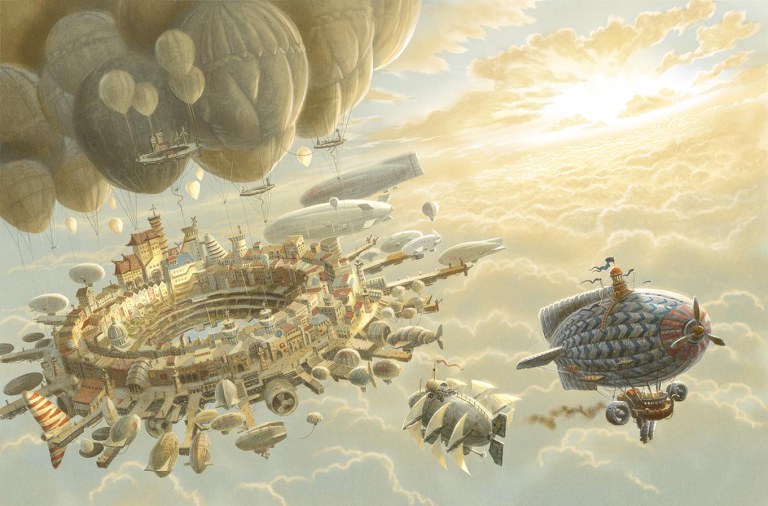
Chances are if you’re a fan of Philip Reeve’s worlds you’ll already be familiar with the works of David Wyatt. He’s responsible for the charming black-and-white illustrations of the Larklight series and, closer to home, a series of Mortal Engines and Fever Crumb covers (along with the Haunted Sky comic-that-never-was.) His covers are exactly how I imagined the world of Mortal Engines as a little boy, and the IWOME simply wouldn’t have felt right without him involved.

David’s huge full-page illustrations are scattered through the IWOME. All his works have an incredible sense of atmosphere: contrast the rain-slick, overcast landing pad of the 13th Floor Elevator with his light, airy Brighton, or the calm of his Zoffany-like art gallery with the oppressive, chaotic Battle of Three Dry Ships, where a three-tiered London grinds implacably into view over a blood-red battlefield. I also adore his Nuevo-Mayan traction city chase, which is like the cover of a Mortal Engines book that never happened – it’s so close to what I had in mind when writing the brief it’s spooky.

David is a prolific illustrator (I hadn’t realised quite how prolific until, looking at his portfolio, I found half the books of my childhood were in his covers – everything from The Hobbit to The Amazing Maurice and his Educated Rodents), and recently won the Blue Peter Book Award for The Legend of Podkin One-Ear alongside Kieran Larwood. Like Philip Reeve, he lives on Dartmoor, and you can see evidence of its mossy hillocks, windswept tors and curly, spooky old trees in his art here. More of his IWOME art (among many wonderful other things) can be found on his blog here.

X is for Xanne-Sandansky

…one of the many, many Traction Cities mentioned in the Quartet, but which never got its own entry in the IWOME. I’d love to come back to it – there are plenty of ideas for cities which we never quite got round to.

Xanne-Sandansky is best known in the IWOME as the eater of Borsanski-Novi, a catch so crammed with spare parts and useful machined goods that its Gut bosses had a spring in their step for months thereafter.
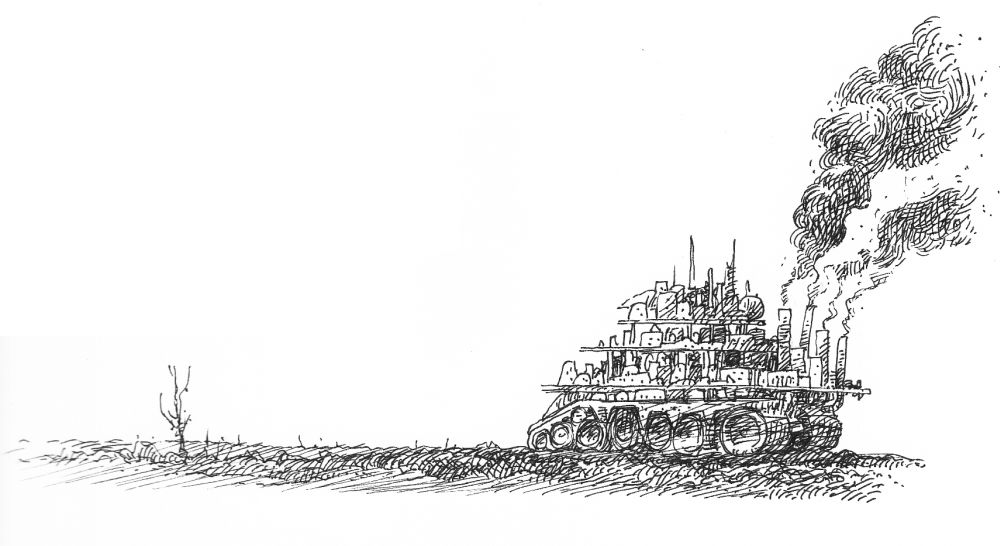
Y is for whY can’t I think of anything for the letter Y?

It’s a copout. But I really can’t. Suggestions in the comments section, please…

And finally, Z is for Amir Zand.

 Although he’s last in the alphabet, Amir Zand was one of the first artists involved in the IWOME. Amir is an Iranian illustrator and concept artist, specialising in cover art and promotional illustration. He’s been featured in numerous magazines and books, including Spectrum 25: The Best in Contemporary Fantastic Art, and has illustrated more than 35 book covers.
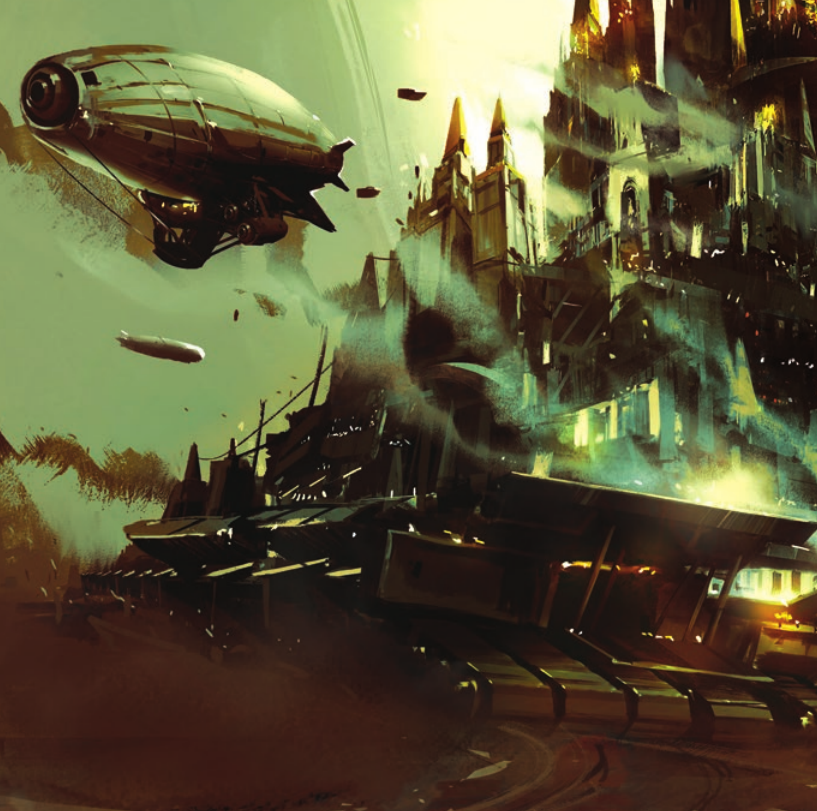
Detail of Bayreuth – get the book for the rest!

Amir contributed all sorts of works to the IWOME, providing a marvellous set of mutant creatures (his Maydan Angels look rather a lot like shoebills, which are easily the most malevolent-looking birds in the world) and a lot of static settlements as well as a wonderful variety of cities (his Juggernautpur, continuing the “person in front of Traction City” theme of the Ian McQue covers, also looks like the cover of a book which hasn’t been written yet.) Amir’s works are all incredibly evocative: you can feel the chill of his winter-dawn Kometsvansen, the heat of the sun on his gleaming Zagwan city, and the aching stillness of his wreck of Motoropolis, lit from below by scavenger’s spotlights in the purple night. One of my favourites is his Panzerstadt-Bayreuth, a huge, intimidating silhouette wreathed in smoke and scattered with lights, and you can get a sense of how Londoners must have when they saw it bear down on them in Mortal Engines.

More about Amir, including an excellent portfolio, can be found at his website http://amirzandartist.com, and he also tweets as @amirzandartist.


Pictures in order: Piranha suburb, Railhead postcards and Kom Ombo, by Rob Turpin; Sky-train, by Philip Reeve (originally for the Traction Codex); detail of pre-Traction London and Diagram of Municipal Darwinism , by Philip Varbanov; Airhaven and Nuevo Maya, by David Wyatt; Traction City, by Philip Reeve; Arkangel, detail of Panzerstadt-Bayreuth, and Tunbridge Wheels, by Amir Zand.

An A-Z of the Illustrated World, part 3

This was originally posted on Philip Reeve’s blog here. Philip’s blog has been overrun with malware so all four posts are now on my own site: Part 1 Part 2 Part 4 

To mark the publication of The Illustrated World of Mortal Engines, my co-author Jeremy Levett has put together an A-Z guide to what it is, how we wrote it, and who did all the lovely artwork. The first part is here, the second is here, and now for the third:

N is for Night Flights…

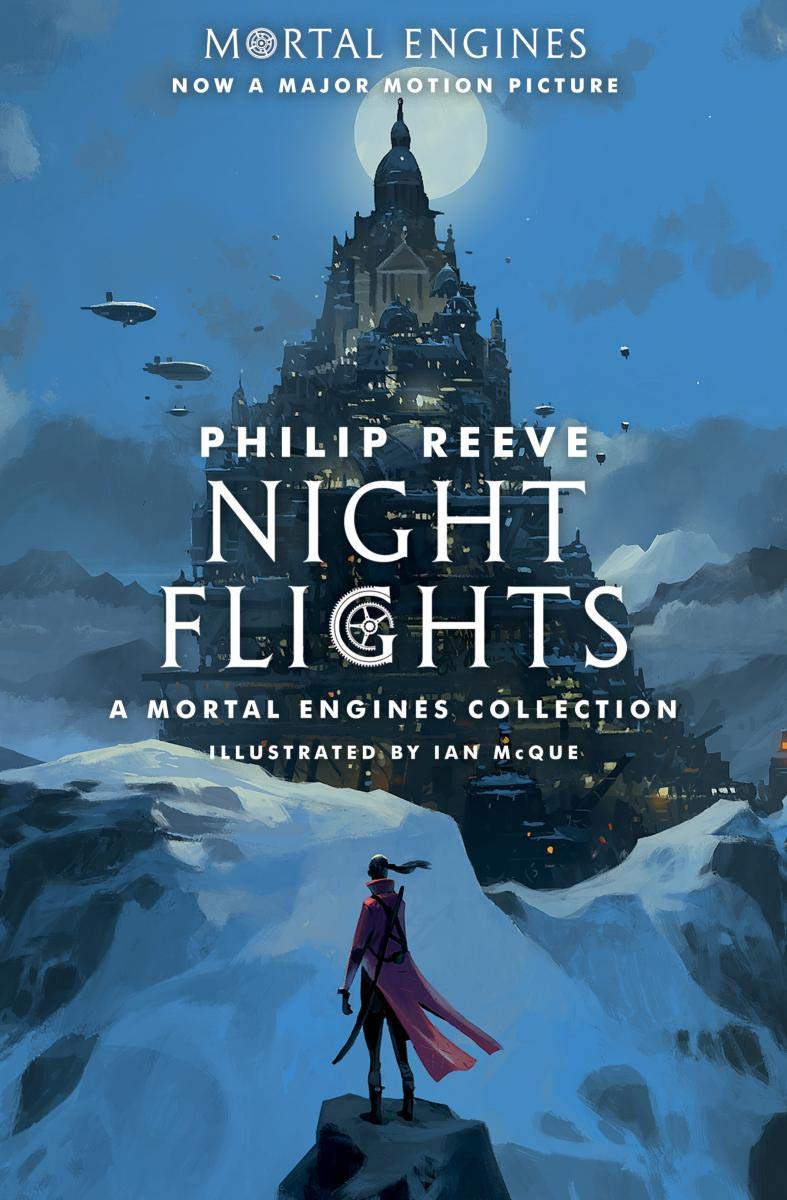
the Annathology of Fang short stories illustrated by Ian McQue and released earlier this year.

Night Flights is very much its own thing – most of it came from old stories and ideas Philip had about Anna Fang – but one story, The Teeth of the Sea, drew on an idea that came out of the IWOME *: Fastitocalon, a very peculiarly adapted aquatic predator city. You can see David Wyatt’s gorgeous illustration of Fastitocalon in action here, and another version by Ian McQue in Night Flights itself.

* To give time for all the illustrations, the manuscript for the IWOME was actually finished by autumn 2017 – it’s been difficult keeping a lid on it all this time!


O is for Old-Tech
A problem with setting things in the future that refer back to the present is that the present won’t stand still, and episodes of Black Mirror keep coming true. Most of the stuff being dug up in the world of Mortal Engines is old tech right now. Fever Crumb found herself standing on a floor tiled with iPods in Scrivener’s Moon, which is about all they’re useful for now. When Tom first found a CD in Mortal Engines, they were common, but here in 2018 they’re now less popular than vinyl, for some reason. How long until they’ll need explaining to young readers, as if he’d found a VHS or a 5″ floppy disc? (Perhaps this is why the film seems to have replaced it with a toaster…)

It’s mad to think about now, but back when the original Codex was written hardly anyone actually had a smartphone, the quintessential Screen Age device. Of course, these feature (our archaeology is bang up to date), but perhaps future editions of the IWOME will have to keep with the times. I’m looking forward to some sort of hands-free brain implant replacing smartphones, which a) will mean no more fiddling around with perishing touchscreen keyboards and b) will neatly explain where Stalker-brains came from…

Some of the Old-Tech actually belongs in the future, and as well as the carefully preserved modern remnants being loaded into the 13th Floor Elevator, you can read about artefacts from lost civilisations like the Electric Empire or the Blue Metal Culture (which everyone seems to think is a reference to some obscure musical movement – it’s really just a civilisation which made lots of things out of an attractive blue metal.)


P is for Maxime PLASSE

…who illustrated all the IWOME’s maps. Maxime has been a role-playing gamer from an early age and always had an interest in fictional worlds, mythology and ancient history; he found his way into graphic design through part-time work for a French RPG publisher, alongside his career as a social worker. He now works full time as a graphic/layout designer and freelance cartographer, working on RPGs, video games, historical magazines and for a range of other clients.

Maxime has a very versatile style, and put all sorts of beautiful details into his IWOME maps: an Aboriginal pointillist pattern surrounding Australia, an Mayan-influenced one for Nuevo Maya. As well as depicting places like south India, Australia and Nuevo Maya, he’s produced a military-style campaign map of the Zagwan Deluge and a lovely, highly stylised representation of the Bird Roads.


You can see his website here and his deviantART page here.


Q is for Ian (Mc)Que

(sssh, it’s a difficult letter.)

Ian McQue was born in Sunderland and worked on the Grand Theft Auto games before becoming a freelance concept artist and illustrator. He now mainly works in the film industry, and lives with his wife and an assortment of cats in rural Scotland.

Ian is one of Philip’s favourite artists, and has worked on covers for the Railhead books as well as illustrating Night Flights and the new set of Mortal Engines covers (you can see some of the new cover art in the IWOME!) Ian has a gorgeous style, filled with stark light and mechanical intricacy, and you can almost feel his cities bearing down on you. As well as giant mechanical things, he’s also very good at character art, and all the little portrait pictures in the IWOME are his work.

You can follow Ian’s twitter here (he shows a splendid appreciation of funny little specialised airport vehicles), find him on Instagram here and buy his artwork here. And if you want to experience his work in a non-Mortal Engines context, give the spookily beautiful game The Signal from Tölva a play.


R is for Realism

Realism is something a lot of people get hung up on, particularly in a science-fiction context, and especially these days now that internet forums allow one to rage to an appreciative audience about how hearing things in space is Stupid, or try to calculate the velocity of an asteroid from how big a half-second explosion in a movie is. This sort of “realism” demands copper-bottomed mathematical working-out of every detail. There’s a place for this – “hard sci-fi” is a popular genre for a reason – but it’s an unhelpful mindset to apply to everything.

I was brought in on the Codex and IWOME partly because I have enough of a reasonable basic engineering knowledge of guns/planes/airships/tanks etc, but the moment scientific reality gets too far in the way of a plot point or a good pun we ignore it, especially if there isn’t a good “OLD-TECH DID IT” handwave.

Something much more important than realism is verisimilitude, in the sense of “internal realism”. The world of Mortal Engines isn’t really a “realistic” one: it’s based around machines that are probably impossible and has immortal cyborg zombies. But it obeys its own internal logic, and, importantly, the humans inside relate to it in a believable way. There are some very, very silly things going on in the IWOME, but it’s not completely implausible that people would think, for instance, that a bouncing city would work (it does for kangaroos!)


S is for Spoilers

How, in a history book where the end of Mortal Engines is one of the more significant events in recent history, do you get around the fact that, well… Mortal Engines has an end? Referring darkly to “the MEDUSA incident” could only get us so far. We ummed and ahhed about how to address the rather important point, and finally decided to take the bull by the horns on the very last page of the IWOME, set against a full two-page rendering of Ian McQue’s cover for A Darkling Plain.

Hopefully, few people who get to the last page of the IWOME will find what’s written there as a surprise – and those that do will go off and read the book to find out how we got there.

An A-Z of the Illustrated World, part 2

This series was originally jointly on my blog and Philip Reeve’s, but his has been overrun with malware so all four posts are now on my own site: Part 1 Part 3 Part 4 

I’m immensely chuffed to announce that the Illustrated World of Mortal Engines, the actual, factual, physical, gorgeous, expanded and wonderfully illustrated version of the Traction Codex Philip Reeve and I worked on together back when I was at uni… launches TOMORROW (though it’s turning up in bookshops and letterboxes already). I haven’t talked about it here yet, because honestly I haven’t talked much about anything other than travelling since I started getting real jobs which don’t like you talking about them online. But it was Very Cool to do.

To commemorate the launch, and talk a bit more about the process of creating the book, I’ve put together an A-Z of the Illustrated World. The first part is on Philip’s blog here, and there’ll be two more after this one. Had a look at the first part? All settled? Read on…

Part Two: G-M

G is for Green Storm…

…who readers will know are very important in the later books, but are most conspicuous here by their absence.

The IWOME developed through a long period of writing, hashing out ideas and improving the general structure. One of the issues which emerged, which we never really found an answer to, was that going into the Storm and their war with the cities was a big distraction from the original story of Mortal Engines. Worse, due to the limit on the length of the book and the time pressures of getting illustrations for all the other new stuff in, there wasn’t really time or space to do the Green Storm War justice. So the Storm, and the war, are alluded to but don’t feature heavily in the IWOME.

But! We have the early drafts of lots of material – hydrofoil swarms and shaped-charge lancers, the Battle of the Bay of Bengal, increasingly grotesque and ludicrous applications of Stalker technology – and on the Traktionstadtsgesellschaft side, a heap of mad flying machines, armoured fighting towns and an effort to create the Longest Possible German Compound Noun (“Traktionstadtsgesellschaftstandardausgabeverteidigungsreihenfeuerpistole”). Perhaps, one day, we’ll get to come back to them, and the world will see a beautiful professional illustration of the abortive “Stalker walrus”.

H is for Historians and their Disagreements

The phrase “Historians disagree” will be familiar to any readers involved in academia. In the real world, if Historians Disagree, it means right now someone in an archive somewhere is furiously typing up the latest volley in a protracted battle of books and monographs with other people in other archives, all of which will then be glibly summarised in one sentence by an undergrad who’s skim-read half of them. (Possibly, they also will say that the aforementioned battle has generated more heat than light, or something like that.)

But when writing a fictional history, it’s a marvellously useful phrase. Historians will Disagree when we want to allude to something the reader already knows but people in the WoME don’t, or when we haven’t written the relevant backstory but want to speculate on it, or when we have two or three equally good ideas for what might have happened and want to use all of them…

We owe the Historians of the WoME a great deal, and gave them Puerto Angeles for their trouble, a cheerful historian party city where the museums and the samba clubs are both 24/7.
I is for International Productions

The IWOME travels widely across its fictional world, but the people who helped create it are spread all across the real one! Many of us, like Philip, are based in the UK, but work came in from as far afield as France, Bulgaria, Iran and Indonesia (an artist from the USA was going to be involved but couldn’t participate in the end – I’m told this was due to a commitment clash rather than finding out what happened to their homeland in the books.)

I think it’s a real shame we may never get everyone who worked on this book into a room together – but such an international cast of creators is a cool, strange part of putting something like this together in the modern networked world. (And hats off to poor Jamie Gregory, who had to stay up late and work with people in all these timezones!)

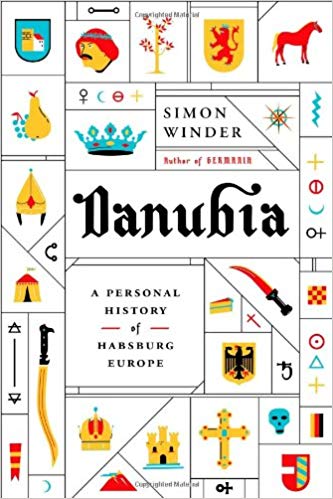
I is also for Influences, and I thought up a great long self-indulgent post about all the stuff which in some way made it into the IWOME, but it was too mechanical and not very funny. So I’ll just mention Simon Winder, whose description of the actual Schloss Runkelstein/Castel Roncolo in Danubia painted such a compelling and side-splitting picture it earned its own tribute city (well, fort). If I’m ever able to write observations half as canny and funny as his, I’ll be very happy.

J is for Jokes…

…which are Very Important. The IWOME isn’t really a “reference book” for other books – we worked hard to make it something which people will actually enjoy reading in its own right (there’s not much point in writing it, otherwise), with the same sense of humour that runs through the Mortal Engines books. There are… well, quite a lot of bad puns.

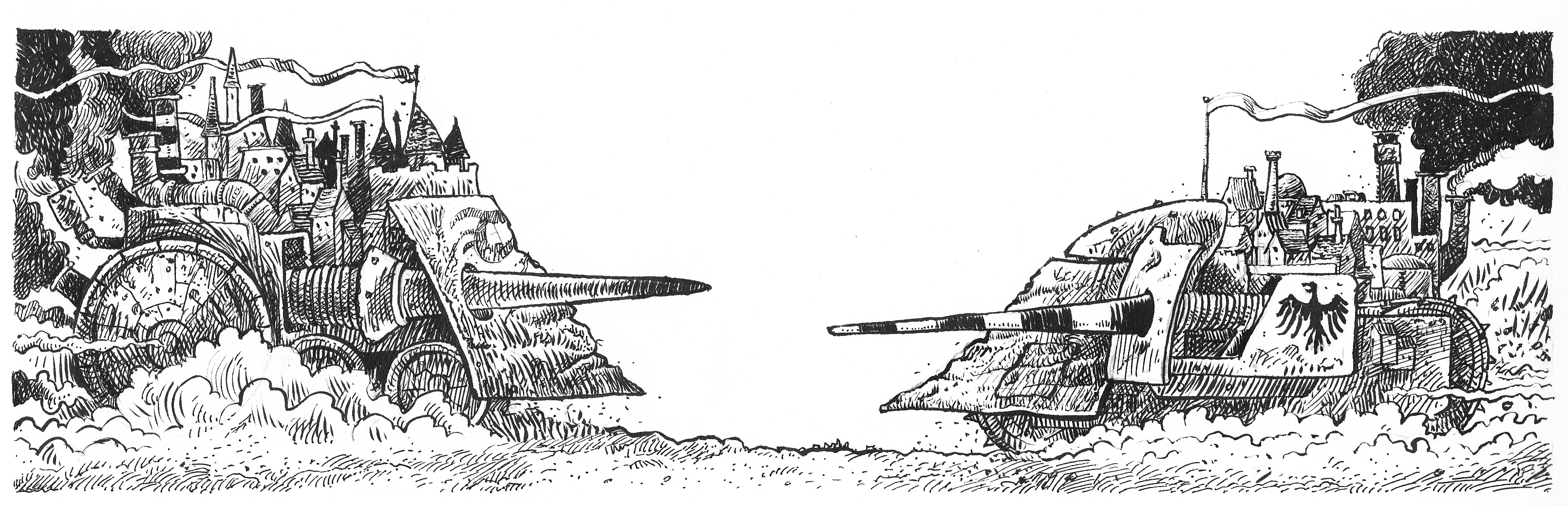
Actually, the hardest part in all this was reining the jokes in – humour is important, but it also has to be something that works even if the reader doesn’t get the joke (some of the punchlines are pretty obscure); a jokey double meaning is bad if it makes the original meaning too hard to understand. (Philip has discussed in-jokes in his splendid Railhead A-Z.) And some had to be pruned because they were too gratuitous – we toyed with a mitre-shaped Traction Vatican City, with a lot of popes called Urban (white smoke from the exhaust stacks when a new one was elected) but it was just Slightly Too Silly. So please appreciate the horrible jokes, because there are plenty more on the cutting room floor.

Traktionturnieren, of course, is not a joke. Traktionturnieren is ABSOLUTELY SERIOUS.

K is not for Characters, but will have to do

There’s plenty going on in the IWOME with all these maps, cities, wars, histories and amusing pictures, but what about the people who inhabit them? There are loads of little character portraits throughout the IWOME, illustrated by the excellent Ian McQue (I hadn’t really realised before this book Ian was a dab hand at character art as well as all his robots, flying ships and traction cities.)

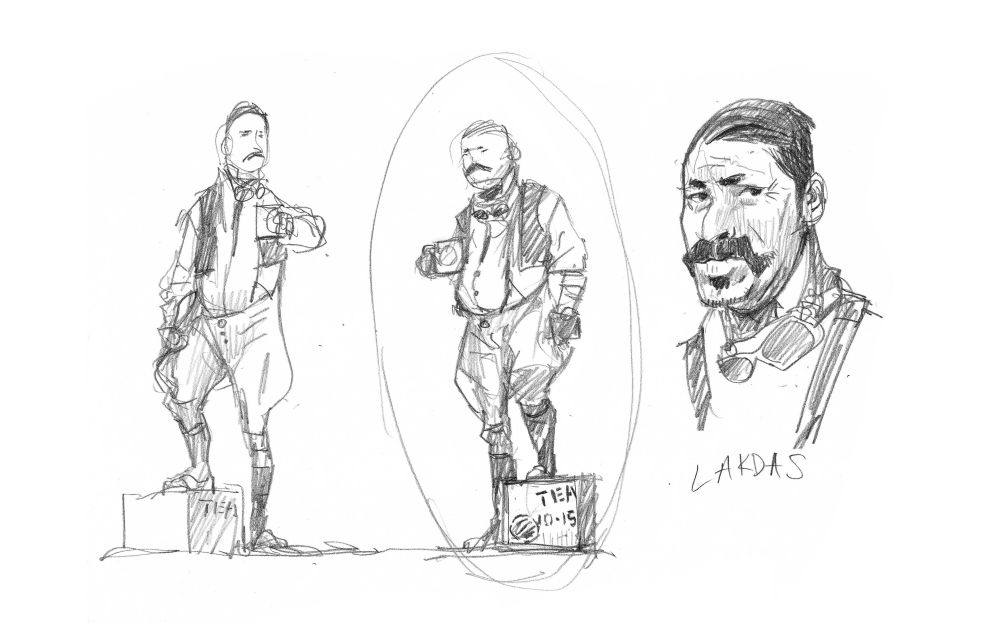
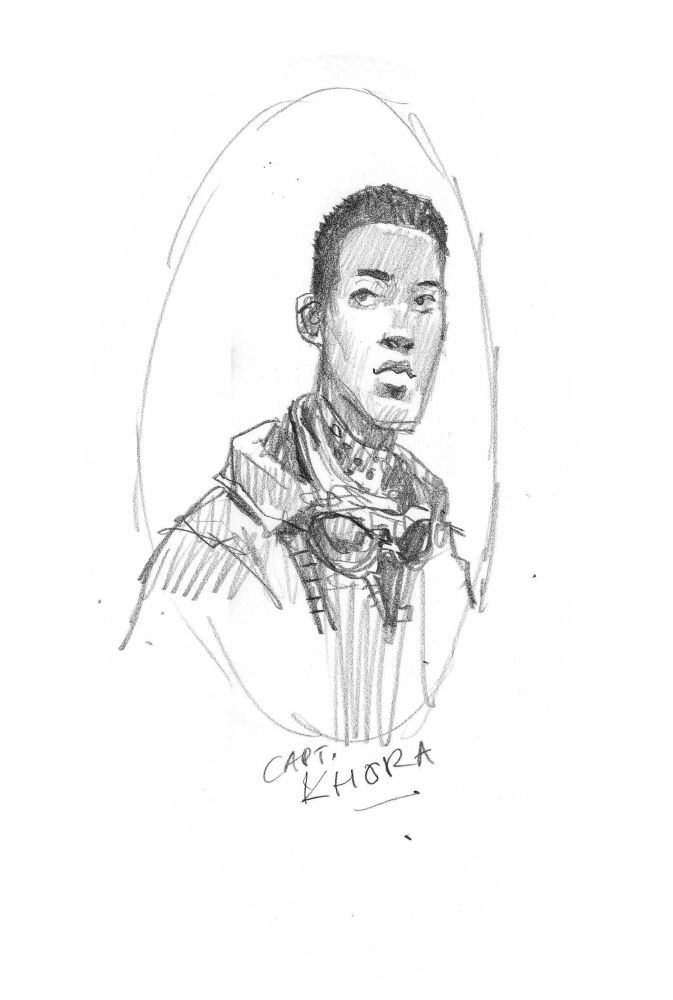
Some people, like Thaddeus Valentine and Freya Rasmussen, are familiar; some, like Madzimoyo Khora, give familiar names a bit more of a background, and some are brand new, like Woolloomooloo Smith (credited with introducing Australian culture to the Great Hunting Ground). Some of them address unanswered questions (like how Anglish-speaking cities in the Hunting Ground have ready access to tea when presumably all the good tea plantations are in League territory – Lakdas Weerasinghe, captain of the blockade runner Invisible Worm, will be very happy to answer that). Others, like pioneer air rustler El Condor, or Niccolo Tornatore, the Doge of Brighton’s arch-rival Venice, are just there as people and stories who can give a little more human texture to the world.

L is for Jeremy Levett

which is to say… me. I’m far too self-conscious these days to write this sort of thing about myself, but Philip had some kind words…

From the moment the iWOME was first suggested I knew I couldn’t write it alone, and I knew that the person I wanted to write it with was Jeremy Levett. He’s a longtime fan of the books, but his mind works in a completely different way to mine – I’m interested in things because of how they look and how they make me feel: Jeremy wants to know how they work. So where in the books I had the Green Storm develop giant military airships because giant military airships are cool, and then had their Tractionist counterparts build rickety flying machines because rickety flying machines are fun, Jeremy instantly understood that the real reason is that the Storm’s mountain heartlands contain good sources of helium to provide huge air-destroyers with lift, while the Tractionists prefer hydrogen, which their heavily industrialised cities can easily split from water – but this makes their airships kind of explodey and drives a move to heavier-than-air solutions. 
Faced with this kind of top-notch historical analysis, I can only nod and agree and pretend I planned it that way all along. And Jeremy also has the ability to write all this stuff in a way that’s both funny and informative (just check out his travel blogs). He has a glittering literary career ahead of him if he wants one, and I’m proud that it began in the WOME.
Image may contain: 1 person, smiling
A Picture of the Writer in his Natural Habitat.

M is for Maps

Maps of fictional worlds are very popular, from Tolkien’s Middle-Earth to Keith Thompson’s world of Leviathan, based on actual First World War propaganda-y maps.. However, the WoME has a slightly complicated relationship with them. One problem is that Traction Cities, the primary landmarks, move around. Another is that committing to a map leaves you a bit boxed in story-wise as to where things can or can’t be (I remember Brian Jacques had to keep extending the Redwall map in new directions to tell new stories).

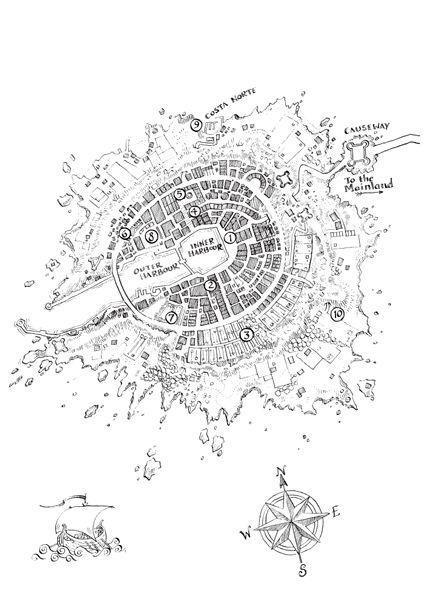
So the maps we do have in the IWOME are mainly places that don’t feature heavily in the story (there is a map of the general shape of the Great Hunting Ground, but it’s very scuffed-up): southern India, South America, Australia. We were given a lot of help creating them by cartography expert Lowtuff, a regular on the Mortal Engines Discord server, who gave a lot of detailed thought to plausibly answering mad questions like “what if we just tilted the whole continent west a lot?” and produced excellent outlines which our artist Maxime Plasse turned into the final maps.

An interesting issue we discovered with the maps, playing around with sea levels and continental plates, is that you can do some absolutely horrible things to continents and and they still don’t actually look that different. Take Nuevo Maya here: most of the important rivers have completely changed course, a million square miles of slightly salty pampas have risen out of the sea, the Falklands are no longer islands and the Panama isthmus is no longer anything… but it’s still instantly recognisable as South America. But, put it side by side with an actual map of South America, and you’ll see quite how different they are.

One which came together particularly well at the eleventh hour is the Dead Continent. Many of its coasts are guesswork, and the interior is a great black patch of terra(/or) incognita, with the only light cast by the paths of scientific expeditions – some of which come back, while some head inland and are lost in the darkness.

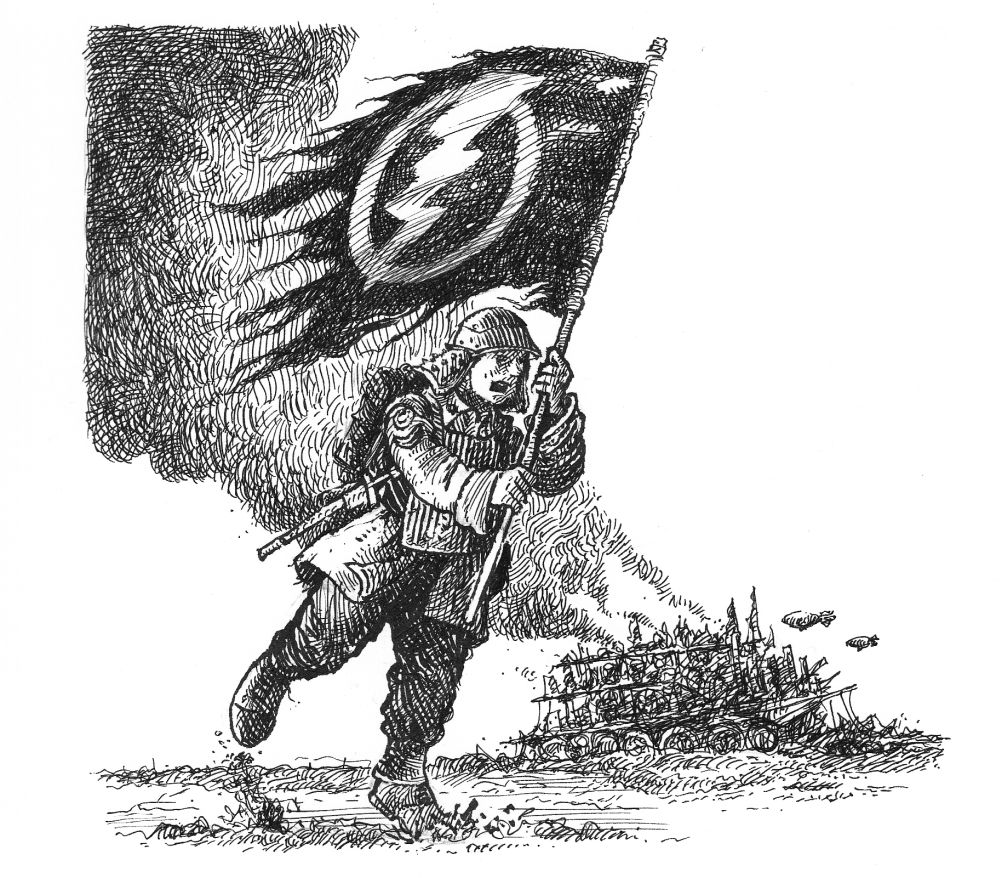
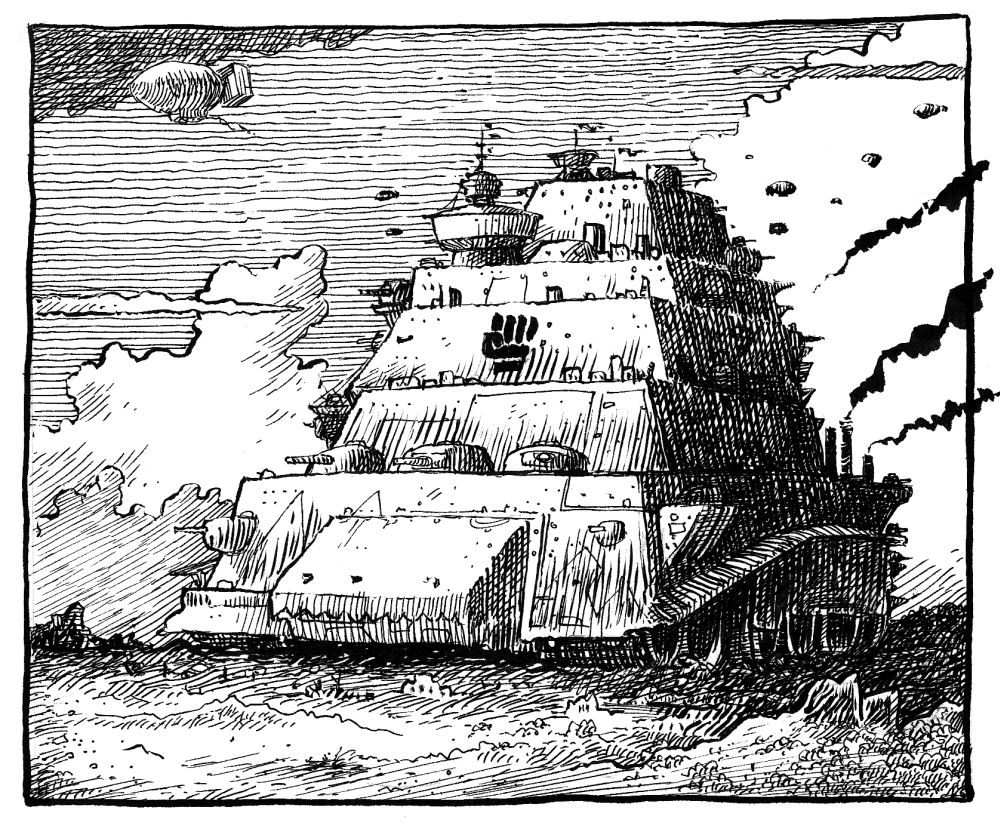
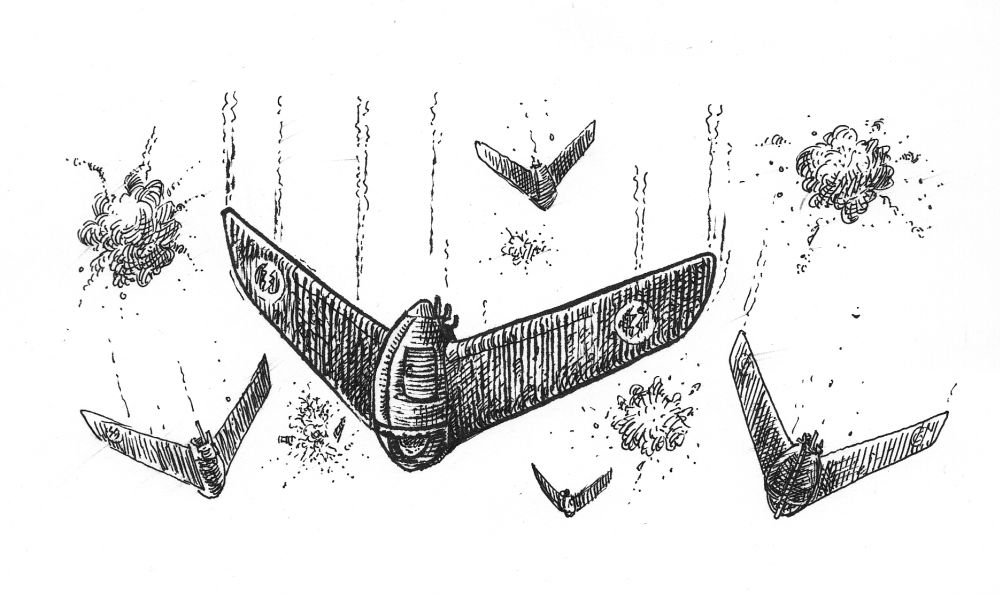
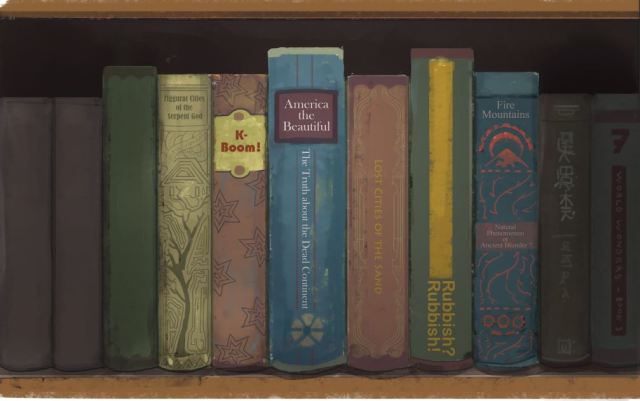
Pictures in order: Green Storm Soldier, Panzerkampfstadt and Green Storm Tumblers, by Philip Reeve (all originally for the Traction Codex); Bookshelf, by Aedel Fakhrie (due to multi-language printing issues, this hasn’t quite been done justice in the printed version, so here’s the original); Danubia cover pinched off the book’s Amazon page – READ IT; Traktionturnieren by Philip Reeve; Captain Khora, Smoke Jaguar and Lakdas Weerasinghe sketches by Ian McQue (the final versions are in the IWOME!); selfie with 12″ railway gun, by me; Nuevo Maya map, cartography by me and Lowtuff, final art by Maxime Plasse.

An A-Z of the lllustrated World, part 1

This series was originally jointly on my blog and Philip Reeve’s, but his has been overrun with malware so all four posts are now on my own site: Part 2 Part 3 Part 4

The Illustrated World of Mortal Engines is published this week. It was written by me and Jeremy Levett, with Jeremy doing the bulk of the actual work while I just fired suggestions for weak puns at him from Dartmoor and Iceland. It’s also lavishly illustrated by what can only be described as a glittering galaxy of star illustrators.

To mark the completion of this epic project, we’ve compiled the following A-Z guide…

Part One: A – F

A is for Art

A very important part of the Illustrated World is right there in the title: ILLUSTRATED. The original Traction Codex had a number of lovely drawings by Philip (some of which we’ll be putting up in these blogs – only one made it into the final IWOME), but the IWOME has seven different artists from all across the world: Aedel Fakhrie, Ian McQue, Maxime Plasse, Rob Turpin, Philip Varbanov, David Wyatt and Amir Zand. Ian and David have already been involved in Mortal Engines before (both have done a set of covers, Ian illustrated Night Flights and David illustrated Philip’s Larklight series). These artists all have quite different styles, and you can find at least four different versions of London in the IWOME.

Jamie, the design chap at Scholastic, managed a great back-and-forth of illustration briefs, sketches and final artwork between us and the artists to make everything just-so. It was very cool seeing the ideas we came up with given form by such skilled artists, especially when some of said ideas were really quite silly…

It was an interesting process: a number of times an artist came back with something that wasn’t exactly what we imagined but was actually better. Some needed a bit of changing, and a couple of pieces took ages of back-and-forth email to get right. But hopefully, you won’t be able to tell which…

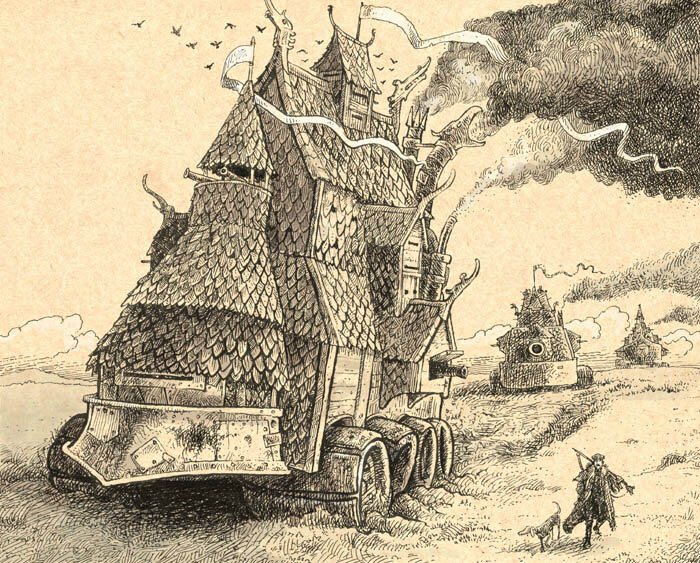
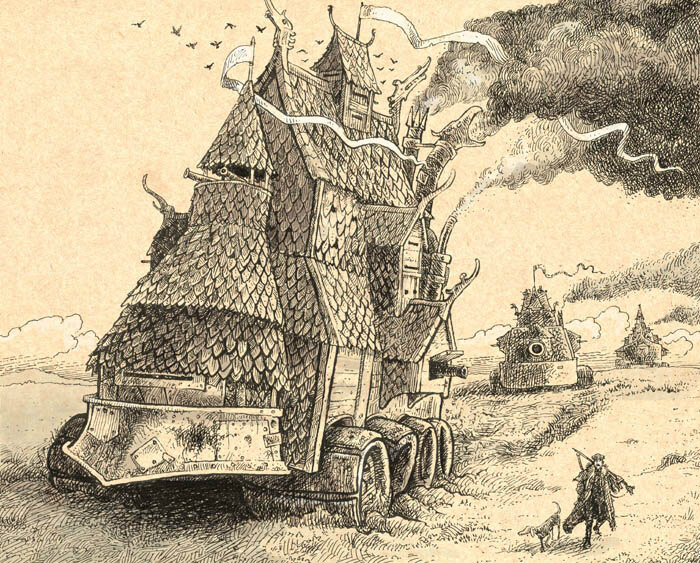
Weaponised stave churches on the move, around 350 TE

B is for Black Centuries
“…a savage age, when life was cheap, and most people would happily have sold their own children for a tin of rice pudding.”

The Black Centuries occupy most of the time between the world we have now and the world of Mortal Engines. They’re a period of horrible upheaval and universal misery, punctuated by lots of localised problems which made moving around all the time a logical way of life. They’re also a Dark Age about which very little is known or understood, as people were too busy eating radioactive cockroaches and worrying about runaway climate change* to write much down.

The properly-worked-out history of the Mortal Engines world is a self-contained timeline lasting around a thousand years, with the Fever Crumb books happening halfway through, and the Mortal Engines quartet at the end. But something which often comes up in online discussions is: how far in the future? What’s 1TE in AD? We never worried about an exact answer to how long the Black Centuries lasted – some people within the world of Mortal Engines think they know, but some of them are also convinced people coexisted with dinosaurs.

From a narrative point of view, the Black Centuries are a very useful way of drawing a thick (black!) line underneath the world-that-was and setting the scene for something else. But how many Centuries there really were is open to interpretation…

* This is a suggestion, as well as a descriptor.

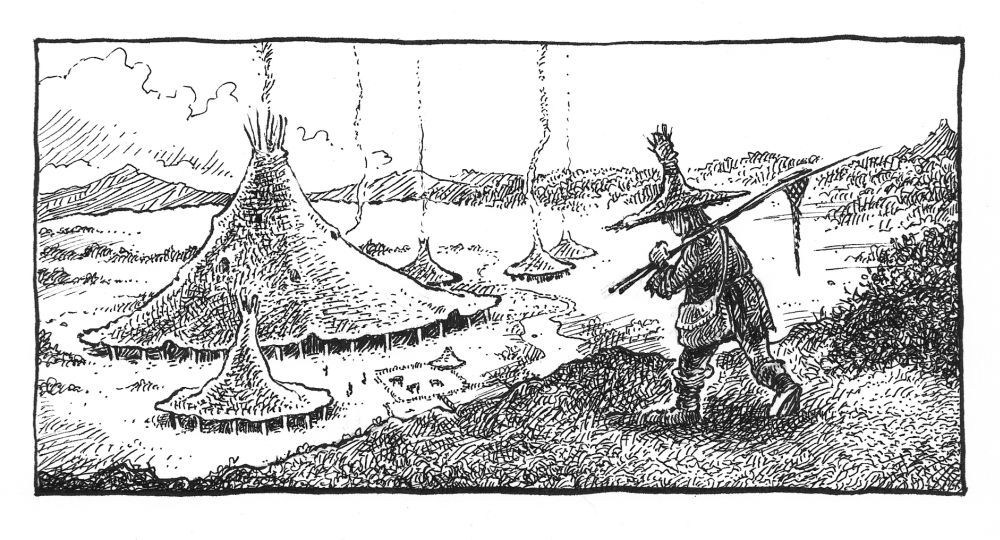
Everyday life in the Raffia Hat Culture

C is for Canon…

…and Continuity, and Contradiction, and all those other words about the ambiguity which creeps into worlds written across many years or spread across different media adaptations.

Ambiguity is quite fun and, from a writing perspective, can be very useful! But it can also be pretty frustrating when the pieces don’t fit together. We’ve done our best to make it all work, but it’s probably inevitable there’ll be a list of “Differences between the IWOME and the Mortal Engines books” up on the (really very good!) Mortal Engines wiki soon.

The IWOME should be seen as an “in-universe” book, one whose writers don’t know everything (as you’ll see from entries like Anchorage). It’s quite possible they’ve got things wrong. So if the IWOME contradicts the books, the book is the one that has it right.

Relatedly, C is also for the Traction Codex, the little ebook which the IWOME was partly built from. The IWOME uses many parts of the Codex but doesn’t invalidate it – if there’s a direct contradiction, the IWOME takes precedence, but if there’s something mentioned in the Codex but not in the IWOME (Sydney’s cork fenders, for instance) they’re probably still there!

(Oh, and while we’re at it, the short story Traction City Blues in Night Flights supersedes the World Book Day story Traction City. There were some specific requirements for the World Book Day book; this is the short story without them, and is quite a bit closer to the original idea for the story.)

All sorted out? Excellent.

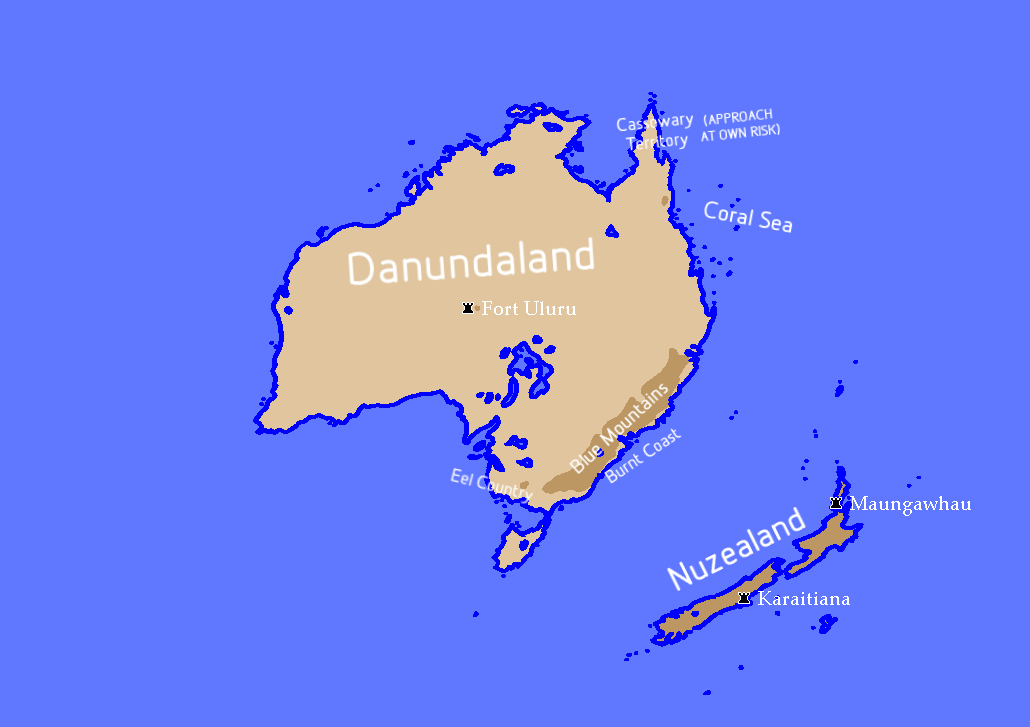
D is for Danundaland

Australia, along with much of sub-Saharan Africa, wasn’t hit as hard in the 60 Minute War as America, Europe or China, although it still suffered heavily from the war’s indirect effects.* Not having quite the same geological upheaval or tempestuous weather, there was no practical reason for Australians to embrace Tractionism – but, when the word reached the continent they did, with enormous enthusiasm.** Much like actual Australia, evolution has led to all sorts of bizarre specialist creatures unknown anywhere else.

Australian cities, from the billabong-dwelling bunyips to the flying-squirrel-like drop-boroughs, are often so heavily adapted as to be unrecognisable to visitors from the Hunting Ground. But as they say on the proud city of Darwin (which regularly reconfigures itself for an advantage over the leaping/burrowing/semi-submersible/intermittently airborne predator towns of the great red interior,) the Australian city is more highly evolved…

A draft map of Danundalund, by Lowtuff,

* Nevil Shute’s On the Beach is a disturbing tale of death creeping down to Australia from an apocalyptic war in the Northern Hemisphere, although even the weapons of the Sixty Minute War weren’t as all-destroying as the radiation cloud Shute imagines.

** Having lived in the Outback for a little while I’m not hugely convinced that it would take that much to turn it from a huge, barren expanse full of absurdly large vehicles driven by cheerful sunburnt people into, well…

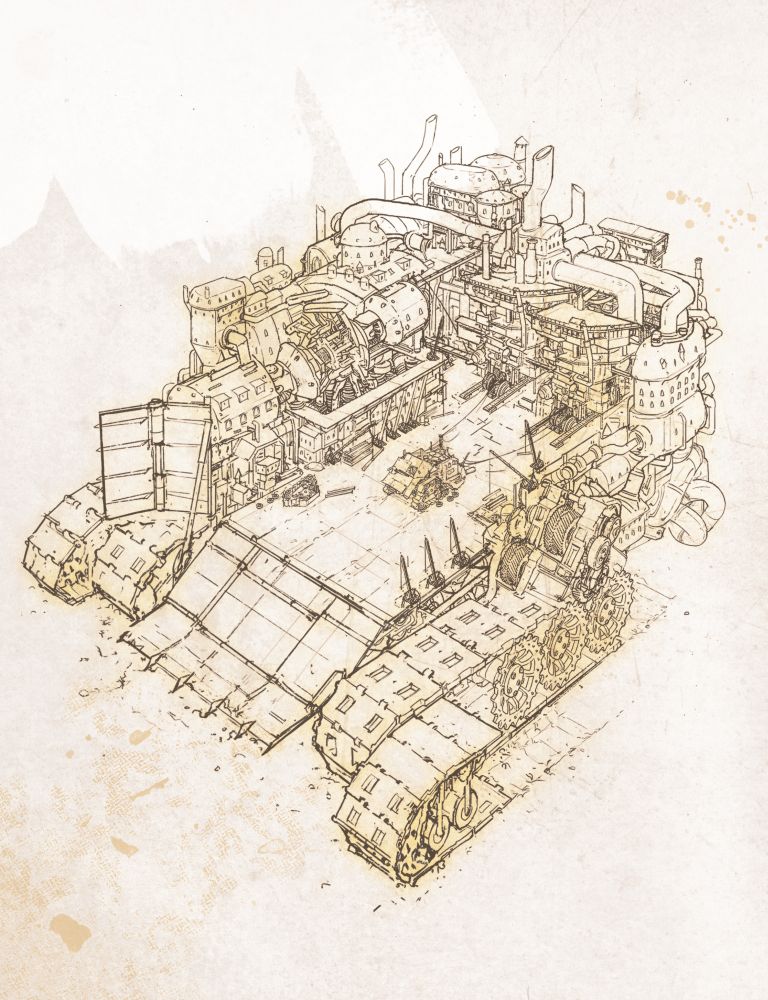
E is for Exploded Diagrams

One of the things we had in mind when putting together the IWOME were all those interesting Dorling Kindersley visual dictionaries and books of cross-sections. These books show things like a vehicle or a castle, often with cutaways so you can see what’s going on inside, with all the individual parts and their functions labelled.

Doing something like for an entire city is very ambitious, but the hugely talented Philip Varbanov stepped up and created some beautifully detailed illustrations, including the Jenny Haniver and three different stages of London’s history. (And arguably Ian McQue’s gorgeous picture on pages 186-7 is a very exploded London…)

F is for Film

The IWOME is not a film tie-in – it’s based on the books and follows their “canon”. Airships have propellers rather than great big Podracer jets, Engineers are bald and Hester Shaw has one eye. But the people behind the film are very clearly big fans of the series, and (from what we’ve seen!) the world they’ve created is very faithful to that of the books. Hopefully, people who haven’t read the series should still be able to appreciate the IWOME (although they should of course then run off and read the books!).

We also owe some thanks to Peter Jackson, Philippa Boyens, Christian Rivers and all the other people who’ve worked on the film- without it, and all the attention it’s drummed up, the IWOME would probably never have happened. We look forward to seeing it on the big screen!

F is also for Aedel Fakhrie, who has illustrated a variety of things in the IWOME – Old-Tech items and artefacts, vehicles and cities in the IWOME. Aedel hails from Indonesia and owns 17 cats and a cool jacket.

Aedel’s mechanical details, creative city designs and earthy, lived-in colour schemes make for some really distinctive art, and contrast nicely with the black and white cities of Rob Turpin and Philip Varbanov. His Tin Book of Anchorage is fantastically detailed, and his Bunyip is a particularly creepy machine you can absolutely envision roaring unexpectedly out of a billabong (an earlier version with legs was rejected for being slightly too terrifying.)

You can find his Instagram here, his artstation page here and his Twitter here.


The Traction Codex

The short story is, a book(let)(thing) I wrote with the renowned and wonderful Philip Reeve is now for sale! For 85p! And I think it’s actually pretty good and worth reading, if you are even remotely interested in Mr Reeve’s excellent Mortal Engines series and its universe.

The long story is somewhat longer. Quite some time ago, Mr Reeve got me to help with a side project, a “Fan’s Guide to Mortal Engines” – the sort of thing I’d probably happily do for free, except he was offering fame and fortune (well, co-author credit and a one-off fee.) So I read through all the Mortal Engines and Fever Crumb books, noting down all the proper nouns and references to times and dates, and accumulated a great long list of potential entries and data-points on the WOME’s great sprawling timeline, and he visited me in Bristol and we bounced ideas off one another and hashed out ideas and concepts to reconcile the various wild, outlandish claims and references within the books into a coherent history.

Mr Reeve is one of those people I’m terribly proud to count as a friend* – not just because he’s a superb writer (and, you know, famous – not incredibly, but a hell of a lot of my friends have independently heard of him) but because he is an all-around top bloke; very well-read, really rather cultured (but because he genuinely likes watching and reading things, rather than for the sake of being “cultured”), a man of great integrity, and a highly independent and rational thinker. Also, despite claims of curmudgeonliness, a really nice chap and a proper gentleman. I wasn’t sure how working with him was going to turn out – it’s his world, and I didn’t want to step on his creative toes! – but it turned out to all be extremely chilled-out and great fun. It was almost all history geekery and world-building, which for me is honestly the best part of writing – world-building with rubbish puns and giant moving cities which eat each other. Getting paid to do that sort of thing was A Fanboy Dream Come True.

A sample quote:

Anti-Traction League

Though politically its roots can be traced to an alliance of upland nobles based around the static city of Tienjing, Shan Guonese legend holds that the League began in spirit when Lama Batmunkh laid the first stone in what was to become the Shield-Wall. While Tractionist historians sniffily point out that specific references to a “League” do not begin until many centuries later, and postmodernist historians contend that the concept of “walls” merely represents the pseudosemiotic discourse derived from the deconstruction of subcultural narratives, Batmunkh’s act was the beginning of a great wall-building tradition among the eastern kingdoms. The Mortar and Harmony Period, as it later came to be known, pooled the resources of the flatland kingdoms that had long sought to keep marauding nomads from their territory, and the monastic mountain orders who wished for better feng shui in the shape of the nations all about them; walls were laid out according to the Eight Trigrams and the principles of overlapping fields of fire. The walls at one point stretched from the Novosibirsk crater-clover to Kandahar, combining powerful symbolism with an obstacle that presented far more trouble than it was worth. While initially just a mutual defence-and-cosmic-harmony arrangement among a loose confederation of eastern states, with the rise of Traction Cities in the fifth and sixth centuries TE the League consolidated into a formal alliance, its member states contributing to a standing military. However, in its early days this military was rarely successful against Tractionism, and with ever-larger cities devouring its walls and flatland castles, the League gradually withdrew to the mountains and turned to rocketry and airships over bagua-based defences. While retaining its capital at Tienjing and spiritual home in Shan Guo, the League gradually came to represent anti-Tractionism everywhere, with the Spitzbergen Static, Tibesti and Zagwa variously counted among its member states or allies.
(See Lama Batmunkh; Shan Guo; Green Storm)

This was however a very long time ago, and sadly, after months and months and months of publisher stalling, the release they’ve finally put out is… a bit shambolic. They’ve misspelled Philip’s name as “Phillip” in the ebook metadata, the cover isn’t particularly appropriate (or good), Philip’s gorgeous high-res illustrations are reduced to postage-stamp size, the actual page-to-page formatting is a mess. Most galling of all, they’ve screwed me out of cover credit. Which is, I know, vain, as I contributed probably less than half of the words, and none of the illustrations, but still: I worked on this, this was my work, and they said they would.

Mr Reeve is wondering – no promises! – about making a proper dead-tree edition, an expanded de luxe version with everything fixed up and laid out properly and his illustrations restored to their proper glory, but that’s a way off if it ever happens. For now, of course, you can get it off Amazon; neither I nor Philip get any money if you do, but it’s not dear, and it is hopefully worth your time. (He does of course get money if you buy copies of the rebranded “Predator Cities” books, which come with the Codex free, and if you haven’t read ’em yet you should.)

So yeah, I am now officially a Published Author (sort of) (hah.) Cool.

* How we met is a story I’ve told far too many separate times, so I’ll write it up here for reference and just refer everyone here in future: he visited my old school in my gap year, and I of course came along to listen and get all my books signed. I stayed at the end to ask incoherent, breathless fanboyish variations of “so where do you get your ideas from”, and promised to write him a letter – which I did, but thanks to either Scholastic or Royal Mail it never got through. So I assumed that was that, until many months later he was first venturing onto The Internet, and our paths crossed, and I said “hello, do you remember me?” and he said “hello, yes!” and we wrote each other emails and it sort of snowballed from there.

gold or iron

The process is not, in truth, all that complicated. The rock is surveyed, its mass and density ascertained. Stays are drilled into its core and motors attached; sometimes, an abort mechanism is added, though usually not. The most sophisticated aspect is the navigation; the calculations are logical enough, but the raw data must be perfect. Once the course has been determined and the relative positions of the rock and the target fit – once the planets have aligned, if you will – the motors fire, and the rock accelerates. It passes for a time through the depthless vacuum; once its fuel has all burnt away, it is acted on only by the tug of distant stars and the faint drift of the galaxy a-whirl all about it. Then, if the aiming solution is good, it makes contact with the target and, through a brief but intense series of interactions that can be explained to you by any schoolboy caught doodling explosions in his physics class, introduces that target to all the pent-up hate and frustration of the rock’s engineers.

I can see the rock now, through the Blantyre’s one real window. I’ve been seeing images of it almost constantly for a year, from mission-briefing models six months and three systems away to crass, blurred “action footage” from a few hours ago as the Longstreet shot off the booster engines at unnecessarily close range. As it lies before me now it’s a tiny glint, only visible by the reflected sunlight; but say what you like, there’s something special about seeing things with your own eyes.

Starbreakers, Inc., say the patches on my suit and the livery on the hull of the Blantyre, a meaningless moniker thought up by people who believe in “brand management”, men and women in suits who I’m glad I’ll never meet. We are not the biggest or the oldest of the rock-stopping operations around – both of those titles are for Spiros & Harker – but our oh-so-understated ads, placed in the pages of people who pray they’ll never need us, say we’re the best. Response times matter in this business, and we’re faster than S&H; less institutional inertia, less of the stultifying regulation that comes from trying to standardise something too big over too wide a space. S&H have fossilised as a corporation; we might overtake them in a few years, and have our own turn at the top of the slippery pole, underdogs snapping at our vulnerable nethers. The only other serious contender on the interstellar stage are Weltabwehr, who kicked off fifteen years ago and are so good it’s scary, but who fouled up the Leo job through no fault of their own; the bets are still open as to whether the company’s rep died in that impact, but four million people certainly did, and counting.

So: here we are, a few hundred kilometres from this nameless lump of inertial murder, and coming in quick, with very large amounts of currency and, potentially, human life, at stake.

“It’s a military op,” I remember saying with some surprise to Artem, two months ago, when the Blantyre set off from the company station above New Ambleside.

“Well, of course it is,” he said. Then, with some suspicion, “Do you make a habit of clocking on without even looking at the mission?”

“Do you think I’d turn a job down?” I replied, and that seemed to satisfy him.

Of course, I was breaking the line by even calling it a “military op”; we are meant to be neutral here, acting only as civilian contractors, apolitical averters of impact events. But you can work most of the situation out from context; people don’t pay Starbreakers fees unless their existence is at stake, and people don’t weaponise asteroids unless they wish their fellow man considerable discomfort. There are at least two players involved beside us: one of them has attached the drivers to set this rock on its way, and the other, who presumably lives on the planet in the way, objects to being annihilated by a giant inertial kill vehicle, and is willing to pay a staggering amount of money to avoid this happening. You can draw further conclusions – that these are two rather undeveloped players, nascent colonies without spaceflight and possibly without even serious industry, from inferring that the victim nation doesn’t have the launch capacity to attempt an intercept themselves and the aggressor can’t afford anything more subtle or sophisticated than a pebble from God’s own sling – but here you enter the realms of speculation.

As this is a contentious mission rather than a random rock, we’ve got some shooters to look after us; a warship named the Longstreet, run by an outfit called Brisk Security, which will be shadowing the Blantyre for the duration. I personally haven’t heard a single good thing about their character; the one who was constantly trying to chat me up over the link for the last six weeks was certainly no paragon. But rep matters, even out here at the ends of the stars; and their rep for competent violence is solid as a million tonnes of nickel-iron.

Speaking of which. The rock ahead doesn’t have a name; optics have picked up PANDEMONIUM scrawled on some of the engine housings, but nobody wants to write that in a report. We just call it “the rock”, in a display of stunning imagination.

I’ve been on two rock-stopping jobs for Starbreakers before, the first of which paid off my training, the second of which gave me savings enough to live comfortably for the rest of my days. Neither was contentious; there are plenty of pieces of stellar debris threatening to rub out underdeveloped colonies, and plenty of governments who will pay us to avoid that. But there are only so many people insane enough to attempt to weaponise an asteroid. Rocks flung at planets are objectively bad weapons, full stop. They’re extremely difficult to shoot down, but they cost more than a ballistic missile programme, and if the calculations are even slightly off they miss entirely or, worse, flatten the wrong continent. Even when they work perfectly, they cause the sort of collateral damage that makes them a crime against good business practice.

Like everything, it comes down to money. Doing anything in the void costs. Motors are cheap and ubiquitous enough in space terms, and rocks are a budget option compared to genuine spaceborne weapons, but cheap in space terms is still ruinous, and the “budget” in question is that of a well-off planet. And as a countermeasure, the cost of a Starbreakers callout… well, we’re the best, and we charge accordingly. You get what you pay for; you pay for what you get.

I’ve done my reading: there have only been twenty-one contentious rock-stopping runs in all of human history. Spiros & Harker have done six, one of which saw two of their teams killed and a warship dragooned in at the eleventh hour; a considerable expense in both blood and treasure. Starbreakers have done one, which went off without a hitch.

I don’t know what was in the minds of the people who planned this particular rock. They may even be mad enough to believe it will actually hit. But it will be a year before the rock hits, long enough for the suits to try again and again. A second mission would turn profit to loss, a third would put the entire company in financial jeopardy; but their rep rests on it, and that is worth everything.

Compared to all those trillions, the expense of a few sophisticated booby-traps and deterrents is negligible, and we have no doubt the rock is riddled with them. I’m fighting the craftsmen who worked this rock, not the planners or the paymasters. If they are better at their jobs than me, I’ll never be close enough to my killers to even see them. There can be no malice at such distances.

“Belt up,” says Artem, terse as he always is, and we go below to prepare.

We are the pawns in the most detached method of fighting ever devised. This is war without slaughter, war without hate; war reduced to a puzzle game, played down a one-way wire five years old and fifty million kilometres long. The only person likely to die is me.

overwrought overeducated overthinking

I always think of rainy nights as dull and gloomy, but every part of this one shines before me, glittering and brilliant. The lights of streetlamps and rocket-motors and swishing headlights glance in angled pieces off the wet glimmer the rain paints across every surface, like fragments of a broken mirror, an infinitely fractured panoply of light.

The rain isn’t heavy, but it’s everywhere at once, in falling streaks and slashes dancing at the periphery of my sight, placing an unearned halo on every streetlamp’s head as the sodium-vapour bulbs creak grudgingly from red to orange. It turns the landing lights of jetliners above into glowing cones of white as they fall below the clouds, and the jets chase after them like backwards comets. On the water of the bay, the wind-ruffled waves reflect the floodlights of the port in a flickering, uncertain zoetrope as they rise and fall.

Every time a rocket goes up from the port, the sun-bright flames of its motors are solid fire, their sharp definition unique among the rain-shaken uncertainty of the night. The rockets rise, atop a billowing column of exhaust lit white-gold from within, and the rain brings out a nimbus, brighter than bright, that makes everything else feel insipid and ethereal. It grows as the rocket rises, casting black shadows along the coast-road bollards and just as quickly shrinking them to stubs. They live and die in those first staggering seconds before the rocket punches through the cloud-cover, and the clouds all light up with its passing; a dull, bruised glow that fades, imperceptibly but inevitably, like the deceptive solidity of the exhaust plume or the afterimage of the flames.

If I could stop time, I would watch the rocket held there, see it hanging in the sky on its pillar of frenzied, frozen flame. If I could hold that moment forever, I would see the world caught in every raindrop, each one a reflected universe in distorted detail, a trillion points of light made infinitesimally different by the raindrop’s place in space and time. Too much to see in a frozen lifetime; enough detail to be lost in its fractal beauty, forever finding new intricacies, until they flooded my consciousness and overwhelmed my memory so that even the familiar seemed new, until all I had ever seen was their twinkle.

I wonder what people back on old Earth would make of this, back before any of it was a glint in inventors’ eyes. I wonder how they felt as they looked at all the lights in creation and gave them names and legends, whether they wondered at the silver-ripple of moon on sea, what magic it was that they thought animated the simmering stars. Before rockets and arc-lights, there were glimmers in the night. Before fire and language, there was rain and reflection. And darkness is older than light itself.

I know there’s no magic there. The waves shimmer because the water’s surface moves and changes angle faster than my eyes can perceive, the reflections coming and going in strobe-flashes of perception like the sweep of a ladar beam. The streetlamps wear saintly halos because the raindrops catch their light, and reflect it back to the world in fleeting, broken scatter. Reflection and refraction, intensity and incidence, particles and waves bending and stretching, passing and bouncing at different speeds and angles before they are at last contorted by the lens of my eye, and photon acts on retina, nerve winds round nerve and neuron touches neuron.

I understand all the processes and I know all their names, and still I can feel that little touch of magic, that certain sense of wonder, that last shiver of perception as the final pieces coalesce into the rain-slick totality of understanding. Perhaps because there’s so little wonder left to find that every time I feel the magic it leaves an indelible memory, a unique touch above all the mundane, scientific certainty that other men have felt and known and written down, and stared at until they couldn’t see it any more. Clarity, wonder, lucidity, call it what you want. Magic; its rarity itself makes it precious, the slimmest supply in a world of depthless, desperate demand.

Even a faint light shines brightly, against a dark background.

there are no roads here

It’s a careless land, a dusty, unkempt place that hasn’t noticed men. The ground is flat, but textured by a monotony of scrub and low trees whose dark green waxy leaves all hang drooping from the same height. The earth is red-orange and hot under the sun. Defence mounds rise like pimples out of the stubble, some still with old rusted guns on their turret rings, some stripped and crumbling, all empty. They look like they have been there forever and have looked that way since the day they were made. Here and there huge dome-shaped hills made of rough dark stone stud the flats in patterns that make sense only to them. They have been there forever but they are not worth anything. There are no clouds in the sky, and the land has a feeling that there will not be any clouds for a long time.

The land doesn’t care about the men, but the men care about the land and they are afraid of it. Every hillock fort they pass draws the worried stare of round eyes and rifle scopes. They all carry the same guns and wear the same clothes and their black hair is all cut in the same fashion. The rough, open-topped six-wheeled vehicles they ride are all the same shape and size, and bounce in the same way one after another over the humps and potholes of a road that can only be called a road because the rest of the land around it is even less helpful. They regard the dry place uncertainly behind their dark glasses, and fidget when they realise the camouflage of their uniforms does not match it. There are two hundred of them.

Captain Espera is a bad soldier and he knows it. He could not afford prestige, and the academy whose brass badge he wears nestling among rank insignia and meaningless decorations is not a good one. In his satchel, with his maps and ammunition, he keeps books by old war heroes. When he tells his men to do something by the numbers you can see his lips counting silently. He is afraid of Lieutenant Jafa.

Lieutenant Jafa is a bad soldier too, but he is too aware of the captain’s flaws to care about his own. He knows that it is the young, bright men who go far. He is young, and as bright as he is pleasant. He could afford prestige, and the better quality silver badge he wears gives him another reason to sneer at the captain. He collects curses like men collect butterflies, and uses them on Staff Sergeant Tam at every opportunity.

Staff Sergeant Tam is a good soldier, a pragmatic, unimaginative man who brings the men above him solutions whether or not they ask for them. He is convinced that he will die in uniform. He has seen far too much and there is little left in the world that can frighten him. He knows his place and is not unhappy, though the men quietly despise him.

The enlisted men are mostly aware that they are tiny parts of something too large to really understand them, and that their dirty jokes and love stories and funny habits and quiet, secret ways mean nothing to anyone, and that their lives are worth as little as the careless land on which they will fall.