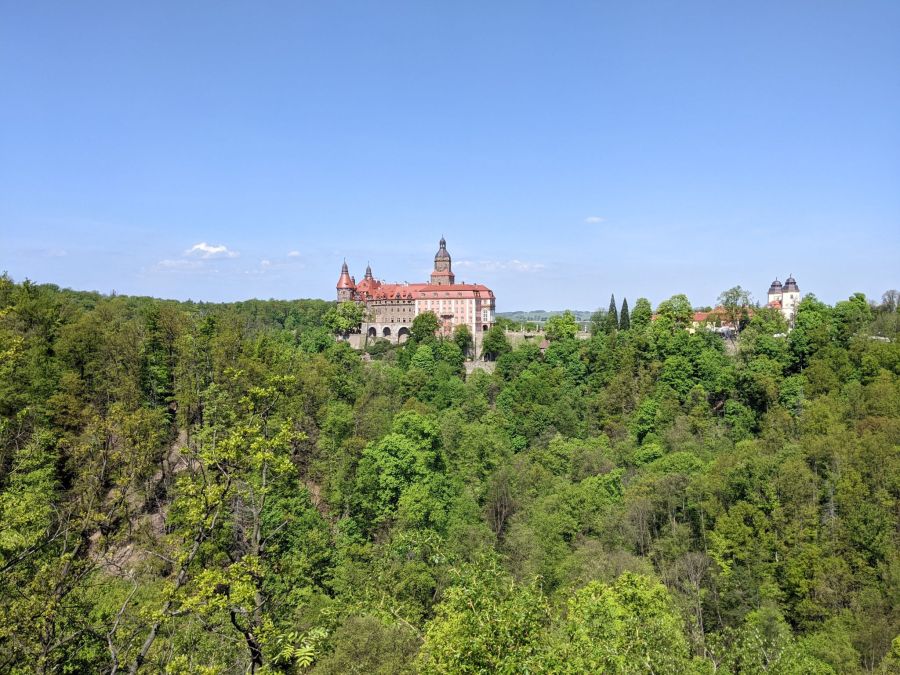
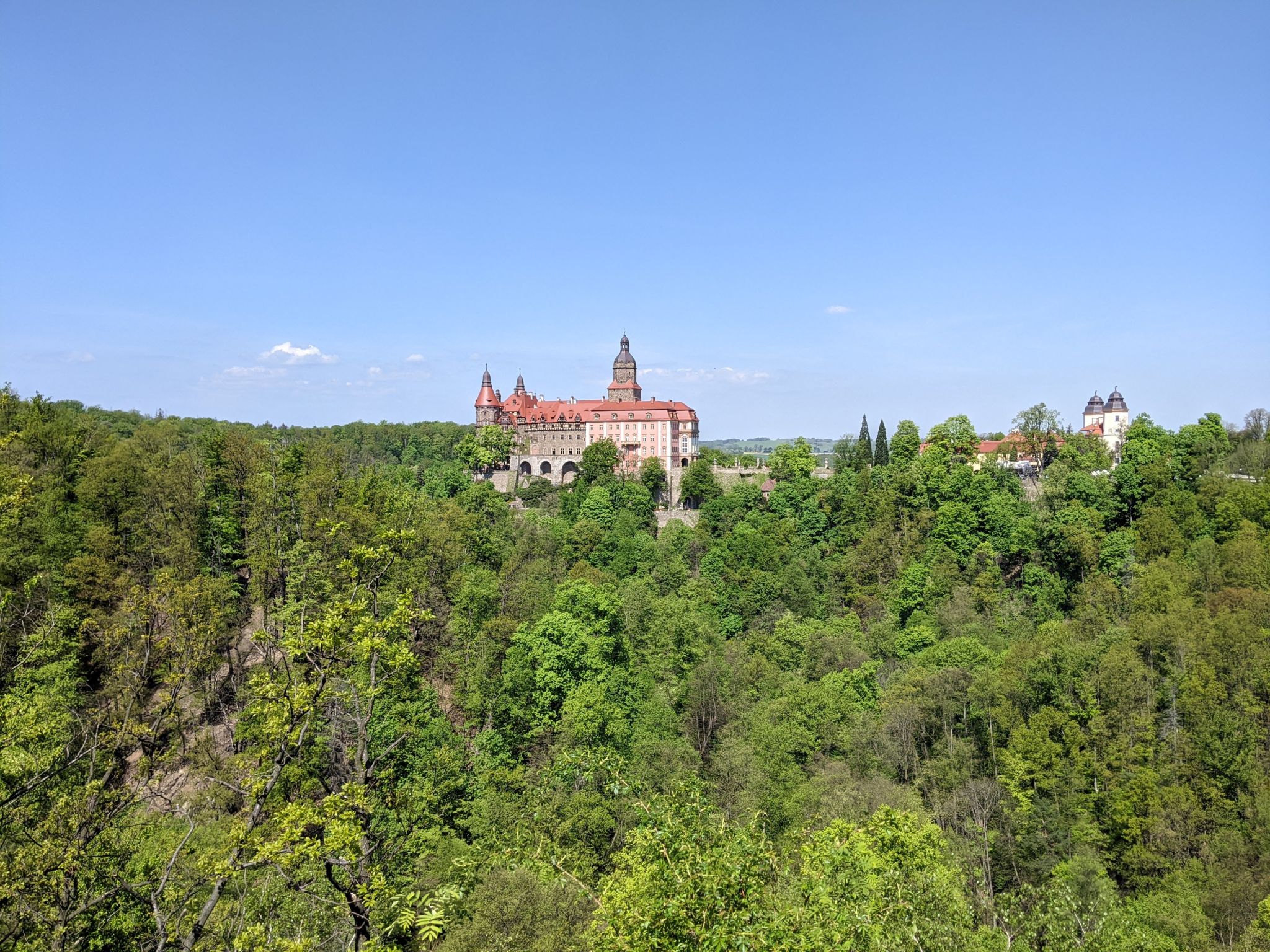
Książ is as quintessentially Mitteleuropan a castle as Dover or the White Tower are quintessentially English. There are structures underneath it all from the Iron Age, and a proper fighting castle was built and rebuilt in the early middle ages for the constant Bohemian-Silesian border wars, including one episode where it was overrun by the war-wagon-riding nonconformist Hussite insurgency. In the late fifteenth century it ended up in the hands of the Hochberg family, who hung on to it and steadily increased both their own wealth and grandeur and the castle’s, masterminding various extremely high budget expansions including an entire fake ruined castle on a nearby crag (oh, those Romantics). Despite shapeshifting from German to Polish nobility (most of their holdings being in the Polish state that was resurrected after the Great War), the family eventually imploded spectacularly between the World Wars. In the mid 1940s the castle, then in German Silesia, was identified as the keystone of a huge, pointless late-war Nazi building project (possibly as a personal HQ of Hitler himself, as they won’t stop telling you). Concentration camp slave labour was worked pointlessly to death in the final days of the second world war overengineering various tunnels to nowhere. Vandalised by Nazi architects and shelled by the Red Army, the castle has undergone a clumsy socialist-era reconstruction and an ongoing, more considered modern one, and it is now trying to style itself as a luxury hotel for a certain type of modern traveller. You could, in short, make any statement about it or set any sort of story in it and be comfortable that it would, in some way, be true.


Breakfast was at the bar mlecny “Mis”, which while closer to the Poznan experience wasn’t actually offensive. I had a cutlet with buckwheat and cabbage, followed by a lavender matcha latte from a hipstery place nearby which cost as much as the entire breakfast (still, for the record, not very much.) After a slight panic with ticket times we got onto the upper deck of a busy and somewhat smelly commuter train south. To the east, a lonely mountain broke the monotony of the landscape, and every town boasted a lovely old Victorian water-tower and, more often than not, a turntable engine-shed. An actual working rail-freight yard went by to one side. Arriving at Wałbrzych, we bought snacks (cactus juice!) and found a bus to the castle itself.


The customer service experience of getting in was what Gosia delicately called “classic Eastern Europe”. In the tunnels (deliciously cool after a warm bus journey and warmer walk), a well-made but slightly repetitive presentation hyped us up through lurid legends of golden trains and wonder-weapon labs, then supplied much more boring and historically rigorous explanations of what actually (probably) happened. The boring version is that in the exceptionally insane Gotterdammerung atmosphere of the late war people did all sorts of things for all sorts of reasons, most of the records have been destroyed and we don’t really know for certain what the tunnels were for, although as a junior officer noted they sucked up large quantities of steel and concrete that could have gone to more useful things.


Back above ground, the castle itself is just ridiculously big and mostly quite empty, populated with historical furniture but with most of the interiors refurnished fairly cheaply, consistently and incompletely. The pastel-painted rooms and endless parquet floor gave the odd impression of a communist school refurnished entirely from some rather good antique shops. I started off sneering at this, but after a while I warmed to it: just as the hacked-about wall décor and photographs of the once-magnificent Curved Room have a wan, badly-taxidermied-corpse feel to them, the obscene ostentation of the Maximilian Hall shines all the more by contrast with the haggard lemon-yellow main staircase and the obvious empty stair-rod holders its carpets were stolen from under.


The later Hochbergs’ closeness to the imperial family (the Hohenzollerns, not the Habsburgs) and ownership of lands which turned out to be full of coal mines brought them an astonishing wealth and apparently a Victorian town-building social conscience (claiming that a Hochberg inspired Bismarck’s social reforms is probably a bit much though); they indulged the usual hobbies of political intriguing, dressing up their servants in ridiculous uniforms, and the mass-murder of animals with modern express rifles. There’s a lot of stuff about “Princess Daisy”, a minor British noble who married into the Hochbergs in the 1890s. Despite the tourist-friendly Sissi-lite bootlicking towards her, Daisy comes through as quite a nasty figure, a parodically un-self-aware exemplar of chinless privilege and snobbery who spent her earlier years bullying interior decorators and sneering at gardeners, and her later ones periodically re-releasing increasingly gossipy autobiographies to a huge American readership. She gradually lost her money, friends and health, dying in 1943 against the background of a front moving westward again and the second war mopping up the few fragments of her Europe that had survived the first. There is a legend about a seven-metre string of pearls she owned, and a statue of her survives in a town her husband owned.


Easily the best part of the castle was the album of Louis Hardouin, a French chef who served the family through the early 20th century and moonlighted as a photographer: a mixture of posed and candid photographs of the three hundred staff employed night and day at the castle, dogs in hats, and the absolute splendour of the place in its heyday. We poked listlessly at a MAGIC ROCK which claims to bring luck and draw you back to Książ with your true love, and passed through the gift shop (standard issue mass-stamped-in-China “medieval aesthetic”, plus a fun coin-funnel soliciting donations to look after the castle’s many cats). We wandered out, circling the castle through the terraces of splendid, sun-soaked gardens (including a friendly cat that allowed us to pet it; instant return on investment) and had a drink and an enormous Polish dinner as a drone whined around overhead insufferably.


Twenty minutes’ walk away is the Palmarium: the Hochbergs’ wealth was such that Daisy essentially had her own Kew Gardens built for her, which nowadays has peacocks, lemurs and bonsai trees along with some very good succulents. A taxi back to the station later, the train was parping across the flat Silesian plain, for us to quest for a bottle shop, drink congenially on the balcony of our airbnb and invent stories about the strip club touts interrupting a nice Tuesday evening for the punters in the square down below.


Poland 2022
The Lost Wawel – Barbican, Celestat, Auschwitz – From Wieliczka to Wrocław – Racławice, Ostrow Tumski, Museums of Wrocław – Książ Castle – Gdansk town hall, Westerplatte – Malbork
 underneath the open sky